Content developed with the assistance of AI tools and reviewed by the author.
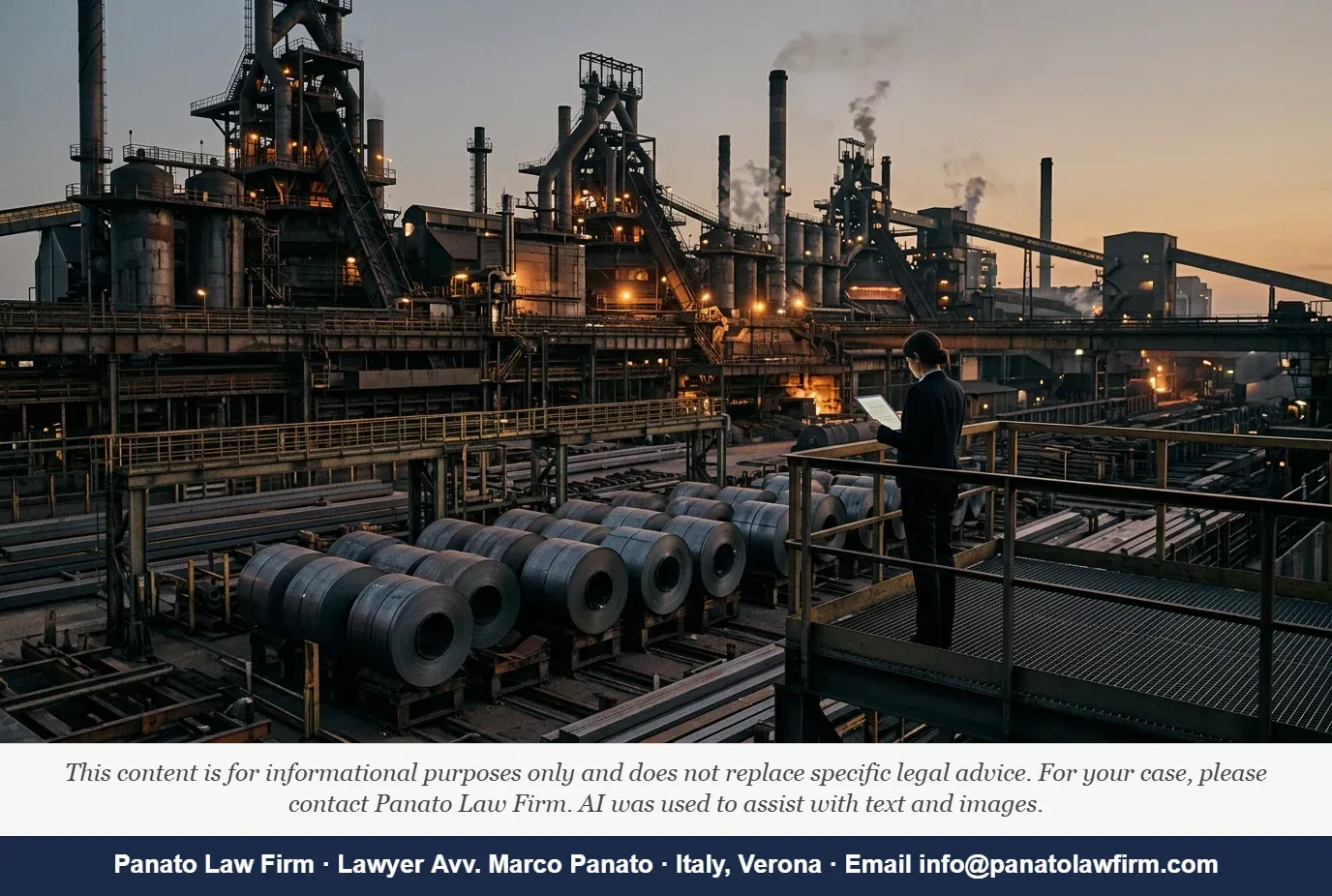
What UK suppliers and investors owed money by Acciaierie d'Italia must decide before the extraordinary administration hardens their position
Do nothing for the next 30 days and three things happen automatically. Your unpaid invoices become an ordinary pre-insolvency claim in the Italian extraordinary administration (amministrazione straordinaria, D.Lgs. 270/1999). The extraordinary commissioners appointed by the Ministry of Business classify your supply contract as continuing or terminated — without your input. And the 90-day hot-end shutdown period ordered by the Milan Court of Appeal on 27 July 2026 shortens the period during which any further output from Taranto remains commercially viable. By the time you have taken local advice, the window may have closed and your leverage will have disappeared.
Acciaierie d'Italia S.p.A., the Taranto-based steelmaker formerly known as ILVA, entered extraordinary administration — the Italian large-enterprise insolvency framework reserved for companies employing more than 200 workers and carrying debts above EUR 300 million — under Legislative Decree no. 270 of 8 July 1999 (D.Lgs. 270/1999), the so-called Prodi-bis regime. Under that regime the Ministry of Business and Made in Italy (MIMIT) appoints extraordinary commissioners who simultaneously manage daily operations, preserve employment and pursue a recovery or disposal plan under judicial supervision. The procedure is fundamentally different from English administration: unlike administration in England and Wales under the Insolvency Act 1986, where an administrator owes duties primarily to secured creditors and must achieve the best outcome for creditors as a whole, the Italian extraordinary administration is a state-steered process with employment preservation as an explicit statutory objective. Creditor recovery is a secondary objective. Recovery rates in Italian extraordinary administrations of comparable scale have historically settled below 15 per cent for ordinary unsecured creditors — a figure practitioners quote but which seldom reaches the English-language press.
The commissioners are simultaneously pursuing a EUR 7 billion damages claim against ArcelorMittal in the Milan courts, alleging breach of the 2018 business transfer agreement. That litigation is live but its proceeds, even if recovered, are subject to administration costs and priority claims before reaching ordinary creditors.
A foreign creditor must lodge a formal proof of claim — called a domanda di ammissione al passivo, the written application for admission to the schedule of liabilities / the statement of claims — with the extraordinary commissioners. Under D.Lgs. 270/1999, the procedure follows the creditor-admission rules of the Italian Code of Business Crisis and Insolvency (Legislative Decree no. 14 of 12 January 2019, in force from 15 July 2022, the CCI). You must file in Italian, using certified email (PEC — the Italian secure-email system with legal value equivalent to registered post) or paper delivery. The claim must specify the legal basis, the contract or invoice reference, the amount in EUR, any security interest and the preferred creditor category you are claiming. Missing the commissioners' published deadline — typically 30 to 60 days from the date of their order — moves your claim to a supplementary schedule with lower priority and, in practice, later payment.
The distinction between a pre-insolvency claim (a debt that arose before the administration order) and a post-insolvency claim (a debt that arose after, for goods or services the commissioners authorised) is binary and decisive. Post-insolvency liabilities are administration expenses and rank above pre-insolvency unsecured debts. If your company delivered goods on credit after the administration order without written confirmation from the commissioners that the purchase was authorised, you face a dispute about which category applies.
Decree-Law no. 168 of 29 September 2026 (D.L. 168/2026, Gazzetta Ufficiale Serie Generale n. 226 del 29 settembre 2026, in force 30 September 2026), still awaiting parliamentary conversion at the time this article is published, authorises emergency payments for the operational continuity of the Acciaierie d'Italia plants. The decree is widely reported as a creditor lifeline. It is not.
This is the passage that matters most to any foreign CFO reading this. The D.L. 168/2026 payments are targeted at specific categories of suppliers whose continued performance is classified by the commissioners as essential to maintaining plant operation — energy providers, safety contractors, certain raw-material inputs. A supplier whose contract is classified as non-essential by the commissioners remains an ordinary pre-insolvency creditor. That classification is made by the commissioners, not by you. And at the scale of Acciaierie d'Italia's pre-insolvency liabilities, the practical consequence is that the decree's emergency payments reach a narrow band of counterparties. Ordinary trade creditors — including many UK manufacturers, logistics companies and industrial-services firms — are not automatically in that band, regardless of the aggregate amounts owed.
The decree also does not convert pre-insolvency debts into administration expenses. If you supplied raw materials six months before the administration order and were not paid, D.L. 168/2026 does not change the nature of that claim. Its value to you depends entirely on whether your relationship falls within the commissioners' defined scope of operational continuity.
The Latin principle par condicio creditorum — equal treatment of creditors of the same rank — applies formally throughout the procedure. In practice, creditor ranking in Prodi-bis creates material differences. Secured creditors (mortgage holders, pledge holders) rank first. Employment-related claims, including tax and social security, follow under statutory preference rules in Articles 2751-bis of the Italian Civil Code (codice civile). Ordinary unsecured trade creditors rank last.
Foreign currency exposure adds a layer of complexity. Claims must be admitted in EUR at the exchange rate on the date of the administration order. A UK company that invoiced in sterling carries a conversion risk that locks in at that date regardless of subsequent sterling movements. This is a common omission in UK-side advice on Italian insolvency exposure.
The pending Milan litigation against ArcelorMittal creates an asset-recovery scenario that could improve distributions. However, proceedings of that scale routinely take five to seven years to conclude at first instance in the Italian commercial courts, and any eventual recovery would first cover administration costs — which in a procedure of this scale and duration are substantial.
This is the question that English-law advisers most frequently answer incorrectly, because they apply English rules. Under English law, a contract may be terminated for repudiatory breach or may discharge automatically by frustration. Under Italian law, the position is governed by Articles 94 to 97 of the CCI (D.Lgs. 14/2019), which regulate contratti pendenti — pending contracts, those in force on the date of the administration order. The commissioners have the right, not the counterparty, to elect continuation or termination of pending contracts. If the commissioners elect continuation, you are obliged to perform, and your pre-insolvency claim for arrears is not a basis to withhold future delivery. If they elect termination, you recover damages as an ordinary pre-insolvency creditor.
The Milan Court of Appeal's 27 July 2026 confirmation of mandatory hot-end closure within 90 days adds a separate argument. A UK company whose supply contract was predicated on receiving Taranto hot-rolled steel output may have an English-law frustration argument if that output permanently ceases — the doctrine in Krell v Henry 2 KB 740 addresses exactly the scenario where the commercial purpose of a contract is destroyed by an unforeseen supervening event. That argument must be assessed against the specific contract terms, the governing-law clause and, if Italian law governs, the narrower doctrine of eccessiva onerosità sopravvenuta (supervening excessive burden) under Article 1467 of the codice civile. Italian courts apply this doctrine sparingly; it requires a burden that is not merely commercially inconvenient but objectively extraordinary and unforeseeable. The 90-day closure order strengthens, but does not guarantee, that argument.
If your contract contains an English-law clause but performance is in Italy, the interplay between the two systems requires advice from someone who has handled both sides of that interface. The firm does not advise on English law but works with English solicitors on the Italian-law dimensions of cross-border contract analysis.
Generic commentary on Prodi-bis describes the procedure's architecture. What it does not say is this: the moment you receive no communication from the commissioners, your default status is ordinary pre-insolvency creditor. You do not get reclassified upward without actively asserting your claim. And the commissioners have an institutional incentive — protecting employment, preserving operational assets, satisfying MIMIT's political priorities — that does not automatically run in the direction of maximising distributions to foreign trade creditors.
In our files the most consistent mistake is a foreign company that holds unpaid invoices against an Italian group entering extraordinary administration, waits for news from its Italian distributor or local agent, and misses the formal proof-of-claim window. The recovery on a claim filed on the supplementary schedule in a large Prodi-bis case is materially worse than on a timely-filed claim. Worse still: a supplier that continues to perform under an existing contract after the administration order, expecting payment on pre-insolvency arrears as a condition, and does so without written commissioner authority, accumulates performance obligations it cannot unwind while its arrears claim remains in the ordinary queue.
How long does Italian extraordinary administration last and when do creditors get paid?
The initial programme period under D.Lgs. 270/1999 is two years, extendable. In complex cases such as Acciaierie d'Italia, the procedure can run for five years or more before a disposal or liquidation plan produces distributions. Ordinary creditors typically do not receive partial payment until the plan is confirmed and assets are realised. A foreign creditor should not plan its balance sheet around a recovery within 24 months.
Does my English-law contract govern how my claim is treated in the Italian administration?
Your English-law governing-law clause determines how the contract's terms are interpreted and whether frustration is available to you. It does not control the insolvency process. The treatment of your claim in the extraordinary administration — how it is ranked, whether the commissioners can force continuation, how distributions are calculated — is governed entirely by Italian insolvency law regardless of what your contract says. An English solicitor who has not coordinated with Italian counsel will not see the Italian-law constraints in time to protect your position.
Is it worth engaging Italian counsel at this stage if I only have a small unpaid invoice?
The threshold for commercial engagement depends on your invoice amount against the costs of filing and legal representation in Italy. A standalone EUR 20,000 claim may not justify full litigation support. It may still justify a one-off review to ensure the proof of claim is correctly filed, the claim category is properly asserted, and any contract-termination rights are preserved before deadlines pass. A missed filing deadline cannot be corrected; a late-assessed right of termination may have already been exercised by the commissioners.
Panato Law Firm, led by Avv. Marco Panato in Verona, Italy, advises international clients on Italian insolvency procedure, creditor claims in extraordinary administration and cross-border contract analysis under Italian law. If your company has exposure to Acciaierie d'Italia — unpaid invoices, a continuing supply contract or a long-term off-take arrangement — the first step is a written assessment of your claim category and filing deadline. Write to info@panatolawfirm.com or call +39 045 5867034 before the commissioners' next schedule closes.
HREFLANG BLOCK:

Editorial Team — Panato Law Firm Staff