Content developed with the assistance of AI tools and reviewed by the author.

The June 2026 Supreme Court ruling that makes one unwritten motion the difference between keeping the family home and watching it sold at public auction
Three siblings inherit a Venetian villa worth approximately €900,000. Two live in Italy. One, based in California, sends an email to the Italian estate lawyer saying she wants to keep the property and will pay her siblings' shares. The Italian proceedings begin. The court reaches the assignment stage. No formal motion has been filed on her behalf. The judge orders a public auction.
That is not a hypothetical. It is the operational consequence of Italian Court of Cassation, Second Civil Division, order no. 17988 of 4 June 2026 (Cass. civ., Sez. II, ord. 4 giugno 2026 n. 17988). The ruling is discussed in the Italian legal press. Nothing has been written about it in English. Until now.
Yes — and the mechanism is more automatic than most US-based heirs expect.
When an Italian estate includes real property that cannot be split physically, the Italian Civil Code sets out a strict sequence. First, the court tries natural division into equal shares. If that is impossible, Article 720 requires assignment of the whole property to one co-heir, who compensates the others in cash. If no co-heir qualifies or requests assignment, the court orders a public auction. The process is called the divisione giudiziale (court-supervised estate division), and it covers the full range of division disputes under Arts. 713–768 of the Italian Civil Code (codice civile, the Italian Civil Code).
The June 2026 ruling clarifies the second step with precision: a judge has no discretionary power to assign the property without a formal written application — known as an istanza di assegnazione (formal motion for assignment) — filed by one of the co-heirs. An informal statement of interest, a letter, an email, or a verbal instruction to an Italian attorney does not count. The court cannot act on its own initiative.
Unlike a US partition action — where a court in California, New York, or Florida can order a forced sale of co-owned real estate on its own motion once it finds the property indivisible, or can approve a buyout arrangement under relatively flexible procedural rules — Italian law imposes a rigid hierarchy that favours keeping the property within the family. The problem is that this preference is entirely passive. It counts for nothing unless you act on it.
Nemo iudex sine actore — no judge without a claimant. The maxim describes exactly what the Italian Court of Cassation affirmed in June 2026: the court cannot stand in for the co-heir's formal act.
US attorneys advising clients on Italian estates often read the divisione giudiziale as structurally similar to a partition proceeding. It is not. In a US partition, equitable considerations, prior communications between the parties, and the court's broad discretion all shape the outcome. In an Italian court-supervised estate division, the procedural steps are statutory and sequential. The judge follows a script written by the Italian Civil Code. The heir who wants the villa must file the correct document at the correct stage. If she does not, the process moves to auction however clear her intention may have been.
This is a structural difference, not a matter of degree. It trips up well-meaning US counsel who assume that their client's expressed preference — communicated clearly to everyone involved — will be treated as legally operative. It will not.
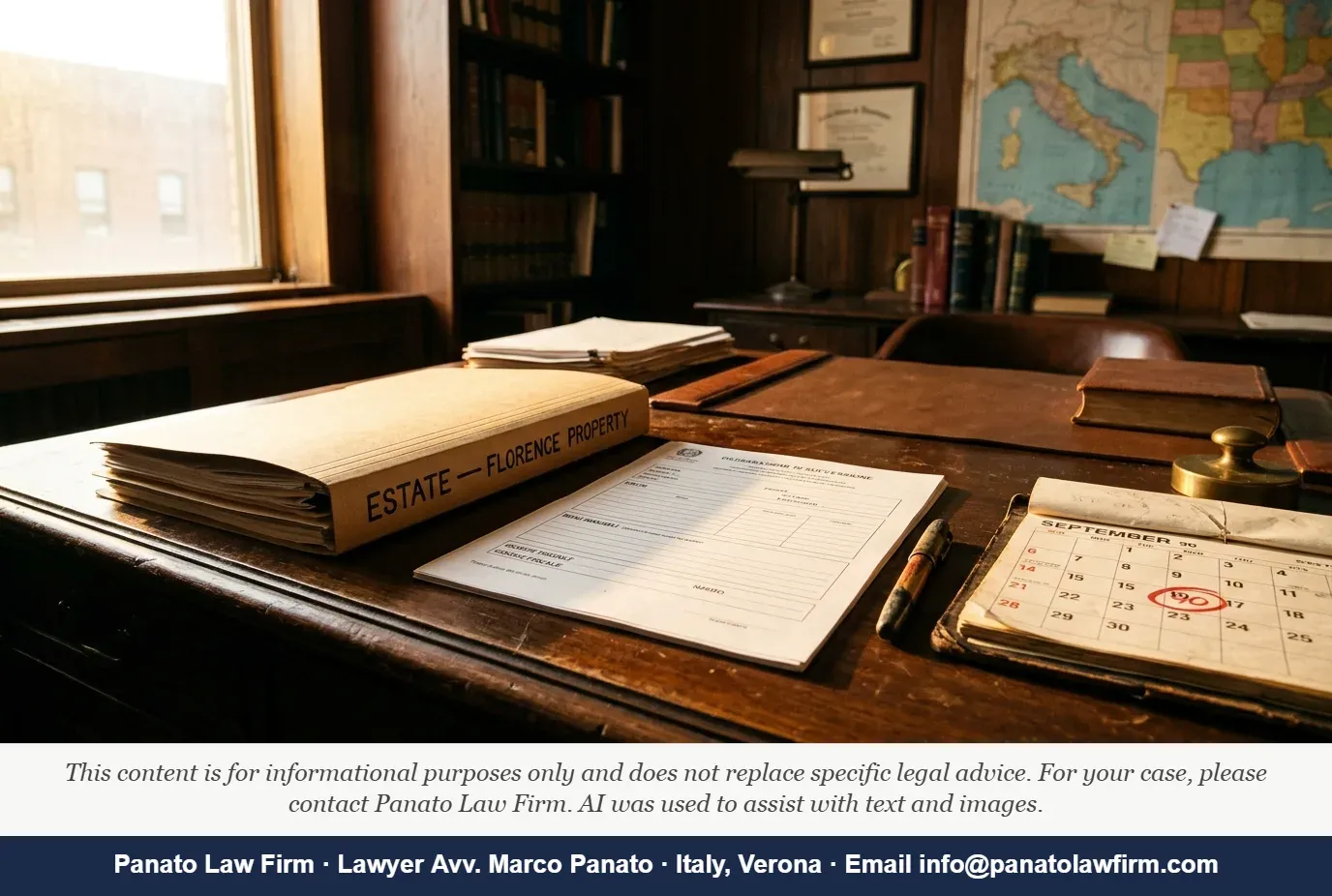
The formal motion for assignment is the document that activates the co-heir's priority right under Article 720. It must be filed in writing, within the division proceedings, before the court reaches the assignment stage of the hearing. It must identify the co-heir making the request, the specific property at issue, the basis for the claim (co-ownership by intestacy or under a will), and the offer to compensate the other heirs at a value determined by the court-appointed expert.
Filing from the United States requires a local Italian attorney holding a valid power of attorney (procura alle liti) granted by the co-heir and, depending on the US state, apostilled under the Hague Convention of 5 October 1961. Obtaining that document alone can take two to three weeks from scratch. That time runs out fast once Italian proceedings are already under way.
There is a further complication that most guides omit entirely.
Before any heir can file a claim in an Italian court to force division, Italian law requires an attempt at mediation. Article 5(1) of Legislative Decree no. 28 of 4 March 2010 (D.Lgs. 28/2010) makes mediation mandatory for inheritance and estate division matters. A party who skips this step and files directly in court will have the claim declared inadmissible.
The practical timeline therefore looks like this. After the death, the heirs must accept or renounce the estate within ten years, though in practice the division is usually sought within one to three years. Before litigation, a mediation request is filed with an accredited mediation body (organismo di mediazione). The other parties have thirty days to respond. A first mediation session must be held. Only after that session — or after the other parties fail to attend — can court proceedings be commenced.
Add the time needed to prepare the power of attorney, the apostille, and the actual court filing of the formal motion for assignment, and a US-based heir who learns about proceedings late in the process may find themselves with a matter of days to act, not months. The court does not pause to notify absent foreign co-heirs that the assignment stage is approaching.
The sequence of actions for a US-based co-heir who wants to retain an inherited Italian property runs as follows.
Verify the current stage of any Italian proceedings immediately. If the estate division is already before a court, confirm through Italian counsel whether the assignment stage has been reached. This takes one working day for an attorney with access to the court file.
If mediation has not yet been attempted, file a mediation request promptly. This is the step that must precede any court filing and that resets the clock in your favour.
Once mediation fails or concludes without agreement, file the formal motion for assignment as early in the court proceedings as possible. Do not wait. The motion must be on file before the judge reaches the assignment stage of the hearing.
Prepare evidence of your capacity to compensate the co-heirs. The court-appointed expert will set the property's value. You must demonstrate willingness and ability to pay the other heirs their shares in cash, at that figure. For a property worth €900,000 divided among three equal heirs, that means being in a position to pay approximately €600,000, less any offsets the court approves.
Unlike probate in most US states — where the executor or personal representative has broad powers to manage, sell, or distribute estate assets, and where a court can intervene equitably to prevent a forced sale if the circumstances warrant — Italian inheritance law does not vest any single heir or administrator with broad management authority. There is no Italian equivalent of the executor's consolidating role. Each co-heir holds an undivided fractional share of every estate asset from the moment of death. Any co-heir can petition for division at any time. None can unilaterally prevent it.
The Italian legal writer Francesco Carnelutti, whose procedural theory still shapes how Italian courts read their own codes, described the distinction between substantive right and procedural act as absolute: having the right is never the same as exercising it. The June 2026 ruling is an application of that principle in its starkest form.
The abolition of the coacervo successorio (the mechanism that aggregated lifetime gifts with estate value for inheritance tax threshold purposes), effective 1 January 2026 under Legislative Decree no. 139 of 18 September 2024 (D.Lgs. 139/2024, G.U. n. 231 del 2 ottobre 2024) and implementing decree no. 123 of 2025 (D.Lgs. 123/2025), means that families who made large Italian-situs gifts in prior years can now plan the residual estate without those gifts eroding the €1 million per-heir tax exemption at death. That is a genuine planning benefit. But it means nothing if the property goes to auction before the division is completed.
In our files, the most common mistake is this: a US-based heir instructs an Italian attorney to "represent my interest in the estate" and considers the matter handled. The attorney files the acceptance of inheritance and monitors the proceedings. Nobody specifically instructs them to file the formal motion for assignment because nobody realised it was a separate, affirmative act. The division reaches the assignment stage. The motion was never filed. The file that lands on our desk at that point is far harder — and far more expensive — to resolve than the one we could have handled at the outset.
The single most useful action in the next seven days is to contact Italian counsel and ask one direct question: has an istanza di assegnazione been filed in my name?
Can my Italian relatives handle the estate division without me being involved in every step?
They can handle many procedural steps, but they cannot file a formal motion for assignment on your behalf. That motion must be filed by you — through your own Italian attorney holding your power of attorney. If your Italian relatives also want the property, their interests and yours are directly opposed. Relying on them to protect your position is one of the most common and costly errors we see.
What happens at an Italian public auction of an inherited property?
The court appoints an expert who values the property. A reserve price is set — often below market value. The auction is public, advertised, and open to any buyer. Co-heirs can bid, but so can developers and investors. The proceeds are divided among the heirs in proportion to their shares, after court costs. The family loses the property entirely. Recourse after the auction is extremely limited.
Does it matter that I am based in the United States and have never lived in Italy?
Your residence does not affect your inheritance rights under Italian law, but it does affect your ability to act quickly. Italian court deadlines do not extend for foreign heirs. The apostille and power of attorney process takes time. If Italian proceedings are already under way, the gap between when you learn about a hearing and when you can lawfully file a document in that proceeding is often shorter than the travel time from the US to Italy. Acting through Italian counsel before proceedings begin — not after — is the only reliable way to protect your position.
HREFLANG BLOCK:

Editorial Team — Panato Law Firm Staff