Content developed with the assistance of AI tools and reviewed by the author.
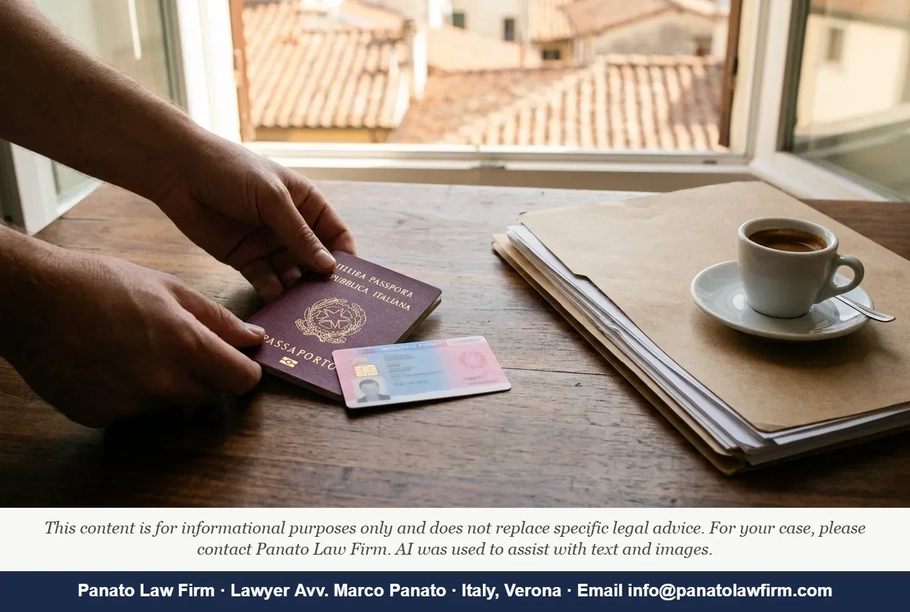
For foreigners who have built their life in Italy without Italian ancestry or marriage, citizenship by residence is the main route. The years must be counted carefully.
Citizenship can be granted by decree to a foreigner legally resident in Italy for at least ten years, to a citizen of an EU Member State after four years, to a stateless person after five, and to an adult adopted by an Italian citizen after five years of residence following the adoption (art. 9 Law 91/1992). Legal residence means registered residence with a valid permit.
The law also requires knowledge of Italian at least at B1 level (art. 9.1), and in practice the authorities check that the applicant has adequate income. The procedure must be completed within twenty-four months of the application, extendable up to thirty-six months (art. 9-ter Law 91/1992).
At a glance
What to do
Legal basis: Arts. 9, 9.1 and 9-ter Law 91/1992.
This note is general information and does not replace advice on a specific case.

Avv. Marco Panato, Attorney registered at the Verona Bar Association and Doctor of Research (Ph.D.) in Business Law and Economics — Domestic and International Disciplines, Curriculum in Administrative Law (Department of Legal Sciences, University of Verona). Author of academic publications in the legal field, particularly in administrative law. He also delivers lectures and advanced professional training.