Content developed with the assistance of AI tools and reviewed by the author.

How the Bologna ruling of April 2026 protects Brazilian descendants who wrote to an Italian consulate before 27 March 2025 — even without a formal appointment
Roughly 25 million Brazilians claim some Italian ancestry. After Law 74 of 24 May 2025 (Legge 74/2025) introduced a two-generation cap on jus sanguinis citizenship claims, that number collapsed into a much smaller group who still qualify under the old rules — those whose cases were already "pending" before 27 March 2025. The question no one answered clearly until recently is: what does "pending" actually mean?
A Tribunal in Bologna has now answered it. The answer is better than most applicants feared — but the evidentiary bar is higher than anyone warned.
The Tribunal of Bologna, in ruling no. 3335/2026 of 17 April 2026 (Tribunale di Bologna, sentenza n. 3335/2026 del 17 aprile 2026), found in favour of / declared the citizenship of for descendants of the second, third and fourth generation who had no formal appointment at an Italian consulate but had sent documented written contact to the consulate before the deadline.
The ruling construes / The court construed of Law 74/2025, which preserved pre-reform rules for cases already pending on 27 March 2025. Bologna held that "pending" is not synonymous with "appointment confirmed." A formal, documented written request to the consulate — sent before that date and capable of proof — satisfies the transitional condition.
This is a single first-instance ruling. It is not yet Supreme Court authority. But it is the first Italian court decision to define the outer boundary of the transitional window in favour of applicants, and it carries persuasive authority / is persuasive authority hearing similar claims.
Under Bologna 3335/2026, a written contact sent to an Italian consulate before 27 March 2025 can count — but only if it satisfies three conditions the court examined in detail.
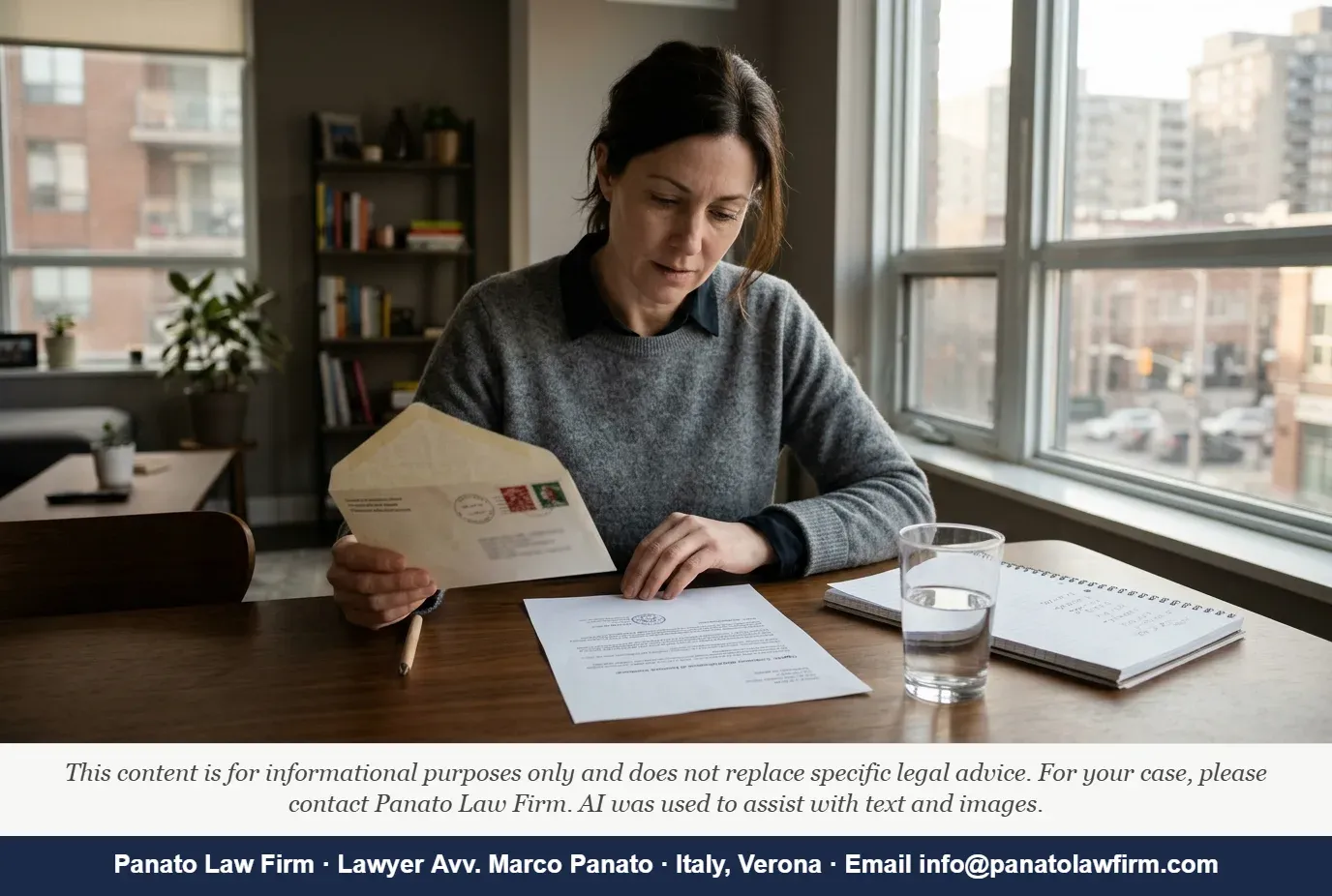
First, the contact must have been addressed to the consulate, not to a facilitator, a lawyer, or a Facebook group. An email to info@conssaopaulo.esteri.it, a registered letter (raccomandata con avviso di ricevimento, the Italian equivalent of a registered delivery with return receipt) sent to the consulate's official address, or a contact form submission through the consulate's official portal all satisfy this requirement. A WhatsApp message to a consular officer's personal number almost certainly does not.
Second, the contact must have expressed a clear intent to initiate a citizenship recognition procedure under Italian law 91 of 5 February 1992 (Legge 91/1992). A message asking about booking an appointment for a tourism matter does not qualify. A message asking about jus sanguinis recognition, ancestral documentation requirements, or citizenship procedures does.
Third, and most demanding: you must be able to prove the date it was sent, to a standard sufficient to withstand scrutiny in Italian civil proceedings.
This is where most Brazilian applicants are about to discover the real difficulty. Italian civil procedure requires certified documentary proof of date. Personal recollection counts for nothing. Printed screenshots count for very little. The court in Bologna examined the evidence item by item.
The strongest evidence, in descending order of probative weight, is as follows. A postal receipt from the Correios or the Italian postal service (Poste Italiane) showing a registered delivery to the consulate with a date stamp before 27 March 2025 is the gold standard. A protocol number issued by the consulate itself — a confirmation email or acknowledgement carrying a reference code and a timestamp — is equally strong. Email server metadata, exported from the original sending account in its raw format (not a copy-pasted screenshot), is admissible but will require expert or technical evidence. WhatsApp metadata, extracted from a device backup with a verified timestamp, has been admitted by some Italian courts but is subject to challenge.
What will not work: a PDF you printed from your browser in 2026, a message forwarded from an old phone, a photo of a screen, or an attestation from a relative saying "I saw you send it." The Italian law on documentary declarations — Article 76 of Presidential Decree 445/2000 (DPR 445/2000) — imposes criminal liability for false attestations. Any attempt to reconstruct or fabricate evidence after the fact gives rise to criminal liability, not just a failed claim (text appears truncated)ship claim.
The forensic exercise, then, is not hunting for an appointment slip. It is auditing email server logs, registered postal receipts and consulate acknowledgements. Most competitor blogs focus on appointment records; they are looking in the wrong place.
Under Bologna 3335/2026, yes — if the documented contact pre-dates 27 March 2025. Unlike in most common-law countries, where an application typically has legal effect only once it is formally received and registered by the relevant authority, Italian administrative law and the transitional provisions of Law 74/2025 turn on the date of the applicant's own act of contact. The Bologna court drew on the principle that a person cannot be penalised for a delay caused by the consulate's own inability to process appointments — a point of direct practical relevance given the years-long waiting lists at Italian consulates in São Paulo, Rio de Janeiro and Brasília throughout 2023 and 2024.
In the Brazilian context, this matters enormously. The Consulado-Geral d'Italia in São Paulo — the busiest Italian consulate in the world by case volume — had appointment wait times of two to four years for citizenship matters during 2023–2024. Thousands of applicants wrote formally to request appointments or to ask about procedures and received either a generic auto-reply or silence. Bologna 3335/2026 says that the act of writing is what counts, not the act of being answered.
The Constitutional Court had already confirmed, in Judgment no. 63/2026, deposited 30 April 2026 (Corte Costituzionale, sentenza n. 63/2026, depositata il 30 aprile 2026), that Law 74/2025's two-generation cap is domestically constitutional. For descendants beyond the second generation who cannot demonstrate pre-deadline contact, the only remaining domestic route is the facilitated naturalisation path. The CJEU referral arising from Constitutional Court Order 147/2026 (Corte Costituzionale, ordinanza n. 147/2026 del 23 luglio 2026) may eventually reopen the issue on EU proportionality grounds, but proceedings at the Court of Justice of the European Union take years and offer no near-term relief.
Iura novit curia — the court knows the law. What the court does not know is your facts. Gathering them is your immediate task.
In the next seven days, take every step you can to locate and preserve primary evidence of your pre-deadline contact. Log in to the email account you used in 2023 or 2024 to contact the consulate. Do not delete, move or print anything yet: export the raw file (EML or MBOX format) from the account settings. This preserves server-side metadata including originating IP address and timestamp, which a PDF printout destroys. If you used Gmail or Outlook, both platforms allow full message data export; do this immediately.
Search the Correios tracking portal if you sent a registered letter. The tracking number on your receipt will confirm the dispatch date and, where a delivery scan occurred, the receipt date at the consulate's address. Save the tracking page in PDF format and note the URL.
If you received a protocol number or reference code from the consulate, even in an automated acknowledgement, locate it and treat it as a primary document. If you contacted the consulate through the Prenot@mi system — the online appointment booking platform used by Italian consulates abroad — your submission record may still exist in the system. A lawyer experienced in Italian citizenship proceedings can assist with a formal information request to retrieve it.
The approximate cost of a first evidentiary review varies. Based on files handled in this practice, a document audit covering three to five years of correspondence typically requires four to six hours of professional time. Do not delay this step in the expectation that courts will be lenient with late evidence.
In our files, the most common mistake is waiting for the consulate to confirm receipt before approaching a lawyer. Applicants who sent well-documented emails in 2023 and 2024 but never received a reply often assume their correspondence was lost or does not count. Bologna 3335/2026 reverses that assumption — but only if you can still retrieve and certify the original sending record. We have seen cases where the applicant changed phone, changed email provider, or had their account suspended, destroying the only primary evidence. Act on the export and preservation step today, before anything else.
I emailed the Italian consulate in São Paulo in 2024 asking about citizenship. Does that count under Bologna 3335/2026?
It may count, but the subject line and content of the email must show a clear intent to begin a citizenship recognition procedure under Italian law. An email asking about jus sanguinis documentation requirements is strong evidence. An email asking about general consulate services is not. The decisive question is whether the content, read objectively, identifies you as seeking citizenship recognition — and whether you can still produce the original email in a certified format showing its send date.
I am a third-generation Brazilian descendant. Does Law 74/2025 permanently exclude me?
Under current domestic law, yes — unless you can establish transitional protection through documented pre-deadline contact as described in this article, or unless the CJEU referral in Constitutional Court Order 147/2026 eventually produces a ruling in applicants' favour. The facilitated naturalisation route under Article 9 of Law 91/1992 remains available regardless of generation, though it requires legal residence in Italy and carries a different set of requirements. Each case turns on its own facts.
Can I file a citizenship claim in Italian court without going through the consulate first?
Yes. Italian citizenship recognition proceedings (procedimento di riconoscimento della cittadinanza italiana per discendenza) can be filed directly before the civil tribunal in Italy, without a prior consular appointment. For applicants resident in Brazil, the competent court is determined by the Italian rules on jurisdiction for non-residents. Filing directly in Italy rather than waiting years for a consulate appointment has become the preferred route for applicants with strong documentation. A lawyer experienced in Italian citizenship law can identify the correct tribunal and manage the filing from Italy on your behalf.
Panato Law Firm, led by Avv. Marco Panato in Verona, Italy, advises international clients on Italian citizenship by descent, cross-border inheritance, and Italian property matters. If you received an Italian consulate acknowledgement or sent written contact before March 2025 and want to know whether you still qualify, write to info@panatolawfirm.com or call +39 045 5867034.
HREFLANG BLOCK:

Editorial Team — Panato Law Firm Staff