

Content developed with the assistance of AI tools and reviewed by the author.
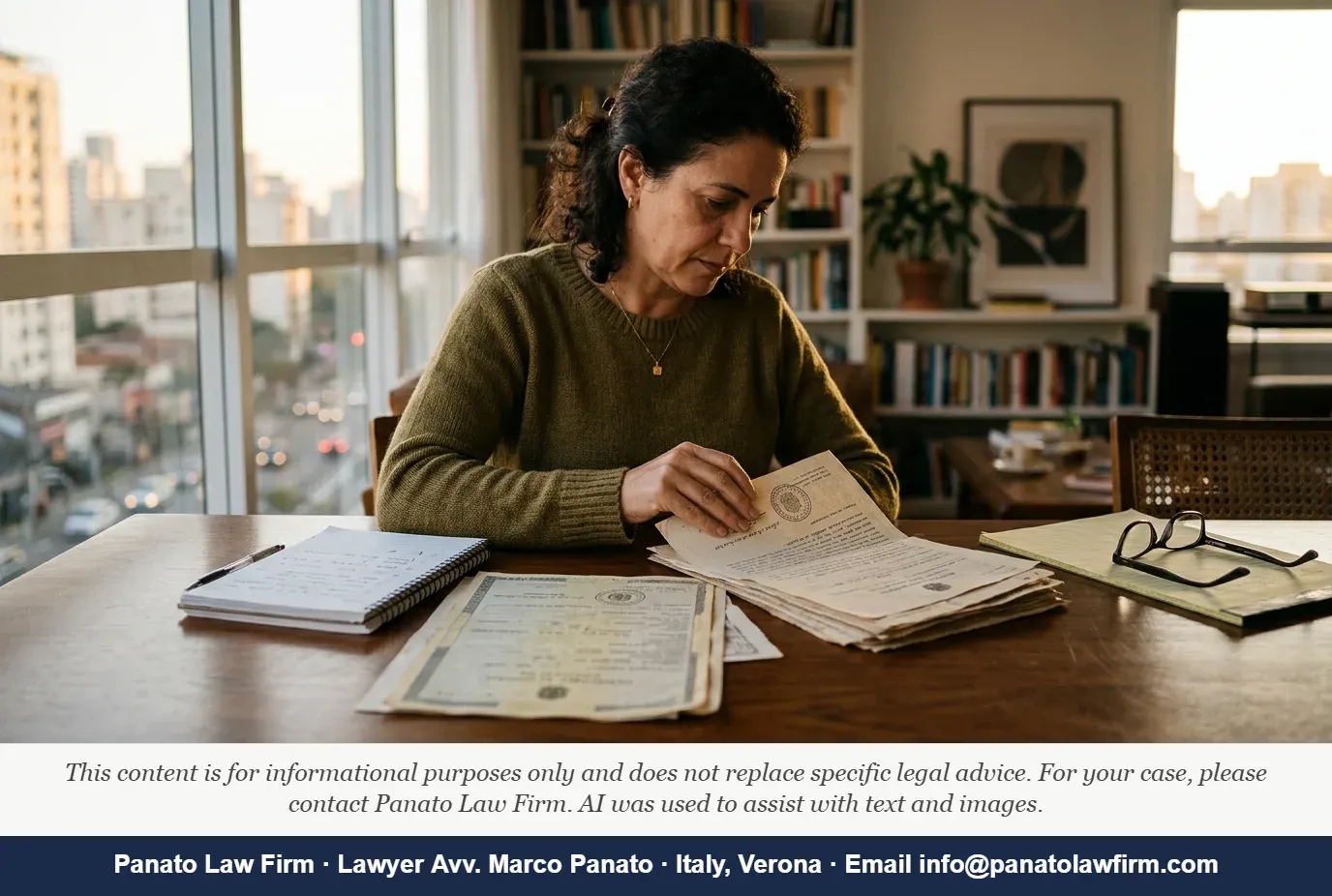
The Supreme Court settled the 'minor issue' in July 2026 — but the consulate door is open only if you move now
Do nothing in the next few weeks and the free re-examination window at your consulate in Brazil may close. The Italian consul has discretion to refer your file back to the Italian courts at any time. Once it goes to court, you are looking at costs of roughly EUR 500–1,000 in contributions and filing fees, plus months of additional waiting. Families who act now with a correctly assembled file can avoid that entirely.
Yes — if your application was blocked specifically because of the minor issue. On 26 July 2026, Italy's Supreme Court of Cassation, Joint Sections (Corte di Cassazione, Sezioni Unite), issued Ruling No. 24045/2026. The decision draws a clear distinction between two provisions of Law 555/1912, Italy's century-old citizenship statute. Under Art. 7 of that law, a minor who was born abroad as a dual citizen by jus soli — acquiring a foreign nationality automatically at birth — did not lose Italian citizenship when their Italian parent later naturalised as a foreign citizen. Loss of citizenship under Art. 12 applied only to a minor who held exclusively Italian citizenship and then acquired foreign nationality derivatively, as a direct consequence of the parent's own naturalisation. The Sezioni Unite resolved a split between civil divisions that had persisted for years and had been exploited / invoked by the Italian Ministry of Interior in Circular Prot. 43347/2024 to block entire family lines from descent-based citizenship claims.
For Brazilian applicants this matters enormously. Brazil is a jus soli country: anyone born on Brazilian soil acquires Brazilian citizenship at birth, regardless of their parents' nationality. An Italian emigrant's child born in Brazil therefore typically held dual Italian-Brazilian nationality from day one. When the Italian parent later obtained / applied for Brazilian naturalisation — a common path for emigrants seeking to vote, own rural land, or access full civil rights — the Ministry argued that this extinguished the child's Italian citizenship under Art. 12. The Sezioni Unite said that argument was wrong in law. It always had been.
On 10 August 2026, the Ministry of Interior issued Circular Prot. 65050/2026, formally revoking Circular 43347/2024 and instructing consular posts to allow administrative re-examination (riesame in autotutela) of previously rejected applications without a new fee. That sounds straightforward. It is not.
The re-examination procedure is discretionary. The consulate is not obliged to grant the positive outcome: it may still refer the file to an Italian civil court if it considers the documentation insufficient. What practitioners are now observing — and what competitor commentary overlooks — is a new de facto documentation threshold. Before 2024 a lineage file assembled from civil status records (atti di stato civile) and naturalisation certificates was generally sufficient. After Circular 65050/2026, several consulates are requesting supplementary evidence that was never required before: authenticated translations of Brazilian naturalisation decrees cross-referenced against ANSC (Italy's national civil status archive) records, updated estratti integrali (full extract civil records) for every generational link, and proof that no voluntary renunciation was recorded in any Italian register. None of these requirements is unreasonable in isolation. Together, it adds weeks of preparation time and, if the applicant is not aware of what is coming, the consulate simply closes the file and redirects it to the Italian civil courts.
A correctly prepared file — assembled before the first appointment — eliminates that risk. The three practical steps are: first, obtain and verify the original rejection letter to confirm that the minor issue was the ground relied upon / the stated ground; second, prepare a complete lineage file including all items now required under the post-circular practice; third, submit a written request for riesame in autotutela citing Ruling No. 24045/2026 and Circular 65050/2026 explicitly by reference number. Consulates are unlikely to act on generic requests.
No. Nothing is automatic. Unlike the position in Brazilian administrative law, where a supervening constitutional ruling by the Supremo Tribunal Federal can trigger mandatory ex officio review of prior decisions, Italian consular procedure does not impose a self-executing obligation on the post. The consulate will not contact rejected applicants unsolicited. If you do not submit a formal request for re-examination, your file stays rejected.
This contrast is worth sitting with. In Brazil, when the STF changes the interpretive basis of an administrative decision, the affected party can often rely on the administrative body to act. Under Italian administrative law as applied consularly, the burden falls on the applicant: you must invoke the remedy, identify the ruling, and present the corrected file. Vigilantibus, non dormientibus, iura succurrunt — the law aids those who are watchful, not those who sleep. That maxim, borrowed from Roman procedure, describes Italian consular practice precisely.
The minimum set, based on current consular practice in Brazil, is broader than it was before 2024. Every document from a Brazilian authority must carry an apostille under the Hague Convention of 5 October 1961, translated by a sworn translator (traduttore giurato) into Italian.
For the key generational link affected by the minor issue, you will need: the Italian ancestor's original Italian birth certificate and emigration record; the Brazilian birth certificate of the minor child born in Brazil (confirming jus soli acquisition of Brazilian nationality); the Italian parent's Brazilian naturalisation decree, showing the date — the date is decisive because it must postdate the child's birth to confirm the child was already a dual national at the moment of the parent's naturalisation; and a declaration or certificate from the Italian consular register (AIRE, the registry of Italians residing abroad) or from ANSC confirming that no voluntary renunciation of Italian citizenship was recorded for the minor during the relevant period.
If any civil record was transcribed at the consulate under the old rules and the transcription was refused or cancelled on the minor-issue ground, that refusal decision itself should be included in the re-examination request.
Approximate assembly time with a competent document agent in Brazil: four to eight weeks. Do not leave the apostille step to the last week: Brazilian notarial offices in São Paulo and Rio de Janeiro are currently running three-to-four-week turnaround times on apostilles for civil records from interior municípios.
Yes, and here the ruling operates differently — it is immediately operative in court proceedings. Any Italian civil court currently examining a citizenship recognition case in which the minor issue was raised as a ground of rejection must apply Ruling No. 24045/2026 as binding precedent from the Joint Sections. The applicant or their Italian counsel should file a brief (memoria integrativa) citing the ruling and requesting that the court apply it. Courts that were previously adjourning cases pending the Sezioni Unite outcome should now proceed to judgment.
There is, however, a separate issue that practitioners must check before celebrating: the generational limit introduced by Law 74/2025, Art. 3-bis, which restricts descent claims to the first and second generation counted from the last Italian-born ancestor, and fixes 27 March 2025 as the filing cutoff for claims that would exceed that limit. The minor issue ruling and the generational limit are entirely independent legal barriers. Ruling 24045/2026 solves the minor issue. It does not solve a generational-limit problem. Brazilian families frequently conflate the two, particularly where the family line runs three or more generations back.
The correct sequence is: confirm the ground of rejection first. If it was the minor issue alone and the family satisfies the generational count or filed before 27 March 2025, the path is now clear. If the rejection included or concealed a generational-limit ground, the legal position is more complex: Italian Constitutional Court Order No. 147/2026 (23 July 2026) has referred Law 74/2025 Art. 3-bis to the Court of Justice of the European Union as Case C-816/26, Picuso, questioning its compatibility with EU citizenship rights under Arts. 9 TEU and 20 TFEU. That referral does not suspend applications in the meantime, but it means families with a generational-limit problem should not abandon their claims.
As the legal scholar and historian Raquel Rolnik observed in a different context, bureaucratic silence often functions as a policy instrument. That is precisely what the Ministry of Interior achieved between 2024 and 2026 with Circular 43347/2024. The judicial correction has arrived; the administrative machinery is moving more slowly.
In our files, the most common error at this stage is submitting a re-examination request before reading the original rejection letter carefully. Many refusal letters from 2024 and early 2025 list the minor issue as the stated ground but also contain a secondary paragraph noting that the generational limit "may apply". That secondary paragraph is not merely boilerplate: if a consulate later treats it as an independent ground, the re-examination of the minor issue becomes irrelevant. We always advise clients to have the rejection letter reviewed by a lawyer experienced in Italian citizenship law before doing anything else. An incorrectly framed re-examination request does not reset the clock — it can actually confirm a rejection under a different ground.
My grandfather was born in Brazil to an Italian emigrant who later naturalised as Brazilian. The consulate rejected my application in 2024. Does ruling 24045/2026 help me?
Almost certainly yes, if the rejection was based on the minor issue. Your grandfather was born Brazilian by jus soli and therefore held dual nationality at birth; the Joint Sections ruled that the Italian parent's subsequent naturalisation did not affect his Italian citizenship. Request the re-examination in writing, citing Ruling No. 24045/2026, and attach the documents described above. Have the rejection letter reviewed first to confirm no secondary grounds exist.
Is there a deadline to request the free re-examination under the August 2026 circular?
Circular 65050/2026 does not fix a hard expiry date. However, the waiver of re-examination fees is an administrative concession, not a statutory right, and it can be withdrawn or modified. Consular practice already suggests that files submitted without complete documentation are being deferred rather than processed. Acting within the next 30 to 60 days gives the strongest position. Waiting until a court deadline or a change in consular instructions is a risk that need not be taken.
I live in São Paulo and my file is pending at the Consolato Generale. Do I need an Italian lawyer or a Brazilian lawyer?
For the consular re-examination phase, you need a lawyer experienced in Italian citizenship law and Italian administrative procedure, because the legal framework is entirely Italian — Law 555/1912, Law 91/1992, and Ministry of Interior circulars issued in Rome. A Brazilian advogado can assist with obtaining and apostilling Brazilian documents but cannot advise on Italian law. If the consulate refers your file to an Italian civil court, proceedings are conducted in Italy under the Italian Code of Civil Procedure, and you will need representation in Italy. Panato Law Firm advises on Italian law and works with local counsel in Brazil for document handling where needed.
HREFLANG BLOCK:

Editorial Team — Panato Law Firm Staff



