Content developed with the assistance of AI tools and reviewed by the author.
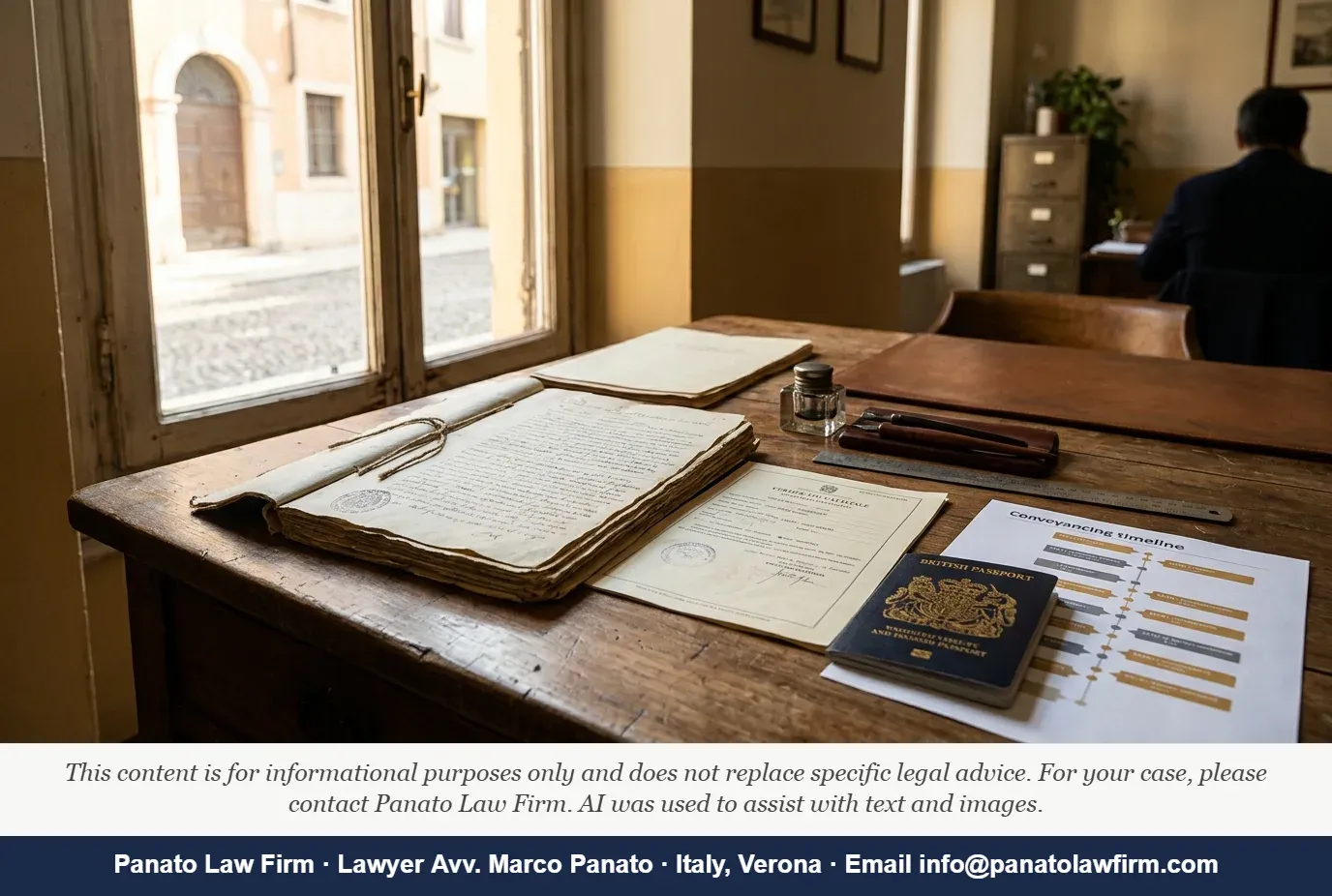
The title chain, the capital gains trap, and five steps to complete before you sign the preliminary sale contract
Your parent died in January. You are the sole heir. An estate agent has found a buyer for the flat in Verona and is pressing for a preliminary sale contract (the compromesso) within eight weeks. The notary's office is asking for documents you have never heard of. Your UK solicitor is warning about capital gains tax. And somewhere in the paperwork there is a reference to a succession filing that apparently has to happen before any of this can proceed.
Every one of those concerns is legitimate. The problem is that they are connected in a strict sequence, and a missed step in the wrong order will stall — or kill — the sale.
No — and this surprises almost every UK heir. Unlike the English probate process, where a grant of probate is issued by the court and then governs the estate's administration, Italian succession law works differently. Under the Italian Civil Code, ownership passes to the heirs at the moment of death by operation of law. There is no court-issued grant. But ownership passing to you automatically does not mean you can sell. Before any property transaction can complete, you must formally register the succession with the Italian Revenue Agency (Agenzia delle Entrate), pay the applicable taxes under the self-assessment regime introduced on 1 January 2026, and then have the updated title transcribed at the land registry. Only after that transcription can a notary lawfully execute the notarial deed of sale (rogito). Signing the preliminary sale contract before those steps are finished does not give the buyer a safe title. Exchanging on one before the succession is registered means you are promising to transfer something you cannot yet legally convey.
Italian conveyancing law sets a rigid sequence. Compress it and the sale collapses.
The first step is filing the dichiarazione di successione, the Italian succession declaration, within twelve months of the date of death. This document identifies the estate, the heirs, and every Italian asset. Miss the twelve-month window and penalties apply: a late return currently attracts a base penalty of 120% of the tax due, reduced to 60% if filed within ninety days of the deadline (Article 50, Legislative Decree 346/1990, as amended by Legislative Decree 139/2024, in force from 1 January 2026).
The second step is the self-assessment and payment of inheritance tax, mortgage tax, and cadastral tax. Since January 2026, heirs calculate and pay these taxes themselves at the time of filing — the Revenue Agency no longer issues a preliminary demand. This is a structural change. Any arithmetical error in your calculation will be discovered by the Revenue Agency at the post-filing audit stage, which can occur after the property has already been sold. The Agency can then place a lien on the sale proceeds or, in theory, on the already-transferred property. This risk did not exist under the old demand-led system, and it is one that most English-language guides have not yet reflected.
The third step is obtaining the Revenue Agency's receipt confirming the declaration has been accepted and the taxes settled. This receipt is the gateway document for everything that follows.
The fourth step is filing the land registry update (voltura catastale) and requesting the transcription of the transfer at the Conservatoria dei Registri Immobiliari, the Italian equivalent of HM Land Registry. Until that transcription is completed, the register still names the deceased as the registered owner. A notary cannot execute a valid deed of sale on that basis.
Only at the fifth step — with transcription confirmed — can you sign the preliminary sale contract and then the notarial deed of sale.
The practical implication for your timeline: if the death occurred in January, the succession declaration deadline is January of the following year. A buyer's solicitor who insists on exchange within six months of death is asking you to act before the succession filing can even be completed, let alone the land registry updated. Push back. Build your timeline around the succession deadline, not around the buyer's convenience.
Here is what most online content about selling inherited Italian property overlooks entirely.
If the deceased acquired the property by an informal transfer — a gift never registered, a purchase where the deed of sale was signed but never transcribed, or a succession from an earlier generation that was similarly left unregistered — the title chain is broken. When the notary runs the preliminary checks before the rogito, the break will surface. The current land registry entry will not lead back to the deceased in an unbroken sequence of registered transactions. The notary cannot proceed. The sale collapses.
In our files the most common version of this problem involves a property that passed informally from grandparent to parent, with the intervening succession never registered. The heir then inherits a legal right to property that has an unresolved gap in its official title history. Correcting a broken title chain requires a separate legal procedure — sometimes an adverse possession claim (usucapione in Italian), sometimes a retroactive succession registration for the skipped generation — and it takes months. If you discover this the week before the rogito, you will lose your buyer.
The fix is to instruct a land registry search (visura catastale) before you agree a completion date with any buyer. The visura catastale traces the current registered ownership and any encumbrances. It costs approximately €10 and takes twenty-four hours. It is not optional.
On the Italian side, the position is relatively straightforward. Article 67(1) of the Italian Consolidated Income Tax Act (TUIR, Presidential Decree 917/1986) provides that the capital gains charge — the plusvalenza — does not apply to property received by inheritance. The five-year rule that catches ordinary property sellers does not apply to heirs. So if you sell an inherited Italian flat at a profit, Italy imposes no capital gains tax.
Unlike in most common-law countries, however, this Italian exemption does not end the analysis for a UK-resident heir. HMRC does not defer to Italy's tax treatment. Under section 62 of the Taxation of Chargeable Gains Act 1992, a UK-resident beneficiary is treated as having acquired the inherited asset at its market value as at the date of death. Any increase in value between the date of death and the date of sale is a chargeable gain in the UK, regardless of whether Italy taxes it. The 1988 UK–Italy Convention for the Avoidance of Double Taxation provides credit relief, not an exemption — and because Italy charges nothing, there is no Italian tax to credit. The full UK gain is taxable at the applicable rates: currently 18% for basic-rate taxpayers and 24% for higher-rate taxpayers on residential property (Finance (No.2) Act 2024, effective from 30 October 2024). For a flat inherited at €250,000 and sold at €310,000, that is a UK CGT liability of between approximately £10,800 and £14,400 on the £60,000 gain, depending on your tax position. These are illustrative figures; the exact liability depends on your full UK income position, allowable costs, and the sterling/euro exchange rates at the relevant dates.
Budget for UK CGT from the outset. It is not optional and it does not disappear because Italy exempts the gain.
The succession declaration must be filed within twelve months of the date of death. In practice, gathering the necessary documents for a foreign heir — certified translations, apostilles, the Italian tax code (codice fiscale) for each heir, a cadastral valuation, and potentially a legal opinion on the governing law under Regulation (EU) 650/2012 — takes two to three months. Allow a further four to eight weeks for the Revenue Agency to process the filing and issue the receipt, and a further three to six weeks for the land registry transcription.
A realistic minimum from death to a legally clear title ready for sale is five to six months. Six to nine months is the most common timeline we see in practice. If you add the buyer's search process and conveyancing, a sale completing less than nine months after the death is ambitious. A sale completing less than six months after the death is, in most cases, legally impossible without risk.
At the succession stage you will need: the original death certificate with apostille and certified translation into Italian; a certificate of the deceased's last residence; each heir's passport and Italian tax code; a cadastral plan and current land registry extract for the property; and, if the deceased was not Italian, a declaration of the applicable succession law under Regulation (EU) 650/2012 (the EU Succession Regulation). If the estate includes property in multiple Italian regions, each property's land registry documents must be sourced separately.
At the sale stage the notary will additionally require: the Revenue Agency receipt confirming the succession declaration and tax payment; proof of the land registry transcription in the heir's name; an energy performance certificate (Attestato di Prestazione Energetica); certificates of planning regularity; and, for flats, the condominium administrator's certificate of no outstanding service charge arrears. Missing any one of these on the day of the rogito will delay completion.
The Latin maxim nemo plus iuris ad alium transferre potest quam ipse habet — no one can transfer more right than they themselves possess — captures the essential risk. Until the title is registered in your name, you cannot safely transfer it to anyone else.
The most consistent mistake we see in files involving the sale of inherited Italian property is the heir signing the preliminary sale contract before the succession has been transcribed at the land registry. The heir assumes, not unreasonably, that since ownership passed at death, a commitment to sell is safe. But the preliminary sale contract (compromesso) binds both parties to complete. If the title cannot be transcribed in time — because of a broken chain, a late succession filing, or a Revenue Agency query on the self-assessment — the heir faces either a breach of contract claim from the buyer or a forced extension that costs money and goodwill. Never sign the compromesso until step four of the title sequence is confirmed in writing.
Can I sell the Italian property without visiting Italy?
Yes. A foreign heir can grant a notarised and apostilled power of attorney to an Italian-qualified lawyer to execute both the succession registration and the sale deed on their behalf. The power of attorney must be carefully drafted to cover all the specific acts required; a general power is often insufficient for the rogito. This is the standard solution for heirs who cannot travel and is straightforward provided the document is prepared in advance.
What happens if I miss the twelve-month succession filing deadline?
The filing can still be made late, but penalties apply immediately. Under the rules in force from 1 January 2026, a late filing within ninety days of the deadline attracts a reduced penalty of 60% of the tax due. Beyond ninety days, the base penalty of 120% applies, subject to voluntary disclosure reductions available under the ravvedimento operoso procedure (Legislative Decree 346/1990, as amended). A late filing does not prevent the eventual sale, but it adds cost and delays the point at which the land registry transcription can proceed.
Does the Italian succession have to be completed before I can accept an offer from a buyer?
Accepting an offer informally carries no legal risk. Signing a preliminary sale contract (compromesso) before the succession is registered and the title transcribed carries significant legal risk. The compromesso is a binding contract in Italian law. If you cannot complete because your title is not yet clear, you may be liable to return any deposit paid — doubled, under the Italian rules on caparra confirmatoria — or to compensate the buyer's losses. Accept offers. Do not sign contracts until the title chain is clear.

Avv. Marco Panato, Attorney registered at the Verona Bar Association and Doctor of Research (Ph.D.) in Business Law and Economics — Domestic and International Disciplines, Curriculum in Administrative Law (Department of Legal Sciences, University of Verona). Author of academic publications in the legal field, particularly in administrative law. He also delivers lectures and advanced professional training.