What Australian acquirers of Italian business units must know before signing — and why asset deal structuring does not leave staff behind
LANG: English (en) · AREA: M&A, Company Acquisitions & Joint Ventures in Italy · TYPE: Short practical tip · MODEL: Sonnet 5.5 · SEO 76/100 · Flesch Reading Ease 38 · QA acceptable
ABSTRACT: An Australian buyer structuring an Italian acquisition as a targeted asset purchase — machinery, client contracts, a brand — may discover at closing that Italian law has imported the entire workforce and three years of unpaid entitlements along with it. Article 2112 of the Italian Civil Code applies automatically to any transfer of an economic entity that retains its identity, regardless of how the deal documents are labelled. This article identifies the five liabilities foreign acquirers consistently miss, anchored to 2025–2026 case law that has expanded the risk perimeter.
The assumption most Australian buyers carry into an Italian deal is this: if we structure it as an asset purchase, we choose what we take and what we leave behind. That assumption is wrong in Italy, and it has cost acquirers in ways that do not appear until the first post-closing employment tribunal claim lands.
Italian law does not give the buyer a menu. Once a transaction crosses the threshold of a
cessione di ramo d'azienda — the transfer of a business unit — Article 2112 of the Italian Civil Code (codice civile) operates as a matter of law. Contracts, liabilities, and claims transfer automatically. No individual employee consent is required. No side agreement in the sale and purchase contract overrides it. The label on the transaction is irrelevant; the economic substance controls.
Do Italian employees automatically transfer when I buy a business unit?Yes. Under Article 2112 of the Italian Civil Code, which implements EU Acquired Rights Directive 2001/23/EC, every employment contract in force at the date of transfer passes to the buyer by operation of law. The employee does not sign anything. The buyer does not elect to accept them. If the transferred unit constitutes an economic entity retaining its identity — meaning it was organised to pursue an economic activity and continues to do so after the deal — the workforce comes with it. Unlike in Australia, where a business sale under the Fair Work Act 2009 does not automatically transfer employment contracts and a buyer may engage staff on new terms, Italian law offers no equivalent opt-out. The buyer steps into the seller's shoes on day one.
This is not a formality risk. Italian employment tribunals are active, well-resourced and sympathetic to employees. A claim filed on the morning after closing is not an unlikely scenario; it is a documented pattern in cross-border transactions.
Liability One: Joint and Several Responsibility for Pre-Transfer DebtsArticle 2112 makes the buyer jointly and severally liable, for one year from the date of transfer, for all employment-related debts the seller owed at the date of completion. That means unpaid wages, accrued holiday, social security contributions, and — critically — unfair dismissal claims already pending before a labour tribunal at the date of transfer.
A seller running a redundancy programme in the six months before signing is not shedding exposure; it is creating a claims pipeline that transfers with the deal. An Australian buyer who relies on seller warranties without independent verification of open labour proceedings will absorb those claims as its own.
The one-year window under Article 2112 runs concurrently with the seller's liability, so both entities can be sued. In practice, claimants pursue the solvent party. After closing, that is usually the foreign acquirer.
Liability Two: The End-of-Service Allowance That Cannot Be WaivedEvery Italian employee accrues an end-of-service allowance (TFR) — a statutory deferred-pay entitlement calculated on annual salary and revalued each year at 75% of inflation plus 1.5 percentage points. Unlike an Australian employer's obligation to make superannuation contributions into an external fund, TFR is typically held on the employer's balance sheet until the employment relationship ends. When a business unit transfers, the accrued TFR of every transferring employee becomes the buyer's liability.
On a unit with ten employees averaging gross annual pay of EUR 35,000, the aggregate accrued TFR after five years of service is approximately EUR 100,000 — a readily calculable figure but frequently absent from foreign buyers' financial models. Due diligence must extract the exact TFR balance per employee from the seller's payroll records, not from management accounts.
What is the consultation period for a business transfer in Italy?For any transfer involving a business or business unit where the transferor or transferee employs at least 15 people, Article 47 of Law 428/1990 requires a written notice to the relevant trade unions — or, in their absence, to employee representatives — at least 25 days before the transfer date. The notice must state the reasons for the transfer, its legal, economic, and social consequences for employees, and any measures contemplated. The parties must then consult in good faith for up to 25 days.
This is not a box-ticking formality. Italian courts and the Italian Court of Cassation have held that failure to conduct the consultation properly can expose both parties to damages equal to the employees' pay for the period of the omission. In transactions with a fixed closing date, the consultation window must be built into the timetable before signing — not after.
Liability Three: Defective Consultation Renders the Transfer ChallengeableBuyers who discover post-closing that the seller skipped or truncated the consultation phase inherit that defect. Employees can bring claims for the salary equivalent of the omitted consultation period. Where the consultation failure is egregious, Italian courts have treated the transfer of specific employees as void, meaning those individuals may claim reinstatement with the seller while simultaneously pursuing the buyer for damages.
An Australian general counsel reviewing a compressed timeline — three weeks from heads of terms to closing — should treat this as an immediate red flag. The 25-day consultation period under Article 47 of Law 428/1990 is a pre-condition, not a formality.
Can I leave Italian employees behind in an asset deal?In theory, yes — if the transaction is genuinely an asset purchase that does not constitute the transfer of an economic entity retaining its identity. In practice, Italian courts apply a substance-over-form analysis derived from the Court of Justice of the European Union's ruling in Spijkers (CJEU, Case C-24/85, 1986), as consistently applied by Italian labour tribunals.
The Tribunale di Ravenna, in a ruling of 26 June 2025, examined a transfer of machinery and three ancillary contracts and held that the unit possessed sufficient functional autonomy before the deal to constitute a
ramo d'azienda — a business unit — within the meaning of Article 2112. The fact that the seller had reorganised the unit six months earlier did not insulate the buyer.
Liability Four: The Pre-Existing Autonomy Doctrine and Artificial Carve-OutsThis is the liability that no competitor guide discusses with adequate precision. Article 2112 applies to a business unit only if that unit was functionally independent before the transaction — not if it was carved out of a larger structure specifically for the purpose of sale.
The practical risk runs in both directions. If the seller creates an artificial
ramo d'azienda on paper — allocating employees, contracts, and assets to a new cost centre shortly before signing — and the carve-out lacks genuine pre-existing operational autonomy, Italian courts can look through the structure. The Italian Court of Cassation, Labour Division, in order no. 11806 of 7 May 2026 (Cass. civ., Sez. Lav., ord. 7 maggio 2026, n. 11806), confirmed that the functional independence of the transferred unit is assessed at the date of transfer, not at the date of the contractual carve-out. An acquirer relying on seller-side due diligence that simply accepts the carve-out structure at face value carries the invalidation risk.
Conversely, where the Italian Court of Cassation has found that the transferred activity was sufficiently coherent — even where only staff moved without significant tangible assets — the transfer has been caught by Article 2112. The CJEU's Spijkers doctrine, applied by Italian courts, reaches labour-intensive transfers where the identity of the entity is preserved through the continuity of the workforce itself.
Liability Five: The Uncapped Dismissal Indemnity After the July 2025 Constitutional Court RulingNemo plus iuris transferre potest quam ipse habet — no one can transfer more rights than they themselves hold. In the context of Italian employment liabilities, the corollary is that the buyer inherits exactly what the seller held, including the risks the seller may not have disclosed or quantified.
Until July 2025, buyers of small Italian companies — those with fewer than 15 employees — could estimate unfair dismissal exposure with reference to the statutory cap under Legislative Decree No. 23 of 2015 (the
Jobs Act indemnity regime). A Constitutional Court ruling of July 2025 substantially altered that position for small employers by directing courts to apply proportionality assessments case-by-case rather than a fixed indemnity grid, removing the ceiling that made exposure quantifiable.
For an acquirer of a business unit with, say, eight employees, each with five years' service, the inherited dismissal exposure is now a range rather than a number. Pre-closing quantification requires a litigation risk opinion from Italian employment counsel, not a spreadsheet formula.
What liabilities do I inherit for Italian staff when I acquire a ramo d'azienda?In summary: you inherit all accrued employment rights (wages, holiday, TFR), all pending and reasonably foreseeable dismissal claims, joint and several liability for pre-transfer debts for one year, and any procedural consequences of a defective consultation process. You cannot contract out of Article 2112 in the sale agreement, and indemnity clauses payable by the seller do not extinguish the employee's direct claim against you.
Rhodri Harrison in his comparative study of EU employment law transposition notes that the Acquired Rights Directive creates a floor, not a ceiling — member states may provide stronger protections. Italy does. The practical gap between what an Australian M&A lawyer drafts and what Italian labour law actually provides is rarely bridged by general warranties alone.
The Transaction Sequence That Actually Manages the RiskBefore signing heads of terms, a buyer should commission an Italian employment law review that extracts the full employee schedule (names, roles, seniority, TFR balance, open claims), assesses whether the target unit meets the pre-existing autonomy test, and calculates the aggregate TFR liability and the realistic dismissal exposure range. This review takes seven to ten business days and costs a fraction of a post-closing tribunal award.
The 25-day union consultation window should appear as a condition precedent or a closing condition, not as a concurrent obligation. Closing before consultation completes is a common structuring error in compressed timelines.
Price adjustments for TFR, open labour claims, and consultation risk should appear as specific indemnities — ring-fenced, with a basket and a cap — rather than absorbed into a general warranty package. The seller's employment counsel should provide a formal opinion on the status of pending proceedings; verbal assurances are not adequate.
In our files, the most common mistake is a foreign buyer accepting a seller's representation that the workforce is "clean" without requesting the formal statement of open proceedings from the relevant labour tribunal (
Tribunale del Lavoro) and without independently checking whether consultation notices were served on trade unions. By the time the first claim arrives, the seller is often unreachable or insolvent.
The next step in the transaction is to instruct Italian employment counsel to run an employment liability audit before you sign the letter of intent. Everything negotiated before that audit is negotiated without the information you actually need.
Frequently Asked QuestionsIf the seller dismisses employees before the transfer date, does the buyer still face exposure?Pre-transfer dismissals carried out in connection with the transfer are treated by Italian courts with particular suspicion. Article 2112 does not prevent dismissal for genuine operational reasons unrelated to the transfer, but dismissals timed to reduce the transferring workforce are regularly challenged. If an Italian tribunal finds the dismissal was connected to the transfer, the affected employee's reinstatement claim runs against the buyer. Due diligence must capture any dismissals in the 12 months preceding signing.
Does Article 2112 apply if I am only buying the contracts and intellectual property, not the staff?It may. Italian courts apply a holistic test: if the acquired contracts and IP, together with any transferred know-how or customer relationships, constitute an economic entity that retains its identity in the buyer's hands, the employees dedicated to that activity may transfer regardless of what the sale agreement says. A transaction structured as a pure contract assignment should be reviewed against the Spijkers criteria and the 2025 Ravenna tribunal reasoning before closing.
Can the buyer and seller agree that the buyer takes no employees?The parties cannot contract out of Article 2112 to the detriment of employees. A clause in the sale agreement purporting to exclude employee transfer is void as against the employees, who retain their rights directly. The clause may have contractual effect between buyer and seller — creating an indemnity obligation — but it does not bind the employee or the tribunal. The only way to avoid employee transfer is to ensure the transaction does not meet the legal threshold for a business unit transfer in the first place, which requires structural analysis before the deal is signed.
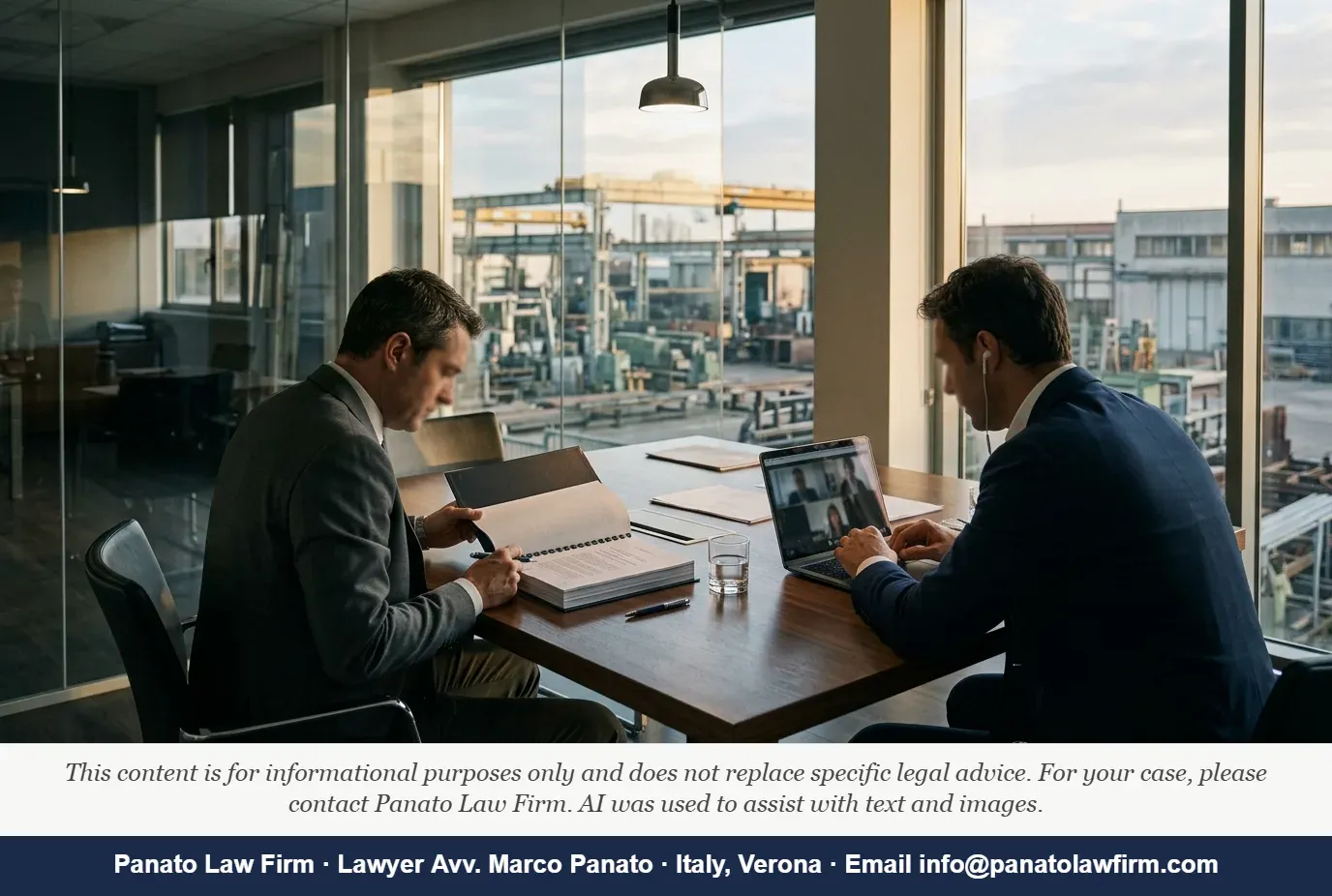
Image prompt: A glass-walled boardroom in a northern Italian industrial district, late afternoon light cutting across the table where two executives — one reviewing a bound due diligence report, one on a video call — discuss terms. Behind them, through the glass, a factory floor is visible but stilled, its machinery idle. The mood is focused and slightly tense. Muted palette: grey, warm ochre, steel blue. Photorealistic corporate photography style.
Image file: buying-business-unit-italy-employee-transfer-liability-cover
HREFLANG BLOCK:
JSON-LD:
LANGUAGE QA: the label on the transaction is irrelevant; the economic substance controls -> the label on the transaction is irrelevant; substance governs · a claims pipeline that closes with the deal -> a claims pipeline that transfers with the deal · the buyer steps into the seller's shoes on day one -> the buyer stands in the seller's shoes from completion · at the moment of closing -> at the date of completion · after five years of service is approximately EUR 100,000 — a figure that is arithmetically predictable -> after five years of service is approximately EUR 100,000 — a readily calculable figure · a notification box to be ticked -> a box-ticking formality · any measures envisaged -> any measures contemplated · well-resourced, and employee-friendly -> well-resourced and sympathetic to employees
Quality: Italian terms without a plain explanation: codice civile · keyword absent from subheadings · keyword not in the first 100 words
GATE: REVIEW — check RED; authorities dated in the future: 24/85; authorities dated in the future: 24/85; 3 quality issues
Source check: verdict RED — verify before publication
CHECK:
REFERENCE: Court of Cassation, Labour Division, in order no. 11806
1. EXISTS? not verified by the agent
2. CONTENT MATCHES? not verified
3. CONFIRMING SOURCE: —
REFERENCE: Article 2112
1. EXISTS? not verified by the agent
2. CONTENT MATCHES? not verified
3. CONFIRMING SOURCE: —
REFERENCE: Article 47
1. EXISTS? not verified by the agent
2. CONTENT MATCHES? not verified
3. CONFIRMING SOURCE: —
REFERENCE: C-24/85
1. EXISTS? not verified by the agent
2. CONTENT MATCHES? not verified
3. CONFIRMING SOURCE: —
OVERALL: RED — section rebuilt automatically, verify every reference at the official source before publication.
REINFORCED CHECK (second pass on the authorities):
I'll search for all four references simultaneously.Now I need to search specifically for Cassation order no. 11806 on labour/transfer of business to verify it exists and its content.No specific results for order no. 11806. Let me do one more targeted search.I now have sufficient information to deliver the verdict. The search found a Cassazione Sez. Lavoro **sentenza** n. 11806 of 7 September 2000, but its subject matter concerns mobility procedures and mansioni/downgrading (Art. 2103 c.c.), **not** the transfer of a business unit. The article's cited use describes it in the context of *cessione di ramo d'azienda* under Art. 2112, which is inconsistent with what n. 11806/2000 actually concerns. Furthermore, the article describes it as an "**order**" (*ordinanza*), whereas the found ruling is a **sentenza**. No *ordinanza* n. 11806 of the Labour Division on Art. 2112 was found. The reference as cited is therefore not verifiable and appears to be either wrong in number, wrong in year, or fabricated.
---
Court of Cassation, Labour Division, order no. 11806 | NO (not found as cited) | secondary only (simpliciter.ai — a Cassazione Sez. Lavoro *sentenza* n. 11806 of 7 Sept. 2000 exists but concerns Art. 2103 c.c. / mobility procedures, not Art. 2112 / business-unit transfer; no *ordinanza* n. 11806 on the cited topic was found) | NO — the ruling found under that number does not concern cessione di ramo d'azienda or automatic employee transfer
Article 2112 (Italian Civil Code) | YES | secondary only — text widely reproduced (brocardi.it, altalex.com, camera.it); authoritative primary source is normattiva.it (https://www.normattiva.it/uri-res/N2Ls?urn:nir:stato:regio.decreto:1942-03-16;262~art2112) but was not directly returned in results | YES — Art. 2112 governs automatic continuation of employment contracts upon business-unit transfer, exactly as described
Article 47 (Law 428/1990) | YES | secondary only — full text found on ance.it, consiglioregionale.calabria.it, doctrine.it; authoritative primary source is normattiva.it (https://www.normattiva.it/uri-res/N2Ls?urn:nir:stato:legge:1990-12-29;428~art47) but not directly returned | PARTIAL — Art. 47 governs the trade-union information/consultation procedure for transfers, not the automatic transfer of employees itself (which is Art. 2112); the article conflates or does not clearly distinguish the two provisions
C-24/85 | YES | PRIMARY SOURCE — EUR-Lex: https://eur-lex.europa.eu/legal-content/EN/TXT/?uri=CELEX%3A61985CJ0024 (also listed on curia.europa.eu) | YES — *Spijkers* established the "economic entity retaining its identity" test for transfers of undertakings, directly consistent with the article's use
---
**OVERALL: RED** — one reference (order no. 11806) is not found as cited and is content-inconsistent; Article 47 is content-partial; only C-24/85 has a confirmed primary source.
Do you need legal assistance or a free estimate?
- October 01, 2026
- Redazione
Author: Editorial Team — Panato Law Firm
Editorial Team — Panato Law Firm Staff