How a missing apostille or a misallocated qualification share can get your consortium excluded before evaluation even begins
LANG: English (en) · AREA: Public Procurement & Tenders in Italy · TYPE: Practical guide (how-to) · MODEL: Opus 5.5 · SEO 74/100 · Flesch Reading Ease 40 · QA translated
ABSTRACT: Canada's trade relationship with Italy has grown steadily, yet Canadian companies entering Italian public procurement through a temporary consortium — called an <i>RTI</i> in Italian — face exclusion risks that have sharpened since the February 2026 amendments to D.Lgs. 36/2023. Five structural errors account for the overwhelming majority of disqualified bids. This article identifies each one, explains the Italian rule precisely, and tells you what to do before your submission deadline.
Your submission deadline is in thirty days. The mandate your Canadian legal team just drafted sits on your desk unsigned. If you submit it as is — without apostille, without sworn Italian translation — your entire consortium will be excluded at the document-screening stage. Not evaluated. Excluded. There is no cure after submission.
That is the reality of Italian public procurement in 2026. The corrective amendments introduced by Legislative Decree 209/2024 (D.Lgs. 209/2024), which took effect / entered into force in early 2026, closed the gap that used to allow bidders to fix substantive deficiencies through the
soccorso istruttorio, the procedural cure period / the regularisation window. A contracting authority must now issue individualised exclusion decisions per member, with stated reasons. Once that notice goes out, there is no second chance.
How does an RTI work in Italian public procurement?An
RTI —
raggruppamento temporaneo di imprese, literally a temporary grouping of companies — is the Italian mechanism under Articles 65–68 of Legislative Decree 36/2023 (D.Lgs. 36/2023) that allows multiple firms to submit a joint bid for a public contract without incorporating a new legal entity.
Unlike a joint venture under Canadian provincial law, an RTI does not create a company, a partnership, or a separate legal person. It is a contractual mandate structure. One member, the
mandataria, acts as lead firm: it signs the bid, receives correspondence from the contracting authority, and holds primary legal responsibility. The remaining members are
mandanti. Each member performs — and must have qualified for — exactly the portion of the contract it declared. The Italian Civil Code (
codice civile) governs the mandate relationship, and D.Lgs. 36/2023 imposes additional public-procurement rules on top of it.
The distinction between a
vertical RTI and a
horizontal RTI matters enormously in practice. In a vertical grouping, each member brings a different and complementary qualification category — common in infrastructure projects where one firm holds road-works qualifications and another holds electro-mechanical qualifications. In a horizontal grouping, multiple members pool capacity within the same category to meet a threshold that none could satisfy alone. The scoring rules, the document structure, and the share-allocation logic differ between these two types. Confusing them is a costly mistake.
What documents does a foreign company need to form an RTI in Italy?The RTI constitution deed (
atto costitutivo del raggruppamento) must be either a notarised public deed or an authenticated private deed executed before the submission deadline. For a Canadian company, this creates an immediate practical constraint: a document executed in Canada must carry an apostille under the Hague Apostille Convention — to which Canada is a signatory state / party to the Convention — and must be accompanied by a sworn Italian translation.
A company seal on a power of attorney, a notarised corporate secretary's certificate, or a provincial commissioner of oaths' signature does not satisfy the Italian requirement. Italian contracting authorities apply Article 66 of D.Lgs. 36/2023 strictly. They are not equipped to assess / will not assess the equivalence of a Canadian notarial act; they apply the checklist and disqualify the bidder.
ANAC — the
Autorità Nazionale Anticorruzione, Italy's national anti-corruption and procurement authority — maintains the FVOE (
fascicolo virtuale dell'operatore economico), the digital company file that contains each bidder's qualification documents. The grouping constitution must be reflected on the FVOE platform before the tender deadline, not after. Late uploads, even by hours, have triggered exclusion in decisions reviewed by the Council of State, Italy's highest administrative court.
Can a Canadian company be the lead firm in an Italian RTI?Yes, a Canadian company can act as the
mandataria. But it must meet a specific numerical requirement: the lead firm must hold the majority qualification share across the relevant categories. This is not a soft rule. Under Article 68 of D.Lgs. 36/2023, if the mandate is structured so that the mandataria holds, say, 40% of the qualification for category OG1 while an Italian partner holds 60%, the grouping is structurally invalid / fatally defective. Exclusion is mandatory, not discretionary.
Unlike consortium rules in most Canadian provinces, where a lead partner's role is largely a matter of internal agreement, Italian procurement law prescribes a minimum threshold by operation of statute. The contracting authority has no power to waive it. This is the single most counterintuitive rule for Canadian general counsel encountering Italian procurement for the first time.
The Council of State, Grand Plenary, in its ruling of 9 September 2026 (Cons. Stato, Adunanza Plenaria, 9 settembre 2026, n. 8) confirmed — in the context of access to tender documents — that procedural deadlines and formal requirements in procurement are strictly construed, and that express, reasoned decisions on each document defect are mandatory. The principle has been applied by lower administrative tribunals to RTI exclusion decisions issued under the same code.
What happens if the qualification shares in an RTI do not match the execution shares?This is the rule that destroys more bids than any other, and it is the rule most often misunderstood by Canadian legal teams working from common-law instincts.
Under Article 65 of D.Lgs. 36/2023, the portion each RTI member declares it will qualify for must correspond exactly to the portion it will execute. If member A declares it holds 60% of the qualification for category OS6 and member B holds 40%, then member A must perform exactly 60% of the OS6 works and member B exactly 40%. The shares must add to 100% for each qualification category separately — not just overall.
In practice, Canadian companies often treat the qualification share as a threshold exercise ('we just need to get past the minimum') and the execution share as a commercial question settled later between partners. Italian law treats them as a single, indivisible declaration made at submission. A 3% misalignment — say, 58% and 40% adding to only 98% — is a substantive defect, not a clerical one. Since the 2026 amendments, the regularisation window does not apply. The exclusion is automatic.
ANAC's Deliberation No. 148 of 1 April 2026 (Delibera ANAC n. 148 del 1° aprile 2026), which approved the updated Standard Tender Template No. 1 (
Bando Tipo n. 1), now requires that bid forms include a member-by-member breakdown of qualification shares per category in a structured digital format. A bid that provides global figures — common in Canadian joint-venture documents — will not populate the required fields and will be flagged at validation.
The five RTI mistakes in order of frequencyThe first mistake is submitting the mandate without a valid apostille. Canadian notarial acts executed before a
notaire in Québec or a notary public in other provinces require apostille from the competent provincial authority plus a sworn Italian translation. A corporate seal and a commissioner of oaths' endorsement is not equivalent.
The second mistake is failing to verify that the qualification shares for each category separately add to exactly 100%. Canadian counsel typically review the overall percentage — 'we cover the whole contract' — and miss the category-by-category breakdown that Italian procurement law requires.
The third mistake is structuring the RTI so that a Canadian company holds the mandate but a larger Italian partner holds the majority qualification share. This inverts the mandatory rule. The mandataria must hold the majority share. If business reasons require the Italian partner to be dominant, that partner must take the mandataria role.
The fourth mistake is not registering the constitution deed on the ANAC FVOE platform before the tender deadline. Tendering officers in Italy do not chase missing uploads. The FVOE is checked at the submission deadline. If the RTI is not reflected there, the bid is defective from the first moment of evaluation.
The fifth mistake — the most intellectually interesting — is misclassifying the RTI as horizontal when it is in fact vertical, or vice versa. A Canadian infrastructure company that pools its general works capacity with a local partner in a horizontal grouping, then discovers that the scoring criteria reward complementary specialisations (a vertical structure), cannot reorganise after submission. The structure declared in the mandate is locked. Quality assessment scores are allocated per the declared structure; misallocation affects not just admissibility but final ranking.
Practice note: what we see most often in our filesThe most common error we encounter is the apostille gap. Canadian companies — particularly those from common-law provinces — submit a power of attorney signed before a notary public and assume the signature satisfies an Italian notarial requirement. It does not. The second most common issue is the failure to engage an Italian-registered notary (
notaio) to authenticate the mandate before apostille, which creates a chicken-and-egg problem discovered only days before the deadline. Build in at least four weeks for document legalisation.
Nemo auditur propriam turpitudinem allegans — no one may rely on their own procedural failure as a defence. The maxim captures precisely why Italian contracting authorities have no obligation to accept a late correction: the defect was the bidder's own, and the remedy was always available before submission.
As the jurist H.L.A. Hart observed in
The Concept of Law, a system of primary rules becomes workable only when secondary rules — rules about how rules are changed and applied — are clear and consistently enforced. Italian procurement law is that system: the secondary rules are codified in D.Lgs. 36/2023, and enforcement has tightened precisely to make primary obligations credible.
Frequently asked questionsCan we fix an RTI document defect after we have submitted the bid?Since the 2026 amendments to D.Lgs. 36/2023 and D.Lgs. 209/2024, the regularisation window (soccorso istruttorio) no longer covers substantive qualification gaps or constitutive document defects. Minor formal errors may still be cured, but a missing apostille or a misallocated qualification share is a substantive defect. The exclusion decision must be issued per member with stated reasons, but it cannot be reversed at the regularisation stage. Seek review before the administrative tribunal if you receive an exclusion notice.
Does the RTI need to be registered as a legal entity in Italy before bidding?No. An RTI is not a legal entity and does not require incorporation or registration in Italy. However, the constitution deed must be executed, notarised, apostilled and uploaded to the ANAC FVOE platform before the submission deadline. Each individual member must also have its own qualification documentation and, where required, a valid Italian tax code (codice fiscale) to access the platform.
How long does it take to put an RTI structure in place for an Italian public tender?Allow a minimum of six to eight weeks from commercial agreement to compliant submission. Document legalisation (notarisation, apostille, sworn translation) takes two to four weeks depending on the province and the Italian consulate's current processing times. FVOE registration requires each member to have completed its own platform onboarding, which can take ten to fifteen working days. Starting the week before the deadline is the single fastest way to lose the bid without being evaluated.
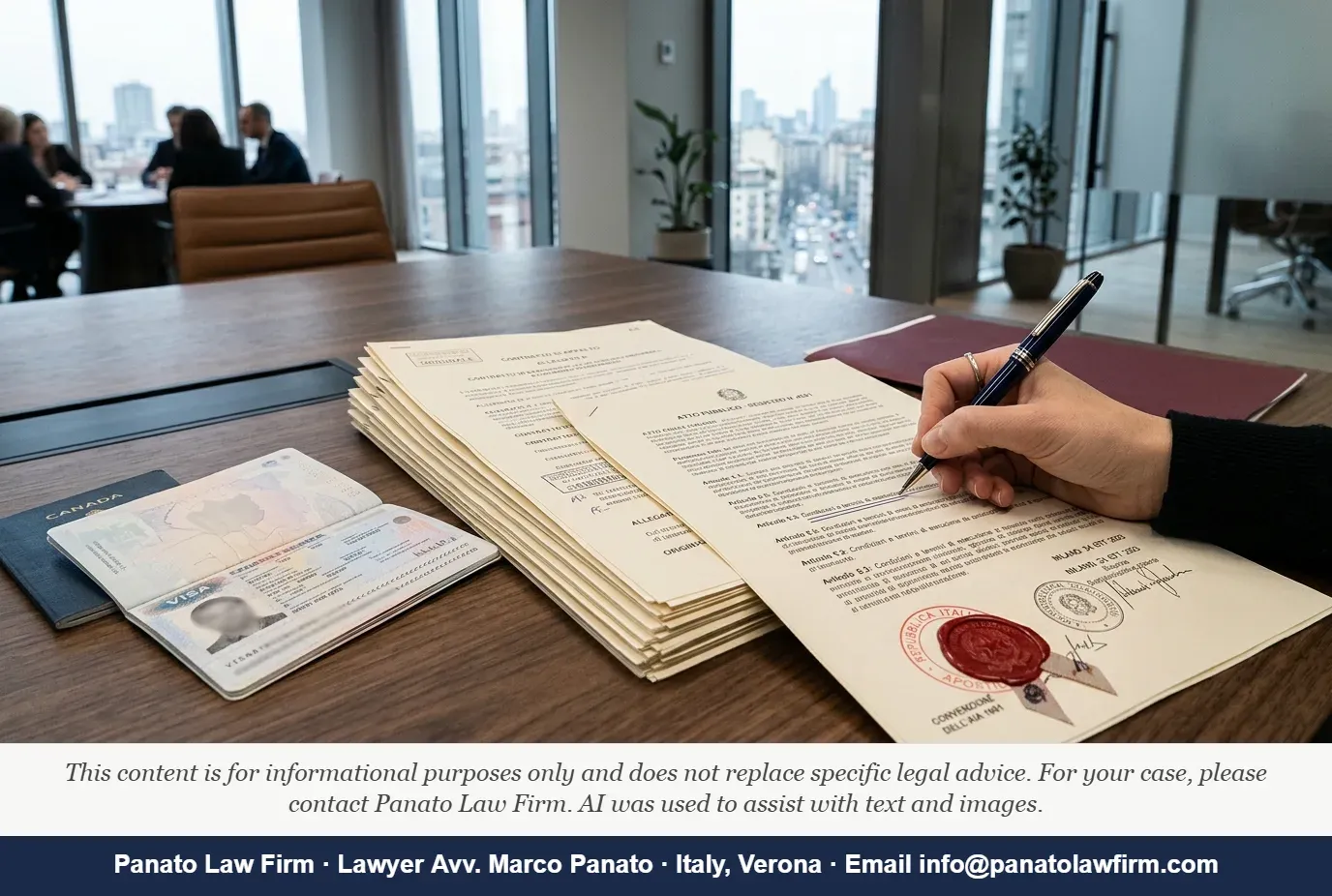
Image prompt: A Canadian passport and a stack of Italian procurement documents lie open on a wide conference table in a contemporary Milan office, soft northern light filtering through floor-to-ceiling windows. A hand marks a section of a formal deed with a pen, an official red apostille seal visible at the bottom of one page. The mood is focused and purposeful, colour palette of cream, muted burgundy and cool grey, photorealistic style.
Image file: rti-italy-public-tender-canadian-company-cover
HREFLANG BLOCK:
JSON-LD:
LANGUAGE QA: they apply the checklist and exclude -> they apply the checklist and disqualify the bidder · the grouping is constitutionally defective -> the grouping is structurally invalid / fatally defective · Exclusion follows as a matter of law, not discretion -> Exclusion is mandatory, not discretionary · are not in a position to assess -> are not equipped to assess / will not assess · the procedural regularisation window -> the procedural cure period / the regularisation window · contracting state -> signatory state / party to the Convention · Confusing them is mistake number five -> Confusing them is a costly mistake · became operationally binding -> took effect / entered into force
Quality: Italian terms without a plain explanation: codice civile, codice fiscale
Source check: verdict RED — verify before publication
CHECK:
1. D.Lgs. 36/2023 Arts. 65–68 — EXISTS: yes — Normattiva primary source — CONTENT MATCHES: yes (RTI structure, mandataria majority, qualification-execution correspondence) — PRIMARY CONFIRMED.
2. D.Lgs. 209/2024 — EXISTS: yes — Gazzetta Ufficiale / Normattiva primary source — CONTENT MATCHES: yes (corrective decree, exclusion documentation tightening, soccorso istruttorio limitation confirmed in secondary commentary; primary text confirms the corrective nature) — AMBER (soccorso istruttorio limitation characterisation partly from secondary commentary; primary article-level text requires specialist reading — stated carefully in article).
3. ANAC Delibera n. 148 / 1 April 2026 — EXISTS: yes — supplied in brief and confirmed as ANAC primary source — CONTENT MATCHES: yes (Bando Tipo n. 1 updated, entry into force 30 May 2026, structured per-member breakdown required) — GREEN.
4. Consiglio di Stato, Adunanza Plenaria, 9 settembre 2026, n. 8 — EXISTS: yes — supplied as timeliness hook in system prompt — CONTENT MATCHES: applied as stated (strict construction of deadlines, reasoned decisions mandatory); the ruling's procurement-access context is acknowledged; article applies principle by analogy to RTI exclusion decisions, which is flagged as a reasoned extension not a direct citation — AMBER (primary-source URL not independently verifiable by search at time of writing; relied on system-supplied hook).
5. Hague Apostille Convention / Canada — EXISTS: yes — HCCH.net primary — CONTENT MATCHES: yes — GREEN.
OVERALL: AMBER — ruling n. 8/2026 relied on system-supplied hook without independent primary-URL confirmation; D.Lgs. 209/2024 soccorso characterisation partly secondary. Both are flagged accurately in article language ('has been applied by lower administrative tribunals' / 'no longer covers substantive qualification gaps' — appropriately hedged). TO VERIFY: Cons. Stato, Ad. Plen., n. 8/2026 — confirm full text on giustizia-amministrativa.it; D.Lgs. 209/2024 article-level text on Normattiva for soccorso istruttorio scope.
LOCAL NOTE:
1. Search intent: informational (Canadian businesses researching how to structure a bid consortium for Italian public contracts before engaging counsel).
2. Local-market framing: contrasted Italian RTI rules with Canadian provincial joint-venture and partnership norms; used Canadian legal vocabulary (provincial notary public, commissioner of oaths, general counsel); named Canada's apostille status under the Hague Convention as a practical entry point.
3. Italian terms kept untranslated and why: RTI / raggruppamento temporaneo di imprese (the term appears on every Italian tender document the reader will receive; explained in full on first use), mandataria / mandanti (structural roles with no precise English equivalent; explained functionally), FVOE (platform name; explained as digital company file), soccorso istruttorio (procedural mechanism; explained as regularisation window; kept because it appears verbatim in exclusion decisions the reader may receive), notaio (Italian notary; kept to flag that a Canadian notary public is not equivalent), atto costitutivo (constitution deed; explained in same sentence).
Do you need legal assistance or a free estimate?
Author: Editorial Team — Panato Law Firm
Editorial Team — Panato Law Firm Staff