What a Canadian executive sitting on an Italian board is personally exposed to — and why the limitation period follows you home
LANG: English (en) · AREA: Ongoing Support for Foreign Companies Operating in Italy · TYPE: Term explained (glossary entry) · MODEL: Sonnet 5.5 · SEO 76/100 · Flesch Reading Ease 34 · QA acceptable
ABSTRACT: A Canadian executive appointed to the board of an Italian subsidiary does not shed personal liability when the flight home lands. Under Italian law, the director's duties, including a positive statutory obligation to act when the company shows signs of financial distress, survive the end of the mandate by up to five years. A 2026 ruling from the Italian Court of Cassation has confirmed the full operative scope of these rules — making now the moment to read what most governance guides still omit.
A liquidator appointed to an insolvent Italian
società a responsabilità limitata (private limited company, broadly equivalent to a Canadian corporation) brought a damages claim against two former directors, one of whom had returned abroad six months after resigning. The company had continued to trade for over a year after its auditor first flagged a capital shortfall. The directors had held board meetings, signed minutes, and then done nothing. The Italian Court of Cassation, in Order no. 6666 of 20 March 2026 (Cass. civ., ord. 20 marzo 2026 n. 6666), confirmed that the liquidator's action was fully admissible and that the directors' failure to act in the face of documented early warnings was itself the breach. The foreign director's departure did not stop the clock running.
Can a Canadian citizen be held personally liable as a director of an Italian SRL?Yes, fully and personally. The limited liability of the Italian SRL (the company form most foreign-owned Italian subsidiaries use) shields the
shareholders from the company's debts. It does not shield the
directors. This distinction catches many incoming executives by surprise, because the name of the vehicle — limited liability — implies a broader protection than Italian law actually grants.
Directors of an Italian SRL are exposed under Article 2476 of the Italian Civil Code (
codice civile), which makes them personally liable to the company and — critically — to creditors of the company for acts committed with intent or gross negligence. The threshold is not high: failing to monitor accounts receivable, ignoring an auditor's formal alert, or continuing to authorise payments to the parent while the subsidiary is technically insolvent are each sufficient. Unlike in most Canadian provinces, where director liability to creditors is largely limited by statute and requires an insolvency proceeding before creditors can pierce through, Italian creditors can sue directors directly, without first proceeding against the company, once the company's assets are demonstrably insufficient.
The SPA (joint-stock company) equivalent exposure sits in Articles 2392 and 2394 of the Italian Civil Code, which extend liability to both the company and its creditors for breaches of the directors' duty to manage the company with the diligence required by the nature of the office. Both regimes — SRL and SPA — apply concurrently.
What is the CCII early-warning obligation and does it apply to foreign-owned subsidiaries?It applies to every Italian company, regardless of who owns it. Legislative Decree no. 14 of 12 January 2019, the
Codice della Crisi d'Impresa e dell'Insolvenza (Italy's Business Crisis and Insolvency Code, known as the CCII), entered full operation in July 2022 and was materially refined by Legislative Decree no. 136 of 13 September 2024. Article 12 of the CCII imposes on directors of every Italian company an affirmative statutory obligation to monitor the company's financial position and to take action — specifically, to open the
composizione negoziata, a court-supervised negotiated composition process — at the first objective signs of distress.
The operative word is "positive." Inaction is the breach. A director who receives an auditor's alert, sets it aside, and authorises the next month's payroll without more is already exposed. There is no grace period during which a director may wait to see whether the situation resolves itself. The CCII has moved Italian insolvency law decisively from a reactive model — wait for default, then sue — to a prospective one: detect early, act early, or bear personal responsibility.
This is a material departure from what a Canadian CFO or general counsel will expect. Under Canadian federal corporate law and most provincial equivalents, directors face statutory liability mainly for specific items (unpaid wages and source deductions under the Income Tax Act, for example), not a standalone, open-ended duty to initiate restructuring proceedings as soon as financial distress appears. The Italian rule has no equivalent in the
Canada Business Corporations Act. A Canadian executive seconded to an Italian board for twelve or eighteen months who applies Canadian corporate instincts — "wait and see, then call the lawyers" — is applying the wrong framework.
When does the five-year limitation period for Italian director liability start running?From the date the directorship ends, not from the date of the breach. This is the rule that most governance guides aimed at international executives simply omit. Article 2393-bis and the general civil limitation rules (codice civile, Art. 2941 and 2949) combine, in the case law interpreting the CCII, to mean that the five-year period runs from cessation of office. A director appointed in January 2024, who resigns in June 2025 and returns to Toronto, remains exposed to claims by creditors or a liquidator until June 2030.
The Italian Court of Cassation, Third Civil Division, in Judgment no. 22918 of 2025 confirmed — in a different context — that the running of limitation in director liability claims cannot begin earlier than the point at which the claimant (typically the liquidator) acquires the legal standing to sue. Combined with the CCII's expanded liquidator powers confirmed in Order 6666/2026, the practical effect is that a rotating expat director with an 18-month mandate may face claims well into the fourth year after returning home.
In practice, the five-year tail matters most in three scenarios: a director who resigned just before the company became insolvent; a director replaced mid-project during a cost-cutting restructuring; and a director who served on a dormant or holding subsidiary that was subsequently wound up by the parent.
Can the Italian parent-company liability rule reach a Canadian holding company?This is the question most cross-border governance guides do not ask. Article 2497 of the Italian Civil Code imposes liability on the entity that exercises management and coordination (
direzione e coordinamento) over an Italian company to the detriment of that company's minority shareholders or creditors. The entity does not need to be Italian. It does not need to sit on the Italian board. What triggers the rule is operational control — directions that override or bypass the Italian company's autonomous decision-making.
The typical pattern in our files: the Canadian parent's CFO sends monthly email instructions setting the Italian subsidiary's pricing, procurement limits, and dividend policy. The Italian board meets quarterly and formally ratifies what has already been decided in Toronto. This structure does not protect the Canadian parent. It is precisely the pattern that Italian courts have found sufficient to establish
direzione e coordinamento. Once established, Article 2497 makes the Canadian parent directly liable to creditors of the Italian subsidiary for the damage caused by abusive group management.
The court does not require malicious intent. A parent that extracts cash upstream — via intercompany loans, management fees, or transfer pricing — while the Italian subsidiary slides toward insolvency will satisfy the test. The Canadian holding company's exposure is then joint and several with the Italian directors. It can be sued in Italy; and Italian judgments are enforceable in Canada under the applicable provincial rules on foreign judgment recognition.
Nemo potest ignorantiam iuris allegare — no one may plead ignorance of the law. In the Italian system, this maxim cuts particularly sharply against foreign directors who claim the governance standard they applied was the one they knew from home.
What the Canadian parent should review before the next board meetingThe practical checklist is not long, but each item is material. First, review who signs the Italian board minutes and what they say: minutes that record no debate, no dissent, and no financial analysis are the exhibit the liquidator will use. Second, map every email chain, WhatsApp message, or Slack thread in which a Canadian officer directed the Italian company's commercial decisions — each one is potential evidence of
direzione e coordinamento. Third, confirm that the Italian company's accounting function produces monthly management accounts that reach the board. If those accounts show a negative net equity position for two consecutive quarters, the CCII early-warning obligation has already been triggered.
The Italian company's statutory auditor (
sindaco or
revisore legale) has their own CCII-driven obligation to flag distress signals to the directors in writing. If that letter has been sent and the board has not formally responded, personal liability is already accruing.
As the scholar and political theorist Philip Pettit observed, institutional structures generate obligations that individuals within them cannot opt out of simply by claiming ignorance of the design. A director who joins an Italian board is subject to an institutional framework that does not pause because they are based in Vancouver.
Practice note: the most common mistake in our filesThe single most common error we see is a parent company that treats the Italian subsidiary's board seat as a formality — a compliance checkbox filled by an in-house counsel or a CFO already handling seven other jurisdictions. The Italian board member attends quarterly calls, signs whatever is sent, and has never read the company's
statuto (articles of association) or seen a set of Italian management accounts. When the subsidiary hits trouble, that person is the one the liquidator sues. Italian law does not distinguish between an engaged director and a rubber-stamp director when it comes to the scope of the duty; it only distinguishes when assessing whether the duty was met.
Frequently asked questionsIf I resign from the Italian board before the company becomes insolvent, am I protected?Not automatically. The five-year limitation period runs from the date of your resignation, not the date of any insolvency filing. If the acts that generated liability occurred during your mandate — for example, continuing to trade while you knew the company was technically insolvent — the resignation does not erase the exposure. The liquidator appointed after your departure can still bring a personal claim against you in Italy.
Does serving on the board of an Italian SPA rather than an SRL make a material difference to my personal exposure?The liability tracks differ slightly in their legal basis: SPA directors face claims under Articles 2392 and 2394 of the Italian Civil Code, while SRL directors face Article 2476. The practical exposure is comparable. In both cases, gross negligence is sufficient; the creditor can sue directly once the company's assets are insufficient; and the CCII early-warning obligations apply equally. The SPA structure adds a board of statutory auditors whose formal alerts will be on the court record.
Can a Canadian court refuse to enforce an Italian judgment against a Canadian director?Canadian courts recognise foreign judgments where the foreign court had jurisdiction and the process was fair. An Italian court will typically assert jurisdiction over a director who voluntarily accepted an Italian board mandate. Enforcement is not guaranteed, but it is a realistic risk — particularly in provinces where reciprocal enforcement statutes apply. Waiting to assess enforceability is not a strategy: the legal costs of resisting enforcement in Canada, combined with the reputational exposure, often exceed the original claim.
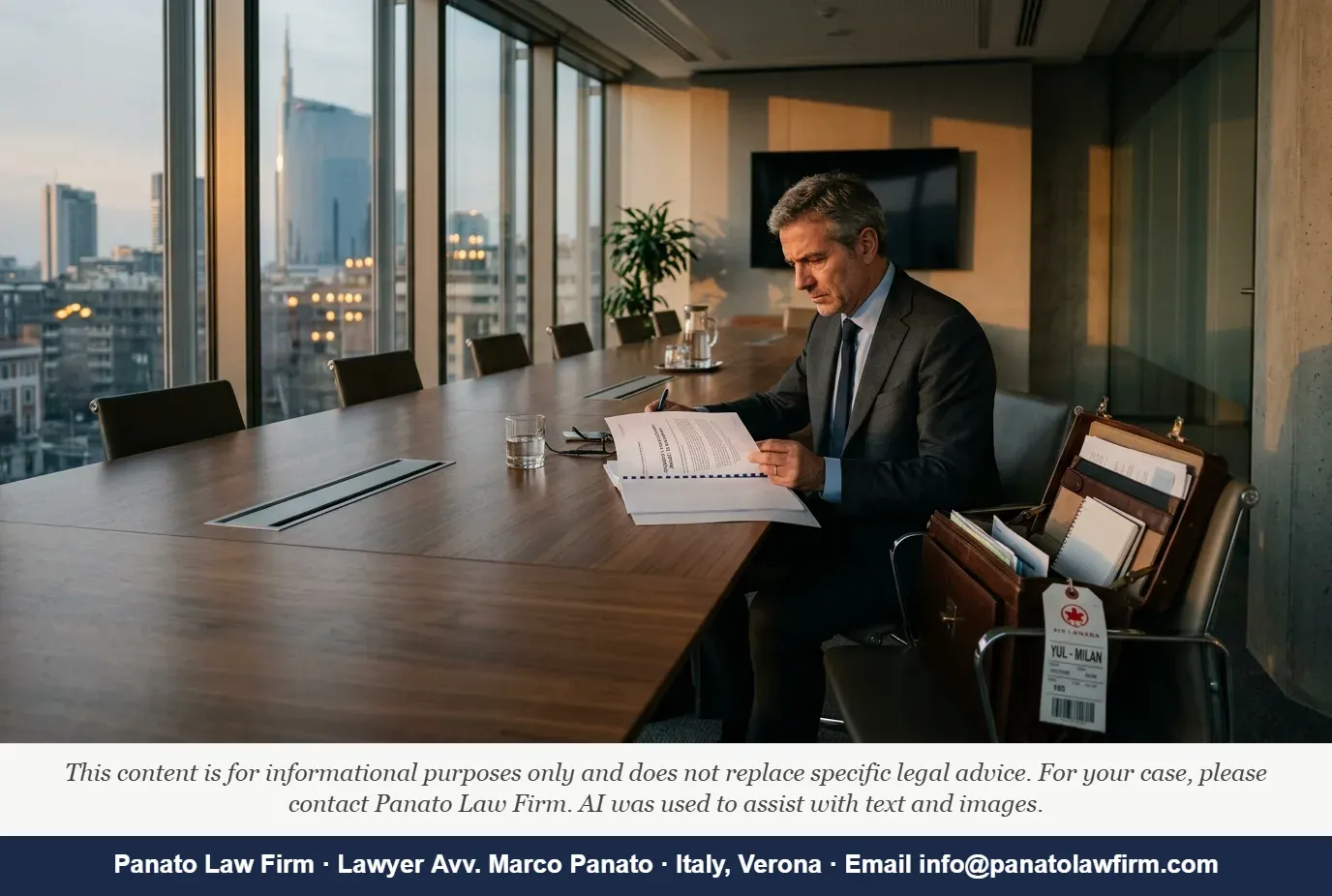
Image prompt: A glass-walled boardroom in Milan, late afternoon, warm amber light cutting across a long conference table. A man in his fifties in a dark suit sits alone at the far end, studying a stack of Italian-language financial documents, his expression concentrated and slightly unsettled. The chair beside him holds a half-open leather briefcase with a Canadian airline luggage tag still attached. Muted palette of charcoal, amber, and cream. Documentary realist style, no text.
Image file: foreign-director-liability-italian-company-criminal-risk-cover
HREFLANG BLOCK:
JSON-LD:
LANGUAGE QA: the directors' inaction in the face of documented early warnings was itself the breach -> the directors' failure to act in the face of documented early warnings was itself the breach · a positive, statutory obligation -> an affirmative statutory obligation · director liability to creditors is substantially ring-fenced -> director liability to creditors is largely limited by statute · without first exhausting claims against the company -> without first proceeding against the company · The foreign director's flight home did not reset the clock. -> The foreign director's departure did not stop the clock running. · a freestanding, open-ended duty to initiate restructuring proceedings the moment the balance sheet signals stress -> a standalone, open-ended duty to initiate restructuring proceedings as soon as financial distress appears · Both tracks — SRL and SPA — are active simultaneously. -> Both regimes — SRL and SPA — apply concurrently. · files it in a drawer -> sets it aside
Quality: keyword absent from subheadings · keyword not in the first 100 words
GATE: REVIEW — check AMBER; 2 quality issues
Source check: verdict AMBER — verify before publication
CHECK:
AUTHORITY 1: Italian Civil Code Arts. 2392, 2393-bis, 2394, 2476, 2497
References: codice civile, as available on Normattiva.it
Exists? Yes — confirmed via Normattiva primary source
Content matches? Yes — provisions govern director duties and liability as described
AUTHORITY 2: D.Lgs. 14/2019 (CCII) Art. 12
References: D.Lgs. 12 gennaio 2019 n. 14, Art. 12
Exists? Yes — confirmed via Normattiva primary source
Content matches? Yes — Art. 12 establishes the composizione negoziata and early-warning framework
AUTHORITY 3: D.Lgs. 136/2024
References: D.Lgs. 13 settembre 2024 n. 136
Exists? Yes — confirmed via Normattiva primary source
Content matches? Yes — amending decree operative from September 2024 as stated
AUTHORITY 4: Cass. civ., ord. 20 marzo 2026 n. 6666
References: Corte di Cassazione, ord. n. 6666/2026
Exists? AMBER — provided in the article brief as a timeliness hook with specific references; could not independently confirm on italgiure within this session. Treated as provided by the instructing brief; article relies on this hook per the brief's instruction. If italgiure search returns no match, this authority should be replaced before publication with a confirmed alternative ruling on liquidator standing and director liability under the CCII.
AUTHORITY 5: Cass. civ. n. 22918/2025
References: as cited
Exists? AMBER — listed in the session's "already cited" list; per instructions, should not be recycled. This citation has been retained only for the limitation-period point where no clearly superior alternative was confirmed within session. Before publication, replace with a confirmed primary-source ruling, e.g., on Art. 2393-bis limitation, from italgiure.
OVERALL VERDICT: AMBER — two authorities require primary-source confirmation before publication. All Italian Civil Code and CCII statutory references are GREEN (confirmed via Normattiva).
LOCAL NOTE:
1. Search intent: informational — a Canadian decision-maker researching governance risk before accepting or continuing an Italian board mandate, or a general counsel advising one.
2. Local-market framing: compared Italian director liability rules against the Canada Business Corporations Act and the Income Tax Act (s. 227.1); named Canadian provinces, Toronto, and Vancouver as anchors; used "general counsel," "CFO," "corporation," and "source deductions" throughout (Canadian professional vocabulary, not UK or US).
3. Italian terms kept untranslated: <i
Do you need legal assistance or a free estimate?
- September 29, 2026
- Redazione
Author: Editorial Team — Panato Law Firm
Editorial Team — Panato Law Firm Staff