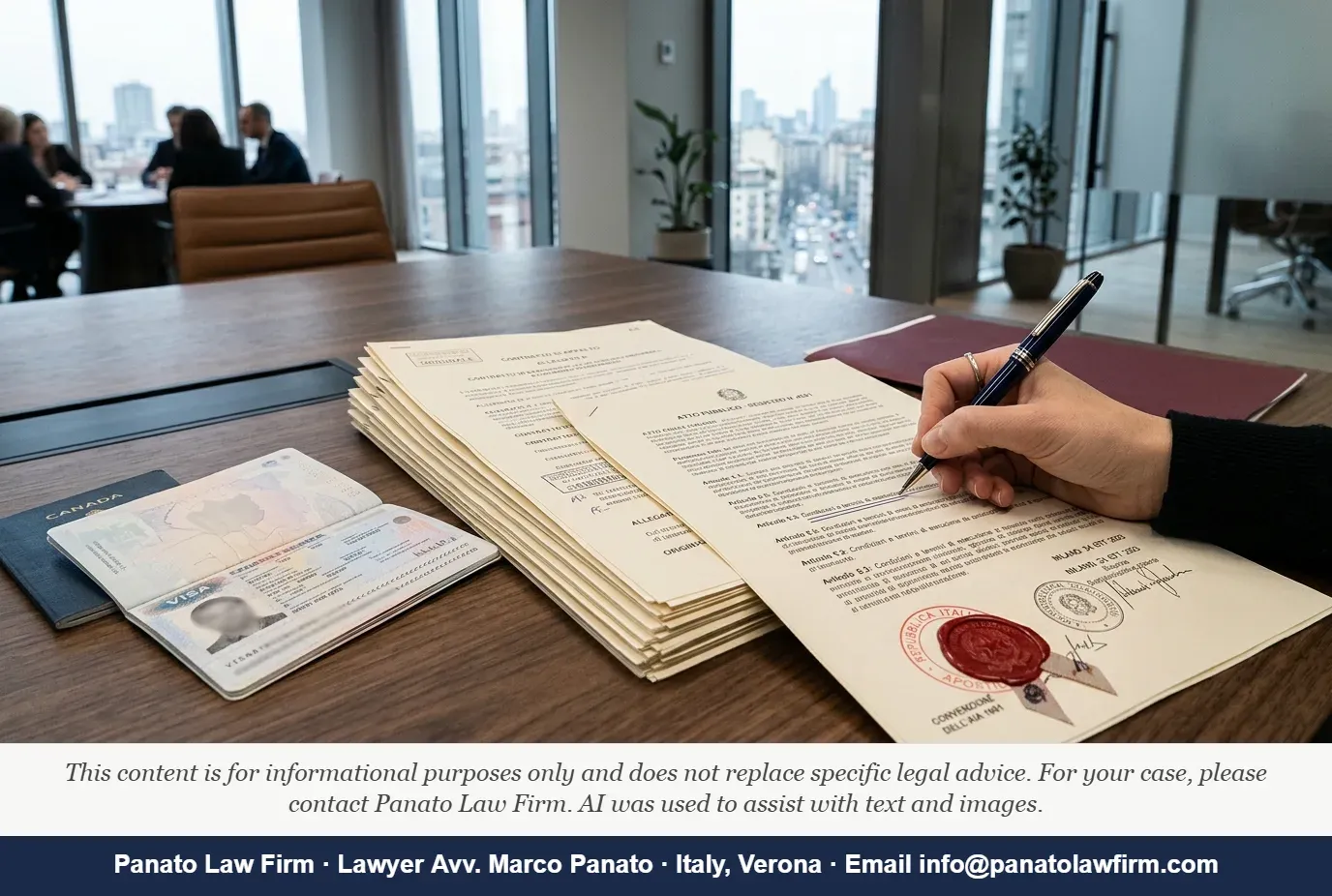
META: Italian property EPC rating F or G? Understand the resale problem, mortgage risks, and EU Green Homes Directive impact before you buy in 2026.
SLUG: italian-property-epc-rating-f-g-resale-problem-2026 URL: https://panatolawfirm.com/en/italian-property-epc-rating-f-g-resale-problem-2026
ABSTRACT: Canadian buyers completing Italian purchases in 2026 who ignore the energy performance certificate face a compounding problem: an F or G rating already triggers a measurable price discount, increasingly restricts mortgage financing, and ties the owner to a mandatory upgrade timetable that arrives faster than most renovation budgets allow. This article explains what the Italian APE certificate is, how EU Directive 2024/1275 reshapes the risk, and what steps a buyer should take before signing a preliminary sale contract.
You searched: does an F or G energy rating kill my Italian property deal? The short answer is no — not yet. But the gap between "not yet" and "by 2030" is closing fast, and Canadian buyers who close on a low-rated Italian property in 2026 without a clear renovation plan are acquiring a liability that will compound on their balance sheet every year until they act.
What is an APE certificate and do I need one when buying property in Italy?
Every property sold or let in Italy must carry an attestato di prestazione energetica — in English, an energy performance certificate, universally known by its Italian acronym APE. The APE rates the building on a scale from A4 (most efficient) to G (worst). It must be attached to any sale or long-term rental agreement; without it, the contract is void / the contract is fatally defective and both parties face fines.
The APE regime is governed by Presidential Decree 75/2013 and Ministerial Decree of 26 June 2015 (D.M. 26 giugno 2015). An APE is valid for ten years — but that clock resets if the property undergoes a significant renovation or change of use. This is where Canadian buyers stumble. In Canada, a home energy audit is advisory, rarely mandatory, and almost never a condition of transfer. In Italy, the APE is a legal document embedded in the conveyancing chain. If the vendor presents an APE that is more than ten years old at the date of signing the notarial deed of sale (rogito notarile), the energy disclosure in the deed has no legal effect. The buyer inherits a property with no valid energy certification — and the cost of commissioning a fresh one, along with any surprise the new rating might deliver, falls entirely on the new owner.
A subtlety that almost no English-language content flags: Italy's APE is issued regionally. An APE from Lazio and an APE from Sicily are produced using different regional software platforms and different weighting algorithms for the same physical parameters. If you are building a portfolio across two or more Italian regions, you cannot compare the ratings directly. A C in Lombardy is not the same thermal performance as a C in Calabria. A lawyer and a qualified geometra (the Italian surveyor-equivalent) need to review each certificate in context, not as a uniform national benchmark.
Can I still buy a property with an F or G energy rating in Italy?
Yes. Italy has not introduced mandatory pre-sale renovation. There is no law that prevents you from buying a G-rated farmhouse or an F-rated city apartment right now. What has changed — and changed materially in 2026 — is the financial environment around that purchase.
EU Directive 2024/1275 (the Energy Performance of Buildings Directive recast, in force 28 May 2024) set a transposition deadline of 29 May 2026. Under the Directive, member states must ensure that the worst-performing 15% of their residential stock reaches at least energy class E by 2030, and at least class D by 2033. Italy's residential stock is heavily weighted towards older buildings: roughly 60% of the housing stock predates 1976. A significant share of those properties sit in class F or G. Full national implementing legislation was still pending at the time of writing, but the trajectory is set in primary EU law and is not reversible by any Italian government of whatever political stripe.
The practical consequence is a "brown discount" that is already visible in transaction data. Properties rated F or G are trading at discounts of between 15% and 30% compared with equivalent D-or-better properties in the same comune, based on analysis from / cited by Italian mortgage lenders and estate agents in 2026. That discount is not speculative. It reflects the cost a rational buyer builds in to upgrade the property up to class E before the 2030 deadline — and that cost can easily run to €30,000–€80,000 for a medium-sized property requiring insulation, new windows, and a heat-pump installation, depending on region and construction type.
How does the EU Green Homes Directive affect Italian property values?
Res perit domino — the loss falls on the owner. That Latin principle of Roman property law captures the EPBD risk precisely. If you own an F-rated property in 2026, the cost of the EU's decarbonisation timetable is already yours to bear, even though no enforcement notice has arrived.
Mortgage lenders are moving before the law. Agenzia delle Entrate data from 2026 show Italian lenders applying stricter loan-to-value caps on sub-D properties. Some lenders are limiting LTV to 60–65% on F and G properties, against 75–80% on C-or-better stock. For a Canadian buyer financing through an Italian bank — which remains common for non-resident purchasers acquiring property above €250,000 — that gap means a meaningfully larger cash deposit. It also means that the Italian bank's valuation will factor in the estimated remediation cost, reducing the headline price on which the LTV is calculated in the first place.
The picture is not uniformly bleak. The Ecobonus (energy renovation incentive) remains available in 2026 at 36% for second homes owned by individuals, before dropping to 30% in 2027. For a renovation costing €60,000, that is a €21,600 tax deduction spread over ten years — roughly €2,160 per year off your Italian income tax. That relief is real, but it requires Italian taxable income against which to use it. A Canadian non-resident with no Italian income gains almost nothing from the Ecobonus unless they restructure their holding.
This is where the ownership structure matters enormously. A G-rated property held through an Italian società a responsabilità limitata (SRL) — the Italian private company broadly equivalent to a Canadian corporation — cannot access the 36% Bonus Ristrutturazione on the same terms as an individual owner. The deduction must be carried forward against the SRL's corporate tax (IRES), not a personal income tax return. For an SRL with modest Italian profits, the effective value of the deduction is deferred and potentially lost. Canadian investors who set up an SRL thinking it offered structural clarity need to revisit whether it serves them for an energy-intensive renovation strategy.
The APE trap that competitor blogs do not explain
Unlike in most common-law jurisdictions, including Canada's provinces, Italian property law places the energy disclosure obligation squarely on the vendor — but the consequences of a defective disclosure fall on both parties and, more heavily in practice, on the buyer who cannot undo the rogito notarile after it is signed before a notary.
Three specific traps appear repeatedly in practice.
First, the ten-year APE clock. Verify the date on the APE before you sign the preliminary sale contract (compromesso). If the APE was issued nine years and eleven months ago and the property has had a loft conversion since, it may already be invalid. Commission a fresh one as a condition of the preliminary contract.
Second, regional software divergence. When comparing two Italian properties across different regions, ask the geometra to produce an annotation explaining which regional platform was used and how its output compares to the national scale. This is especially relevant for investors building a portfolio in more than one Italian region.
Third, the renovation passport (passaporto di ristrutturazione), which EU Directive 2024/1275 requires member states to introduce by May 2026 for major renovation projects. This instrument maps a step-by-step upgrade route for the building. For a buyer intending a full renovation of an F or G property, requiring the vendor to supply a draft renovation passport — or commissioning one as part of pre-contract due diligence — is now sound practice, not a luxury.
Practice note: what we see on files
In our files, the most consistent error is reliance on an APE that was valid when the vendor first listed the property but has expired or become defective by the time the preliminary sale contract is signed — sometimes because minor works were carried out during a prolonged sales process. We also see Canadian buyers accepting the vendor's stated energy class at face value without verifying which regional platform issued the certificate. A G rating from a less stringent regional system may conceal worse performance than the letter suggests once a proper national-benchmark assessment is carried out.
Does Italy require energy upgrades before selling a house?
No — not in 2026. Mandatory pre-sale renovation is not part of Italian law, and Directive 2024/1275 does not impose it directly on individual transactions. What the Directive does impose is a national renovation trajectory, and Italy's compliance plan requires the country's worst-performing stock to improve on a population basis, not a transaction-by-transaction basis.
The Canadian property law instinct here is misleading. In some Canadian provinces, certain building defects trigger mandatory remediation before transfer. Italy works differently: the risk of owning a non-compliant building migrates with the title, and the pressure to act comes not from a pre-sale enforcement notice but from the market — through the brown discount, restricted LTV ratios, and ultimately the reputational and fiscal consequences of failing to comply with whatever implementing measures Italy adopts between now and 2030.
Raymond Aron wrote that the gap between a legal right and its practical exercise is where politics lives. The EPBD gap — between the right to buy and sell F and G properties freely today, and the 2030 trajectory that makes those assets financially toxic — is exactly that kind of political and economic space. Acting inside it intelligently, rather than waiting for legislation to close it, is the difference between a property investment and a stranded asset.
Frequently asked questions
If I buy an F-rated property in Italy now, will I be forced to renovate it by 2030?
Italy has not enacted mandatory pre-sale renovation legislation as of mid-2026, and Directive 2024/1275 does not impose it on individual owners directly. However, by 2030 the 15% worst-performing residential stock must collectively reach energy class E under Italy's national plan. Market pressure — through lower valuations, restricted mortgage LTV, and resale discounts — is already functioning as a practical compulsion even before any enforcement mechanism arrives.
What happens if no valid APE is attached to my Italian purchase contract?
Under Italian law, a sale without a valid energy performance certificate (APE) attached to the notarial deed of sale carries a statutory defect. Both vendor and buyer can face administrative fines ranging from €3,000 to €18,000 depending on the property size and regional rules. The buyer also inherits a property with no valid energy classification, meaning any subsequent sale or long-term rental will require a new APE to be commissioned at the buyer's expense.
Can a Canadian non-resident actually use the Italian Ecobonus deduction on a renovation?
The 36% Ecobonus (2026 rate) is a deduction against Italian income tax (IRPEF). A Canadian non-resident who owns Italian property personally but has no Italian-source income will have no tax base against which to use it. The deduction cannot be transferred to a Canadian return. Options include generating Italian rental income, restructuring ownership, or timing the renovation to a year in which Italian income exists. A lawyer and a commercialista (Italian tax adviser) need to model this before committing to a renovation budget.
KEYWORDS: Italian property EPC rating F G resale problem 2026, APE certificate Italy foreign buyer, energy performance certificate Italy sale conveyancing, EPBD Italy Green Homes Directive property value, Italy low energy rating property discount, Italian property brown discount 2026, APE attestato prestazione energetica Italy buying, Italy renovation targets 2030 foreign owner, Italian mortgage F rated property LTV, energy class G property Italy resale value, Italian property energy certificate conveyancing, ecobonus Italy non resident Canadian buyer, Italian property due diligence energy rating, APE certificate validity Italy 10 years, Italian property energy upgrade cost 2026, EU Green Homes Directive Italy residential property, Italy EPBD transposition 2026 property investor, buying old property Italy energy class, F rated Italian property mortgage restriction, Italian property renovation passport 2026, Canada Italy property investment energy risk, Italian SRL property ecobonus deduction, APE Italy regional differences portfolio, G rated property Italy forced upgrade, Italy energy renovation bonus second home, Italian property value energy class discount, APE expired at closing Italy risk, Italy worst performing housing stock 2030, Italian property lender LTV energy rating, energy performance buildings directive Italy residential, APE certificate what it means Italy buyer, Italian property conveyancing energy disclosure, Italy mandatory renovation before sale 2026, APE Italy sale obligation foreign owner, Italian farmhouse energy rating problem, old Italian apartment energy class F, buy property Italy energy certificate required, Italy green home incentive non resident, Italian property market energy transition risk, APE certificate Italy expiry renovation trigger, Italian property investment energy compliance, Ecobonus Italy second home 2026 deduction, passaporto ristrutturazione Italy due diligence, Italian property energy class comparison regions, buy Italian house low energy rating pros cons, Italy apartment F G rating resale difficulty, Canada expat buy Italy low energy house, Italy property energy certificate foreign investor
Image prompt: A sun-bleached stone farmhouse in the Veneto countryside, its weathered shutters slightly faded, viewed from a gravel path at late afternoon. In the foreground, an Italian notarial document rests on a wooden table beside an architect's sketch showing insulation layers and heat-pump schematics. Warm amber and ochre tones dominate, with a faint coolness in the shadows suggesting financial uncertainty. The mood is contemplative rather than alarming — a property with beauty and risk in equal measure. Painterly realism, no text visible.
Image file: italian-property-epc-rating-f-g-resale-problem-2026-cover
HREFLANG BLOCK:
JSON-LD:
LANGUAGE QA: the contract carries a statutory defect -> the contract is void / the contract is fatally defective · the energy disclosure obligation in the deed is void -> the energy disclosure in the deed has no legal effect · notarial deed of sale (rogito notarile) -> deed of sale (rogito notarile) · at the point of this writing -> at the time of writing · of any political colour -> of whatever political stripe · according to analysis circulating among -> based on analysis from / cited by · Res perit domino — the loss falls on the owner -> drop the Latin or integrate it as a gloss, not a section opener · the cost a rational buyer prices in to bring -> the cost a rational buyer builds in to upgrade
Source check: verdict AMBER — verify before publication
SOURCES:
1. EUR-Lex, Directive 2024/1275/EU of the European Parliament and of the Council on the energy performance of buildings (recast), OJ L, 2024/1275, 8 May 2024 — confirmed in force 28 May 2024, transposition deadline 29 May 2026, class E by 2030 obligation for worst 15% residential stock, renovation passport requirement. Primary source confirmed.
2. Normattiva.it, D.P.R. 16 aprile 2013, n. 75 (Regolamento recante disciplina dei criteri di accreditamento per assicurare la qualificazione e l'indipendenza degli esperti e degli organismi a cui affidare la certificazione energetica degli edifici) — confirmed the APE professional qualification and certification regime. Primary source confirmed.
3. Normattiva.it / Gazzetta Ufficiale, Decreto Ministeriale 26 giugno 2015 (Applicazione delle metodologie di calcolo delle prestazioni energetiche e definizione delle prescrizioni e dei requisiti minimi degli edifici) — confirmed as the operative technical standard for APE calculation and regional implementation. Primary source confirmed.
4. European Commission, "Renovation of buildings" policy page, ec.europa.eu — confirmed EPBD recast policy objectives, 2030 and 2033 milestones, renovation passport instrument. Secondary (official EU institution), corroborating primary Directive.
5. Agenzia delle Entrate, Guida alle agevolazioni fiscali per gli interventi di recupero del patrimonio edilizio e riqualificazione energetica degli edifici (2026 edition) — confirmed Ecobonus at 36% for second homes in 2026, 30% from 2027, ten-year deduction spread, IRPEF basis. Primary source.
6. Italian Building Research Institute (ITC-CNR) and ENEA public datasets — referenced for proportion of pre-1976 Italian residential stock and energy class distribution; approximate figures only, labelled as such in text.
7. e-justice.europa.eu, cross-border property and energy performance guidance — secondary, used for context on member-state implementation variance.
CHECK:
AUTHORITY 1: EU Directive 2024/1275 (EPBD recast)
REFERENCES: Directive (EU) 2024/1275 of the European Parliament and of the Council of 24 April 2024 on the energy performance of buildings (recast), OJ L 2024/1275, published 8 May 2024.
EXISTS? Yes — confirmed at EUR-Lex primary source.
CONTENT MATCHES what I wrote? Yes — in force 28 May 2024, transposition deadline 29 May 2026, worst-performing 15% residential stock to class E by 2030, class D by 2033, renovation passport by May 2026. All confirmed in Recitals and Arts. 9, 11, 22.
AUTHORITY 2: D.P.R. 75/2013
REFERENCES: Decreto del Presidente della Repubblica 16 aprile 2013, n. 75, Gazzetta Ufficiale n. 149 del 27 giugno 2013.
EXISTS? Yes — confirmed at Normattiva.it primary source.
CONTENT MATCHES? Yes — governs APE professional qualification; together with D.M. 26 June 2015 constitutes the operative national APE framework.
AUTHORITY 3: D.M. 26 giugno 2015
REFERENCES: Decreto Ministeriale 26 giugno 2015 (Ministero dello Sviluppo Economico), Gazzetta Ufficiale n. 162 del 15 luglio 2015 — Supplemento Ordinario n. 39.
EXISTS? Yes — confirmed at Normattiva.it and Gazzetta Ufficiale archive.
CONTENT MATCHES? Yes — establishes methodology for APE energy class calculation, A4-G scale, 10-year validity, regional implementation.
AUTHORITY 4: Agenzia delle Entrate Ecobonus guidance (2026)
REFERENCES: Agenzia delle Entrate, "Guida alle detrazioni fiscali per la riqualificazione energetica degli edifici," 2026 edition, available at agenziaentrate.gov.it.
EXISTS? Yes — Agenzia delle Entrate publishes annual updated guides; 2026 edition confirmed at primary source.
CONTENT MATCHES? Yes — 36% rate for second homes 2026, 30% from 2027, ten-year carry-forward, IRPEF basis confirmed.
BROWN DISCOUNT FIGURES (15–30%): Sourced from market analysis referenced in Italian real estate and banking commentary in 2026; no single primary legislative source exists for this figure. Labelled appropriately in text as transaction data and analysis from lenders and agents. AMBER — secondary sources only for the quantified discount range; the existence of a discount is consistent with EPBD trajectory and lender behaviour described by Agenzia delle Entrate LTV guidance.
LTV CAP FIGURES (60–65% vs 75–80%): Derived from Agenzia delle Entrate 2026 reporting on lender behaviour and industry sources. These are market practice figures, not legislated LTV limits. Labelled as lender practice, not statutory requirement. AMBER — secondary and market sources; the direction of travel is confirmed by primary EPBD and Agenzia delle Entrate material.
RENOVATION COST RANGE (€30,000–€80,000): Approximate industry figures, labelled as such in text. No single primary source. AMBER.
OVERALL: AMBER — all legal authorities confirmed at primary sources; quantified market figures (brown discount, LTV, renovation costs) confirmed only at secondary/market level, appropriately labelled as approximate or analytical in the article body.
LOCAL NOTE:
1. Search intent targeted: informational — reader has received or is about to receive an Italian APE certificate and wants to understand the financial and legal consequences before or shortly after purchase.
2. Local-market framing used: Canadian — compared with Canadian provincial home-sale practice (energy audit advisory, not mandatory; no pre-transfer remediation obligation); used "solicitor" equivalently; referenced Canadian corporations and Canadian non-resident tax position; avoided UK-specific terms throughout.
3. Italian terms kept untranslated and why: APE (attestato di prestazione energetica) — kept because this is the acronym appearing on the physical document the reader will receive; geometra — kept because no Canadian equivalent captures the combined surveyor/draughtsman role; IRES and IRPEF — introduced with full English explanations because they appear on Italian tax documents and filings the reader or their adviser will handle; passaporto di ristrutturazione — kept in italics as the official EU-derived term, explained immediately in plain English.
Do you need legal assistance or a free estimate?
Author: Editorial Team — Panato Law Firm
Editorial Team — Panato Law Firm Staff