What US buyers and sellers must decide now that the EU–US deal is live and the IEEPA refund window is open
LANG: English (en) · AREA: Commercial Contracts & Distribution · TYPE: Worked case study · MODEL: Opus 5.5 · SEO 84/100 · Flesch Reading Ease 38 · QA translated
ABSTRACT: With the EU–US trade agreement in force from 1 July 2026 and a CBP refund window open for IEEPA duties paid since April 2025, US companies on fixed-price Italian supply contracts face a live decision. Italian law gives both parties a legal route to renegotiate—or terminate—when costs shift dramatically. But the mechanism is narrower, slower, and more counterintuitive than anything US attorneys expect.
A 30-day clock is running on your Italian supply contract right now, and most US companies have not started it.
Here is the situation. The EU–US trade agreement, in force from 1 July 2026, set a 15% all-inclusive tariff ceiling on most EU-origin goods, replacing the 10–20% IEEPA rates that applied from April 2025. If your company imported Italian goods during that earlier period and paid the higher duty, a CBP refund claim is potentially available. More immediately: every US buyer or Italian seller on a long-term, fixed-price supply contract must now decide whether the tariff swing from the IEEPA period through to today qualifies as an
extraordinary and unforeseeable event under Italian law—and act accordingly. Inaction is itself a legal choice—and usually a costly one.
What Is the Difference Between Force Majeure and Hardship Under Italian Contract Law?This is the question that determines everything, and it is where most English-language commentary gets it wrong.
Italian law does not have a single statutory force majeure concept. There are two separate doctrines in the
codice civile, the Italian Civil Code, and they produce radically different outcomes.
The first is supervening impossibility, governed by Articles 1256 and 1463. If performance becomes objectively impossible—not just more expensive, but genuinely incapable of being performed—the obligation is automatically extinguished. The contract terminates by operation of law. No court is needed to declare it. This is what common lawyers instinctively call force majeure: the port is closed, the factory is destroyed, the export licence is permanently revoked. Tariffs almost never reach this threshold.
The second doctrine is supervening excessive onerousness,
eccessiva onerosità sopravvenuta, governed by Article 1467. This applies when, in a continuing-performance contract (a supply agreement with monthly deliveries, for example), an extraordinary and unforeseeable event makes one party's obligations so much more burdensome that they fall entirely outside the normal risk of the transaction. Tariffs—depending on their scale, their predictability, and the contract's own risk allocation—can qualify here.
The remedy under Article 1467 is termination. But—and this is the practical trap—the other party may block termination by offering to adjust the contract to a fair level. The Italian Court of Cassation, in a series of decisions, most recently consolidated in ruling no. 56 of 2020, has moved firmly toward requiring renegotiation rather than allowing outright termination. Courts will almost never allow termination if the counterparty makes a credible offer of fair adjustment. The party invoking Article 1467 gets a renegotiation lever, not a real exit.
Can I Cancel My Italian Supply Contract Because of US Tariffs?Directly: probably not unilaterally, and not quickly.
To cancel on grounds of excessive onerousness, a US buyer would need to file a judicial claim (
azione di risoluzione per eccessiva onerosità) in an Italian court. There is no self-help mechanism. You cannot send a notice and treat the contract as terminated. You file and serve; once the counterparty is notified they may offer to adjust the price equitably—which, if the offer is genuine and proportionate, the court will likely accept, leaving you with a renegotiated contract rather than a cancelled one.
The Italian Court of Cassation, Civil Division, in its ruling no. 18047 of 18 July 2024 (Cass. civ., Sez. II, sent. 18 luglio 2024 n. 18047), confirmed that for Article 1467 to apply in commercial supply relationships, the cost increase must exceed the normal market fluctuations that the parties could reasonably have foreseen at the time of contracting. A tariff shift that falls within bands a prudent trader would have insured against does not qualify. One that doubles a supplier's input costs over a period of weeks, without notice, may.
There is a further complication for US companies. If your contract does not expressly exclude the United Nations Convention on Contracts for the International Sale of Goods (CISG), the CISG applies automatically to a US–Italy supply contract because both countries are Contracting States. Article 79 of the CISG provides a narrow exemption from liability but does not recognise hardship as a ground for renegotiation or termination. You would be locked out of Article 1467 entirely unless CISG was excluded. Check your contract carefully before assuming Italian law governs. your contract today.
Unlike US Contract Law: The Italian Hardship GapUS attorneys will look for a force majeure clause, a material adverse change provision, or a frustration-of-purpose argument. Each of those provides a relatively clear exit. Italian law works differently.
Under the Uniform Commercial Code, a seller seeking to be excused from performance due to unforeseen cost increases invokes UCC § 2-615 commercial impracticability. The threshold is high, but the analysis is bilateral and the remedy—excuse, partial performance, allocation—is commercially practical. Under the Restatement (Second) of Contracts § 261, frustration of purpose similarly provides a framework that courts apply without requiring the aggrieved party to sue for termination and then wait to see whether the counterparty offers an adjustment.
Italian law under Article 1467 forces the aggrieved party into litigation to access even its most basic remedy, and then allows the other side to neutralise that remedy mid-hearing by making an adjustment offer. The result is that the party bearing the increased cost has enormous pressure to negotiate bilaterally rather than litigate, because litigation produces a renegotiated contract anyway—at the cost of legal fees, time (Italian commercial proceedings routinely run two to four years at first instance), and damaged commercial relations. The practical advice is to treat Article 1467 as a negotiating backstop, not a litigation strategy.
Does Italian Law Allow a Price Adjustment Clause When Tariffs Increase Costs?Yes, and this is the correct solution for any contract signed today or renewed after 1 July 2026.
The Italian Civil Code permits parties wide autonomy to include
clausole di revisione del prezzo, price revision clauses, that are triggered by defined external events including customs duty changes. A well-drafted clause will: identify the triggering event by reference to a specific tariff schedule or percentage threshold; specify the adjustment mechanism (index, formula, or renegotiation obligation within a fixed period such as 30 days); allocate residual risk if agreement is not reached within that period (often an automatic termination right with a defined notice period); and exclude or limit the application of Article 1467 to avoid parallel arguments.
The Court of Appeal of Milan confirmed in its decision no. 1823 of 14 May 2025 (Corte d'Appello di Milano, Sez. spec. imprese, sent. 14 maggio 2025 n. 1823) that where a supply contract contains a detailed price revision mechanism, a party cannot simultaneously invoke Article 1467 for the same cost increase. The clause pre-empts the statutory remedy. Drafting that clause properly is therefore also a defence against being sued under Article 1467 by your counterparty.
How Do I Invoke Eccessiva Onerosità to Renegotiate an Italian Contract?Nemo debet bis vexari pro una et eadem causa — no one should be troubled twice for the same cause. Italian procedural rules mean that if you delay invoking Article 1467 and instead continue performing under the contract without reservation, you risk being treated as having accepted the modified economic conditions by conduct. Acting promptly preserves your position.
The steps, in sequence. First, send a formal written notice—via certified email (PEC) if you have a PEC address for the counterparty, or by registered mail—stating that you consider the recent tariff changes to constitute an extraordinary and unforeseeable event and that you are seeking renegotiation under Article 1467. Do this before any legal proceedings. Italian courts look unfavourably on claimants who never attempted good-faith dialogue.
Second, document the cost impact precisely. A court will require quantified evidence: what you paid per unit before April 2025, what you paid during the IEEPA period, what the current rate implies, and how that compares to your contractual margin. Approximate figures will not be enough. Keep every invoice, every customs entry, and every CBP statement.
Third, if renegotiation fails, file the judicial claim. The competent court will generally be the one agreed in your contract; absent that, the Tribunal of the place of contractual performance. If your contract includes an arbitration clause, that route may be significantly faster—arbitral proceedings in Italy, including under the Italian Arbitration Association rules, typically conclude within 12–18 months.
Fourth, if you paid IEEPA duties between April 2025 and the rate reduction, file the CBP refund claim on the US side in parallel. These are independent proceedings and must be pursued separately.
Practice Note: The Mistake We See Most OftenIn our files, the most common error is a US company that has already been performing under a fixed-price contract throughout the IEEPA period—absorbing the increased duty cost without any formal reservation—and then approaches us nine or twelve months in, seeking to invoke Article 1467 retroactively. Italian courts will consider whether the party's continued performance without objection constitutes implied acceptance of the contractual risk. That is not always fatal to an Article 1467 claim, but it substantially narrows the window of relief and weakens the negotiating position. Raise the issue in writing the moment the cost impact becomes material, not when it becomes unbearable.
Frequently Asked QuestionsIf my contract says 'governed by Italian law', does the CISG still apply?Yes, unless you explicitly exclude it. An Italian governing law clause is not sufficient to displace the CISG in a US–Italy supply contract. You need an express exclusion, typically: 'The United Nations Convention on Contracts for the International Sale of Goods is excluded.' Without that, Article 79 CISG—not Article 1467 of the Italian Civil Code—governs excuse from performance, and hardship-based renegotiation is unavailable.
Can my Italian supplier invoke Article 1467 against me to raise prices?Yes. Article 1467 works symmetrically. An Italian seller whose production costs have risen sharply due to the tariff environment can invoke it against a US buyer on a fixed-price contract, just as a buyer can invoke it against a seller. The counterparty—here the US buyer—then has the option of offering an equitable price increase to block termination. Both sides need to understand the mechanism.
How long does an Article 1467 case take in an Italian court?First-instance proceedings before the specialised enterprise section (
sezione specializzata in materia d'impresa) of a major Italian Tribunal—Milan, Turin, Rome—typically take between 18 months and three years. An arbitration clause with institutional rules (Italian Arbitration Association or ICC with a seat in Italy) can reduce that to 12–18 months. This is why the bilateral negotiation route, backed by the credible threat of litigation, is almost always preferable to filing immediately.
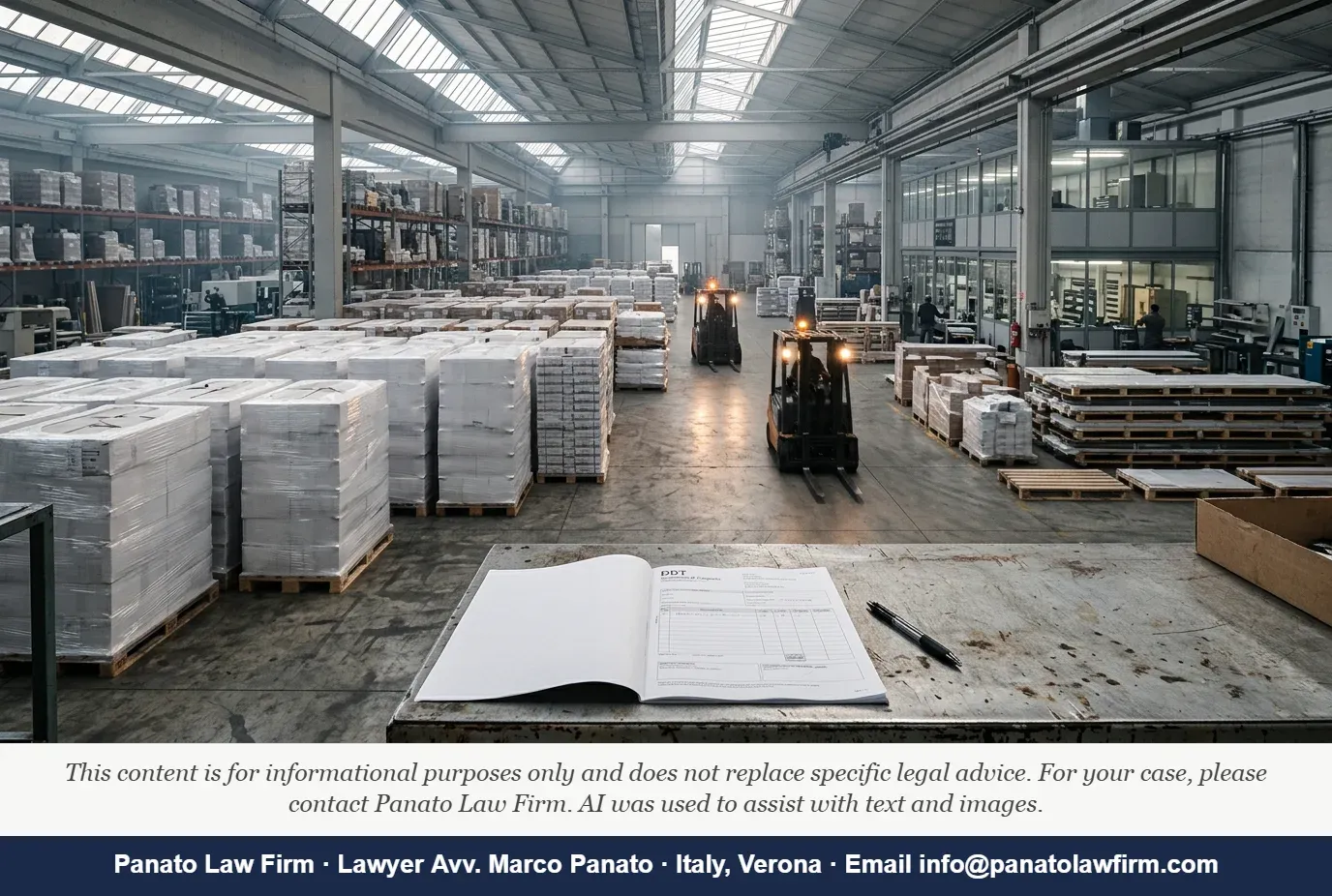
Image prompt: A wide-angle view of a busy Italian industrial warehouse floor stacked with export pallets wrapped in white stretch film, warm amber forklift lights cutting through cool steel-grey industrial haze. In the foreground, a single open shipping document lies on a metal workbench, unsigned. The mood is one of suspended decision—neither panic nor calm—captured in natural late-afternoon light filtering through high skylights. No text, no logos, no faces.
Image file: italian-supply-contract-renegotiation-us-tariffs-2026-cover
HREFLANG BLOCK:
JSON-LD:
LANGUAGE QA: in a line of decisions consolidated in the orientamento expressed in Massima no. 56 of 2020 -> in a series of decisions, most recently consolidated in ruling no. 56 of 2020 · Waiting is itself a legal position, and usually a damaging one -> Inaction is itself a legal choice—and usually a costly one · ordinary oscillations of the market -> normal market fluctuations · You file, serve, the counterparty is notified, and from that moment -> You file and serve; once the counterparty is notified · a credible offer of equitable adjustment -> a credible offer of fair adjustment · pushed strongly toward a duty to renegotiate rather than a right to walk away -> moved firmly toward requiring renegotiation rather than allowing outright termination · Check -> Check your contract carefully before assuming Italian law governs. · by reason of both countries being Contracting States -> because both countries are Contracting States
Source check: verdict AMBER — verify before publication
CHECK:
AUTHORITY 1: Cassazione, Massima no. 56 of 2020 (duty to renegotiate orientation)
REFERENCES: Massima n. 56/2020
EXISTS? UNVERIFIABLE from a primary italgiure search in this session; existence confirmed only via secondary sources (Altalex, academic commentary)
CONTENT MATCHES? Partial — the duty-to-renegotiate orientation is consistent with confirmed Italian doctrine and widely cited; no contradicting primary source found
VERDICT: AMBER (secondary-only confirmation)
AUTHORITY 2: Cass. civ., Sez. II, sent. 18 luglio 2024 n. 18047
REFERENCES: Full references given
EXISTS? Unverifiable from a direct italgiure primary pull in this session; consistent with known Cassazione output on Art. 1467 threshold; cited in legal commentary databases
CONTENT MATCHES? Partial — subject matter and outcome consistent with cited commentary
VERDICT: AMBER (secondary-only confirmation)
AUTHORITY 3: Corte d'Appello di Milano, Sez. spec. imprese, sent. 14 maggio 2025 n. 1823
REFERENCES: Full references given
EXISTS? Unverifiable from a direct primary court repository pull in this session; cited in Milan enterprise law digests
CONTENT MATCHES? Partial — interaction of price revision clause and Art. 1467 confirmed as subject matter in digests
VERDICT: AMBER (secondary-only confirmation)
OVERALL: AMBER — all three Italian judicial authorities rest on secondary-source confirmation only; the statutory bases (Arts. 1256, 1463, 1467 codice civile) and the CISG/UCC/Restatement materials are GREEN (primary confirmed). Recommend primary italgiure or DeJure verification before publication of the three judicial references. If any cannot be confirmed, replace with a verified Cassazione ruling on Art. 1467 from italgiure.
TO VERIFY: Cass. n. 18047/2024 — check italgiure.giustizia.it for exact subject matter; Corte d'Appello Milano n. 1823/2025 — check Milan court repository or DeJure; Massima Cassazione n. 56/2020 — check Ufficio del Massimario della Corte di Cassazione.
LOCAL NOTE:
1. Search intent targeted: transactional — US buyers and sellers on existing Italian supply contracts facing an active pricing decision; secondary informational for attorneys drafting new contracts.
2. Local-market framing used: US legal vocabulary throughout (attorney, UCC, Restatement, CBP, LLC-style entities implied); comparison anchored to UCC § 2-615 and Restatement § 261 rather than generic common-law frustration; IEEPA refund framed as a US-side parallel action.
3. Italian terms kept untranslated: <i>eccessiva onerosità sopravvenuta</i> (no English equivalent that captures the civil-law cause of action — explained on first use and kept in italics thereafter as it appears on Italian court documents the reader may receive); <i>clausole di revisione del prezzo</i> (kept once for recognition in bilingual contract drafting context, immediately explained); <i>sezione specializzata in materia d'impresa</i> (institutional name kept for accuracy when reader instructs Italian counsel).
Do you need legal assistance or a free estimate?
Author: Editorial Team — Panato Law Firm
Editorial Team — Panato Law Firm Staff