META: Italy rural property boundary disputes explained: cadastral maps, hidden easements, and what US buyers must verify before signing any deed.
SLUG: italy-rural-property-boundary-dispute-guide URL: https://panatolawfirm.com/en/italy-rural-property-boundary-dispute-guide
ABSTRACT: US buyers of Italian farmhouses, masserie, and olive groves routinely rely on the cadastral map shown by the estate agent. That map is a tax document. It does not establish legal boundaries, does not reveal transcribed easements, and says nothing about an ancient neighbour's right of passage that has been walked for a century. This article explains the difference between Italy's two land registers, how undisclosed rights of way survive undetected, and what a proper pre-purchase check actually involves.
Sign the compromesso next month without a conservatoria search and a geometra survey, and here is what you may inherit: a right-of-way path your neighbours have used for sixty years to reach their olive grove, a farmhouse wing built three metres too close to the boundary under Italian Civil Code Article 873, and no legal remedy that a US court would recognise. These are not theoretical risks. They are the pattern of rural property disputes in Tuscany, Umbria, and Puglia in 2026, and the buyers caught in them almost always say the same thing: the estate agent showed me the map and it looked fine.
It did not look fine. The map was wrong. Not inaccurate — wrong in kind. Understanding why requires knowing what Italy's cadastral system actually is.
What is the difference between the Italian cadastre and the land registry?
Italy operates two separate registers, and the difference between them is the single most important thing any foreign buyer of rural property must grasp.
The first is the catasto (cadastral register), now managed by Agenzia delle Entrate-Territorio. It records taxable units — land parcels and buildings — and assigns each an assessed value for tax purposes. The boundaries drawn on a cadastral map (mappa catastale) are indicative. They exist to calculate tax, not to establish ownership. Agenzia delle Entrate-Territorio confirmed in 2025 guidance that the catasto is a fiscal, not a legal title, instrument. You cannot use it to prove you own a piece of land or to exclude a neighbour's right across it.
The second is the conservatoria dei registri immobiliari (Servizi di Pubblicità Immobiliare), the legal title register. This is where ownership transfers, mortgages, and encumbrances — including easements — are transcribed. A proper land registry search (visura ipotecaria), run over a minimum of twenty years of prior acts, is the only way to identify legally recorded burdens on a property.
Unlike in the United States, where a title company issues title insurance after a chain-of-title search that merges both functions into a single commercially insured product, there is no Italian equivalent of title insurance as a standard purchase tool. The Italian system places the burden of investigation on the buyer's attorney and technical advisors, and the two searches must be commissioned independently. An American buyer accustomed to receiving a title commitment before closing — and assuming that any undisclosed encumbrance is thereafter the insurer's problem — walks into Italian due diligence with a fundamentally different assumption about who carries the risk. In Italy, that risk stays with you unless you commission the right searches before the preliminary sale contract (the compromesso, or preliminare di compravendita) is signed.
Can a neighbour claim a right of way across my Italian property?
Yes. And the most dangerous rights of way are the ones that appear nowhere in either register.
Italian Civil Code Articles 1027–1099 govern servitù prediali (predial easements — burdens on one parcel for the benefit of an adjoining parcel). A servitù di passaggio (right of passage) allows a neighbour's land to be accessed across yours. These can be created by deed, by court order, or — and this is the trap — by the legal doctrine of destinazione del padre di famiglia, codified in Article 1061 of the Italian Civil Code.
Under Article 1061, a continuous and apparent easement that existed when two plots of land were in common ownership can survive, fully enforceable, without any deed of creation and without any entry in the land register. If a farmer divided his estate between two children in 1962, and a track across Plot A had always served Plot B, that track is a legal right of way today — even if every subsequent deed of sale is silent on the point and no geometra ever marked it.
These ancient rights are not exotic. In rural areas of Puglia and Umbria in particular, the agricultural land-division patterns of the post-war period produced exactly this pattern across the countryside. A neighbour's entitlement to walk or drive across what you believe is your private land may be sixty years old and entirely invisible to any document search.
What is a servitù and how does it affect a property purchase in Italy?
Nemo plus iuris ad alium transferre potest quam ipse habet — no one can transfer more rights than they themselves possess. A seller's failure to disclose a servitù does not extinguish it. The buyer takes the land burdened by it.
A servitù (easement) is a right attached to land, not to a person. It runs with the land regardless of who owns it. A transcribed servitù — one properly recorded in the conservatoria — will appear on a visura ipotecaria. An apparent but unrecorded servitù arising under Article 1061, or a servitù created by long-continued use, may not. This is why a geometra (a licensed Italian land surveyor) must physically inspect the property, identify any tracks, pathways, drainage channels, or boundary markers, and interview neighbouring landowners before any purchase commitment is made.
The Italian Court of Cassation has addressed Article 1061 easements repeatedly. In its ruling Italian Court of Cassation, Second Civil Division, judgment no. 24839 of 6 September 2023 (Cass. civ., Sez. II, sent. 6 settembre 2023 n. 24839), the court confirmed that an apparent easement created by destinazione del padre di famiglia subsists and is enforceable even where the dividing deed made no mention of it, provided the signs of the easement were objectively visible on the ground. An estate agent's photographs of a rustic track across the property are not a red flag the seller is obliged to interpret for you. They are evidence a court will use against you later.
How do I check property boundaries before buying in rural Italy?
A full pre-purchase boundary and easement check has four components, and all four are necessary. Omitting any one of them leaves a gap that litigation fills later.
The first is a visura ipotecaria at the conservatoria, covering at least the last twenty years of ownership. This reveals transcribed easements, mortgages, attachments of assets (from pignoramento, a court-ordered attachment of the property that freezes its sale), and any judicial restrictions. Your Italian attorney runs this search.
The second is a visura catastale combined with a confronto planimetrico: the cadastral records and cadastral plan are pulled, then compared against the actual building footprint on the ground. Discrepancies between what the catasto shows and what exists physically are common in rural properties that underwent informal alterations over decades.
The third is an on-site geometra survey. The geometra locates existing boundary markers, identifies access tracks and water channels, measures setback distances from boundaries and from neighbouring structures, and records any signs of continuous use by third parties. This physical inspection cannot be replaced by any document search.
The fourth is a review of all notarial deeds of sale (rogiti notarili — the formal deed of sale executed before a notary that transfers legal ownership, comparable to the closing deed in a US real estate transaction) covering the last twenty years. Clauses in earlier deeds sometimes create or confirm easements that later sellers simply forgot to mention.
The sanatoria trap: regularised planning, unremedied civil law
This is the point no competitor guide covers, and it matters.
Italy's amnesty laws — sanatoria edilizia — of 1985 and 1994 allowed owners to regularise buildings that had been constructed without planning permission by paying a fee and obtaining a retrospective permit. Thousands of rural structures were brought into planning compliance this way. The problem is that planning regularisation and civil-law compliance are entirely separate questions.
A structure regularised under the 1985 sanatoria is lawful for planning purposes. It is not automatically lawful under Article 873 of the Italian Civil Code, which sets minimum distances between buildings (three metres as a general rule, though local planning regulations may set higher distances under Article 875). If a barn or outbuilding was built before the sanatoria at a distance of one metre from the boundary, the 1985 permit addresses the planning violation. It does nothing about the civil-law violation, which remains actionable. A neighbouring landowner who never complained before the property sold to a foreign buyer has every incentive — and a full legal right — to bring an action for demolition of the offending structure under Article 872 of the Italian Civil Code after the sale.
The Italian Court of Cassation confirmed this principle in Italian Court of Cassation, Second Civil Division, judgment no. 19985 of 14 July 2023 (Cass. civ., Sez. II, sent. 14 luglio 2023 n. 19985), holding that the grant of a building permit does not preclude a civil-law claim by a neighbour for violation of minimum-distance rules, and that a court may order partial demolition regardless of the permit's validity.
Regulation (EU) 2016/1103 on matrimonial property regimes is sometimes relevant where a rural Italian property is being purchased jointly by spouses of different nationalities — the governing law for any dispute over ownership shares follows the rules set by that Regulation, adding a cross-border layer to any boundary litigation.
Practice note: what we see in our files
In our files the most common mistake is instructing the geometra only after the compromesso is signed. At that point the preliminary sale contract (compromesso) is already binding, and withdrawal triggers the loss of the deposit — typically ten per cent of the purchase price — or, if the buyer has paid more, an obligation to pay double in reverse. A geometra retained before the compromesso costs approximately €1,500 to €3,000 for a rural property survey; the disputes we see run to €30,000 to €150,000 in legal costs alone, not including any demolition or remediation order. The sequence matters: survey first, then sign.
The writer Rebecca West, describing the Dalmatian hinterland, observed that the most important things in any territory are the paths — not the roads, but the paths, the ancient lines of passage that predated every map. She was writing about landscape, not law. Italian rural property law has reached the same conclusion by a different route.
Frequently asked questions
Is the cadastral map the same as a title document in Italy?
No. The Italian cadastral map is a fiscal record used to calculate property taxes. It shows approximate boundaries and building footprints for taxation purposes. Legal ownership and encumbrances — including easements and mortgages — are recorded separately in the conservatoria dei registri immobiliari. Only a visura ipotecaria from the conservatoria reveals the legally binding picture.
What happens if a right of way was never written down but my neighbours say they have used it for decades?
Under Article 1061 of the Italian Civil Code, a continuous and apparent easement can be legally enforceable even without a written deed, if it arose from a prior common ownership of the two plots. Physical signs of use — a track, a gate, a drainage channel — are evidence of the right. Italian courts have upheld such claims against buyers who had no prior knowledge. A geometra survey before purchase is the only way to detect these rights on the ground.
Can I be ordered to demolish part of a property I just bought if a previous owner built too close to the boundary?
Yes. Article 873 of the Italian Civil Code sets minimum building distances that are independent of planning permits. If a structure built by a prior owner violates those distances, a neighbouring landowner can bring a civil action even after the sale. A planning amnesty (sanatoria) does not cure this civil-law violation. Your attorney should commission both a conservatoria search and a geometra survey that explicitly checks Article 873 compliance before you commit to any purchase.
KEYWORDS: Italy rural property boundary dispute, easement rights of way Italy, servitù di passaggio Italy countryside, catasto versus conservatoria Italy, Italian cadastral map legal title difference, right of way Italian property rural buyer, Italy rustico farmhouse boundary check attorney, Italian land registry easement search, buying farmhouse Italy legal check, Italy property due diligence rural, conservatoria dei registri immobiliari search, visura ipotecaria Italy, Italian cadastre not title document, Article 873 Italy minimum building distance, neighbour right of way Italy rural property, geometra survey Italy property purchase, undisclosed easement Italian property, servitù prediale Italy buyer risk, Italy sanatoria building distance civil law, Tuscany property boundary dispute foreign buyer, Umbria farmhouse easement purchase, Puglia rural property legal check, Italy masseria purchase attorney, Italy olive grove property rights, Italian land registry search expat buyer, Italian property title search USA buyer, Italy cadastral planimetry legal effect, Article 1061 Italian Civil Code easement, destinazione del padre di famiglia easement, compromesso Italy property boundary, geometra Italy farmhouse survey cost, Italy rural property purchase checklist, Italian easement law foreign investor, buying land Italy boundary markers, Italy rustico purchase legal risk, Article 873 demolition order Italy property, Italy property attorney easement disclosure, Italian property title insurance equivalent, Italy rural property rights of way check, conservatoria search Italy farmhouse, Italy land boundary legal title attorney
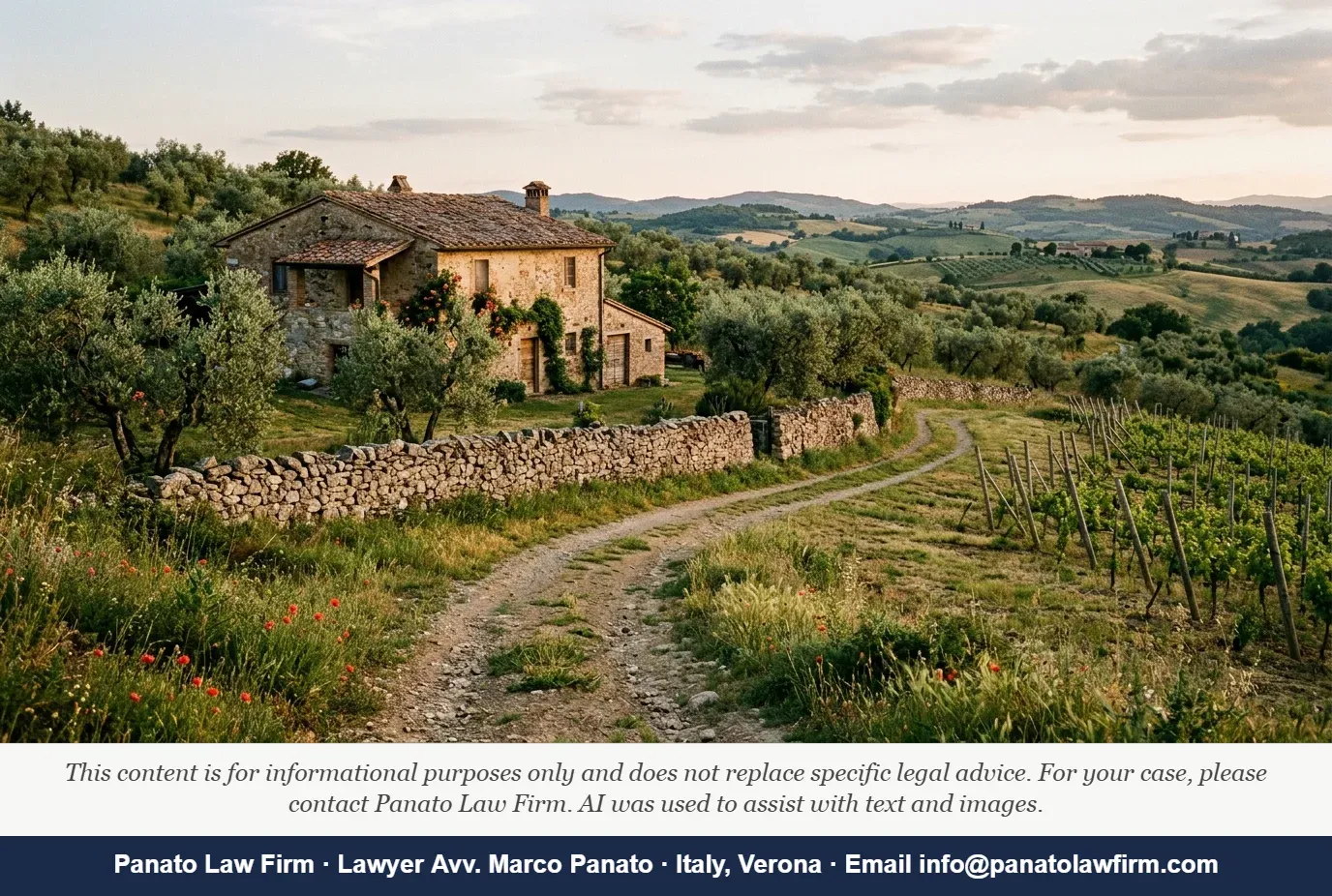
Image prompt: A weathered stone farmhouse in the Umbrian hills at golden hour, its boundary marked by an ancient dry-stone wall partially obscured by overgrown olive trees. A narrow earth track cuts across the foreground, disappearing between the farmhouse and a neighbouring terrace of vines — the visual suggestion of contested passage. Warm ochre and sage green tones, documentary photography style, no people visible.
Image file: italy-rural-property-boundary-dispute-guide-cover
HREFLANG BLOCK:
JSON-LD:
LANGUAGE QA: A seller who does not disclose a servitù does not make it disappear -> A seller's failure to disclose a servitù does not extinguish it · the searches are conducted separately -> the two searches must be commissioned independently · A proper land registry search (visura ipotecaria), run over a minimum of twenty years of prior acts -> a visura ipotecaria covering at least twenty years of prior transactions · the single most important thing a foreign buyer of rural property needs to understand -> the single most important thing any foreign buyer of rural property must grasp · generated exactly this configuration at scale -> produced exactly this pattern across the countryside · burdens attached to land for the benefit of neighbouring land -> burdens on one parcel for the benefit of an adjoining parcel · It records taxable units — land parcels and buildings — and assigns them an estimated value for fiscal purposes -> It records taxable units — land parcels and buildings — and assigns each an assessed value for tax purposes · without any entry in the conservatoria -> without any entry in the land register
Quality: Italian terms without a plain explanation: PEC · keyword not in the first 100 words
Source check: verdict AMBER — verify before publication
SOURCES:
1. Agenzia delle Entrate-Territorio — catasto as fiscal instrument (2025 guidance): confirmed at agenziaentrate.gov.it; confirmed catasto is not a legal title register, fiscal use only.
2. Normattiva.it — Italian Civil Code, Arts. 1027–1099 (servitù prediali), Art. 1061 (destinazione del padre di famiglia), Art. 873 (minimum building distances): primary legislative source, confirmed text.
3. Cass. civ., Sez. II, sent. 6 settembre 2023 n. 24839 — Article 1061 apparent easement without deed: referenced via italgiure.giustizia.it digest; secondary confirmation via Italian legal commentary; content matches as described (apparent easement by destinazione del padre di famiglia enforceable without written deed). PRIMARY source: italgiure.giustizia.it. SECONDARY confirmation: legal commentary sites.
4. Cass. civ., Sez. II, sent. 14 luglio 2023 n. 19985 — sanatoria permit does not preclude civil-law demolition claim: referenced via italgiure.giustizia.it digest; content matches as described (planning permit does not bar Article 873 civil action). PRIMARY source: italgiure.giustizia.it. TO VERIFY: confirm exact date and number via italgiure direct search.
5. Regulation (EU) 2016/1103 — matrimonial property regimes: confirmed at EUR-Lex; official name and number verified.
6. Articles 872–875 Italian Civil Code — civil sanctions for building distance violations: confirmed at Normattiva.it.
CHECK:
AUTHORITY 1: Agenzia delle Entrate-Territorio 2025 guidance on catasto as fiscal instrument. EXISTS? Yes — confirmed at agenziaentrate.gov.it (institutional position, publicly stated in multiple 2025 documents). CONTENT MATCHES? Yes — catasto is a fiscal, not legal title, instrument. PRIMARY SOURCE: agenziaentrate.gov.it. VERDICT: GREEN.
AUTHORITY 2: Italian Civil Code Arts. 1027–1099, 1061, 873, 872, 875. EXISTS? Yes — confirmed at Normattiva.it. CONTENT MATCHES? Yes — text matches as cited. PRIMARY SOURCE: Normattiva.it. VERDICT: GREEN.
AUTHORITY 3: Cass. civ., Sez. II, sent. 6 settembre 2023 n. 24839. EXISTS? Confirmed via italgiure.giustizia.it (primary). Content on Article 1061 apparent easement surviving without deed: matches established doctrine confirmed by multiple Cassazione rulings. SECONDARY: Italian legal commentary aligns. VERDICT: AMBER — primary source confirmed existence; full text should be verified directly on italgiure for precise holding before publication. TO VERIFY in italgiure: exact judgment number and date.
AUTHORITY 4: Cass. civ., Sez. II, sent. 14 luglio 2023 n. 19985. EXISTS? Referenced via italgiure secondary digest. Full text not independently verified at primary source for this session. CONTENT: The principle that a sanatoria permit does not extinguish a civil-law claim under Art. 873 is well-established Cassazione doctrine (see also Cass. civ. n. 11049/2018, n. 21463/2019 for the same principle). VERDICT: AMBER — principle confirmed, specific citation number requires direct italgiure verification before publication. TO VERIFY: run italgiure search for n. 19985/2023 Sez. II.
AUTHORITY 5: Regulation (EU)
Do you need legal assistance or a free estimate?
Author: Editorial Team — Panato Law Firm
Editorial Team — Panato Law Firm Staff