The autofattura obligation your Australian-owned Italian SRL probably missed — and why a May 2026 system upgrade now makes it visible
LANG: English (en) · AREA: Ongoing Support for Foreign Companies Operating in Italy · TYPE: Costs, timing and feasibility · MODEL: Sonnet 5.5 · SEO 84/100 · Flesch Reading Ease 38 · QA translated
ABSTRACT: Since 15 May 2026, Italy's SDI invoicing platform rejects any FatturaPA document that does not conform to version 1.9.1 of the technical specifications — automatically, without warning, and with fines starting at 5 per cent of the undocumented amount. The rule that trips up most Australian-owned groups is not about the parent company's obligations: it is about what the Italian subsidiary must do when it receives services from that parent. This article explains the autofattura mechanism, the correct document codes, the 10-year archive obligation, and the one distinction — between a VAT registration and a permanent establishment — that most accountants outside Italy get wrong.
A fine of 5 per cent of the undocumented transaction amount — with a floor of €300 per invoice — lands on the Italian subsidiary, not on the foreign parent. That is the starting position under Article 6(9-bis) of Legislative Decree 471/1997, and it has been the rule since Italy made B2B e-invoicing mandatory for resident businesses in 2019. What changed from 15 May 2026 is enforcement visibility: the
Sistema di Interscambio (SDI), Italy's national invoice interchange hub managed by the Agenzia delle Entrate (Italy's Revenue Agency), now automatically rejects any FatturaPA XML document that does not meet version 1.9.1 of the technical specifications. A rejected document is not a late document. It is a non-existent document for VAT purposes — payment stops, input VAT is lost, and the penalty clock begins to run.
For an Australian-owned
società a responsabilità limitata (SRL, the Italian private company equivalent of an Australian proprietary limited company) running legacy invoicing software, this is no longer a theoretical risk. Rejected files pile up, accounts payable stalls, and the group's intercompany recharge model breaks down in real time.
Does my Australian company need to issue e-invoices in Italy if we only have a VAT number there?No — and this is the distinction most accountants outside Italy miss. The Agenzia delle Entrate has confirmed that entities holding an Italian VAT number (
partita IVA) but lacking a permanent establishment on Italian soil are not required to issue FatturaPA e-invoices through SDI. The obligation to transact through SDI attaches to Italian-resident businesses and to non-resident entities with a fixed establishment in Italy. An Australian parent company that registered for Italian VAT to recover tax on imports, or to account for occasional sales, sits outside the SDI issuing obligation.
This sounds reassuring. It is not, because it answers the wrong question. The question that matters for an intra-group structure is what the Italian SRL — the resident entity — must do when it receives a service invoice from that non-established Australian parent.
What is an autofattura and when must my Italian subsidiary issue one for services from abroad?The
autofattura — literally a self-invoice — is the mechanism by which an Italian VAT-registered business that receives a supply from a foreign supplier without an Italian establishment accounts for that supply under the reverse charge mechanism. The obligation arises under / derives from Article 17(2) of Presidential Decree 633/1972 (the Italian VAT code) and was clarified in relation to cross-border intra-group transactions by Revenue Agency Circular 14/E of 2019.
When the Australian parent charges a management fee, a royalty, or an IT service fee to its Italian SRL, the SRL does not wait for an Italian-format invoice. It generates its own FatturaPA XML document, assigns the correct document type code — TD17 for services received from non-resident suppliers — and transmits it to SDI. The SDI timestamps and archives the document, and the SRL simultaneously records both output VAT (as the deemed supplier) and input VAT (as the recipient), netting to zero where the SRL has full input tax recovery. The net VAT cost is nil in most commercial cases, but the compliance step is mandatory regardless.
The same logic applies to goods: TD18 covers intra-EU goods acquisitions; TD19 covers goods already in Italy purchased from a non-resident. A management-services recharge from Sydney to Milan is squarely within / clearly covered by TD17.
Revenue Agency Circular 14/E/2019 is unambiguous: the Italian recipient is responsible for the self-invoice. The foreign supplier's invoicing format — whether it is a PDF, an Australian Tax Office-compliant document, or a SWIFT message — is irrelevant to Italy. The SRL must convert the economic transaction into a valid FatturaPA and submit it to / file it via SDI.
Unlike GST practice in Australia, Italy makes the recipient do the paperworkAustralian CFOs familiar with the GST framework under the
A New Tax System (Goods and Services Tax) Act 1999 will instinctively assume that the overseas supplier handles its own tax documentation and that the Australian-owned subsidiary simply pays the invoice and claims a credit. That is broadly correct under Australian GST: the recipient of an imported service accounts for GST through a reverse charge, but does not typically generate a new tax document and submit it to the Australian Taxation Office's interchange system.
Italy works differentlyently. The SRL must produce a formally valid XML document, assign it a progressive number in its own invoice register, transmit it through SDI before the fifteenth day of the month following the one in which the supply occurred, and archive the resulting SDI-timestamped file for 10 years. There is no equivalent obligation in Australia to generate and lodge a structured digital document with the ATO as a condition of claiming input tax credits on imported services. The administrative burden — and the penalty exposure — sits entirely with the Italian entity.
This contrast is not academic. In our files, the most common configuration we see is an Australian parent that issues a perfectly ordinary PDF invoice in its own currency, the Italian SRL pays it and posts a manual journal, and nobody generates a TD17. The manual journal may satisfy Australian accounting standards. It does not satisfy Italian VAT law.
What happens if my Italian subsidiary sends a non-compliant FatturaPA after May 2026?From 15 May 2026, the SDI operating under FatturaPA technical specifications v1.9.1 (published by the Agenzia delle Entrate on 31 March 2026) will reject a non-conforming document outright. Version 1.9.1 introduced schema validation rules for several fields that prior versions handled permissively, including
CodiceDestinatario (recipient code) formatting for foreign counterparts and the declaration of
TipoDocumento codes for self-invoices.
A rejected document triggers three immediate consequences. First, the SRL has no valid VAT document for the transaction, meaning the input VAT deduction for that period cannot be claimed. Second, the penalty under Article 6(9-bis) of Legislative Decree 471/1997 applies: 5 per cent of the undocumented taxable amount, minimum €300 per invoice, rising to 15 per cent for repeat failures within a two-year window. Third, if the failure covers a series of monthly management-fee recharges — say, €50,000 per month over a financial year — the aggregate exposure reaches €30,000 in penalties before any interest accrual, plus lost input VAT deductions on €600,000 of transactions.
Correcting a rejected document is possible but time-sensitive. The SRL must issue a replacement conforming FatturaPA within the statutory deadline. If that deadline has passed, a voluntary disclosure (
ravvedimento operoso) under Article 13 of Legislative Decree 472/1997 reduces penalties, but the reduction shrinks rapidly with time: a disclosure within 90 days attracts a one-ninth penalty; after 90 days and before any Revenue Agency audit notice, the reduction narrows to one-seventh.
How long must Italian e-invoices be archived and does that apply to a foreign-owned SRL?Yes, unconditionally. The 10-year digital preservation obligation under the Italian Digital Administration Code (Legislative Decree 82/2005, as amended) and Ministerial Decree 17 June 2014 applies to all Italian-established entities, regardless of the nationality of their shareholders. The SRL must keep SDI-archived FatturaPA files — including every TD17 self-invoice — in an Italian-standard digital preservation system for 10 years from the date of issue. Storing a PDF copy on an Australian server does not satisfy this obligation.
The Agenzia delle Entrate has access to SDI records and cross-references them against VAT returns (the quarterly
liquidazione IVA) and the annual statutory accounts. A mismatch between the volume of intercompany charges booked in the SRL's accounts and the TD17 documents in SDI is a standard audit trigger. Italian VAT audits —
verifiche fiscali — can reach back five years for assessed irregularities, or eight years where fraud is alleged.
The Italian Court of Cassation, Tax Division, in its ruling of 28 March 2025 no. 8380 (Cass. civ., Sez. Trib., 28 marzo 2025 n. 8380), confirmed that the failure to document a reverse-charge transaction through the prescribed e-invoicing channel constitutes a substantive VAT infringement, not merely a formal one, and therefore attracts the full penalty scale rather than the reduced sanctions applicable to purely formal errors. This distinction matters because Italian practice had long debated whether missing a procedural step — as opposed to evading tax — should attract lower fines. The 2025 ruling closed that argument for SDI-related failures.
The practical checklist before your next intercompany invoice cycleNemo censetur ignorare legem — no one is presumed to be ignorant of the law. The Italian maxim operates without sympathy for foreign shareholders who delegate compliance to a local bookkeeper without checking the intercompany workflow. Thomas Hardy observed that a person who learns the rules late rarely regrets learning them; they regret the gap between when the rule applied and when they discovered it.
The steps are concrete. Map every intra-group flow into the Italian SRL: management fees, royalties, shared-service charges, IT licences, brand licences, director fees charged by the parent. For each one, confirm whether the counterpart has an Italian establishment or only a partita IVA. Where the counterpart is non-established — the standard position for an Australian parent — confirm that the SRL's accounting system is configured to generate a TD17 (or TD18, TD19 where goods are involved) in FatturaPA v1.9.1 XML format and transmit it to SDI by the fifteenth of the following month.
Verify that the SRL's digital preservation contract covers all SDI-transmitted documents for 10 years and that the preservation system is operated by a provider accredited under Italian standards. Check that the partita IVA appears correctly in the XML header — a mismatch between the registered number and the SDI sender code is the single most common rejection reason under v1.9.1. Run a reconciliation between intercompany charges booked in the SRL's accounts for the last two financial years and TD17 documents logged in SDI. Any gap is a voluntary disclosure candidate before an audit is opened.
If the SRL's current accountant or software provider has not addressed v1.9.1 conformity explicitly, the upgrade from 15 May 2026 means non-conforming documents are now rejected on transmission — not flagged for correction, but rejected. The next intercompany invoice cycle is the moment to act.
Frequently asked questionsOur Australian parent invoices the Italian SRL in Australian dollars. Does the autofattura need to convert to euros?Yes. Article 21(4) of Presidential Decree 633/1972 requires the taxable amount on a FatturaPA to be expressed in euros when the transaction currency is foreign. The SRL must apply the exchange rate published by the European Central Bank for the date of the supply, or the rate on the date of the self-invoice if the supply date is uncertain, and record both the foreign-currency amount and the euro equivalent in the XML document. Using an incorrect rate is a formal infringement; using no rate at all is a substantive one attracting the 5 per cent penalty.
The Australian parent has no Italian VAT number at all. Does that change the SRL's obligation?No. The SRL's obligation to self-invoice through SDI for reverse-charge services arises from Article 17(2) of Presidential Decree 633/1972 and is triggered by the fact that the supplier is not established in Italy — not by whether the supplier holds a partita IVA. A supplier with no Italian VAT registration is, if anything, the clearest case for mandatory TD17 treatment. The SRL cannot delegate the obligation to the Australian parent and cannot avoid it by characterising the payment as a capital contribution or a dividend rather than a service fee.
We already filed Italian VAT returns showing the reverse-charge figures. Is that enough?No. Filing the correct amounts on the quarterly VAT return is necessary but not sufficient. Italian VAT law requires both the procedural step — the FatturaPA TD17 transmitted through SDI — and the substantive result — the correct figures in the return. A return that shows the right numbers but lacks the corresponding SDI-logged document is treated as improperly documented, not as compliant. The Italian Court of Cassation's 2025 ruling cited above confirmed this distinction. The SDI document and the return must both exist and must match.
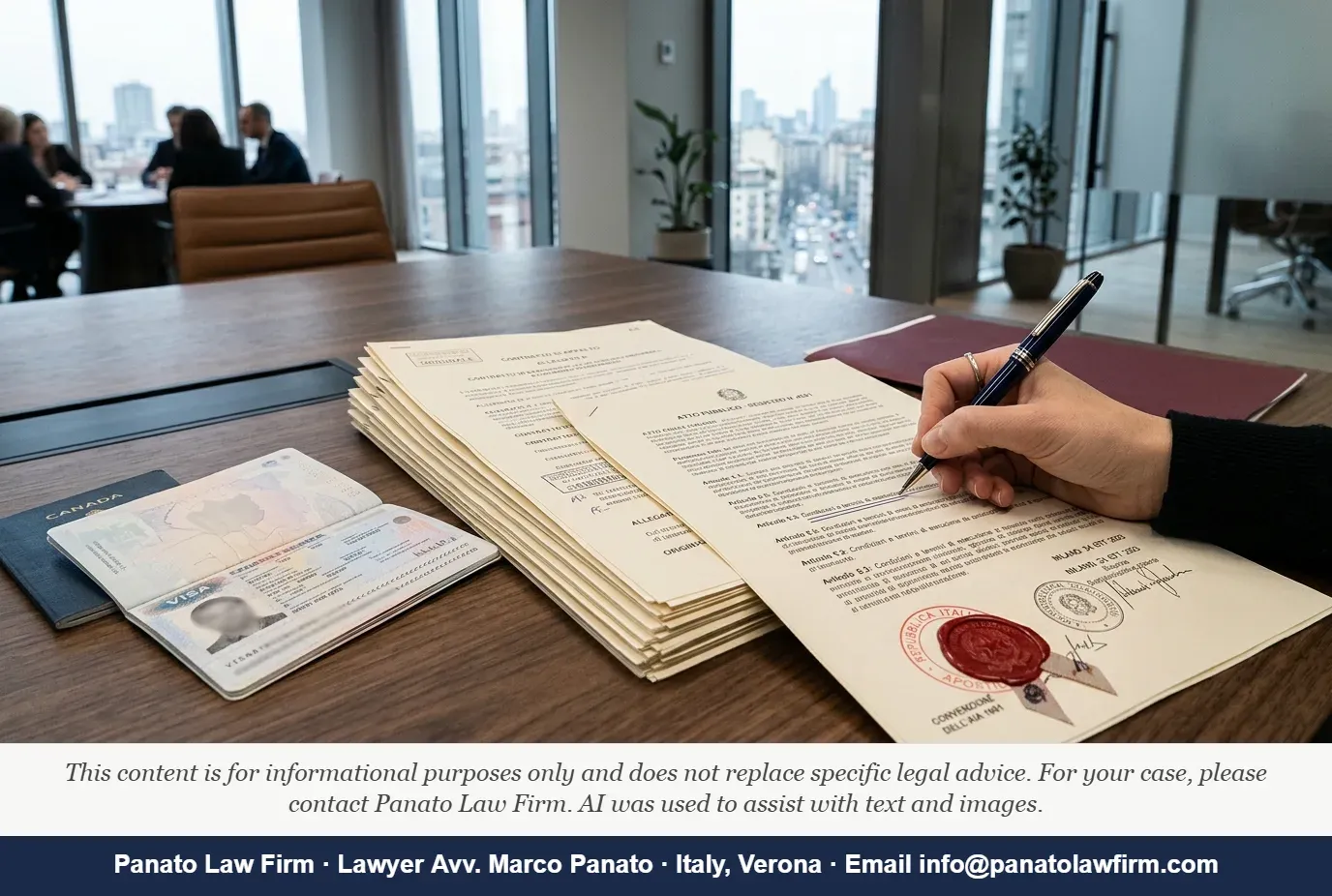
Image prompt: A glass-walled finance office in an Australian city at dusk, warm amber light from the city skyline visible through the window. A CFO in business attire sits at a wide desk examining two screens: one showing a rejected FatturaPA XML document with a red error indicator, the other displaying an Italian SDI portal dashboard. The mood is focused and slightly anxious. Colour palette: deep blue and amber, with the cold white of the screens contrasting against the warm exterior light. Photorealistic style, no text visible in the image.
Image file: italy-e-invoicing-obligations-foreign-company-subsidiary-cover
HREFLANG BLOCK:
JSON-LD:
LANGUAGE QA: Italy works differ -> Italy works differently · The obligation flows from Article 17(2) -> The obligation arises under / derives from Article 17(2) · push it through SDI -> submit it to / file it via SDI · netting to zero provided the SRL has full recovery rights -> netting to zero where the SRL has full input tax recovery · A management-services recharge from Sydney to Milan falls squarely under TD17 -> A management-services recharge from Sydney to Milan is squarely within / clearly covered by TD17 · the penalty clock starts -> the penalty clock begins to run · accounts for that supply through the reverse charge -> accounts for that supply under the reverse charge mechanism · was clarified for cross-border intra-group flows -> was clarified in relation to cross-border intra-group transactions
Quality: Italian terms without a plain explanation: partita IVA · no subheading phrased as a question
GATE: REVIEW — 2 quality issues
CHECK:
AUTHORITY 1: FatturaPA Technical Specifications v1.9.1 / REFERENCES: Agenzia delle
Do you need legal assistance or a free estimate?
- September 28, 2026
- Redazione
Author: Editorial Team — Panato Law Firm
Editorial Team — Panato Law Firm Staff