Content developed with the assistance of AI tools and reviewed by the author.
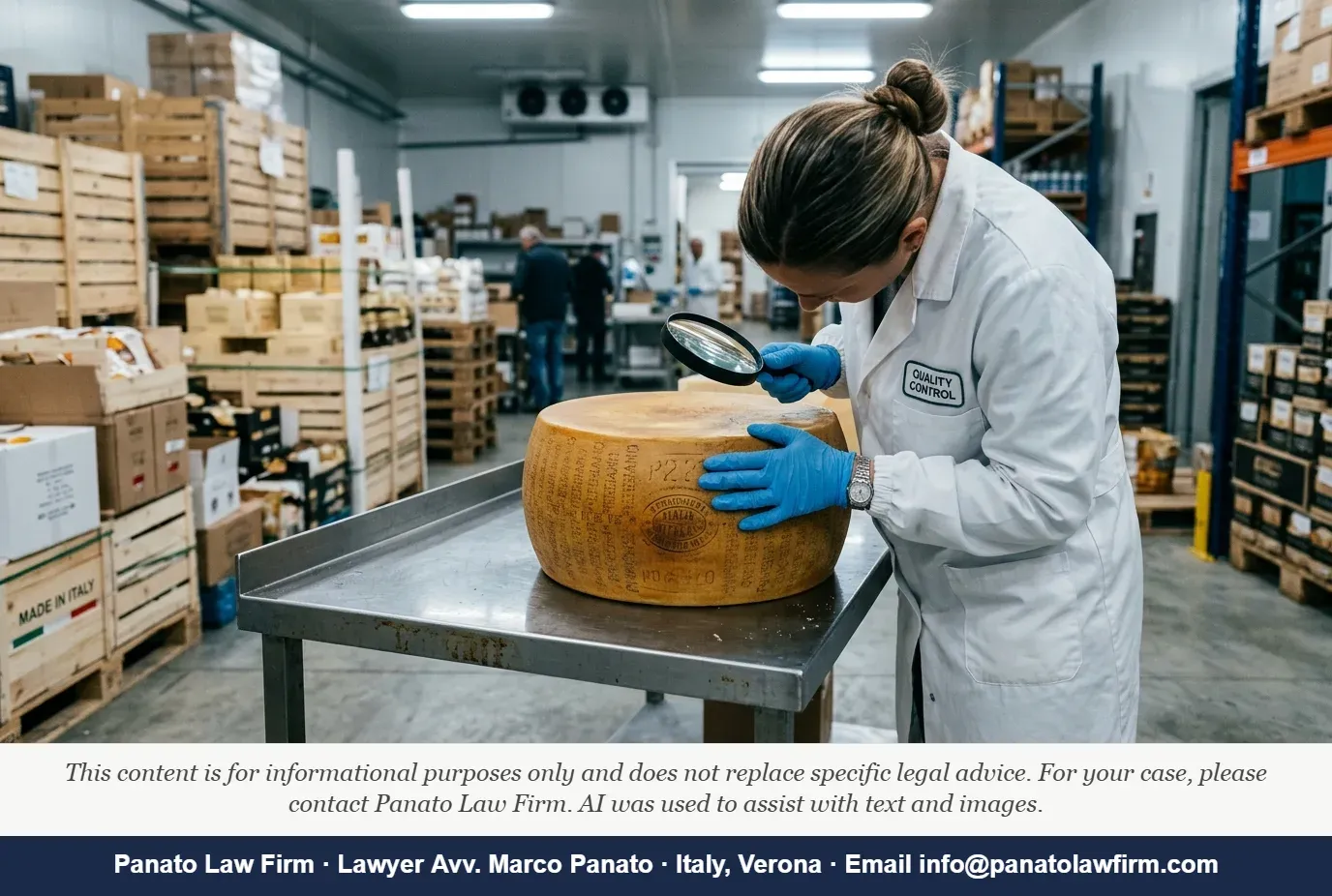
Law No. 75/2026 extends criminal and corporate liability across the DOP/IGP supply chain — including transit, warehousing and export routes used by UK importers and distributors
A pallet of Parmigiano Reggiano sits in a Rotterdam customs warehouse. It arrived from a supplier in Emilia-Romagna, consigned to a UK wholesaler. The label reads "Parmigiano Reggiano DOP" but the rind stamp is a copy. The UK wholesaler had no hand in the fraud. Under Italian law before 29 May 2026, that fact offered meaningful protection. Under Law No. 75 of 21 April 2026 (Legge 21 aprile 2026, n. 75), it may not.
This is not a hypothetical. Italian enforcement authorities — the Carabinieri food-fraud unit (NAS) and the financial police (Guardia di Finanza) — conduct coordinated operations across borders. The new law gives them a broader mandate. Any UK business in the Italian food supply chain needs to understand what shifted and why.
Law No. 75/2026, published in the Italian Official Gazette (Gazzetta Ufficiale) No. 110 of 14 May 2026 and in force from 29 May 2026, introduced a range of new food-related offences and stiffened existing ones. The headline change: counterfeiting a product carrying a DOP (designazione di origine protetta — protected designation of origin, PDO) or IGP (indicazione geografica protetta — protected geographical indication, PGI) mark now carries a sentence of one to four years' imprisonment and a fine of €10,000 to €50,000 per offence.
That alone is not new in kind, only in severity. The structural change is the extension of liability. The law expressly covers goods that are in transit, in temporary storage, in customs warehouses or destined for re-export. It also extends criminal exposure to intermediaries and transporters — not only the producer who affixed the false mark.
For a UK importer, that second shift is the one that matters. If your logistics chain touches a non-compliant product — even briefly, even in a third-country warehouse — Italian jurisdiction can follow the goods.
Yes, under the right factual conditions. Italian criminal jurisdiction under Article 6 of the Italian Criminal Code (codice penale) attaches when part of the offence occurs on Italian territory. The production of the false DOP goods in Italy, or the origination of the fraudulent documentation there, is typically sufficient to establish Italian jurisdiction over the full course of conduct. Law 75/2026 reinforces this by treating the supply chain as a single course of conduct for enforcement purposes.
The standard a UK distributor faces is not one of intentional fraud. The new offences include conduct carried out with gross negligence (colpa grave). A buyer who failed to verify supplier credentials, skipped a conformity check or accepted documentation that an experienced trader should have queried may satisfy the fault element. The prosecution does not need to prove that your commercial director knew the rind stamp was forged.
Unlike in most common-law jurisdictions, where a company's criminal exposure for its supply chain partners depends largely on actual knowledge or a specific statutory duty of care, Italian criminal law has long imposed liability on commercial actors who take insufficient steps to verify compliance. Law 75/2026 does not invent this logic; it applies it to the DOP/IGP context with greater precision and heavier penalties.
For the core DOP/IGP counterfeiting offence: one to four years' imprisonment and a fine of €10,000 to €50,000. These penalties apply per offence, not per shipment, so a distributor handling multiple product lines faces cumulative exposure.
Ancillary penalties include confiscation of the goods and — critically for a trading company — publication of the judgment and temporary exclusion from public procurement in Italy. For a UK business with Italian retail or food-service clients, the procurement bar can be more commercially damaging than the fine.
Enforcement is not theoretical. In April 2025, Operation "Tarocco II" (coordinated by the NAS) led to the seizure of approximately 14 tonnes of mislabelled Italian PDO cheeses at distribution points across northern Italy and Germany. Law 75/2026 was designed in direct response to the supply-chain gaps that operation exposed.
Most commentary on Law 75/2026 focuses on the raised sentencing range. Two things receive almost no attention, and both are more dangerous to a UK business than the headline numbers.
First: the transit extension. UK importers who route Italian DOP products through Rotterdam, Antwerp or another non-EU hub before final delivery to the UK are squarely within the new offences. Under the previous framework, goods physically outside Italian territory in a customs warehouse were in a grey zone. That grey zone is closed. The law treats the goods as within scope from the moment they leave the Italian producer, regardless of where the logistics chain runs.
Second: the corporate liability expansion. Legislative Decree 231/2001, Italy's regime of administrative liability for companies (broadly equivalent to the UK's Corporate Criminal Offence framework under the Criminal Finances Act 2017, but wider in scope), was amended by Law 75/2026 to add the new agri-food offences to its catalogue of predicate offences under Article 25-bis.1. What this means in practice: if an employee, agent or subsidiary of a UK company with an Italian presence — a local subsidiary, a licensed Italian brand partner — commits one of the new offences in the interest or to the advantage of the company, the company itself faces an administrative sanction of up to 500 "quotas" under the 231 scale (currently up to approximately €1.5 million in the most serious cases), plus potential suspension of its Italian operating licences.
The defence available under Decree 231/2001 is that the company had, at the time of the offence, an adequate Organisation, Management and Control Model (Modello di Organizzazione, Gestione e Controllo) in place and functioning. A generic model drafted in 2019 that does not address food-fraud risk, DOP/IGP supply chain controls or the new predicate offences will not meet the standard. Courts examine whether the model was specific, monitored and enforced — not whether the document existed.
For a UK food-and-drink group with an Italian subsidiary or an Italian brand licence, the board is the first line of exposure. The 231 model is a board-level governance document. If it has not been reviewed since Law 75/2026 came into force, the board is operating without a live defence.
Nemo debet bis puniri pro uno delicto — no one should be punished twice for the same wrong. The 231 regime does not violate this maxim because the corporate sanction is administrative in character and attaches to the company as a separate legal person from the natural-person offender. The practical consequence is that both the individual and the company can be sanctioned from the same set of facts.
The legal architecture here reflects a principle John Braithwaite developed in his theory of responsive regulation: liability must reach the entity that profits from misconduct, not only the individual who executes it. Law 75/2026 is a precise application of that logic to the food sector.
The EU framework matters here. Regulation (EU) 1151/2012 on quality schemes for agricultural products and foodstuffs sets the DOP/IGP registration and control structure. Compliance with that regulation — verified through an accredited inspection body — is the evidentiary baseline an Italian court will look at when assessing whether a UK importer exercised due diligence.
Four immediate steps:
Audit your supplier documentation. Every Italian DOP/IGP supplier should hold a current certificate of conformity issued by the relevant consortium (consorzio di tutela) or an accredited third-party certifier. Verify the certificate number against the consortium's public register.
Review your logistics contracts. Any warehousing or freight agreement that does not contain a clause requiring the logistics provider to notify you of non-conforming goods is now a liability document. Redraft the indemnity provisions with law 75/2026 in mind.
Update your 231 model. If you have an Italian subsidiary or hold an Italian brand licence, commission a gap analysis of your existing model. The predicate-offence schedule must reflect the new agri-food crimes. The supervisory body (Organismo di Vigilanza) must have a specific mandate to monitor DOP/IGP compliance.
Map your transit routes. Any pallet passing through a non-EU customs warehouse on its way to the UK should be covered by an authenticated chain-of-custody document that travels with the goods. In our files the most common gap is the absence of any documentation covering the leg between the Italian producer and the EU port of export — that is exactly the leg Law 75/2026 targets.
The next concrete step is a legal and compliance review of your supply chain contracts and your 231 model before the next Italian shipment. That review takes, in a mid-sized importing operation, approximately three to five weeks. Waiting for a NAS inspection to prompt it is not a strategy.
Legislative Decree 231/2001 applies to legal entities that have their registered office, an operational branch or a representative in Italy, and to foreign entities that commit the predicate offence — in whole or in part — on Italian territory. A UK company without any Italian presence is at lower risk from 231 directly, but not immune: if the predicate offence is committed partly in Italy (which is almost always the case for DOP fraud, given the falsification typically originates there), Italian prosecutors have argued for 231 applicability to the foreign parent where it exercised control or received the benefit.
More commonly, the Italian subsidiary or joint-venture partner is the 231 entity, and the UK parent faces exposure through its governance of that entity. A parent-level compliance programme that does not flow down to the Italian subsidiary leaves a structural gap that Italian prosecutors will probe.
If my UK company has no Italian office, can Italian prosecutors still come after us under Law 75/2026?
Italian criminal jurisdiction attaches when any part of the offence occurs in Italy — and the falsification of DOP marks almost always does. A UK distributor who knowingly or negligently placed non-compliant goods on the market can be named in Italian criminal proceedings. The practicalities of enforcement against a purely UK entity are more complex, but the legal exposure is real and should not be dismissed.
What is the difference between the criminal offence under Law 75/2026 and a civil trade-mark claim from a DOP consortium?
The two routes run in parallel. A consortium such as Consorzio del Prosciutto di Parma can bring a civil action for damages and injunctive relief in Italy independently of criminal proceedings. Law 75/2026 does not replace or limit that route. In practice, a criminal referral by the consortium often triggers NAS enforcement, which in turn generates the evidence base for the civil claim. A UK importer facing one should assume the other is coming.
How long does a 231 compliance model update realistically take, and does it need to be in Italian?
A gap analysis and updated model for a mid-sized food importing operation with one Italian subsidiary typically takes four to eight weeks with dedicated external counsel. The model itself must be in Italian to be operative before an Italian court; an English-language summary for the UK board is a separate, secondary document. The supervisory body minutes and monitoring records must also be kept in Italian.
HREFLANG BLOCK:

Editorial Team — Panato Law Firm Staff