How to secure hyper-depreciation and ZES credits before the GSE window closes — and the three steps every foreign-owned company misses
LANG: English (en) · AREA: Ongoing Support for Foreign Companies Operating in Italy · TYPE: Checklist / documents needed · MODEL: Sonnet 5.5 · SEO 84/100 · Flesch Reading Ease 37 · QA acceptable
ABSTRACT: From 1 January 2026, Italy replaced its Transition 4.0 and 5.0 tax credit system with a new hyper-depreciation regime under Legislative Decree 184/2025 (the Incentives Code). UK-owned Italian subsidiaries can claim relief on qualifying capital expenditure up to 180% — but the claim dies without a prior GSE reservation filing that most foreign decision-makers never make. This checklist sets out what to do, in what order, before the window closes.
The CFO of a UK-owned Italian
S.r.l. (a private limited company under Italian law) orders the machinery in September 2026, installs it in October, and books the cost as an asset. The tax return is filed the following year. The accountant then discovers that the enhanced depreciation deduction is unavailable — not because the machinery was ineligible, but because nobody filed the communication with the GSE (Gestore dei Servizi Energetici, Italy's energy services agency that manages the reservation platform) before the investment was completed. The relief is lost. The potential saving was €900,000.
That is the mistake. It happens in our files more often than any other error connected to Italian investment incentives. The GSE communication is not a formality. It is a condition of eligibility. Late filing does not remedy the defect.
What replaced Italy's Transition 4.0 and 5.0 tax credit for investments made from 2026?Italy's Transition 4.0 and Transition 5.0 tax credit regimes, which ran through 2025, were repealed on 31 December 2025. From 1 January 2026, Legislative Decree 184/2025 — the new Incentives Code (
Codice degli incentivi) — governs all state support for business investment. It entered into force on 1 January 2026 and applies to investments made from that date through 30 September 2028.
The new system replaces variable tax credits with hyper-depreciation (
iper-ammortamento): an enhanced deduction computed on the cost of qualifying tangible assets for income tax purposes. The rates are structured in bands. For investments up to €2.5 million, the deductible amount is 180% of cost — meaning a company investing €1 million deducts €1.8 million against taxable income. Between €2.5 million and €10 million the rate falls to 100% (cost doubled). Between €10 million and €20 million it falls to 50%. No hyper-depreciation is available above €20 million of qualifying investment in a single tax period.
Unlike the old Transition 4.0 credit, which reduced tax payable directly, hyper-depreciation reduces the taxable base. For an Italian subsidiary subject to IRES (corporate income tax) at the current rate of 24% — and to IRAP, the regional business tax, at approximately 3.9% — the net cash value at the 180% band is material but falls short of a direct tax credit. A UK parent modelling returns should build in this distinction. The effective relief per euro of capex at the 180% band is approximately 44 euro cents in IRES alone, not 180 euro cents.
Can a UK-owned Italian limited company claim the 2026 hyper-depreciation incentive?Yes — with conditions. Eligibility turns on the Italian entity making the investment, not on its shareholder. A UK parent company investing through an Italian
S.r.l. or
S.p.A. is the correct structure. The subsidiary must be resident and taxable in Italy, must make the qualifying investment itself (not merely fund it), and must use the assets in its Italian business activity.
The qualifying asset categories broadly follow the former Transition 4.0 annexes: digitally interconnected tangible assets (the 4.0 asset list), advanced robotics, additive manufacturing equipment, and certain intangibles. The interconnection test — proof that the asset exchanges data with the company's production or management system — remains mandatory for the highest rates. An independent technical assessment validating interconnection must be obtained from a certified engineer or accredited technical body.
One condition introduced by the 2026 Budget Law (published in the
Gazzetta Ufficiale on 31 December 2025) raised immediate concerns for investors: qualifying tangible assets were required to be produced in a European Union or European Economic Area member state. For a UK-owned subsidiary purchasing machinery from a UK manufacturer, this would have been an effective bar, given that the United Kingdom is no longer an EEA member. The rule was subsequently amended by Decree-Law 38/2026, which partially repealed the EEA-origin restriction for certain asset categories. At the time of writing, the implementing guidance from the Ministry of Enterprises and Made in Italy (
MIMIT) had not yet confirmed the full list of affected categories. This is a live risk: the UK solicitor or in-house counsel advising the subsidiary must confirm the origin of each asset at the point of placing the purchase order, not at installation.
What is the GSE reservation process for Italy's new iper-ammortamento?The GSE operates an online platform through which companies must submit a formal communication before the qualifying investment is completed. The communication triggers a reservation in a national allocation pot. Reservations are processed in chronological order. When the pot is exhausted, no further reservations are accepted for that funding tranche — regardless of whether the investment was otherwise eligible.
The process works as follows. First, the Italian subsidiary must prepare the technical documentation establishing the asset's eligibility: the interconnection report, the asset specification showing it falls within the qualifying categories under the Incentives Code annexes, and the investment plan. Second, the GSE communication is submitted online, with supporting documents attached. Third, once submitted, the reservation date is fixed. The company may then proceed with the investment. Fourth, after investment completion, a closing declaration is filed with the GSE confirming that the investment took place as described. The deduction is then available in the tax period in which the asset enters service.
Missing step two — or submitting it after the asset enters service — forfeits the enhanced rate entirely, even if every other condition is met. The Italian tax authority (Agenzia delle Entrate) has consistently held in its guidance that the procedural steps under incentive frameworks are substantive, not merely administrative, applying a principle visible in its practice notes since the original Industria 4.0 regime:
forma dat esse rei — form gives the thing its existence.
Can an Italian subsidiary combine the ZES tax credit with the new hyper-depreciation?This is the question that matters most for a subsidiary investing in Southern Italy. The answer is: no, not for the same investment.
The
ZES Unica — Italy's single Southern Special Economic Zone, covering the eight southern regions — was established by Decree-Law 124/2023 (
Decreto Mezzogiorno) and extended through 2028, with €2.3 billion allocated for 2026 alone. The ZES tax credit applies to capital investment in plant and machinery located within the ZES, at rates that vary by region and company size but can reach 40% for small enterprises in the most disadvantaged regions.
Legislative Decree 184/2025 explicitly prohibits the combination of hyper-depreciation and the ZES credit for the same asset. The subsidiary must elect one regime. The election is irrevocable once the GSE communication is filed or, for the ZES credit, once the Agenzia delle Entrate application is submitted.
The financial analysis matters here. A subsidiary investing €2 million in qualifying machinery in, say, the province of Reggio Calabria must compare 180% hyper-depreciation (generating roughly €864,000 of IRES relief at 24%, spread over the depreciation life) against a ZES credit of, say, 40% applied as a direct offset against taxes due (€800,000 available immediately). The ZES credit is a direct reduction of tax payable. Hyper-depreciation reduces the tax base and the benefit materialises over the asset's depreciation life. Cash-flow timing is a real factor for a subsidiary operating with intercompany funding.
Unlike the UK's capital allowances regime, Italy's new system is not automaticUK decision-makers instinctively assume that capital allowances work in the background: the accountant applies them at year-end, and HMRC receives the return. There is no prior authorisation required. The Annual Investment Allowance and the Full Expensing regime introduced in the UK require no pre-investment filing, no government platform, and no technical certification.
Italy's hyper-depreciation under the Incentives Code is structurally different. It requires active, time-sensitive steps before the investment is completed. The GSE reservation, the interconnection certification, the origin-of-asset verification, and the election between regimes are all preconditions, not post-investment formalities. A UK group treating its Italian subsidiary's tax filings the way it treats UK capital allowances will miss the window and lose the benefit.
The same contrast applies to the ZES credit. Unlike the UK's Freeport Enhanced Capital Allowances — which are claimed on the tax return without a prior filing — the ZES credit requires an online application to the Agenzia delle Entrate, submission of a digital stamp form, and verification of the asset's location within the designated zone boundaries.
The checklist: four steps before the GSE window closesThe following applies to a UK-owned Italian subsidiary planning capital expenditure in 2026 or 2027.
Step one is to confirm entity eligibility. The investing entity must be the Italian subsidiary, tax-resident in Italy, with an active Italian VAT number (
partita IVA). If the group operates through a branch rather than a subsidiary, eligibility still attaches, but the analysis of permanent establishment scope is material.
Step two is to classify each asset. The subsidiary's technical team and Italian counsel must verify that each planned asset falls within the qualifying annexes of Legislative Decree 184/2025, satisfies the interconnection test, and — in light of Decree-Law 38/2026 — meets any residual origin requirements. This step must be completed before the purchase order is placed.
Step three is the regime election. For investments in Southern Italy, the subsidiary must decide whether to claim hyper-depreciation or the ZES credit. The two cannot be combined for the same asset. The decision depends on cash-flow modelling, the subsidiary's current and projected IRES position, and the timing of the investment. A subsidiary in an early loss-making phase may prefer the ZES credit (which can be carried forward) over hyper-depreciation (which requires taxable income to absorb the deduction).
Step four is to file the GSE communication before investment completion. The GSE online platform must be accessed, the technical file uploaded, and the reservation date confirmed. Do not install the asset before this confirmation is in hand.
The Nuova Sabatini facility — a subsidised loan programme for SME investment in equipment, funded through the Ministry of Enterprises — can in principle run alongside hyper-depreciation, subject to EU State Aid cumulation rules. R&D tax credits under the Incentives Code also remain combinable, within the de minimis or block exemption ceilings.
Frequently asked questionsDoes the UK parent company need to do anything to activate Italy's hyper-depreciation for its Italian subsidiary?The UK parent has no direct role in the Italian incentive claim. The filing and technical steps are carried out by the Italian subsidiary in Italy, using its own tax code and VAT number. The parent should ensure its intercompany arrangements — particularly any asset-leasing or cost-sharing arrangements — do not inadvertently transfer the qualifying investment to an entity other than the Italian subsidiary, which would break the eligibility chain.
What happens if the GSE reservation is submitted after the asset is delivered but before it is installed?Under the current implementing guidance, the critical moment is the asset entering service (messa in funzione), not delivery. Filing the GSE communication after delivery but before the asset formally enters service is a grey area that MIMIT guidance has not yet resolved conclusively under Legislative Decree 184/2025. Until guidance is published, the only safe approach is to file the GSE communication before delivery. Filing after the asset is operational is not salvageable.
Can a UK subsidiary that bought machinery in 2025 under the old Transition 5.0 regime switch to the new hyper-depreciation rules?No. Investments completed under the Transition 5.0 regime before 31 December 2025 are governed by the old rules until the relevant tax periods close. The new hyper-depreciation under the Incentives Code applies exclusively to investments made from 1 January 2026. A subsidiary with 2025 investments in progress should verify whether transitional provisions under the 2026 Budget Law extend any old-regime credits — the answer depends on when the investment was contractually committed and whether a deposit was paid before the cut-off date.
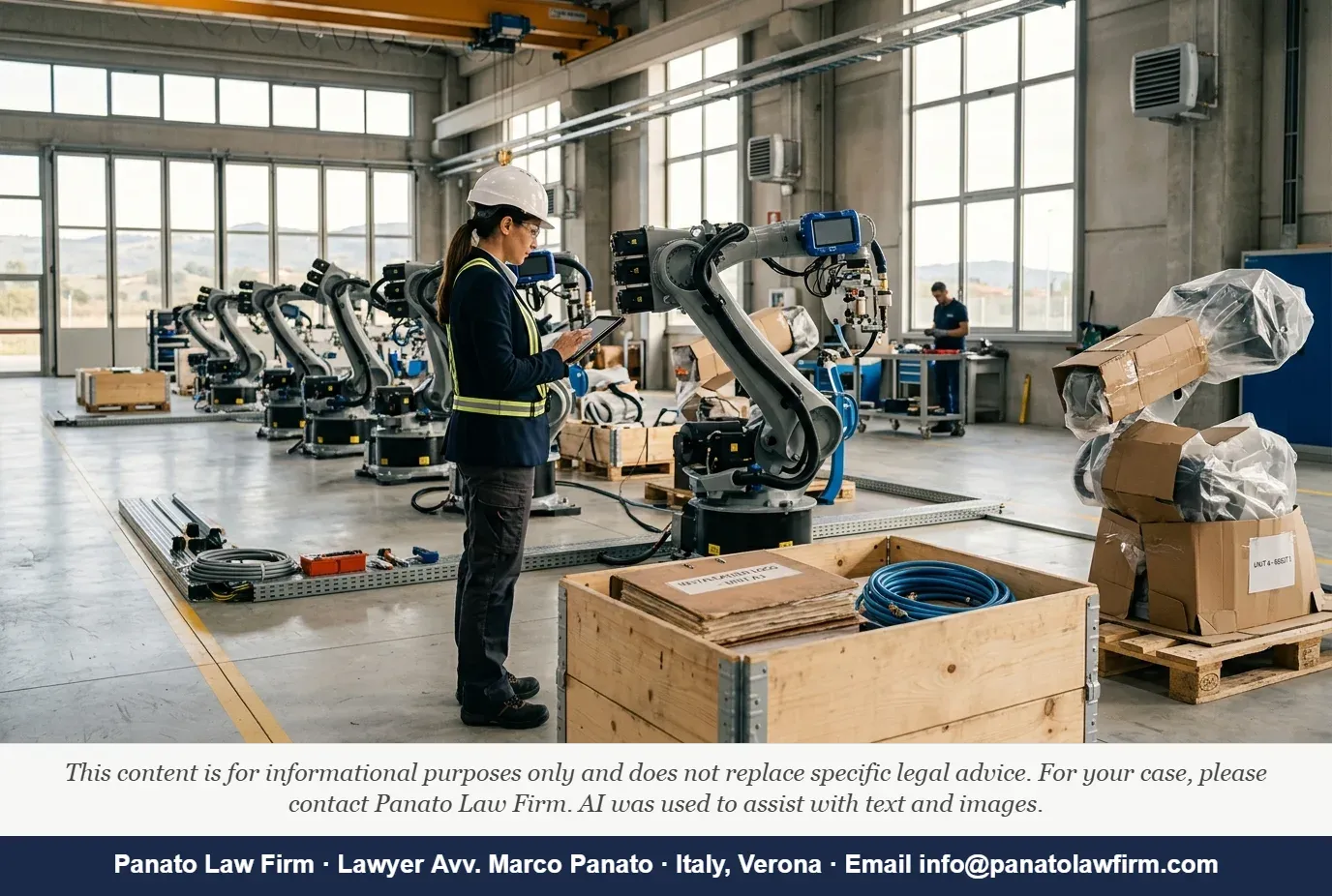
Image prompt: A modern Italian industrial facility in Southern Italy — wide floor of newly installed robotic assembly arms, warm afternoon light through large factory windows, a woman in a hard hat reviewing a tablet. The mood is purposeful and optimistic. Colour palette: pale industrial grey, amber light, flashes of cobalt blue from the machinery screens. The scene is mid-installation, not finished: one arm still boxed, a document folder on a crate nearby.
Image file: italy-investment-tax-incentives-foreign-subsidiary-2026-cover
HREFLANG BLOCK:
JSON-LD:
LANGUAGE QA: The credit is gone. -> The relief is lost. · The potential benefit was €900,000. -> The potential saving was €900,000. · Filing it after the fact does not cure the defect. -> Late filing does not remedy the defect. · a super-deduction applied directly to the cost -> an enhanced deduction computed on the cost · the net cash benefit at the 180% band is substantial but not equivalent to a direct credit -> the net cash value at the 180% band is material but falls short of a direct tax credit · Eligibility attaches to the Italian entity carrying out the investment, not to the shareholder. -> Eligibility turns on the Italian entity making the investment, not on its shareholder. · must verify the origin status of each asset at the point of purchase order -> must confirm the origin of each asset at the point of placing the purchase order · caused immediate concern among investors -> raised immediate concerns for investors
Quality: Italian terms without a plain explanation: partita IVA
GATE: READY
CHECK:
AUTHORITY 1 — Legislative Decree 184/2025 (Incentives Code)
References: D.Lgs. 184/2025, in force 1 January 2026
EXISTS? Yes — confirmed via Normattiva and Gazzetta Ufficiale (G.U. n. 302 of 27 December 2025, S.O. n. 45) — primary source
CONTENT MATCHES? Yes — establishes hyper-depreciation replacing Transition
Do you need legal assistance or a free estimate?
- September 30, 2026
- Redazione
Author: Editorial Team — Panato Law Firm
Editorial Team — Panato Law Firm Staff