Content developed with the assistance of AI tools and reviewed by the author.
Auction windows are open, capacity is finite — here is what to file, in what order, before the deadline closes against you
The most expensive mistake UK developers make entering Italy's renewable market is this: they price the project, secure the land option, appoint an EPC contractor, and then discover — three months before commercial operation — that they never registered on the Gestore dei Servizi Energetici (GSE, Italy's state energy services operator) portal, that their financial-soundness declaration does not meet the FerX Decree thresholds, or that their grid connection request was submitted to Terna (Italy's transmission system operator) after the queue closed. The slot is gone. The next auction cycle is twelve months away.
This checklist is written for the decision-maker who needs to know what to file, who signs it, what it costs, and what blocks it — before the window closes.
The Ministerial Decree of 18 June 2026 (the FerX Decree, adopted by MASE under the framework of Legislative Decree 199/2021 as substantially amended by Legislative Decree 190/2024 and Law 4/2026) replaces the previous Quater and FER 2 incentive schemes. It establishes a feed-in premium — a contract for difference paid by GSE — across three technologies: solar PV (ground-mounted and building-integrated), agrivoltaic, and onshore wind. Offshore wind and hydro have separate auction tracks.
The headline incentive for agrivoltaic projects submitted in the 2026 auction round is approximately EUR 85–92 per MWh (indicative, subject to auction outcome), compared with EUR 70–78 per MWh for conventional ground-mounted solar where permitted. Wind projects are targeting EUR 65–72 per MWh. These are reference premiums on top of the market price; the actual contract rate is set by competitive auction.
Two structural changes matter most to a UK sponsor. First, the FerX Decree expressly requires that the legal entity submitting the bid — typically an Italian società a responsabilità limitata (Srl, the equivalent of a private limited company) or società per azioni (SpA, broadly equivalent to a PLC) incorporated as the project company — must itself satisfy the financial-soundness test at the point of bid submission. A parent guarantee from a London holding company is not a substitute. Second, ground-mounted PV on agricultural land classified as class E (productive farmland) is now effectively closed as a primary development route following a Constitutional Court ruling in July 2026 upholding the regional bans that several Italian regions had introduced under Law 9/2024. The Court confirmed that regional landscape and agricultural land-use competences justify such restrictions even in the absence of a national prohibition. Agrivoltaic — where panels are elevated to allow continued cultivation beneath — is the remaining large-scale solar route on open land.
A UK developer cannot bid directly into a FerX auction. The bidding entity must be an Italian-registered company holding the relevant authorisation for the site. The steps must be followed in order.
Step one: incorporate or acquire the Italian project company. This takes four to six weeks from a standing start. The company must obtain an Italian VAT number (partita IVA) and an Italian tax code (codice fiscale) — both registered separately with the Agenzia delle Entrate — and enrol on the GSE operator portal. Enrolment is not automatic and typically takes a further ten business days.
Step two: obtain the construction permit. For projects above 1 MW the relevant authorisation is the Autorizzazione Unica (AU, a single integrated construction and environmental permit issued by the regional authority). For agrivoltaic projects under the fast-track regime discussed below, a simplified procedure applies. The landscape compatibility clearance — the nulla osta paesaggistico (landscape protection clearance issued by the competent Soprintendenza, Italy's heritage authority) — is a precondition for the AU and is the single most common bottleneck in practice. Soprintendenze have a 45-day statutory deadline, but many routinely exceed it. Allow 60–90 days as a working estimate.
Step three: submit the Terna grid connection request. This must be filed before the auction submission deadline. Terna operates a queue system: a request filed one day late falls into the next annual tranche. — sentence appears to be cut off — agreement is then signed separately. UK developers used to National Grid's grid connection process will find Terna's queue mechanics similar in concept but more rigid in execution — there is no equivalent of the National Grid interim or provisional offer that allows parallel workstreams to proceed.
Step four: bid into the GSE auction with the financial-soundness declaration attached. Without it, the bid is non-compliant and rejected outright.
This is the test that blindsides almost every first-time UK entrant.
The FerX Decree requires each bidding entity to demonstrate financial soundness at the project level. For projects with a total capital expenditure up to EUR 100 million, the threshold is a capitalisation ratio of at least 10%: the Italian project company's equity (paid-in capital plus retained earnings or shareholder contributions) must equal at least 10% of the project's estimated total investment cost. For projects above EUR 100 million, a bank comfort letter from an Italian or EU-regulated credit institution is required in addition, confirming the availability of debt financing commensurate with the project size.
Unlike in most common-law jurisdictions, where a parent company letter of support or a group treasury facility letter is routinely accepted as evidence of financial capacity at bid stage, Italian administrative procurement law — applied by analogy to GSE auctions under Legislative Decree 36/2023 (the Public Procurement Code) — does not recognise upstream credit support as a substitute for the project entity's own capitalisation. The project company must hold the equity itself, on its own balance sheet, at the date of bid submission. A UK sponsor who transfers the land option and the permitting into a newly incorporated Italian Srl without simultaneously injecting the required equity will fail the test regardless of the group's consolidated net worth.
Practical cost: for a 50 MW agrivoltaic project with capex of approximately EUR 45 million (using EUR 900,000 per MW as a working estimate for AgriPV), the minimum equity injection into the Italian entity is EUR 4.5 million. That capital must be in the company's accounts — confirmed by a statutory auditor's certificate or a bank statement — at bid submission, not at financial close.
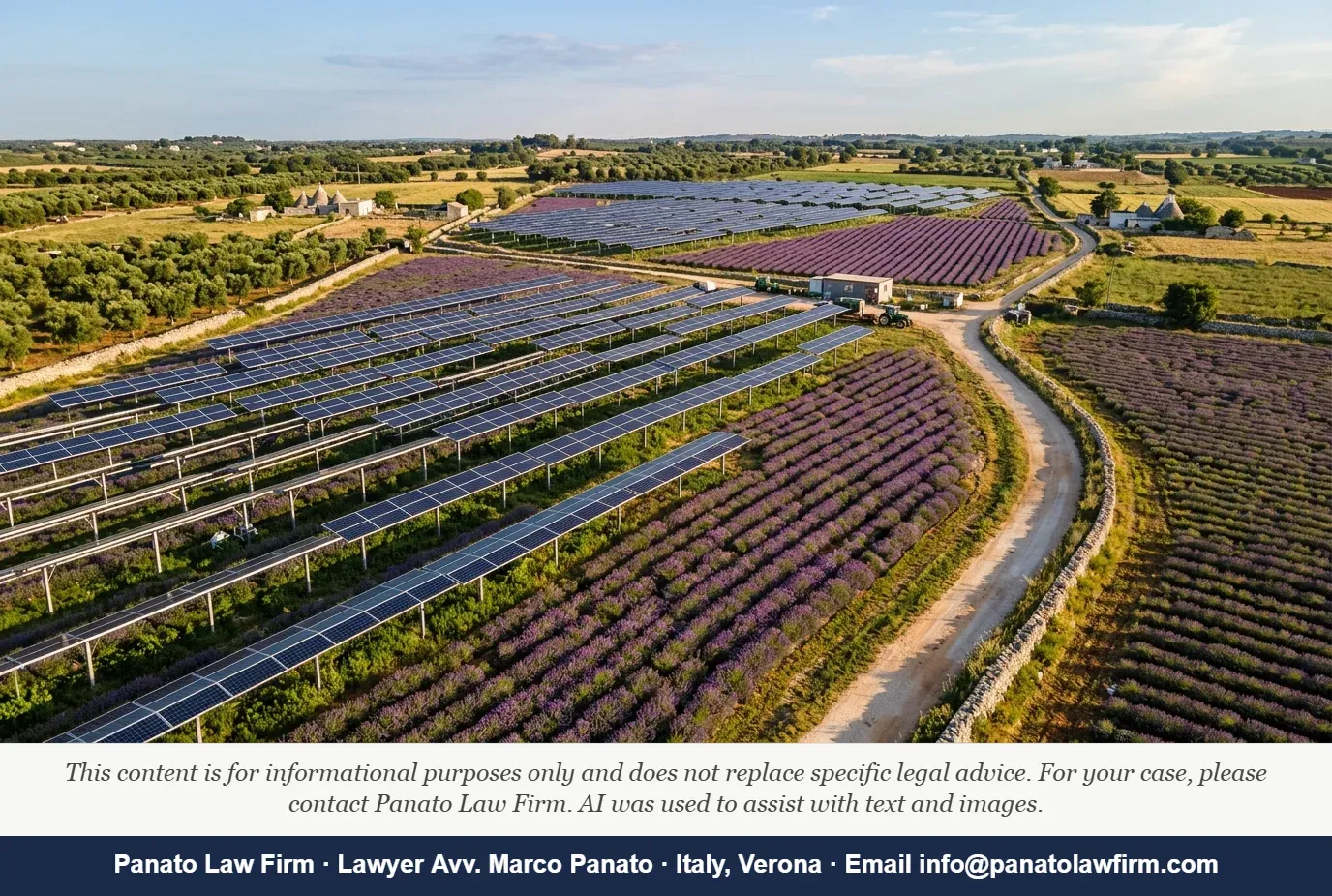
Legislative Decree 190/2024 introduced a 90-day fast-track permitting cap for agrivoltaic projects that meet the technical specifications set out in the Ministerial Decree of 6 July 2012 (as updated by MASE guidelines published in 2024): panels must be elevated at least 2.1 metres above ground level, at least 70% of the land beneath must remain cultivable, and agricultural production must continue throughout the project's operational life, monitored annually by the project company and reported to GSE.
The 90-day cap is a statutory maximum for the competent regional authority to complete the simplified AU procedure (procedura abilitativa semplificata, PAS). It sounds fast. In practice, it runs from the date of a complete submission: any request for supplementary documents resets the clock or, in some regional administrations, suspends it. The practical window from a complete submission to a valid permit is 110–140 days in the regions with the highest renewable pipeline (Puglia, Sicilia, Sardegna).
The land constraint is real. A 10 MW agrivoltaic project requires approximately 12–15 hectares. The 70% cultivability rule means that roughly 8.4–10.5 hectares must remain in active agricultural use. The choice of crop matters for the permit: crops with high light tolerance (lavender, saffron, certain soft fruit) are routinely accepted; intensive arable monocultures are not. Structuring the agricultural lease with an experienced Italian agronomist before the PAS submission accelerates the Soprintendenza clearance because the landscape authority scrutinises the agricultural continuity argument as part of its review.
Yes — and this is the combination that most English-language commentary on FerX misses entirely.
If a UK developer enters Italy not by building a new project but by acquiring an existing Italian renewable energy platform — a common route for funds seeking a shorter path to FerX-eligible capacity — the transaction may trigger the golden power screening regime under Law 4/2026 (the Golden Power Law reform of 15 January 2026). The energy sector is a protected domain under the golden power framework. An acquisition of a controlling or qualifying stake (generally above 10% from a non-EU acquirer, with lower thresholds for strategic assets) in an Italian company owning grid-connected renewable assets requires a notification to the Presidency of the Council of Ministers within ten days of signing.
Post-Brexit, UK acquirers are treated as non-EU investors for golden power purposes. There is no reciprocal exemption. A UK fund acquiring a 25% stake in an Italian IPP (independent power producer) owning 200 MW of FerX-eligible solar assets must file a golden power notification. Failure to notify carries a fine of up to 10% of the transaction value and the government retains the power to impose conditions or, in extreme cases, block the deal or unwind it.
The sequencing risk is acute: the FerX incentive contract runs with the asset, not with the corporate entity that holds it. A change of control without a cleared golden power notification can — in the GSE's administrative practice — trigger a review of the incentive contract's validity. UK sponsors structuring acquisitions of existing renewable platforms should file the golden power notification concurrently with the signing notification to GSE, not after closing.
Nemo iudex in causa sua — no one is a judge in their own case — is a principle that applies as much to self-assessment of regulatory risk as to litigation. The practical danger for a UK sponsor is not any single filing requirement but the interaction between three independent queues running on different clocks.
The Terna grid connection queue runs on a calendar-year basis. The GSE auction window typically closes in October for projects seeking commissioning in the following 24 months. The golden power review window is 45 days (extendable to 60 days in complex cases) and runs from the government's receipt of a complete notification — not from the notification date. If a UK fund signs an acquisition of an Italian platform in September and the golden power notification is not cleared by the October GSE auction submission deadline, the acquired entity cannot bid in that cycle.
In our files, the most common mistake is the assumption that administrative silence is consent: a developer submits the golden power notification, receives no response within 45 days, assumes clearance has been granted by default, and submits the GSE bid. In fact, the 45-day period is extendable, and a bid submitted before formal clearance is a bid submitted by a party whose ownership structure is still under governmental review. GSE's auction rules treat that as a material uncertainty.
The Council of State (Consiglio di Stato, Italy's highest administrative court), Section VI, Decision No. 9619 of 5 December 2025 (Cons. Stato, Sez. VI, 5 dicembre 2025, n. 9619), clarified — in the context of security pledges over strategic-sector companies — that the golden power obligation attaches to the exercise of rights, not merely to their acquisition. The same logic applies to the transition from platform acquisition to GSE auction participation: the moment the acquired entity takes a step that confirms operational control, the golden power clock matters.
Can a UK-incorporated holding company bid directly into a FerX auction without an Italian subsidiary?
No. The GSE auction requires the bidding entity to be registered in Italy, to hold a partita IVA, and to be enrolled on the GSE operator portal. A UK parent company cannot submit a bid on behalf of an Italian project. The Italian Srl or SpA must be incorporated, capitalised and enrolled before the auction submission window opens. Allow at least eight weeks from a standing start before the deadline.
What happens if the agrivoltaic project fails the 70% cultivability test after commissioning?
GSE monitors compliance annually through mandatory agricultural activity reports submitted by the project company. A failure of the cultivability threshold — typically caused by overshadowing, soil compaction or cessation of the agricultural lease — triggers a GSE notice requiring remediation within 90 days. If the project company does not remediate, GSE may reclassify the installation from agrivoltaic to conventional ground-mounted PV and, where the site is on agricultural land now restricted under the July 2026 Constitutional Court ruling, suspend the incentive payment pending regulatory review. The financial impact of a suspended incentive on a project with a EUR 45 million debt package is immediate and severe.
Is there a minimum project size to access FerX auctions?
The FerX Decree sets a lower threshold of 1 MW for auction participation. Projects below 1 MW may access a separate register-based incentive (the registro track) with a different application procedure and lower incentive rates. Most UK developers and institutional funds are working at 10 MW and above, where the auction track applies and the financial-soundness, grid-connection and golden power requirements described in this article all engage simultaneously. The next concrete step for a project at that scale is to instruct Italian counsel to review the GSE portal enrolment status, confirm the Terna queue position, and map the golden power exposure before the October auction window opens.
HREFLANG BLOCK:

Editorial Team — Panato Law Firm Staff