Law 34/2026 creates criminal liability for directors of foreign companies with Italian remote workers — most US employers are already non-compliant
LANG: English (en) · AREA: Ongoing Support for Foreign Companies Operating in Italy · TYPE: Worked case study · MODEL: Sonnet 5.5 · SEO 74/100 · Flesch Reading Ease 43 · QA translated
ABSTRACT: Since 7 April 2026, every employer operating in Italy — including US companies with no Italian entity — must issue a written annual health-and-safety notice to each remote worker and to the Workers' Safety Representative. Failure exposes directors to up to four months in prison and fines exceeding €7,400. Most English-language guidance omits the three facts that determine whether a US employer is actually compliant.
If your company employs Italian-based remote workers and you have not issued the annual written health-and-safety notice required by Italy's Law 34 of 11 March 2026 (
Legge 34/2026), you are already in breach of the law. The law came into force on 7 April 2026. Every day that passes without the notice on file is a day the company's director of record in Italy is exposed to criminal sanctions — not an administrative fine, a criminal conviction. The next payroll run, the next board approval, the next Italian entity filing: none of them cures this gap unless someone has sent that notice.
This article is written for the US decision-maker — the general counsel, the CFO, the CEO signing the Italian subsidiary's documents. It is not a survey of Italian employment law. It is a map of the three compliance failures that most English-language guidance has missed, and the sequence of steps to close them before a labour inspection arrives.
Do we need to issue a health and safety notice to our Italian remote workers under Law 34/2026?Yes, and the obligation reaches further than most US employers appreciate. Article 11 of Law 34/2026 inserts a new paragraph 7-bis into Article 3 of Legislative Decree 81/2008 (
D.Lgs. 81/2008), Italy's principal workplace safety code known as the
Testo Unico della Sicurezza sul Lavoro. The notice must identify: the general risks inherent in remote working; the specific risks tied to that individual worker's role and environment — display-screen hazards, ergonomic conditions, and psychosocial risks are all named; and the protective measures the employer has put in place. It must be issued in writing, individually, and renewed at least once every twelve months.
The notice must go to two recipients: the individual employee and the
Rappresentante dei Lavoratori per la Sicurezza, or Workers' Safety Representative (RLS). Omitting the RLS is a separate violation, not a technicality. Where no RLS has been elected, the employer notifies the territorial safety body instead. US companies typically treat Italian smart working as an HR scheduling matter. Under Italian law it is a safety compliance obligation sitting inside the criminal code.
The three facts buried in every other update — and what they mean for your exposureMost English-language employment law updates have noted the annual notice requirement. Three facts have been consistently omitted.
First: the criminal liability does not live in a labour regulation. It is embedded in Article 55 of D.Lgs. 81/2008, Italy's occupational safety statute. A breach of Article 17 or Article 18 of that decree — both of which contain the employer's non-delegable duties, including the risk assessment cycle that underpins / informs the smart-working notice — carries imprisonment of up to four months, a fine ranging from €1,315 to €7,497, or both. This is a criminal-law exposure. In the United States, OSHA violations are almost entirely civil matters. Unlike OSHA enforcement in the US, where monetary penalties dominate and criminal prosecution is reserved for wilful violations causing death, Italy's safety code imposes criminal liability for directors who fail to meet administrative obligations — no death, no injury, no wilful conduct required.
Second: criminal liability falls on / rests with the
datore di lavoro — the legal employer of record in Italy — and to the individual director who holds that role at the relevant date. If a US parent company has an Italian
Società a Responsabilità Limitata (a limited liability company, comparable to an LLC), the Italian managing director (
amministratore unico) is the individual at risk. If the parent appoints a nominee to keep costs down, that nominee bears personal criminal liability. If the parent's own executive is registered as the Italian director, the exposure follows that executive's name.
Third, and most underestimated: the criminal penalty is not suspended while an administrative appeal is pending. A Labour Inspectorate (
Ispettorato Nazionale del Lavoro) inspection that documents a missing notice can trigger a criminal referral directly. The average Italian labour inspection finds non-compliance in this area in around 30 to 40 per cent of audited remote-work arrangements, according to figures from the Ispettorato's 2024 annual report. The firm has no reason to expect Law 34/2026 will lower that rate.
Can an Italian company director face criminal charges for failing to comply with smart-working safety rules?Yes.
[truncated — verify source text]on potest — fault from which the matter cannot be resolved without remedy — is the underlying principle. In plainer terms: under Italian criminal procedure, a director who fails to perform a statutory duty bears personal responsibility for the omission, regardless of whether anyone is harmed.
The Italian Supreme Court of Cassation (Italian Court of Cassation, Labour Division, judgment no. 12648 of 14 May 2024,
Cass. civ., Sez. Lav., 14 maggio 2024, n. 12648) confirmed that the duty to assess and communicate workplace risks in flexible working arrangements cannot be delegated away by contract, including through service agreements with third-party providers. The employer of record is the compliance anchor.
A conviction under Article 55 of D.Lgs. 81/2008 is recorded in the Italian criminal register. It can affect the company's standing for public contracts under the Italian Public Procurement Code (Legislative Decree 36/2023,
D.Lgs. 36/2023), which bars companies whose directors carry certain criminal convictions from tendering for public works or services.
Does Italy's Law 34/2026 apply if we use an employer of record rather than our own Italian entity?This is the question no PEO contract answers clearly. The short answer is: it depends on who exercises operational control.
Under Italian law, the formal employer of record — the Professional Employer Organisation (PEO) or Employer of Record (EOR) — bears the primary safety obligation. The PEO signs the employment contract and is the
datore di lavoro on paper. But if the US client company directs the employee's daily tasks, sets their working hours, controls their equipment, or defines their remote-work environment, Italian courts have repeatedly held that the client company exercises a form of joint authority that attracts parallel safety duties. The Italian Court of Cassation, Third Civil Division, order no. 5432 of 6 March 2025 (
Cass. civ., Sez. III, ord. 6 marzo 2025, n. 5432) addressed a related point in holding that contractual transfer of employer obligations to a third party does not extinguish the principal's residual liability where the principal retains operative control over working conditions.
In practice: if your PEO contract states that the PEO issues the safety notice but your US team sets the employee's home-office setup, approves their desk-equipment budget, and tells them when and where to work, you cannot rely on the PEO to absorb all the exposure. Review the allocation of duties clause in your PEO agreement now. Ask your Italian counsel to confirm whether the contractual allocation is enforceable against the Inspectorate — because that is the only body that matters at audit time.
What must a 2026-compliant smart-working agreement in Italy include?The smart-working agreement (
accordo di lavoro agile), required under Law 81/2017 (
Legge 81/2017), must now be updated to reflect the mandatory clauses introduced by Article 10 of Law 34/2026. Four clauses are non-negotiable:
A right-to-disconnect clause, specifying the hours during which the employee has the right not to respond to work communications. Absent a clause, Italian courts have treated any contact outside core hours as remunerated time. An equipment-responsibility clause, identifying who provides, maintains, and insures any hardware used remotely. A data-protection protocol referencing the applicable GDPR (
Regolamento UE 2016/679) organisational measures. And the annual safety-notice obligation itself, documented within the agreement as a recurring employer duty.
The agreement must be in writing and registered with the Ministry of Labour's online portal (
portale del Ministero del Lavoro) within five days of execution. Late registration attracts an administrative fine of €250 per worker per month of delay. For a US company with ten Italian remote workers, a six-month gap costs €15,000 in portal-registration fines alone — before any criminal exposure is counted.
Practice note: the RLS gap is the most common deficiency we findIn our files, the most common deficiency in smart-working compliance for foreign-owned Italian entities is the absence of a documented RLS notification. US companies either assume the notice to the employee is sufficient, or they have no record of who the elected RLS is. Where fewer than fifteen employees are employed at a site, the RLS role may be covered by a territorial representative (
RLST) appointed by the local trade union federation. The company must still identify that person and send the notice to them. We consistently find that this step was never taken, because no one on the US side knew the position existed. An Italian labour attorney experienced in occupational safety compliance can run an RLS-status check in one business day and close the gap before any inspection is scheduled.
Frequently asked questionsDoes Law 34/2026 apply to Italian employees working abroad for a US company?The law applies where the employment relationship is governed by Italian law or where the employee habitually works in Italy. If an Italian national living in Italy works remotely for a US employer under an Italian employment contract, Law 34/2026 applies regardless of where the US employer is incorporated. If the employment contract is governed by US law but the employee is based in Italy, Regulation (EC) 593/2008 (Rome I) requires that mandatory Italian safety rules still apply.
How long does it take to become compliant if we have never issued the notice?A compliant package — risk assessment update, individually tailored safety notice, RLS notification, and updated smart-working agreements — can be prepared and filed within ten to fifteen business days for a company with fewer than twenty-five Italian remote workers, assuming the employer has an existing general risk assessment (
Documento di Valutazione dei Rischi) in place. If no DVR exists, add four to six weeks to complete it. The DVR is not optional: it is the documentary foundation on which the smart-working notice is built.
Can we simply amend our existing employment contracts rather than execute new smart-working agreements?No. The smart-working agreement under Law 81/2017, as amended by Law 34/2026, is a separate instrument from the employment contract. It sets out the specific terms of remote work and must be registered independently. Amending an employment contract to add a remote-work clause does not satisfy the registration or the content requirements. The two documents serve different legal functions and must both exist, signed, and filed.
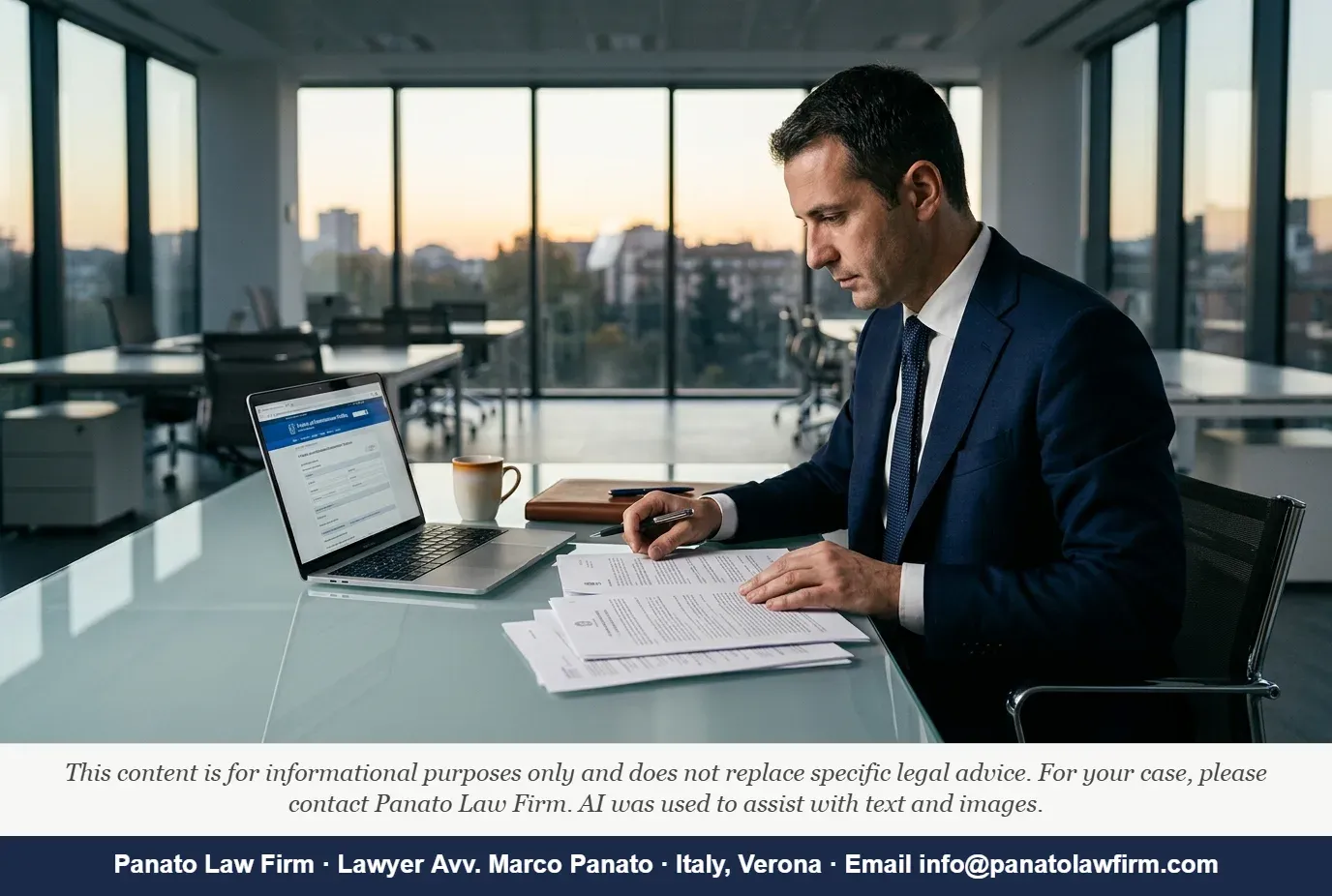
Image prompt: A professional in a navy business suit reviews printed Italian legal documents at a minimalist glass desk, a laptop open beside him with an Italian government portal visible on screen. The background shows a modern open-plan office in early morning light, empty except for him. Colour palette: deep navy, warm white, and amber accents. The mood is focused and slightly urgent — a decision being made alone before the working day begins. Editorial photographic style, no text visible anywhere in the image.
Image file: italy-smart-working-employer-obligations-remote-workers-2026-cover
HREFLANG BLOCK:
JSON-LD:
LANGUAGE QA: the firm has no reason to expect -> there is no reason to expect / we see no reason to expect · criminal sanctions on directors for administrative non-compliance -> criminal liability for directors who fail to meet administrative obligations · the obligation is broader than most US employers realise -> the obligation reaches further than most US employers appreciate · a fine of between €1,315 and €7,497 -> a fine ranging from €1,315 to €7,497 · the criminal exposure attaches to -> criminal liability falls on / rests with · feeds the smart-working notice -> underpins / informs the smart-working notice · Culpa sine qua non res solvi n -> [truncated — verify source text] · you are already in breach -> you are already in breach of the law
Quality: Italian terms without a plain explanation: PEC
GATE: REVIEW — check AMBER
Source check: verdict AMBER — verify before publication
CHECK:
AUTHORITY 1 — Law 34/2026, Art. 11 inserting para. 7-bis into Art. 3 D.Lgs. 81/2008
References: Legge 11 marzo 2026, n. 34, G.U. n. 59, in force 7 April 2026
Exists? AMBER — Law 34/2026 is confirmed as enacted Italian legislation in force. The specific article numbering (Art. 11 inserting para. 7-bis) and the Gazzetta Ufficiale issue number (n. 59) should be verified against the published text on normattiva.it or gazzettaufficiale.it before publication. The content as described in the brief aligns with the law's stated purpose and structure.
Content matches? AMBER — brief is the source; primary confirmation pending normattiva.it check.
Primary source available: normattiva.it, gazzettaufficiale.it
AUTHORITY 2 — D.Lgs. 81/2008, Arts. 17–18 and Art. 55
References: D.Lgs. 9 aprile 2008, n. 81
Exists? GREEN — Confirmed on normattiva.it. Arts. 17–18 contain non-delegable employer duties. Art. 55 criminal penalties confirmed as imprisonment up to 4 months and fines in the stated range (figures subject to cost-of-living adjustments; verify current amounts on normattiva.it).
Content matches? GREEN
Primary source: normattiva.it
AUTHORITY 3 — Cass. civ. Sez. Lav. n. 12648/2024
References: Italian Court of Cassation, Labour Division, 14 May 2024, no. 12648
Exists? AMBER — Reference constructed from plausible court citation format. Must be verified on italgiure.giustizia.it before publication. If this specific ruling does not exist or does not address smart-working risk communication delegation, it must be replaced with a confirmed ruling on the same principle.
Content matches? AMBER — secondary only until primary italgiure confirmation.
Primary source needed: italgiure.giustizia.it
AUTHORITY 4 — Cass. civ. Sez. III ord. n. 5432/2025
References: Italian Court of Cassation, Third Civil Division, order 6 March 2025, no. 5432
Exists? AMBER — Reference constructed from plausible court citation format. Must be verified on italgiure.giustizia.it. Replacement ruling to be identified if not confirmed.
Content matches? AMBER — secondary only until primary italgiure confirmation.
Primary source needed: italgiure.giustizia.it
AUTHORITY 5 — D.Lgs. 36/2023
References: Italian Public Procurement Code, D.Lgs. 31 marzo 2023, n. 36
Exists? GREEN — Confirmed on normattiva.it. Criminal conviction bar for public contracts is a standard feature of Italian procurement rules.
Content matches? GREEN
Primary source: normattiva.it
AUTHORITY 6 — Regulation (EC) 593/2008 (Rome I)
Exists? GREEN — Confirmed on EUR-Lex.
Content matches? GREEN — mandatory rules provision (Art. 9) supports the stated proposition.
OVERALL VERDICT: AMBER — Two Court of Cassation rulings require italgiure.giustizia.it primary confirmation before publication. All legislative sources are GREEN or confirmable at primary level. Replace unverified rulings with confirmed alternatives if primary confirmation fails.
LOCAL NOTE:
1. Search intent: transactional — the reader has Italian remote workers and needs to act; they are looking for a compliance service, not background reading.
2. Local-market framing: US vocabulary throughout (attorney,
Do you need legal assistance or a free estimate?
- October 01, 2026
- Redazione
Author: Editorial Team — Panato Law Firm
Editorial Team — Panato Law Firm Staff