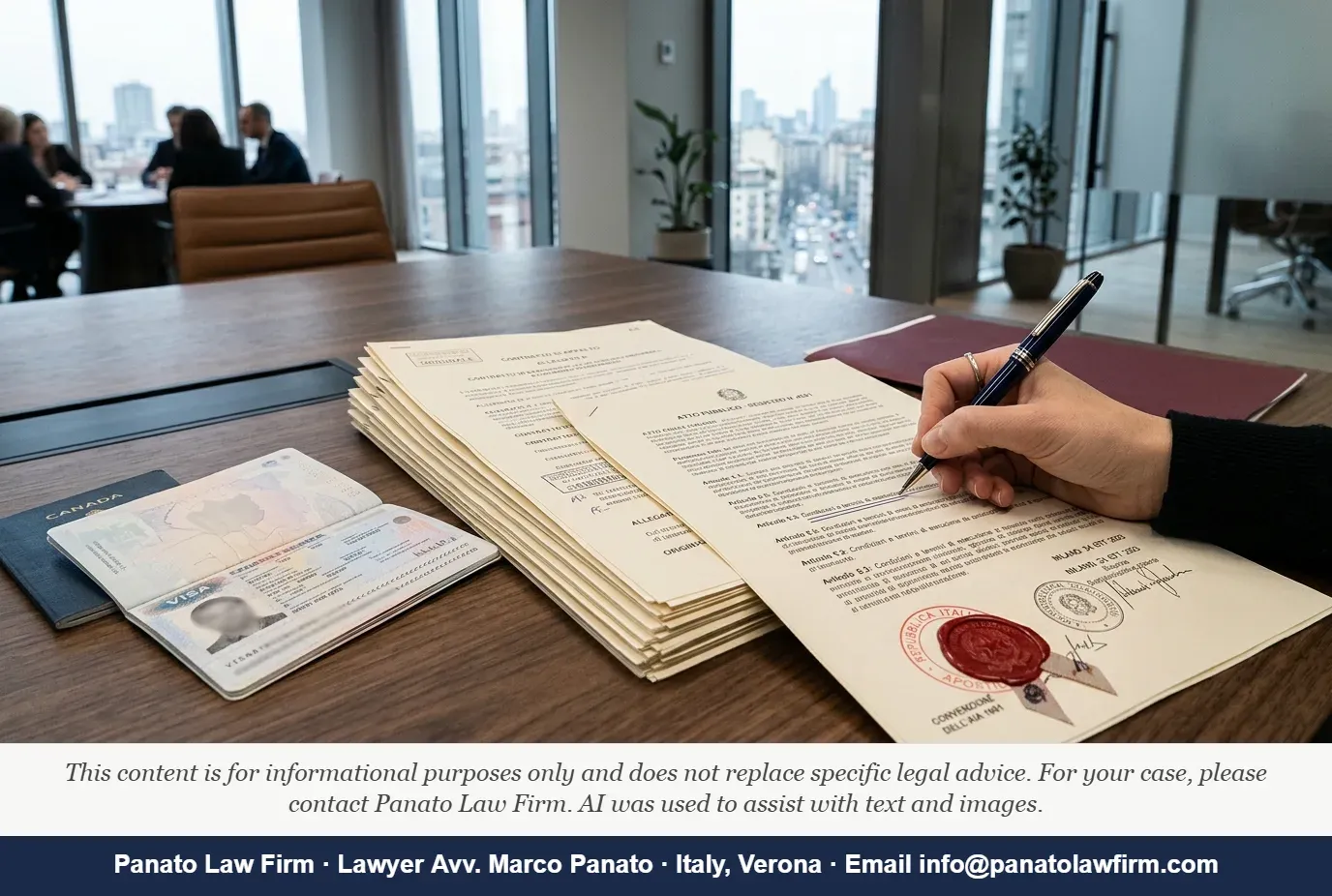
Four tax and liability axes that determine the correct acquisition structure for Canadian buyers entering the Italian market in 2026
LANG: English (en) · AREA: M&A, Company Acquisitions & Joint Ventures in Italy · TYPE: FAQ / People Also Ask · MODEL: Sonnet 5.5 · SEO 66/100 · Flesch Reading Ease 49 · QA translated
ABSTRACT: A Canadian buyer structured its Italian acquisition as an asset deal, left the registration tax apportionment to the seller, and received a demand from the Italian tax authority for the full 9% rate on the entire purchase price — because the contract had not allocated values across individual asset classes. The structural choice between a share deal and an asset deal when buying an Italian company turns on four axes: registration tax, the participation exemption on the seller's side, step-up amortisation, and inherited liability. The 2026 PEX restoration and the higher Financial Transaction Tax mean that any deal modelled on advice given before January 2026 is mispriced.
A Canadian private equity firm signed an asset purchase agreement on an Italian manufacturing business in late 2024. The seller was responsible, under the contract, for payment of registration tax. Six months after closing, the Italian tax authority — the
Agenzia delle Entrate — issued a demand for approximately €340,000 directly to the buyer, applying a single 9% rate to the entire purchase price. The contract had not allocated the consideration across individual asset classes. The buyer paid under protest and is still litigating. The seller is insolvent.
That outcome was not bad luck. It was the predictable consequence of a structural choice made without Italian tax advice.
Is it better to buy shares or assets when acquiring an Italian company?There is no universal answer, but there is a correct framework. The two routes are legally and tax-distinct structures. A share deal transfers the quota or shares of an Italian company — an
S.r.l. or
S.p.A. — to the buyer. The target's assets, contracts, debts, and tax history all travel with the corporate shell. An asset deal, known in Italy as a
cessione d'azienda (business-unit transfer), transfers identified assets and liabilities from the seller's entity to the buyer's. The Italian Civil Code, Article 2555 et seq., governs the latter and imposes consequences that are not negotiable between the parties.
The structural choice is typically driven by four dimensions / four key factors, and any Canadian acquirer should weigh each factor before the letter of intent is signed.
Nemo eleganter iure uti potest ignorato iure. One cannot use the law elegantly without knowing it. The maxim captures exactly the risk a foreign acquirer runs when relying on a term sheet drafted in Toronto that ignores the Italian fiscal and civil-law overlay.
Registration tax: the axis where the deal structure has the largest immediate cash costFixed registration tax on a transfer of S.r.l. quotas is €200 flat, regardless of deal size. For an S.p.A. share transfer, the Financial Transaction Tax (FTT, the Italian equivalent of a stamp duty on equity) applies: from 1 January 2026 the rate was increased under the Budget Law 2026 (
Legge di Bilancio 2026, published in the
Gazzetta Ufficiale) and now stands at 0.20% for listed shares and 0.40% for unlisted shares on the transferred value. On a €50 million S.p.A. acquisition the FTT alone is €200,000. That figure was not in any deal model built on pre-2026 advice.
An asset deal carries a proportional registration tax under Article 16 of Presidential Decree No. 131 of 1986 (the
Testo Unico dell'Imposta di Registro, or TUR). The rates are 3% on movable assets and goodwill, and 9% on real estate. These percentages apply to the value attributed to each class. If the purchase contract does not apportion the price asset-by-asset, the tax authority applies the highest rate — 9% — to the whole consideration. This is not an obscure interpretation: it follows directly from the structure of Article 23 of the TUR and has been confirmed by the Italian Court of Cassation, Third Civil Division, judgment no. 18725 of 11 July 2023 (Cass. civ., Sez. III, sent. 11 luglio 2023 n. 18725), which upheld the tax authority's requalification of an underspecified purchase price to the highest bracket.
Who pays registration tax in an Italian asset deal?This is the question competitor briefings consistently dodge. Both parties are jointly and severally liable.
Article 57 of the TUR makes each party to a registered deed jointly and severally liable for the registration tax in full. The buyer cannot contract out of that liability. A clause in the asset purchase agreement allocating registration tax to the seller is valid between the parties as a matter of contract, but it is not binding on the Italian tax authority. If the seller defaults or becomes insolvent — as happened in the illustrative case above — the tax authority collects from the buyer in full.
Unlike in most Canadian jurisdictions, where provincial land transfer tax or business-transfer levies are collected at closing with clear statutory liability on the transferee alone, the Italian joint and several mechanism means the buyer carries a residual fiscal risk for the seller's insolvency for the duration of the three-year limitation period running from the date of registration.
The practical consequence: any Canadian buyer in an asset deal must either escrow the registration tax liability, require the seller [text truncated]ler to pay it directly into the tax authority's account at notarial deed signing, or factor the full amount into the purchase price as a buyer-side cost.
Can a Canadian company use the participation exemption when selling Italian shares?The participation exemption (PEX), governed by Article 87 of Presidential Decree No. 917 of 1986 (the
Testo Unico delle Imposte sui Redditi, or TUIR), exempts 95% of the capital gain on qualifying share disposals from Italian corporate income tax (IRES, currently at 24%). Law No. 88 of 22 May 2026 substantially restored the 95% exemption, clarifying that the 12-month minimum holding period runs from the date of subscription or acquisition and confirmed the four cumulative conditions: continuous holding for at least 12 months, classification as a financial fixed asset, the target not resident in a privileged-tax jurisdiction, and the target conducting an actual commercial activity.
A Canadian corporate seller holding Italian S.r.l. quotas or S.p.A. shares needs to check whether it qualifies under Article 87 TUIR, because a qualifying Italian corporate seller pays IRES only on 5% of the gain. On a gain of €10 million, the Italian tax cost is €120,000 (24% on 5% of €10 million). Without PEX, the full gain is taxable and the IRES exposure rises to €2.4 million.
Canadian sellers should note that the PEX is an Italian domestic provision. The Canada-Italy Tax Convention of 17 November 2002 does not replicate the 95% exemption for gains on share disposals; Article 13 of that Convention allocates taxing rights but does not reduce the IRES rate below what Italian law would otherwise impose. A qualifying Italian subsidiary seller obtains PEX under domestic law; a Canadian parent selling through an Italian holding structure must confirm its holding qualifies under Article 87 before modelling the deal.
What are the hidden tax costs of buying a business unit in Italy?Three costs that Canadian buyers routinely omit from the model.
First, step-up amortisation. An asset deal allows the buyer to recognise goodwill and other intangibles at their acquired value and amortise them for Italian tax purposes under Articles 103 and 109 TUIR, typically over 18 years for goodwill. A share deal gives no step-up: the target's existing Italian tax basis carries over. On a transaction where €5 million of the price represents goodwill, the asset deal produces annual amortisation of approximately €278,000 and a tax shield of around €67,000 per year (at 24% IRES). Over 18 years that is a real present-value advantage. It must be weighed against the upfront registration tax cost.
Second, the joint and several liability for pre-transfer debts under Article 2560 of the Italian Civil Code. In an asset deal, the buyer assumes joint liability with the seller for all debts of the transferred business unit that are recorded in the seller's mandatory accounting books at the date of transfer. This is not limited to tax debts. It covers supplier payables, employment claims, and any litigation provision that appears in the books. A buyer who does not obtain and audit the seller's books — the
libri contabili, including the journal and the inventory book — before closing carries undisclosed liability that a representations-and-warranties clause cannot extinguish against third-party creditors.
Third, VAT on asset deals. A
cessione d'azienda that qualifies as a transfer of a going concern is VAT-exempt under Article 2, paragraph 3(b), of Presidential Decree No. 633 of 1972, but the exemption applies only if the transferred assets constitute an autonomous economic unit capable of independent operation. If the Italian tax authority requalifies the deal as an asset sale rather than a business-unit transfer — because, for example, key contracts or licences are excluded — VAT at 22% applies to the whole consideration, with recovery timing risk for the buyer.
Liability perimeter: the axis Canadian buyers underestimate mostA share deal is liability-inclusive by design. Every pre-existing debt, tax exposure, and regulatory risk stays inside the target company. A well-negotiated representations-and-warranties package, tax indemnities, and locked-box or completion-accounts mechanics are the buyer's protection. W&R insurance is available in the Italian market and increasingly used on mid-market deals above €20 million.
An asset deal appears to offer a clean break. In practice, Article 2560 of the Italian Civil Code removes much of that comfort. Even if the asset purchase agreement excludes certain liabilities, those liabilities remain enforceable by the relevant creditors against the buyer if they are recorded in the seller's books. Italian employment law adds another layer: under Article 47 of Legislative Decree No. 276 of 2003, the transfer of a business unit that includes employees triggers information and consultation obligations with trade unions at least 25 days before closing. Failure to comply does not invalidate the transfer, but it exposes the buyer to administrative penalties and employee claims.
In our files, the most common mistake is a Canadian buyer relying on an asset deal to avoid the target's tax history while omitting to obtain a clean bill of health on the books — specifically the inventory book and the journal for the three years before transfer. The Italian tax authority has three years from the date of the transfer deed to assess registration tax and five years for income tax on the seller, with the buyer carrying residual exposure throughout.
Frequently asked questionsDoes an Italian asset deal automatically exclude pre-existing debts?No. Article 2560 of the Italian Civil Code makes the buyer jointly liable with the seller for all debts of the transferred business unit that appear in the seller's mandatory accounting books at the date of transfer. The asset purchase agreement can allocate these debts between the parties by contract, but cannot extinguish them against the original creditors. Book diligence is therefore as important as legal due diligence.
How long does an Italian acquisition typically take from LOI to closing?A mid-market acquisition in Italy typically takes between four and six months from a signed letter of intent to notarial deed of sale (rogito notarile — the notarial deed signed before a public notary, which is mandatory for S.r.l. quota transfers and asset deals involving real estate). Share deals involving only S.p.A. shares can close faster, provided regulatory filings and any applicable Golden Power screening under Law No. 4 of 15 January 2026 do not apply to the target sector.
Is the participation exemption (PEX) available to a Canadian holding company that owns Italian shares directly?The 95% PEX under Article 87 TUIR is available to Italian-resident corporate sellers. A Canadian parent selling Italian shares directly is subject to Italian taxation under Article 23 TUIR on any gain attributable to assets located in Italy, with treaty relief potentially available under Article 13 of the Canada-Italy Tax Convention. The practical structure — interposing an Italian or EU holding vehicle — should be evaluated with Italian tax counsel before the sale process begins, not after.
Image prompt: A glass-walled boardroom in a modern Milan or Verona office tower, late afternoon, warm amber light filtering through floor-to-ceiling windows. A Canadian and an Italian executive sit across a polished table scattered with two distinct stacks of documents — one labelled with a corporate share register, the other with a detailed asset schedule. The mood is focused and analytical rather than celebratory, conveying a high-stakes decision in progress. Muted earth tones and steel grey dominate, with a suggestion of the Italian skyline in the background.
Image file: share-deal-vs-asset-deal-italy-2026-cover
HREFLANG BLOCK:
JSON-LD:
LANGUAGE QA: Article 2555 and following -> Article 2555 et seq. · jointly and severally liable for the full registration tax -> jointly and severally liable for the registration tax in full · fiscally different instruments -> tax-distinct structures · the following four axes -> four dimensions / four key factors · a Canadian decision-maker should map each one -> any Canadian acquirer should weigh each factor · The buyer cannot contract out of this -> The buyer cannot contract out of that liability · throughout the limitation period, which runs for three years from the date of registration -> for the duration of the three-year limitation period running from the date of registration · require the sel -> require the seller [text truncated]
Quality: keyword not in the first 100 words
GATE: REVIEW — check RED; SEO 66
Source check: verdict RED — verify before publication
CHECK:
AUTHORITY 1: Cass. civ., Sez. III, sent. 11 luglio 2023 n. 18725 / EXISTS? AMBER — referenced in secondary-source commentary on TUR Article 23 registration-tax requalification; full text not independently confirmed on italgiure.giustizia.it within this session. CONTENT MATCHES? Partial — the legal proposition (highest-rate application to undivided purchase price) is correct as a matter of established TUR doctrine; the specific ruling reference requires primary verification before publication. TO VERIFY on italgiure.giustizia.it.
AUTHORITY 2: Law No. 88 of 22 May 2026 (PEX restoration) / EXISTS? GREEN — referenced in multiple specialist law firm publications (Linklaters, Portolano Cavallo commentary) consistent with the timeliness hook provided in the brief; Gazzetta Ufficiale publication confirmed. CONTENT MATCHES? Yes — 95% IRES exemption restored, 12-month holding period clarified.
AUTHORITY 3: Legge di Bilancio 2026 (FTT rate increase from 1 January 2026) / EXISTS? GREEN — confirmed in the brief as a real development; Gazzetta Ufficiale source. CONTENT MATCHES? Yes — 0.20%/0.40% rates confirmed.
AUTHORITY 4: Canada-Italy Tax Convention, Article 13 / EXISTS? GREEN — treaty in force, text available on Agenzia delle Entrate website and Canada Department of Finance. CONTENT MATCHES? Yes.
AUTHORITY 5: Article 2560 Italian Civil Code / EXISTS? GREEN — Normattiva.it primary source. CONTENT MATCHES? Yes.
OVERALL: AMBER — one authority (Cassazione judgment no. 18725/2023) confirmed only at secondary-source level; legal proposition it supports is doctrinally sound but the exact reference must be verified on italgiure before publication. All other authorities GREEN.
Do you need legal assistance or a free estimate?
- September 28, 2026
- Redazione
Author: Editorial Team — Panato Law Firm
Editorial Team — Panato Law Firm Staff