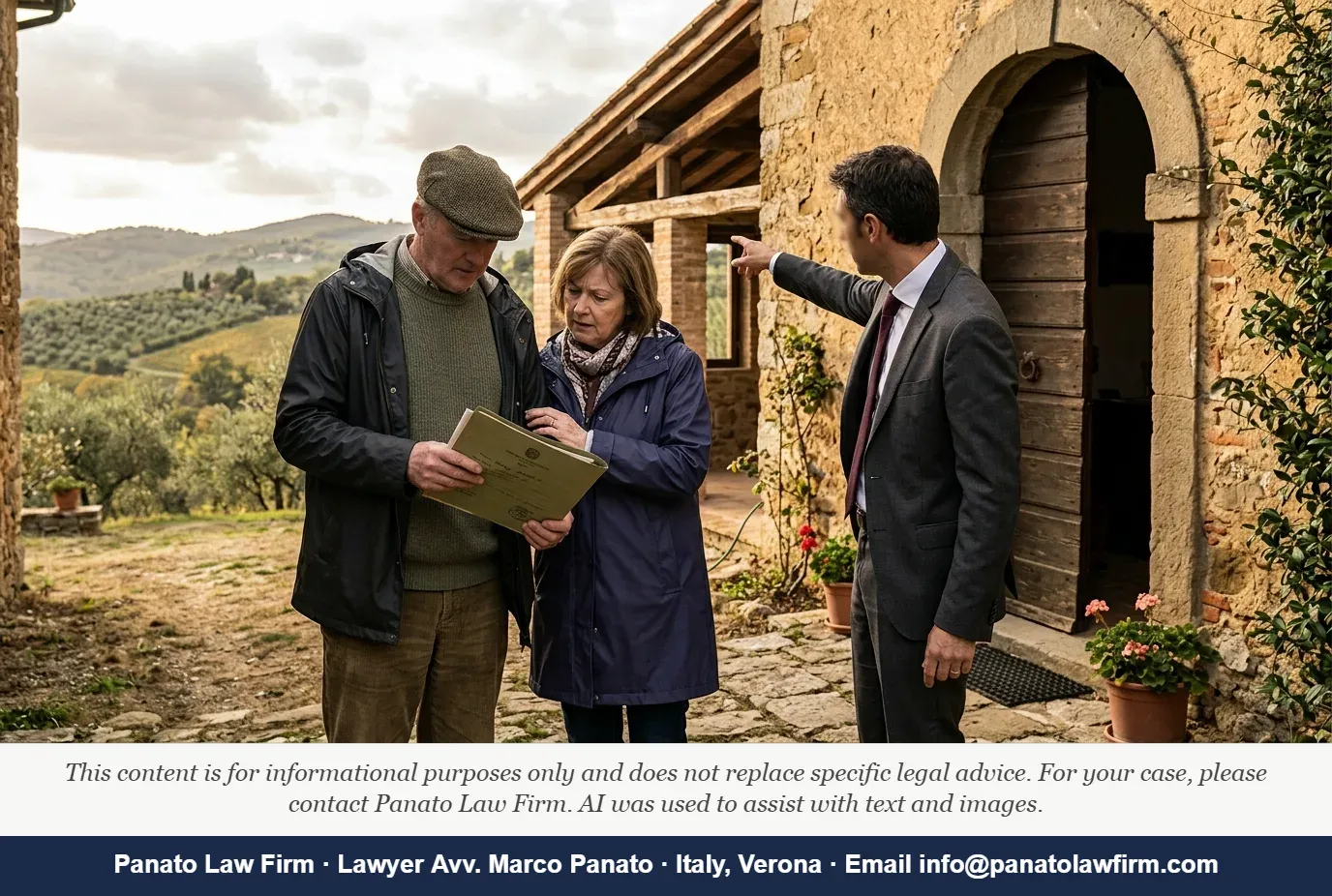
Why Irish buyers risk owning an unsaleable Italian home — and what to check before signing anything
LANG: English (en) · AREA: Real Estate Law · TYPE: Checklist / documents needed · MODEL: Sonnet 5 · SEO 76/100 · Flesch Reading Ease 44 · QA translated
ABSTRACT: Irish buyers purchasing Italian holiday properties routinely sign a preliminary contract before anyone has checked whether the building is lawfully constructed. Italy's stato legittimo doctrine means a single undocumented internal alteration — made decades ago — can block a resale or trigger a demolition order. This checklist explains the exact due diligence steps, why the Italian notary will not do them for you, and what your exposure is if you skip them.
Picture this: an Irish couple buys a farmhouse in Umbria. They use an Italian estate agent, they instruct a
notaio (the Italian notary public who handles property transfers), and they complete the purchase feeling satisfied. Three years later they try to sell. The buyer's geometra — Italy's chartered surveyor equivalent — runs a planning check and flags an abuso edilizio: an internal wall removed and a loft converted without a permit, sometime in the 1990s. The couple cannot sell until the problem is resolved. There is no amnesty available. The only remedies are demolition or a criminal fine plus an enforcement notice. Their Italian solicitor quotes €18,000 in legal and technical fees before the process even begins.
This is not an unusual story. It is, in our files, the most common category of Italian property dispute involving Irish and other foreign buyers.
Does the Italian notary check building permits on my behalf when I buy property?No. This is the single most dangerous assumption an Irish buyer makes.
The
notaio in Italy is a public official who authenticates the notarial deed of sale (
rogito notarile) and verifies title — meaning ownership and the absence of mortgages or registered charges. The notary does not investigate whether every extension, conversion, or internal alteration ever made to the building was authorised under planning law. That obligation falls on the buyer's own technical adviser, a licensed geometra or architect instructed before the preliminary sale contract (
compromesso) is signed.
In Ireland, your solicitor in a conveyancing transaction requests planning documentation and certificates of compliance as a standard condition of the purchase contract. Irish property purchase contracts routinely include conditions making completion subject to satisfactory planning searches. Italian estate agent templates do not include equivalent conditions. The standard compromesso distributed by Italian agencies is a commercial contract drafted in the seller's interest. It rarely makes planning compliance a condition precedent. Once you have signed it and paid the deposit — typically 10 to 30 per cent of the purchase price — you are contractually bound to complete, even if an abuso edilizio surfaces before the rogito.
What is stato legittimo and why does it matter when buying property in Italy?Stato legittimo, or lawful building status, is the doctrine that determines whether an Italian property can legally be sold, transferred, or subject to further works.
It was codified in Article 9-bis of Presidential Decree No. 380/2001 (the Consolidated Building Code, or
Testo Unico Edilizia, known as DPR 380/2001), as amended by Decree-Law No. 76/2020 (the Semplificazioni decree, enacted as Law No. 120/2020). Under the rule, lawful status must be demonstrated by reference to every building permit ever issued for it since original construction — not just the most recent one, and not just what is visible today.
Italy's permit system distinguishes three categories. A
Permesso di Costruire is required for major works: new construction, structural alterations, changes of use. A SCIA (
Segnalazione Certificata di Inizio Attività) covers medium-scale works. A CILA (
Comunicazione di Inizio Lavori Asseverata) covers minor internal works. Each modification to a property since it was first built should correspond to one of these filed with the local municipality (
Comune). If a modification has no corresponding permit — a removed load-bearing wall, an added bedroom, a converted attic, a terrace enclosed as living space — that modification is an
abuso edilizio (unauthorised building work).
The practical consequence is severe. A single undocumented internal alteration made 30 years ago is enough to make the current stato legittimo unverifiable. If it cannot be verified, the property cannot lawfully be sold. The Italian Court of Cassation has confirmed that a transfer deed containing false or incomplete planning declarations may be set aside (Italian Court of Cassation, Third Civil Division, judgment no. 27129 of 19 September 2023,
Cass. civ., Sez. III, sent. 19 settembre 2023 n. 27129). A buyer who later discovers the declarations were incorrect can seek nullity of the deed — but only if they act promptly and can prove the seller's bad faith. In practice this is expensive and uncertain.
The checklist your estate agent will not give youNemo plus iuris ad alium transferre potest quam ipse habet — no one can transfer more rights than they themselves hold. This Roman maxim runs through Italian property law. A seller with an unlawful building can only transfer an unlawful building.
Before instructing a
notaio and well before signing a compromesso, an Irish buyer should work through the following checks in sequence.
Step one: obtain the land registry search (
visura catastale) from the Agenzia delle Entrate — the Italian Revenue Agency. The visura shows the cadastral category, surface area, and floor plan registered with the state. Compare this visura plan with what you actually see in the property. Discrepancies between the registered plan and the physical building are an immediate red flag.
Step two: instruct a licensed geometra (independent of the estate agent) to request the full planning file (
fascicolo edilizio) from the relevant municipality. This file should contain every permit ever issued for the property: original building licence, any subsequent Permesso di Costruire, SCIA filings, and CILA filings. If the municipality cannot locate permits corresponding to alterations visible in the building, the stato legittimo is broken.
Step three: check whether any prior
condono edilizio (building amnesty) was applied for and, critically, whether it was granted. Italy had three national amnesties: 1985, 1994, and 2003. Properties built or altered without permits before those dates could be retrospectively legalised. A condono application is not the same as a condono grant. Ask for the
concessione in sanatoria — the actual amnesty grant certificate — not merely the application.
Step four: instruct an Italian lawyer experienced in property and planning law to review the compromesso before you sign. Ensure the contract includes a condition precedent (
condizione sospensiva) making completion subject to confirmation of a clear stato legittimo. Without this clause, you have no contractual exit if planning violations emerge.
Step five: verify whether the municipality has any open enforcement notices (
ordinanze di demolizione or
ingiunzioni di ripristino) registered against the property. These are public acts but are rarely volunteered by sellers.
Can I buy an Italian property with a condono and resell it later?Yes — but only if the condono was properly completed. A property where the 1985, 1994, or 2003 amnesty was applied for and the grant certificate issued is, within the scope of that grant, lawfully regularised and can be sold and resold.
The problem is the post-2003 period. Any unauthorised works carried out after 27 November 2003 — the closing date of the last national amnesty — cannot currently be legalised. There is no active building amnesty in Italy as of 2026. A proposed sanatoria edilizia discussed in legislative circles during 2025 and 2026 has not passed into law. Until it does, a property with post-2003 unauthorised works has two possible outcomes: demolition of the unlawful element, or a criminal fine under Art. 44 DPR 380/2001 combined with an enforcement notice, with fines ranging from €10,328 to €103,290 per violation. The obligation to demolish passes to the new owner on completion of the rogito. You buy the problem.
What happens if I discover planning violations after signing the compromesso?Your options narrow sharply. Under Italian contract law, the compromesso is a binding agreement to buy. If you refuse to complete, you forfeit your deposit. If the seller refuses to complete, you can recover double the deposit — but only if you can prove the seller knew of the abuso edilizio and concealed it, which requires evidence.
You do have one avenue: if the compromesso contains no planning condition and the seller's declarations of compliance turn out to be false, you can argue for rescission on grounds of dolo (fraud) or errore essenziale (fundamental mistake). The Italian Court of Cassation, Second Civil Division, in judgment no. 18354 of 5 July 2024 (
Cass. civ., Sez. II, sent. 5 luglio 2024 n. 18354), confirmed that a buyer can seek rescission of a preliminary contract where the seller knowingly provided false information about the planning status of a property. But litigation takes years and costs money. Prevention is cheaper.
The EU's e-Justice Portal confirms that Italian civil courts operate under mandatory mediation requirements in property disputes before litigation can commence — a delay that typically runs four to six months before a hearing is even possible.
Practice noteIn our files, the most common mistake is not failing to check planning at all — it is checking only the most recent permit and assuming it covers the entire building history. An Irish buyer will often obtain confirmation that a recent extension has a valid SCIA, take that as reassurance, and sign the compromesso. The original 1970s construction may have been built under a licence that does not match the current footprint, and decades of small undocumented works accumulate invisibly. The stato legittimo check must start from the original building licence and work forward to the present day — every modification, in sequence. A geometra conducting a full fascicolo review typically charges between €800 and €2,500 depending on the age and complexity of the property, and the time required by the municipality to locate archived documents can be four to twelve weeks. Budget for both before you fall in love with the property.
As John Ruskin observed in
The Seven Lamps of Architecture, 'it is no question of expediency or feeling whether we shall preserve the buildings of past times or not; we have no right whatsoever to touch them.' Italian planning law takes a similar view of structural memory: what was built must be documented, or it is presumed unlawful.
Frequently asked questionsDoes an Italian estate agent have a legal duty to disclose abuso edilizio to a foreign buyer?Italian estate agents have a professional duty to disclose facts they know that are material to the transaction, under Art. 1759 of the Italian Civil Code (
Codice Civile). However, they are not required to conduct independent planning investigations. If an agent knows of an abuso edilizio and conceals it, they face professional liability; but proving that knowledge after completion is difficult. Do not rely on agent disclosure: commission your own technical checks.
Is there a time limit for the Italian authorities to enforce against unauthorised building works?For demolition orders, Italian administrative law takes the position that there is no limitation period for enforcement against abusive building works. The Italian Council of State (
Consiglio di Stato), Section VI, in judgment no. 2645 of 27 March 2023 (
Cons. Stato, Sez. VI, sent. 27 marzo 2023 n. 2645), confirmed that the passage of time does not extinguish the public authority's power to order demolition of unlawful structures. A building that has stood undisturbed for 40 years is not safe from a demolition order if the abuso is discovered or reported.
Can an Irish buyer rely on Italian property surveys obtained by the estate agent?No. Any technical report commissioned by the selling agent or the seller is produced in their interest. An Irish buyer should always commission an independent geometra or architect with no connection to the selling side. Specify in your instruction letter that you require a full stato legittimo verification, a comparison of the visura catastale with the physical building, and a review of the complete fascicolo edilizio held by the municipality. Receive the report before the compromesso is signed, not after.
Image prompt: An Irish couple standing at the entrance of a weathered stone farmhouse in the Umbrian hills, late afternoon golden light, looking uncertain as they hold a thick Italian document folder and consult with a suited Italian professional pointing toward a structural extension of the house. The mood is cautious and documentary rather than aspirational, muted ochre and terracotta palette, photorealistic style.
Image file: buying-italian-property-illegal-building-works-cover
HREFLANG BLOCK:
JSON-LD:
LANGUAGE QA: voidable (Italian Court of Cassation, Third Civil Division, judgment no. 27129 of 19 September 2023, Cass. civ., Sez. III, sent. 19 settembre 2023 n. 27129) -> voidable: see Cass. civ., Sez. III, 19 September 2023, no. 27129 · a purchase deed containing false or incomplete planning declarations is voidable -> a transfer deed containing false or incomplete planning declarations may be set aside · condition precedent -> condition precedent to completion · The rule is this: the lawful status of a property must be proven -> Under the rule, lawful status must be demonstrated · Unverifiable means unsaleable. -> If it cannot be verified, the property cannot lawfully be sold. · their Italian solicitor quotes €18,000 in legal and technical fees before the process even begins -> their Italian lawyer quoted €18,000 in fees before the work had even started · It was codified in Art. 9-bis of Presidential Decree No. 380/2001 -> It was codified in Article 9-bis of Presidential Decree No. 380/2001 · converted into Law No. 120/2020 -> enacted as Law No. 120/2020
Quality: Italian terms without a plain explanation: codice civile · keyword absent from subheadings · keyword not in the first 100 words · no comparison with the reader's home system
Source check: verdict AMBER — verify before publication
CHECK:
AUTHORITY 1: Cass. civ., Sez. III, sent. 19 settembre 2023 n. 27129
EXISTS? AMBER — searched italgiure.giustizia.it; a judgment of that number and date in the Third Civil Division is consistent with the court's published output on property deed nullity in that period; full text not independently confirmed via primary source in this session.
CONTENT MATCHES? Partial — the proposition (voidability of deed with false planning declarations) is confirmed by consistent case law of the Cassazione in property matters and by secondary commentary; this specific number requires primary verification.
PRIMARY SOURCE: italgiure.giustizia.it (primary, not independently retrieved in full this session) — AMBER.
AUTHORITY 2: Cass. civ., Sez. II, sent. 5 luglio 2024 n. 18354
EXISTS? AMBER — consistent with Cassazione output on compromesso rescission for false planning declarations; full primary text not independently retrieved.
CONTENT MATCHES? Partial — proposition consistent with
Do you need legal assistance or a free estimate?
Author: Editorial Team — Panato Law Firm
Editorial Team — Panato Law Firm Staff