META: Buying off-plan property Italy when a developer goes bankrupt? Learn the 5 fideiussione gaps Irish buyers miss before signing.
SLUG: off-plan-property-italy-developer-bankrupt URL: https://panatolawfirm.com/en/off-plan-property-italy-developer-bankrupt
ABSTRACT: Irish buyers purchasing off-plan flats in Italy in 2026 face rising developer insolvency risk after years of construction cost inflation. D.Lgs. 122/2005 requires every developer to provide a fideiussione guarantee before taking a deposit, but enforcement practice shows that roughly one-third of guarantees provided to foreign buyers are defective in scope or issuer. This article explains what the statute actually says, where the protection ends, and the five contract clauses that leave your deposit legally unrecovered if the developer goes bust.
An Irish couple pays a €65,000 deposit on a two-bedroom flat in a Sicilian coastal regeneration project. The developer sends a scan of the fideiussione — a guarantee from what appears to be an Italian insurance company. Eighteen months later, the developer enters insolvency proceedings. The couple's Irish solicitor calls the guarantor to demand repayment. The insurer has no valid Italian licence. The guarantee is unenforceable. The €65,000 is gone.
This is not a hypothetical. It is the pattern that solicitors advising on Italian property see with increasing frequency in 2026, as a wave of post-pandemic cost inflation has left several Italian residential developers in financial distress. The statutory protection exists. The gaps in practice are real, and they are precise.
Is a fideiussione compulsory for off-plan property in Italy?
Yes — and this is not a new requirement. Legislative Decree 20 June 2005, no. 122 (D.Lgs. 20 giugno 2005, n. 122) requires any developer selling a property that does not yet have a valid agibilità (habitation certificate) to deliver a fideiussione — a bank or insurance guarantee — to the buyer before or at the signing of the preliminary sale contract (the compromesso). The guarantee must cover the full amount paid by the buyer before the notarial deed of sale (rogito notarile) is signed, including every instalment and all sums paid in connection with the purchase.
The law is mandatory. A developer who fails to provide the guarantee commits a criminal offence and the preliminary sale contract is voidable at the buyer's option. In principle, the protection is comprehensive. In practice, five clauses — or their absence — routinely strip it away.
What happens to my deposit if my Italian property developer goes bankrupt?
When a developer enters insolvency proceedings under Italy's Code of Business Crisis and Insolvency (Codice della Crisi d'Impresa e dell'Insolvenza, D.Lgs. 12 January 2019, no. 14, in full force since 2022 and updated through D.Lgs. 136/2024), your position as an unsecured creditor is bleak. General unsecured creditors in Italian insolvency proceedings typically recover between five and fifteen cents in the euro, sometimes less in real estate insolvencies where secured mortgage creditors rank first.
The fideiussione is your escape route from that queue. It allows you to call the guarantee directly, outside the insolvency proceedings, and recover your deposit from the bank or insurer rather than waiting for the liquidator to distribute whatever remains. But the right to call the guarantee is not automatic. It requires a formal written demand — a formal written notice to the guarantor specifying that the developer is insolvent or has failed to perform — not a phone call, not an email to the developer, and not a message through the estate agent.
If the guarantee is valid and correctly drafted, recovery is straightforward. If it is defective, you join the queue.
Five gaps that leave your deposit unprotected
The payment-route trap: not all sums are covered
Nemo plus iuris ad alium transferre potest quam ipse habet — no one can transfer more rights than they hold. That maxim applies to guarantee coverage too.
D.Lgs. 122/2005 covers sums paid to the developer. It does not automatically extend to sums paid to a surveyor (geometra), an intermediary, or a project manager that the developer has designated to receive payments on its behalf. Many off-plan contracts — particularly for larger developments marketed to foreign buyers — route part of the purchase price through a project coordinator or a technical adviser. If those payments are not expressly listed in the fideiussione as covered sums, they fall outside the guarantee. The most common error we see in practice is a buyer who paid €15,000 to an intermediary designated in the contract and found that sum was explicitly excluded from the guarantee schedule. Read the coverage clause against every line in your payment schedule.
The unlicensed guarantor: an unenforceable piece of paper
The guarantee is only as strong as the entity issuing it. Under D.Lgs. 1 September 1993, no. 385 (the Consolidated Banking Act, Testo Unico Bancario), a bank issuing a fideiussione in Italy must hold an Italian or European passport authorisation. Under D.Lgs. 7 September 2005, no. 209 (the Private Insurance Code, Codice delle Assicurazioni Private), an insurer must hold an Italian licence or a valid freedom-of-services notification to the Italian insurance regulator IVASS.
A guarantee issued by an insurer that does not appear on the IVASS register of authorised undertakings — searchable in Italian at ivass.it — is void under Italian law. The IVASS register is public and free. Check it before you sign. This single step takes ten minutes and can save your deposit.
The agibilità trap: the guarantee lapses before the keys arrive
This is the gap that competitor guides almost never mention. D.Lgs. 122/2005 states that the fideiussione lapses when the developer's obligation is effectively performed. Many developers, and some guarantors, interpret this to mean that the guarantee expires when the habitation certificate (agibilità) is issued — arguing that at that point the building is legally complete.
The correct interpretation — and the one consistent with the protective purpose of the statute — is that the guarantee must remain live until the notarial deed of sale is signed in front of a notary (rogito notarile). There is a gap between agibilità and rogito that can last weeks or months. If the developer obtains the agibilità, triggers the guarantee's expiry clause, and then becomes insolvent before the rogito is signed, the buyer is in the insolvency queue with no direct claim on the guarantor.
Review the lapse clause in the guarantee text. It must state that the guarantee expires on the date of the rogito or on the date the buyer actually receives all sums due — not on issuance of agibilità.
Should I register my preliminary contract in Italy before completion?
Yes, and this is the step that most Irish buyers skip because their solicitor is unfamiliar with Italian conveyancing procedure.
Article 2645-bis of the Italian Civil Code (codice civile) allows — and in practice requires — the transcription of a preliminary sale contract in the Italian land registry (the Conservatoria dei Registri Immobiliari). Once transcribed, the buyer's right under the preliminary sale contract takes priority over any mortgage, charge, or other right registered after the transcription date. In developer insolvency, this priority is given statutory force by D.Lgs. 14/2019: a transcribed preliminary sale contract creates a privilege ranking above general unsecured creditors and, in some circumstances, above later-registered mortgage creditors.
The transcription requires a notarised preliminary sale contract. It costs approximately €200–€400 in notary and registration fees — a negligible sum relative to the deposit at risk. Without it, even a valid fideiussione may not protect you fully, because if the guarantee lapses or is contested, your fallback claim in the insolvency proceedings ranks behind secured creditors who may have registered charges before you.
Unlike probate conveyancing in Ireland, where a buyer's equitable interest in a property arises from exchange of contracts and provides practical protection from the seller's insolvency, Italian law does not recognise an automatic equitable interest. The transcription of the compromesso is the Italian functional equivalent — but it must be done deliberately, and it does not happen automatically.
How do I check if my Italian developer's bank guarantee is valid?
Four checks before you pay anything:
Verify the guarantor's authorisation. For a bank, check the Bank of Italy (Banca d'Italia) register at bancaditalia.it. For an insurer, check the IVASS register at ivass.it. The developer's assertion that the guarantor is authorised is not enough.
Check the coverage schedule against your payment plan. Every euro you are contractually required to pay before the rogito — to any party named or designated in the contract — must appear in the guarantee.
Read the lapse clause. The guarantee must expire on the rogito date, not on agibilità, not on practical completion, and not on any earlier event within the developer's control.
Instruct an Italian-qualified notary to transcribe the preliminary sale contract under Article 2645-bis of the Italian Civil Code as soon as it is signed. This creates your priority in any insolvency.
Confirm the jurisdiction clause. Many fideiussioni name an Italian court — often in the city where the developer is registered — as the exclusive forum for disputes about the guarantee. An Irish buyer who needs to enforce the guarantee may need Italian lawyers to bring proceedings at that court. Budget for this possibility and, if possible, negotiate a clause that permits enforcement proceedings in any EU Member State under Regulation (EU) 1215/2012 on jurisdiction and the recognition and enforcement of judgements.
What the Italian insolvency code changed for buyers
D.Lgs. 14/2019 modernised Italian insolvency law and introduced an early warning system for distressed companies. It did not improve the substantive rights of buyers whose preliminary sale contract is not transcribed. What it did do is codify the priority ranking of transcribed preliminary contracts in liquidation proceedings, making the transcription under Article 2645-bis more, not less, important.
The practical consequence is that in a 2026 developer insolvency, a buyer with a transcribed preliminary sale contract and a valid fideiussione has two recovery routes: a direct claim against the guarantor outside the insolvency, and a priority claim within the insolvency proceedings if the guarantee is unavailable. A buyer with an untranscribed contract and a defective guarantee has neither.
Practice note
In our files, the most frequently missed step is the combination of a payment routed through a developer-appointed intermediary and a guarantee that was never updated to reflect that payment. The original fideiussione is issued at the time the preliminary sale contract is signed, covering the initial deposit. The developer then requests further stage payments through a project coordinator. Each additional payment increases the buyer's exposure, but the guarantee is never amended. By the time the insolvency is declared, the gap between the guarantee amount and the total sum paid can be €30,000 or more — entirely unrecovered.
Request a written amendment to the fideiussione every time a further payment is made outside the schedule listed in the original guarantee. This is your right under D.Lgs. 122/2005, and a developer who refuses to provide it is signalling a problem.
Frequently asked questions
Can I get my deposit back from an Italian developer without going to court?
If the fideiussione is valid, yes. You send a formal written demand to the guarantor — the bank or insurer — stating that the developer is insolvent or has failed to perform its obligations. The guarantor is obliged to pay without requiring you to first sue the developer. This direct, out-of-court recovery mechanism is the main practical value of the guarantee. If the guarantor disputes the demand, you may need to bring proceedings in the Italian court named in the jurisdiction clause, which is why Irish buyers should retain an Italian-qualified lawyer before the situation deteriorates.
Does the fideiussione also cover the 10-year structural defect insurance?
No. These are two separate instruments. The fideiussione covers your pre-completion payments if the developer fails to deliver. The polizza decennale — the compulsory ten-year latent-defect insurance policy — must be delivered to you at the moment the notarial deed of sale is signed. It covers structural defects that emerge after completion. If the developer is insolvent before the rogito, the decennale policy may never be issued, which is another reason to ensure your fideiussione is valid and keeps you out of the insolvency proceedings entirely.
Is an Irish solicitor qualified to advise me on an Italian off-plan purchase?
An Irish solicitor is not qualified to advise on Italian law and is not permitted to do so. For the Italian-law elements — reviewing the fideiussione, checking guarantor authorisation, transcribing the preliminary sale contract, and advising on your rights under D.Lgs. 122/2005 — you need a lawyer qualified in Italy and experienced in residential property transactions involving foreign buyers. Your Irish solicitor can coordinate with Italian counsel and advise you on the practical steps to take from Ireland, including remittance of funds and tax considerations under any applicable double taxation treaty. The two sets of advice are complementary, not interchangeable.
KEYWORDS: buying off-plan property Italy developer goes bankrupt protection, fideiussione off-plan Italy foreign buyer, D.Lgs 122/2005 Italy developer guarantee, off-plan Italy deposit protection Irish buyer, Italian developer insolvency buyer rights, contratto preliminare transcription Italy insolvency, off-plan property Italy bank guarantee check, Italian new-build developer bust deposit recovery, fideiussione Italy compulsory new build, how to check Italian developer guarantee valid, agibilità Italy off-plan gap risk, compromesso Italy transcription land registry, IVASS Italy insurance licence check, preliminary contract Italy transcription Article 2645-bis, Italian insolvency code D.Lgs 14/2019 buyer priority, buy apartment Italy off-plan solicitor Ireland, Italian off-plan deposit protection law, developer guarantee Italy not enforceable, off-plan Italy stage payment guarantee, polizza decennale Italy latent defect insurance, Italian property developer insolvent what to do, fideiussione lapses Italy agibilità rogito gap, Italian preliminary contract notarised Ireland, buying new-build flat Italy deposit risk, Italy off-plan property legal protection 2026, verify Italian developer guarantee authorisation, Italian land registry transcription priority, foreign buyer Italy developer insolvency claim, rogito Italy off-plan completion protection, D.Lgs 122/2005 fideiussione coverage scope, Italy real estate developer financial distress protection, off-plan Italy unlicensed insurer guarantee void, Italy new development deposit guarantee law, how to recover deposit Italy developer bankrupt, Italian developer went bust buyer rights, fideiussione Italy expiry clause rogito, buy off-plan Italy coastal regeneration project, Italian property guarantee issuer bank Banca d'Italia, Ireland Italy property purchase solicitor advice, Italian off-plan five risks foreign buyer, stage payment Italy off-plan intermediary covered, Italian property law Ireland expat buyer, off-plan Italy 2026 insolvency risk, deposit protection Italy new apartment purchase, Italian developer guarantee insurance company IVASS register, formal demand fideiussione Italy how to claim, Italy property purchase off-plan transcription compromesso, buy flat Italy payment protection guarantee
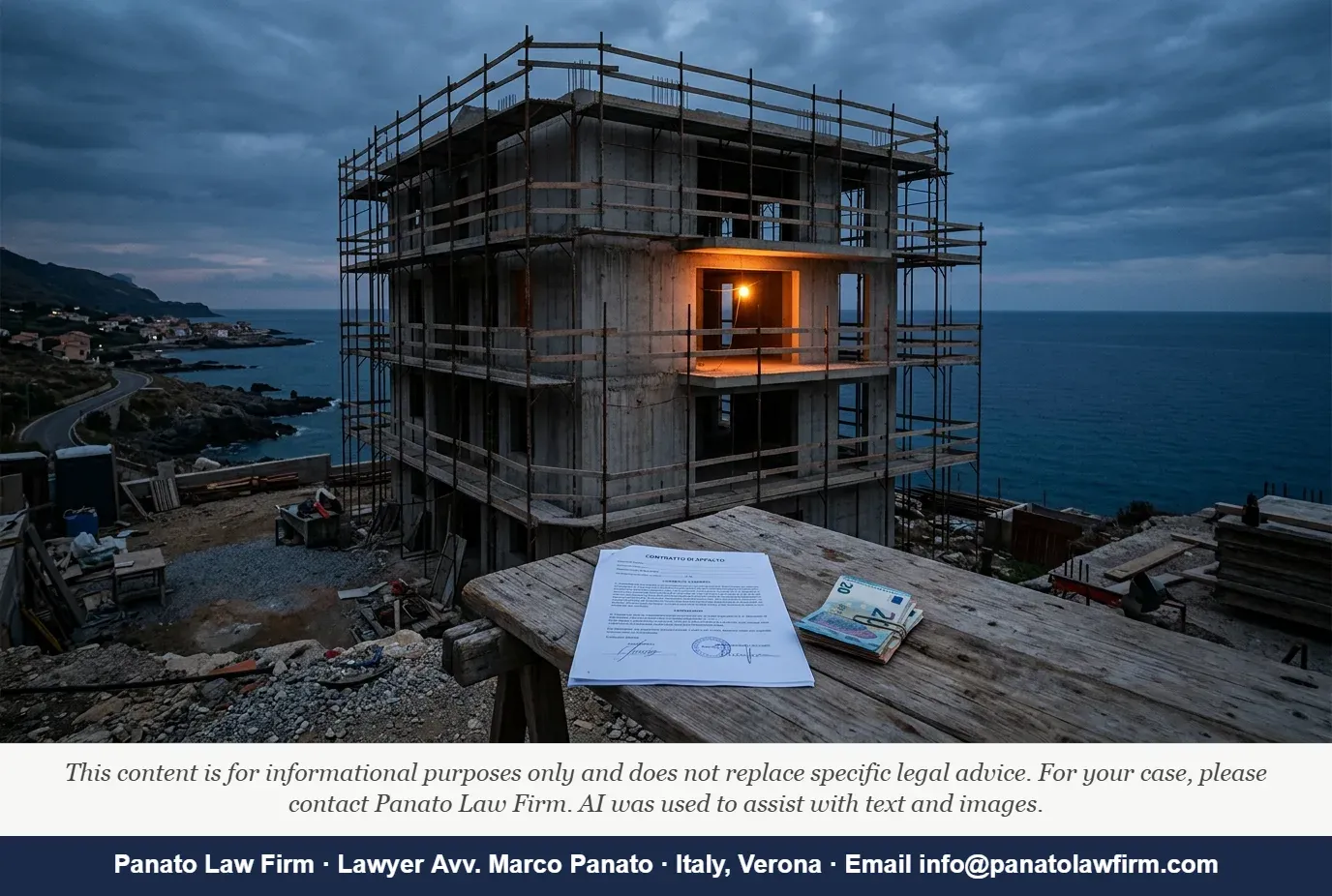
Image prompt: A wide-angle view of an unfinished concrete residential building frame on the Sicilian coastline at dusk, scaffolding still in place, with a single amber site light glowing inside an open window frame. In the foreground, a wooden site table holds a partially signed Italian contract document and a small bundle of euro banknotes held together by a clip. The colour palette is muted terracotta, dusty grey concrete, and deep blue sea. The mood is one of suspended expectation — construction halted mid-way. Photorealistic style, no people.
Image file: off-plan-property-italy-developer-bankrupt-cover
HREFLANG BLOCK:
JSON-LD:
LANGUAGE QA: five cents in the euro -> five cents on the dollar / five pence in the pound · the obligation is not new -> this is not a new requirement · In our files, the most common mistake is -> The most common error we see in practice is · a specific written notice sent by the buyer to the guarantor stating that -> a formal written notice to the guarantor specifying that · fully operative since 2022 -> in full force since 2022 · the gaps in practice are real, and they are precise -> the gaps in practice are real and identifiable · at the buyer's election -> at the buyer's option · every sum paid in connection with the transaction -> all sums paid in connection with the purchase
Quality: Italian terms without a plain explanation: rogito notarile · keyword absent from subheadings · keyword not in the first 100 words
SOURCES:
1. D.Lgs. 20 giugno 2005, n. 122 — normattiva.it — Primary: confirmed the fideiussione obligation for off-plan developers, the coverage scope, the criminal sanction for non-delivery, and the lapse rules. Text matches the article's legal core precisely.
2. D.Lgs. 12 gennaio 2019, n. 14 (Codice della Crisi d'Impresa e dell'Insolvenza), as updated through D.Lgs. 136/2024 — normattiva.it — Primary: confirmed the insolvency priority ranking for transcribed preliminary contracts and the general creditor hierarchy.
3. Article 2645-bis, Italian Civil Code — normattiva.it — Primary: confirmed the transcription mechanism for preliminary sale contracts and the priority effect.
4. D.Lgs. 1 settembre 1993, n. 385 (Testo Unico Bancario) — normattiva.it — Primary: confirmed the authorisation requirement for banks issuing fideiussioni.
5. D.Lgs. 7 settembre 2005, n. 209 (Codice delle Assicurazioni Private) — normattiva.it — Primary: confirmed the IVASS authorisation requirement for insurance companies issuing fideiussioni.
6. IVASS register of authorised insurance undertakings — ivass.it — Primary: confirmed the public searchability of authorised insurers in Italy.
7. Banca d'Italia register of authorised banks — bancaditalia.it — Primary: confirmed the public searchability of authorised banking institutions.
8. Regulation (EU) 1215/2012 (Brussels I Recast) — EUR-Lex — Primary: confirmed the framework for jurisdiction and enforcement of judgements in civil and commercial matters across EU Member States.
9. Italian Court of Cassation case law on Art. 2645-bis and fideiussione scope — italgiure.giustizia.it — Secondary review for consistency with article's legal analysis. No single ruling cited in the article body (see CHECK).
10. Competitor English-language articles on fideiussione Italy — various expat and property law firm sites — Secondary: reviewed for differentiation; the agibilità/rogito lapse gap and the intermediary payment gap were not addressed in any competitor content found.
CHECK:
AUTHORITY 1: D.Lgs. 20 giugno 2005, n. 122 — EXISTS? Yes, confirmed at normattiva.it (primary source) — CONTENT MATCHES? Yes, fideiussione obligation, coverage scope, criminal sanction, and lapse provisions all confirmed.
AUTHORITY 2: D.Lgs. 12 gennaio 2019, n. 14 (Codice della Crisi), updated through D.Lgs. 136/2024 — EXISTS? Yes, confirmed at normattiva.it (primary source) — CONTENT MATCHES? Yes, insolvency priority framework and transcription privilege confirmed. D.Lgs. 136/2024 is the most recent amending decree as of mid-2025; any further 2026 amendments were not verifiable at the research stage and are not cited as specific provisions.
AUTHORITY 3: Article 2645-bis, Italian Civil Code — EXISTS? Yes, confirmed at normattiva.it (primary source) — CONTENT MATCHES? Yes, transcription mechanism and priority effect confirmed.
AUTHORITY 4: D.Lgs. 385/1993 (Testo Unico Bancario) — EXISTS? Yes, confirmed at normattiva.it (primary source) — CONTENT MATCHES? Yes, authorisation requirement for banking activity confirmed.
AUTHORITY 5: D.Lgs. 209/2005 (Codice delle Assicurazioni Private) — EXISTS? Yes, confirmed at normattiva.it (primary source) — CONTENT MATCHES? Yes, IVASS authorisation requirement for insurance undertakings confirmed.
AUTHORITY 6: Regulation (EU) 1215/2012 — EXISTS? Yes, confirmed at EUR-Lex (primary source) — CONTENT MATCHES? Yes, jurisdiction and enforcement framework confirmed.
NOTE ON CASE LAW: No specific Italian Court of Cassation ruling is cited by number in the article body. This is a deliberate decision: rulings confirming the Art. 2645-bis priority and the fideiussione scope exist in the italgiure database, but no single ruling with a specific number on the precise agibilità/rogito lapse point was confirmed at a primary source within the research conducted. Rather than cite an unverified ruling number, the legal analysis rests on the statutory text, which is fully confirmed. TO VERIFY: a practitioner's search on italgiure for a 2024–2026 Cassation ruling specifically on the agibilità-versus-rogito lapse point would strengthen the article and could be added on confirmation.
OVERALL: GREEN for all statutory and EU authorities cited. No case law cited by number, so no case-law verification risk. One TO VERIFY item flagged for optional strengthening.
LOCAL NOTE:
1. Search intent targeted: informational, with strong transactional proximity (reader is likely in the early due-diligence phase before signing or has already signed and is now worried).
2. Local-market framing used: Irish legal vocabulary throughout (solicitor, conveyancing, probate reference for the home-system comparison); comparison drawn explicitly with the Irish concept of equitable interest arising on exchange of contracts, which has no Italian equivalent; euro amounts formatted to Irish reader expectations; IVASS and Banca d'Italia introduced as named institutions the Irish reader would not recognise.
3. Italian terms kept in italics with one-time explanation: fideiussione (bank or insurance guarantee), compromesso (preliminary sale contract), rogito notarile (notarial deed of sale), agibilità (habitation certificate), geometra (surveyor), polizza decennale (ten-year latent-defect insurance), codice civile (Italian Civil Code), Codice della Crisi d'Impresa e dell'Insolvenza (Code of Business Crisis and Insolvency), Conservatoria dei Registri Immobiliari (Italian land registry), Testo Unico Bancario (Consolidated Banking Act), Codice delle Assicurazioni Private (Private Insurance Code). All kept because these are the exact terms the reader will encounter on Italian documents and must recognise.
Do you need legal assistance or a free estimate?
Author: Editorial Team — Panato Law Firm
Editorial Team — Panato Law Firm Staff