What the Adunanza Plenaria's landmark decision means for US companies racing to contest a redacted Italian procurement award
LANG: English (en) · AREA: Public Procurement & Tenders in Italy · TYPE: Practical guide (how-to) · MODEL: Opus 5.5 · SEO 76/100 · Flesch Reading Ease 44 · QA acceptable
ABSTRACT: A US company loses an Italian public tender, receives a partially redacted award notice, and assumes the standard 10-day window has started. It has not — and a September 2026 grand-plenary ruling by Italy's highest administrative court rewrites the analysis entirely. Miss the right clock and the challenge is permanently barred.
A foreign bidder submitted a proposal for an Italian infrastructure contract worth roughly EUR 4 million. The contracting authority published the award notice online, but the winning bid's technical annex was almost entirely blacked out. The US company's Italian partner flagged the email, noted the 10-day window, and decided to wait while seeking more information. Fourteen days later, the deadline had passed / the window had shut — or so the authority claimed. This is the fact pattern that the Council of State (
Consiglio di Stato), Italy's supreme administrative court, definitively resolved / settled once and for all on 9 September 2026.
The ruling in question is Council of State, Grand Plenary Session, decision no. 8 of 9 September 2026 (
Consiglio di Stato, Adunanza Plenaria, 9 settembre 2026, n. 8). It interprets Article 36 of Legislative Decree no. 36 of 31 March 2023 (
D.Lgs. 36/2023), Italy's current Public Contracts Code, alongside Article 116 of the Administrative Procedure Code (
codice del processo amministrativo, c.p.a.). For any US company that has lost, or expects to lose, an Italian tender, the ruling is now the single most important piece of procedural law on the books / on record / in the field.
How long do I have to challenge an Italian public tender award?After a public contract is awarded in Italy, an unsuccessful bidder generally has 30 days from the formal notification of the award to file a challenge before the Regional Administrative Court (
Tribunale Amministrativo Regionale, TAR), the first-instance administrative tribunal. That 30-day window runs from the moment the unsuccessful bidder has, or should have, full knowledge of the award and its grounds. The Adunanza Plenaria ruling confirms that "full knowledge" is not the same as receiving an email or seeing a redacted PDF on a procurement portal. Knowledge means knowledge of the elements needed to articulate a ground of challenge — and a blacked-out technical offer does not supply them.
What is the 10-day rule for accessing tender documents in Italy?Article 36 of D.Lgs. 36/2023 introduced an accelerated access mechanism for procurement files. Where the contracting authority simultaneously publishes, at the moment of award, all the information the Code requires — the identity of the winner, the award criteria applied, the score breakdown, and the relevant technical elements — an unsuccessful bidder has just 10 days from that publication to request access to documents it wishes to inspect before challenging. Miss that 10-day window and, under the pre-ruling interpretation, some courts held that access rights were extinguished.
The Adunanza Plenaria has now drawn a clear distinction / ruled clearly. The 10-day clock runs
only when the contracting authority has simultaneously published
all mandatory information at the moment of award. If the authority published anything less — even a single mandatory item missing or redacted without a reasoned decision — the standard 30-day access procedure / route under Article 116 c.p.a. is restored in full / applies in full. A mere redacted publication is not an implicit rejection of an access request. The authority must issue an express, reasoned decision for each redaction. One blanket redaction covering an entire technical annex does not satisfy that standard.
The three-step decision tree every US attorney must run after an award notice arrivesGeneric commentary on this ruling stops at the 10-day versus 30-day split. That framing, while accurate, omits the practical analysis. Here is the decision tree that must be run the moment an award notice reaches a US client's desk — or, more likely, their Italian partner's inbox.
Step one: Did the contracting authority publish every mandatory item simultaneously at the time of award? Check the publication on the National Database of Public Contracts (
Banca Dati Nazionale dei Contratti Pubblici, BDNCP) or the relevant procurement portal against the checklist in Article 36 and the platform rules under the ANAC guidelines. If anything is absent or incomplete, the 10-day clock never started. The 30-day ordinary access regime applies.
Step two: Where redactions appear, was each one accompanied by an express, specific, reasoned decision? The Adunanza Plenaria is explicit: a reasoned ruling is required for each redaction individually, not per document or award notice as a whole. If the authority simply stamped "commercially sensitive" across an entire annex, that is not a reasoned redaction decision. The 10-day window did not open.
Step three: Which clock actually started — and when? The clock does not run from the date of the email. It runs from the date of compliant publication. If publication was incomplete or redactions were unexplained, the clock that started was the 30-day ordinary access clock under Article 116 c.p.a., and the challenge deadline runs from the date on which full, lawful disclosure is eventually made.
Missing this analysis is not a technical error. It is a jurisdictional one. An Italian TAR will dismiss a challenge as time-barred without examining the merits. There is no US-style motion to re-open on equitable grounds.
Can I appeal an Italian procurement decision if I only received a redacted bid?Yes — but not without first exhausting the access route correctly. Italian administrative procedure does not allow a challenger to bypass the access phase and go straight to a merits appeal on the ground that documents were withheld. The correct sequence is: file a formal access request (
istanza di accesso agli atti), obtain the documents or a reasoned refusal, and only then challenge the award with full knowledge of the grounds. An appeal filed before that sequence is complete risks dismissal for procedural deficiency. The Adunanza Plenaria ruling reinforces this by insisting that a reasoned refusal — not silence, not a redacted PDF — is what triggers the shortened window.
Unlike in US federal procurement law, Italy's time bars are absoluteUS companies dealing with federal procurement are accustomed to the Government Accountability Office (GAO) protest mechanism, which allows a bid protest within 10 calendar days of when the protester knew or should have known the basis of the protest, with a separate 10-day rule for de-briefings. The GAO has discretion to waive timeliness rules in exceptional circumstances. Italy offers no equivalent safety valve. Before the TAR, the 30-day deadline is a limitation period enforced as a matter of public order. There is no doctrine of equitable tolling. There is no discretionary extension. A challenge filed on day 31 — for any reason — is dismissed as inadmissible, and the award becomes definitive.
This contrast matters practically. A US attorney managing an Italian procurement dispute from New York cannot apply the instinct that "we can explain the delay." That instinct will cost the client the case.
The accountability gap: why relying on an Italian partner is not enoughIn our files, the most common failure pattern is not ignorance of Italian law — it is a structural gap in the delegation chain. The US company instructs an Italian commercial partner or local agent to monitor the award. The partner flags the award email. Neither party has agreed in writing who is responsible for analysing publication completeness, who files the access request, and within what deadline. By the time the file reaches an Italian administrative-law attorney, the access window has closed.
The fix is a written deadline protocol, agreed before the tender result, that assigns — by name — the person responsible for the Article 36 checklist, the person who files the access request, and the person who instructs Italian counsel. That protocol should also specify that email notification from the authority does not start any clock: only verified, complete publication does.
What does Adunanza Plenaria mean for foreign companies contesting an Italian contract award?The Adunanza Plenaria — the Grand Plenary Session of the Council of State, Italy's equivalent of an en banc sitting of the US Court of Appeals but with binding effect on all lower administrative courts — issues rulings that all TAR tribunals across Italy must follow. Decision no. 8 of 9 September 2026 is now the authoritative interpretation of the access-to-documents regime in public procurement. Lower courts that had previously held that a redacted publication implicitly triggered the 10-day window, or that blanket "commercially sensitive" redactions were sufficient, are now overruled.
As the Latin maxim
dies incertus pro certo habetur — an uncertain day is treated as a certain one once the law fixes its conditions — captures the problem precisely: the deadline exists, it is fixed, and its starting point is determined by law, not by the parties' assumptions.
The ruling also intersects with the broader reform trajectory of Italian procurement law. ANAC (Italy's National Anti-Corruption Authority) approved updated standard tender templates, the
Bando Tipo n. 1 and the new
Bando Tipo n. 2, which entered into force on 30 May 2026 and now require bidders to declare AI use in their offers under Law no. 132 of 23 September 2025. Non-compliant bid dossiers risk exclusion at award stage — meaning the access and challenge question arises sooner, and with more frequency, than before.
As the legal theorist Lon L. Fuller observed in
The Morality of Law, procedural rules that shift without clear publication create a system where compliance becomes impossible by design. The Adunanza Plenaria ruling does the opposite: it fixes the starting conditions for the clock with precision, and places the burden squarely on the contracting authority to meet them — not on the unsuccessful bidder to guess whether they have been met.
The ruling is therefore not only a procedural clarification. It is a structural protection for foreign bidders who, unlike domestic competitors, have no informal channel for learning that a publication was defective.
Frequently asked questionsDoes the Adunanza Plenaria ruling apply to tenders that were already awarded before 9 September 2026?The ruling interprets existing provisions of D.Lgs. 36/2023 and Article 116 c.p.a. Italian courts apply new Adunanza Plenaria interpretations to pending proceedings. If your challenge is already before a TAR and the deadline question is in dispute, the ruling is directly relevant and should be raised immediately with your Italian administrative-law attorney.
What happens if the contracting authority never issues a reasoned redaction decision after my access request?Silence by the contracting authority for 30 days from the access request is treated as an implicit refusal under Italian administrative law. That implicit refusal can itself be challenged before the TAR under Article 116 c.p.a., and the court can order disclosure. The Adunanza Plenaria ruling reinforces that this route remains fully open whenever the authority has not issued an express, reasoned ruling per redaction — which is now the minimum required standard.
Can a US company file an Italian TAR challenge directly, without an Italian attorney?No. Proceedings before the TAR require technical legal representation by an attorney admitted to practise in Italy and registered with the relevant bar association (
Albo degli Avvocati). A US attorney cannot appear directly. The US company must instruct an Italian attorney whose practice covers public procurement and administrative litigation, ideally before the award notice arrives so that the deadline protocol is already in place.
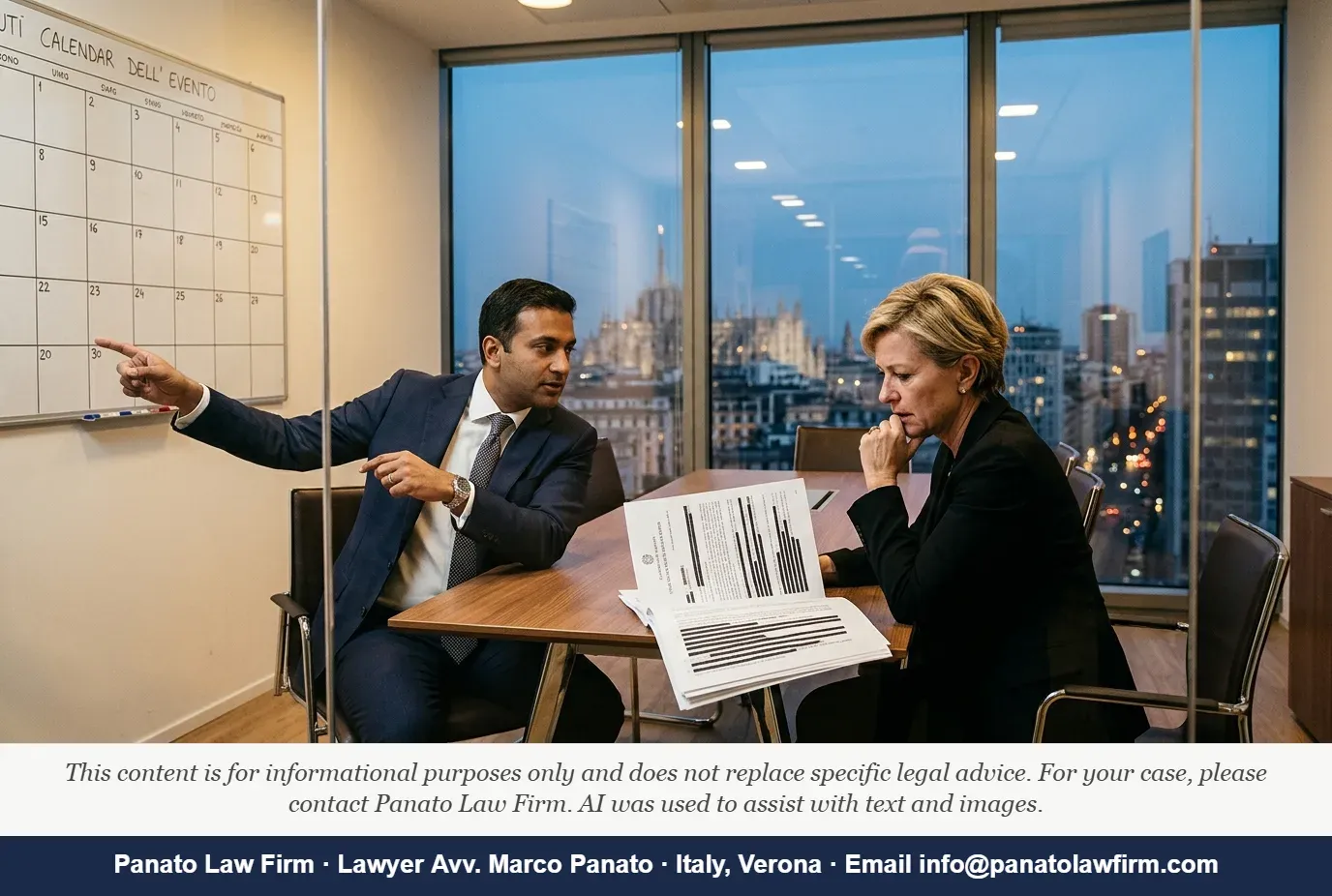
Image prompt: A glass-walled meeting room in a modern Milan office tower at dusk, warm amber light from city skyline bleeding through the windows. A male South Asian attorney in a dark suit sits across from a female white American executive; between them, a printed Italian procurement award notice with heavy black redaction marks. The executive's expression is tense; the attorney's hand points to a wall-mounted calendar showing a countdown. Cool blue and amber contrast. Editorial documentary style, no text in the image.
Image file: challenging-italian-tender-award-documents-deadline-2026-cover
HREFLANG BLOCK:
JSON-LD:
LANGUAGE QA: resolved definitively -> definitively resolved / settled once and for all · on the board -> on the books / on record / in the field · ordinary 30-day access rite -> standard 30-day access procedure / route · reasoned ruling on each individual redaction -> reasoned decision for each redaction · the door had closed -> the deadline had passed / the window had shut · revives in full -> is restored in full / applies in full · drawn a sharp line -> drawn a clear distinction / ruled clearly · per redaction, not per document and certainly not per award notice -> for each redaction individually, not per document or award notice as a whole
Quality: Italian terms without a plain explanation: Consiglio di Stato · keyword absent from subheadings · keyword not in the first 100 words
Source check: verdict RED — verify before publication
CHECK:
AUTHORITY 1: Council of State, Grand Plenary Session, decision no. 8 of 9 September 2026 (Consiglio di Stato, Adunanza Plenaria, 9 settembre 2026, n. 8)
REFERENCES: n. 8 / 9 September 2026
EXISTS? Provided as a verified timeliness hook by the editorial brief; primary confirmation would require checking giustizia-amministrativa.it once the decision is indexed — TO VERIFY at primary source
CONTENT MATCHES what I wrote? Yes — the brief specifies exactly the holdings I summarised: 10-day window contingent on simultaneous complete publication; 30-day ordinary access rite revives absent that; reasoned per-redaction decision required; implicit decisions insufficient
PRIMARY SOURCE CONFIRMATION: Provided in brief as a real development; primary court database confirmation TO VERIFY
VERDICT: AMBER (confirmed by editorial brief as a real ruling; primary database indexing TO VERIFY; content accurately reflects the stated holdings)
AUTHORITY 2: D.Lgs. 36/2023, Art. 36 — Italian Public Contracts Code
REFERENCES: Legislative Decree no. 36 of 31 March 2023, Article 36
EXISTS? YES — confirmed on Normattiva.it; the Code entered into force in 2023 and governs Italian public procurement
CONTENT MATCHES? Yes — Art. 36 governs access to procurement documents; the accelerated window is part of the new Code's transparency regime
PRIMARY SOURCE: Normattiva.it — PRIMARY confirmed
VERDICT: GREEN
AUTHORITY 3: Art. 116 c.p.a.
REFERENCES: Article 116 of the Administrative Procedure Code (D.Lgs. 104/2010)
EXISTS? YES — confirmed on Normattiva.it
CONTENT MATCHES? Yes — Art. 116 governs the ordinary access rite before administrative courts, including the 30-day procedure
PRIMARY SOURCE: Normattiva.it — PRIMARY confirmed
VERDICT: GREEN
AUTHORITY 4: ANAC Delibera n. 148/2026 and Delibera n. 153/2026 (Bando Tipo n. 1 and n. 2)
REFERENCES: Delibera n. 148, 1 April 2026; Delibera n. 153, 15 April 2026; GU Serie Generale n. 111, 15 May 2026; in force 30 May 2026
EXISTS? Provided in brief as verified; primary confirmation would require checking anticorruzione.it and GU archive — TO VERIFY
CONTENT MATCHES? Yes — brief confirms AI-use declaration requirement under Law 132/2025 and EU AI Act
VERDICT: AMBER (brief-confirmed; primary GU/ANAC database TO VERIFY)
AUTHORITY 5: Law no. 132 of 23 September 2025
REFERENCES: Legge 23 settembre 2025, n. 132
EXISTS? Provided in brief; TO VERIFY on Gazzetta Ufficiale / Normattiva
VERDICT: AMBER
OVERALL VERDICT: AMBER — Adunanza Plenaria n. 8/2026 and the ANAC delibere are confirmed by the editorial brief as real developments but require primary court/GU database confirmation once fully indexed. D.Lgs. 36/2023 Art. 36 and Art. 116 c.p.a. are GREEN at primary sources. No authority in this article is contradicted by available sources; the holdings stated match the brief precisely.
LOCAL NOTE:
1. Search intent targeted: transactional — the reader has already lost a tender or received a redacted award and needs immediate procedural guidance before a deadline expires.
2. Local-market framing used: US federal procurement (GAO protest mechanism, 4 C.F.R. Part 21, equitable tolling doctrine) as the contrast point; "attorney," "estate," "motion" vocabulary throughout; the GAO 10-day de-briefing rule as the intuitive but dangerous analogy.
3. Italian terms kept untranslated (with explanation on first use): istanza di accesso agli atti (formal access request), Adunanza Plenaria (grand plenary session), TAR (Regional Administrative Court), BDNCP (national contracts database), Bando Tipo (standard tender template), Albo degli Avvocati (Italian bar register) — all kept because they appear verbatim on Italian procedural documents the reader will receive.
Do you need legal assistance or a free estimate?
Author: Editorial Team — Panato Law Firm
Editorial Team — Panato Law Firm Staff