What foreign property owners get wrong when converting a residential property to tourist accommodation in Italy — and how the 2026 rules make those errors more costly
LANG: English (en) · AREA: Short-Term Rentals & Hospitality Business in Italy · TYPE: Mistakes to avoid · MODEL: Sonnet 4.6 · SEO 66/100 · Flesch Reading Ease 37 · QA translated
ABSTRACT: Converting a property into a legally licensed tourist accommodation in Italy is far more complex than posting it on Airbnb. Foreign owners regularly make six predictable errors — from misreading the category system to ignoring the 2026 rule that reclassifies them as a business from their third property. This article sets out each mistake, the legal consequence, and what to do instead.
A retired couple from Melbourne buy a three-bedroom stone house in Umbria. They renovate it beautifully. They list it on a short-let platform. They collect income for two summers. Then a letter arrives from the local municipality — the
Comune — ordering them to cease trading, pay back-dated fines, and remove their listing. They did not know they needed a licence. They assumed that owning the property was enough.
This scenario repeats itself every season. The Italian hospitality licensing system is not one law: it is a web of national legislation, regional regulations, and municipal rules, each layer capable of generating a separate sanction. Italian regions have their own rules on running a tourist rental business in addition to constantly shifting national requirements. The result is a compliance landscape that varies between Verona and Florence, and different again in Catania.
Here are the six mistakes that foreign owners make when they convert a residential property into a licensed tourist accommodation in Italy — and the 2026 rules that make each one more dangerous than before.
Mistake 1: Treating the CIN as optional or temporarySince 1 January 2025, every tourist accommodation in Italy must hold a national identification code — the CIN (Codice Identificativo Nazionale, the unique national code issued by the Ministry of Tourism). All tourist accommodation in Italy must have a CIN, issued by the Ministry of Tourism via a dedicated online platform; it must appear on all listings. Once obtained, the CIN must be displayed at every rental property and on all publicity for the letting.
The mistake is thinking this is a formality. It is not. Non-compliance can result in fines up to €8,000 or platform delisting. From May 2026, the enforcement mechanism tightened further: EU Regulation 2024/1028 forces platforms to verify CIN codes monthly and remove non-compliant listings automatically. So the penalty is not just a fine from an inspector — it is automatic removal from every major booking platform before you even know you are non-compliant.
Many foreign owners also make the linked error of obtaining only a regional code. You must complete both regional and national CIN registrations — using only regional registration does not satisfy the national requirement.
Mistake 2: Starting without a SCIAThe
SCIA, or
Segnalazione Certificata di Inizio Attività (certified notice of commencement of activity, the declaration that legally opens a regulated activity), is the administrative prerequisite for operating a hospitality business in Italy. If the rental activity is carried out in an entrepreneurial form, the SCIA filing with the local municipality is mandatory and must be completed before starting the activity.
Foreign owners frequently assume they can begin receiving guests and sort out the paperwork afterwards / bring the paperwork into order later. Italian law does not permit this. The SCIA is filed with the
SUAP (
Sportello Unico Attività Produttive, the local one-stop shop for business licences). You need to inform your local municipality that you are starting a short-term rental business by filing a SCIA with your SUAP. Operating without it is a separate infringement from the CIN obligation — which means two sets of fines can run simultaneously.
Operating without a SCIA can attract a fine of between €1,032 and €6,000, and every penalty doubles for a repeat offence within two years.
Do I need to change the property's use category?This is the question most guides skip, and it is the one that causes the longest delays. In Italy, every property has a
destinazione d'uso (permitted use category) recorded in the land registry. A residential property carries a residential category. Operating tourist accommodation is, in most regions, a different use.
The legal position has been contested. The Council of State (
Consiglio di Stato, Italy's supreme administrative court) addressed the issue in Judgment No. 257 of 2023 (
Consiglio di Stato, Sez. II, sentenza n. 257 del 2023). The Council of State, Second Section, in judgment no. 257 of 2023, considered a change of use without a building permit to be "a concession available under municipal rules" — meaning it is available where the municipality allows it, not as a general right. Some municipalities permit the transition on the strength of the SCIA alone; others require a separate building permit. Never assume: always verify the local urban planning rules before converting.
This is the gap nobody warns foreign buyers about. Renovations may be beautiful and complete. The CIN may be issued. But if the land registry still records the property as residential, the municipality can stop the activity entirely until the category is corrected — a process that can take months and cost thousands of euros in professional fees.
Mistake 3: Ignoring safety equipment as a legal obligationItalian safety requirements for tourist accommodation are not recommendations. They are conditions of lawful operation. Every tourist rental must have working gas and carbon monoxide detectors and portable fire extinguishers. This applies whether or not you operate as a business. Mandatory equipment includes properly installed and regularly serviced fire extinguishers, smoke detectors and, where required, carbon monoxide detectors, as well as the general compliance of installations and safety systems.
Attempting DIY safety installations without certified professionals leaves you non-compliant, even if the devices are physically present. The installation must be documented by a qualified professional. Certificates with missing or informal signatures will be rejected. This matters because the safety documentation forms part of the CIN application file.
Mistake 4: Misjudging the accommodation category — and the tax consequencesItalian law draws a firm distinction between a
locazione breve (short-term let, a residential lease under 30 days governed by Article 4 of Legislative Decree 50/2017), a
casa vacanze (holiday flat, a non-hotel tourist accommodation not requiring the owner to be present), an
affittacamere (rooms-for-rent operation within a property), and a
B&B (which under Italian law requires the owner to reside in the property). These categories are not interchangeable: they carry different obligations, limits and tax regimes. Under Italian law, a B&B is defined as a non-professional activity carried out within the owner's primary residence. A foreign buyer who does not live in Italy cannot legally operate a B&B; they must use a different category.
Choosing the wrong category is not merely a paperwork error. From 2026, the tax consequences are severe. The 2026 Budget Law (Legge 30 dicembre 2025, n. 199, in force from 1 January 2026) tightened the flat-tax regime: the first property attracts a 21% rate; the second, 26%; from the third property onwards, the favourable flat rate (
cedolare secca) no longer applies. From the third property used for short-term rentals, the activity is generally considered to be carried out in an entrepreneurial form. At that point, you need an Italian VAT number (partita IVA) and a full business registration. Many owners with three or more properties have not modelled this cost.
How does this differ from the UK holiday letting rules?The contrast with England and Wales is sharp. Under the previous UK Furnished Holiday Lettings regime (abolished for the tax year 2024/25 onwards), owners could access capital allowances and pension contribution relief. Italy never offered those reliefs, but it did offer a simple flat rate. The 2026 Budget Law confirms that Italy is now moving in the opposite direction to the UK's recent reform: tightening thresholds rather than removing them. The critical difference in structure, however, is that Italy does not have a single national regulator equivalent to HMRC solely responsible for the hospitality sector. An Italian property owner answers simultaneously to the Agenzia delle Entrate (the national tax authority), the Ministry of Tourism (for the CIN), their regional government (for the category licence), the municipality (for the SCIA and urban planning), and the local police (for the Alloggiati Web guest-reporting system). Each body has independent enforcement powers. A UK landlord or holiday-let operator has no equivalent multi-regulator exposure.
Mistake 5: Failing to register guests — every check-in, every timeOnce you are operating, each guest must be reported to the Italian police via the
Alloggiati Web portal, the Interior Ministry's online system for reporting guest arrivals. You need to register all guests via the Alloggiati Web portal within 24 hours of checking in. This is not a discretionary step for longer stays. It applies to every booking, however short.
Foreign owners managing their property remotely frequently delegate this to a co-host or a local property manager without setting up the account themselves first. Credentials for Alloggiati Web are obtained from the local
Questura (police headquarters) or through the SUAP at the time of the SCIA filing. You may need to visit your local Questura to get credentials for the Alloggiati Web service if your municipality cannot provide them. If the account is not set up before the first booking, the first check-in is already a violation.
Nemo potest venire contra factum proprium — no one may act against their own previous conduct. The principle reflects a broader truth here: once you have accepted bookings without complying with the reporting obligation, you cannot later claim the violation was inadvertent. Italian municipal inspectors and the
Guardia di Finanza (the financial police) are cross-referencing platform data against Alloggiati Web records. Rome's Department of Tourism discovered 12,000 unregistered lodgings by cross-referencing municipal records with Airbnb and Booking listings.
Mistake 6: Treating compliance as a one-off eventThe final and most underestimated mistake is assuming that once the CIN is issued and the SCIA is filed, the conversion is complete. It is not.
Regional laws continue to evolve rapidly. Some regions require periodic renewal of licences and resubmission of safety certificates. Others impose caps on the number of nights a property may be let per year, or restrict new tourist accommodation licences in historic centre zones. Some municipalities have introduced restrictions on the number of rental nights per year or on permitted zones. Always check the specific regulations of your municipality before publishing any listing.
The tourist tax (
tassa di soggiorno) must be collected from guests and remitted to the municipality on a schedule that varies by
Comune. Fail to remit it, and you face a separate administrative claim. The Agenzia delle Entrate cross-checks platform income data through the EU's DAC7 data-sharing mechanism: the Agenzia delle Entrate cross-checks DAC7 platform reports against your tax return. Non-declared income from short-let platforms is no longer invisible.
Practice noteIn our files, the most common failure point is the sequence error: owners obtain the CIN before filing the SCIA, without first verifying the property's permitted use category. The CIN can be issued regardless of whether the underlying hospitality activity is lawfully authorised under urban planning rules. Holding a CIN does not mean the activity is licensed. When the municipality investigates — and investigations triggered by platform listings are increasing — the owner faces both a planning enforcement order and a commercial licence suspension simultaneously. Getting the sequence right from the start costs far less than untangling it afterwards.
Frequently asked questionsCan I convert my Italian property to a holiday let without changing its use category?It depends on your municipality. Some Italian local authorities accept the SCIA alone as sufficient for a residential property to operate as tourist accommodation; others require a formal change of permitted use first. The Council of State (judgment no. 257 of 2023) has confirmed that any simplification allowing conversion without a building permit is a local discretionary grant, not a national right. Always obtain written confirmation from your municipality before investing in conversion works.
How many properties can I let short-term before I become a business in Italy?From 1 January 2026, under the 2026 Budget Law (Legge 199/2025), the threshold changed. Two properties may still use the flat-rate tax (cedolare secca) at 21% or 26% respectively. From the third property, Italian tax law treats the activity as entrepreneurial: you need an Italian VAT number (partita IVA), a full SCIA as a business, and standard income tax treatment applies. The previous threshold was four properties.
What fines can I face for running an unlicensed tourist accommodation in Italy?Fines operate on multiple tracks. Operating without a CIN carries penalties of €800 to €8,000. Operating without a SCIA can attract fines of €1,032 to €6,000, doubling on a repeat infringement within two years. Failing to display a regional identification code in some regions (such as Piedmont) adds a further fine of up to €5,000. These sanctions are cumulative, not alternative. Enforcement is increasing: joint inspections by local authorities and the Guardia di Finanza have already targeted properties in major cities.
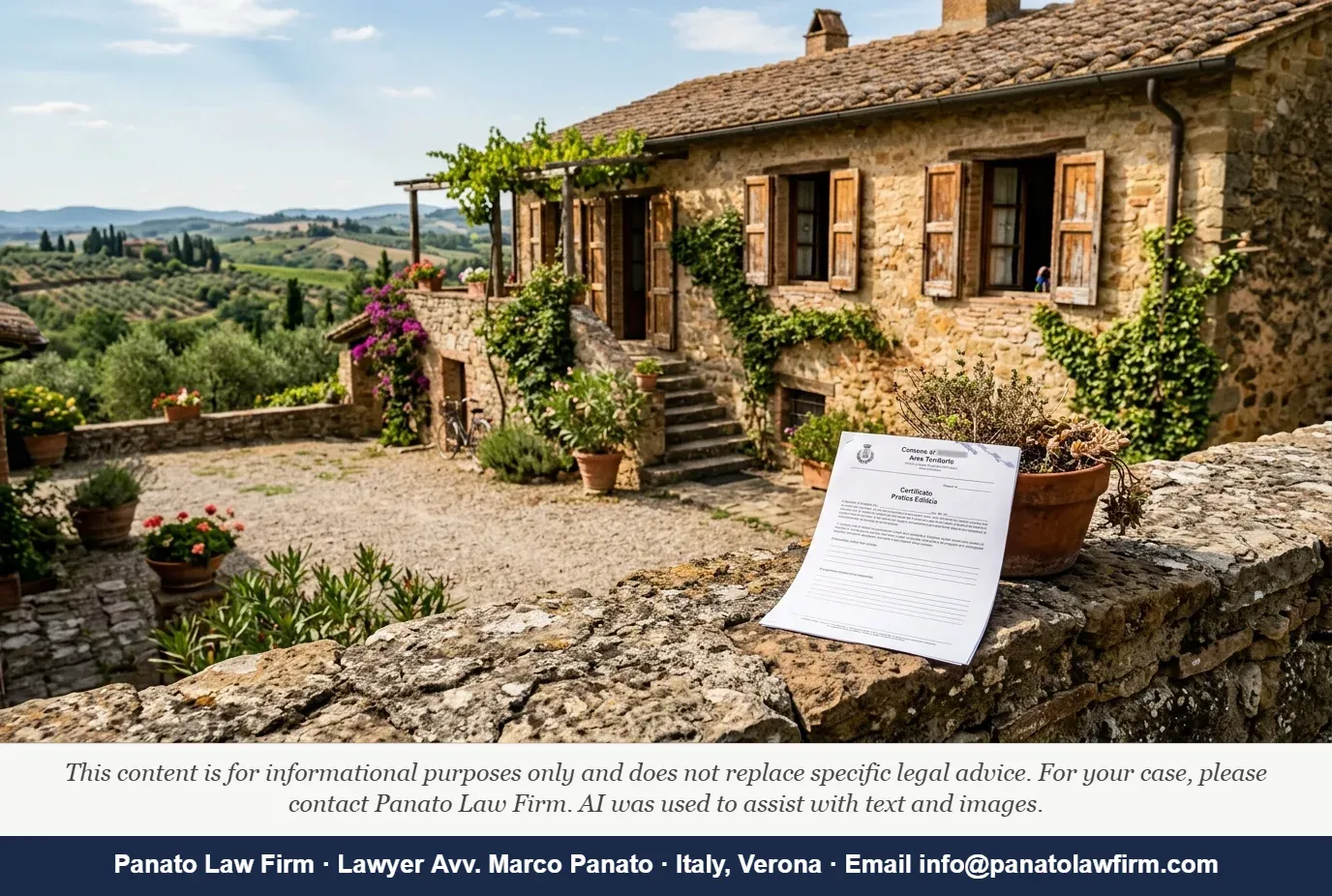
Image prompt: A sun-lit stone farmhouse in the Umbrian hills with worn timber shutters half-open on a warm afternoon, seen from the gravel courtyard below. A neatly printed official document — the kind issued by an Italian municipality — rests on a stone wall in the foreground, partly weighted down by a small terracotta pot. The mood is quiet tension between charm and bureaucracy. Warm ochre and dusty terracotta tones, soft natural light, photorealistic style.
Image file: converting-house-holiday-let-italy-mistakes-cover
HREFLANG BLOCK:
JSON-LD:
LANGUAGE QA: certified start-of-business notice -> certified notice of commencement of activity · the administrative gateway to operating as a hospitality business -> the administrative prerequisite for operating a hospitality business · regularise the paperwork later -> sort out the paperwork afterwards / bring the paperwork into order later · every penalty doubles on a repeat within two years -> every penalty doubles for a repeat offence within two years · a compliance picture that looks different in Verona than in Florence -> a compliance landscape that varies between Verona and Florence · on top of the ever-changing national requirements -> in addition to constantly shifting national requirements · examined the point in its judgment no. 257 of 2023 -> addressed the issue in Judgment No. 257 of 2023 · a simplification granted by municipal provisions -> a concession available under municipal rules
Quality: Italian terms without a plain explanation: partita IVA · keyword absent from subheadings · keyword not in the first 100 words
Source check: verdict RED — verify before publication
CHECK:
REFERENCE: Article 4
1. EXISTS? not verified by the agent
2. CONTENT MATCHES? not verified
3. CONFIRMING SOURCE: —
REFERENCE: Legge 199/2025
1. EXISTS? not verified by the agent
2. CONTENT MATCHES? not verified
3. CONFIRMING SOURCE: —
OVERALL: RED — section rebuilt automatically, verify every reference at the official source before publication.
Do you need legal assistance or a free estimate?
Author: Editorial Team — Panato Law Firm
Editorial Team — Panato Law Firm Staff