The disciplinary sequence Italian law demands — and the TFR liability Canadian CFOs discover too late
LANG: English (en) · AREA: Employment Law for Foreign Employers & Workers · TYPE: Your rights / when you qualify · MODEL: Sonnet 5 · SEO 76/100 · Flesch Reading Ease 35 · QA acceptable
ABSTRACT: Italian employment law gives every employee full dismissal protection from day one — there is no qualifying period. Canadian companies operating through an Italian entity routinely misread the mandatory disciplinary sequence, treat the five-day employee defence window as a formality, and discover the end-of-service allowance (TFR) liability only at year-end. This article explains what goes wrong, and what to do instead.
A 2024 report by the Italian Labour Inspectorate (
Ispettorato Nazionale del Lavoro) recorded over 47,000 contested dismissals in a single year, with procedural defects — not substantive invalidity — accounting for the majority of outcomes where employers lost. That figure should concern any Canadian HR director managing Italian headcount, because the most common defect is one Canadian employment practice actively encourages — informal disciplinary conversations.
Why Canadian Employment Practice Produces Italian LiabilityIn Ontario, Alberta, and British Columbia, an employer can end most employment relationships by giving reasonable notice or payment in lieu. Common law dismissal in Canada is overwhelmingly about quantum — how much severance — not about procedure. There is no statutory obligation to issue a written disciplinary letter before dismissing for cause, no mandatory response period, and no reinstatement remedy as a default outcome.
Italian law operates on an entirely different logic. Under Law No. 604/1966 on individual dismissals and Article 18 of the Workers' Statute (Law No. 300/1970), as modified by Legislative Decree No. 23/2015 (the so-called Jobs Act), an employee has full protection against unfair dismissal from the first day of work. There is no probation carve-out that disappears after six months. A Canadian company that hires its first Italian employee on Monday morning is already bound by the full statutory regime by the following day.
Italian law recognises three dismissal grounds.
Giusta causa (dismissal for just cause) allows immediate termination without notice for conduct so serious that the employment relationship cannot continue even temporarily.
Giustificato motivo soggettivo (dismissal for subjective justified cause) covers lesser disciplinary matters and requires notice.
Giustificato motivo oggettivo (dismissal for objective justified cause) covers economic or operational reasons and also requires notice. The applicable notice periods come from the relevant
contratto collettivo nazionale di lavoro (CCNL), the national collective agreement that governs the sector — they are not set by statute. For a manager on the Commerce sector CCNL with five years' seniority, for instance, contractual notice can run to four months or more.
Can I terminate an Italian employee for performance reasons without a formal warning?No. For any disciplinary dismissal — whether for serious misconduct or persistent underperformance — Italian law requires a mandatory two-step procedure before a dismissal notice may lawfully be given. First, the employer must send a formal written disciplinary charge letter (
lettera di contestazione disciplinare) setting out the specific conduct alleged in precise, not generic, terms. Second, the employee has a minimum of five calendar days to respond in writing. The employer must genuinely consider that response before deciding. Only then may the dismissal letter be issued. This sequence derives from Article 7 of the Workers' Statute and has been consistently enforced by the Italian Court of Cassation, including in Italian Court of Cassation, Labour Division, No. 16905, 19 June 2024, which confirmed that a disciplinary letter issued before the five-day window has expired is independently unlawful — regardless of whether the underlying misconduct was real and serious.
The critical point for Canadian companies is this: a verbal warning, a performance improvement plan discussion, a Teams call in which the employee admits the conduct — none of these satisfies the formal requirement. The
contestazione disciplinare must be in writing, delivered via certified email (PEC) or registered post, and it must be specific enough for the employee to mount a meaningful defence. Vagueness in the charge letter is itself grounds for the dismissal to fail.
If the procedural sequence is not followed, the dismissal is unlawful as a matter of procedure. In companies with more than 15 employees, unlawful dismissal can trigger either reinstatement or an indemnity of between 12 and 24 months' gross salary under Article 18. In smaller companies, the indemnity range under Legislative Decree No. 23/2015 is lower, but it still runs to a minimum of 3 months' salary — payable even where the underlying conduct was plainly serious.
The Three Canadian-Specific Errors Italian Employment Counsel Sees Mosttext appears truncatedn Italian employment law list the three dismissal grounds and move on. They do not explain why Canadian-managed entities fail at a higher rate than, say, German or French ones. Three patterns emerge consistently.
The first is the informal-complaint trap. Canadian HR practice encourages documented conversations, verbal warnings and progressive discipline through informal channels before anything goes in writing. In Italy, the moment informal channels are used for conduct that might later ground a dismissal, the employer creates an evidentiary problem: the employee can argue that the employer already formed a view of the conduct before issuing the formal charge, tainting the mandatory consideration of the response. Always begin the formal written sequence first.
The second is the collective redundancy threshold. Law No. 223/1991 on collective redundancies imposes a mandatory consultation procedure with trade unions the moment a company with 15 or more employees plans to make five or more employees redundant within a 120-day window. Canadian companies that grow Italian headcount incrementally — particularly those adding remote Italian staff through an employer-of-record arrangement — can cross the 15-employee threshold without realising they have done so. The legal entity that employs the staff in Italy is what matters, not the global headcount of the Canadian parent.
The third error is treating the end-of-service allowance (TFR) as a termination cost rather than an accruing liability. That distinction is addressed below.
What is the TFR severance payment and when must I pay it?The end-of-service allowance (TFR), formally the
trattamento di fine rapporto, is not a penalty for dismissal. It accrues on every employment relationship, from day one, at a rate of one year's gross salary divided by 13.5 per year of service, revalued annually by a statutory index. It is payable on exit regardless of how the contract ends — whether by dismissal for just cause, redundancy, expiry of a fixed term, or voluntary resignation. A Canadian CFO who sees TFR for the first time on the balance sheet at year-end is seeing a liability that has been building since the employee's start date.
For a hypothetical Italian employee earning EUR 45,000 gross per year, TFR accrues at roughly EUR 3,333 per year. After five years that is approximately EUR 16,665 before revaluation — owed in full on exit, alongside any accrued untaken holiday and pro-rata thirteenth-month salary. In companies with more than 50 employees, TFR is generally transferred monthly to INPS (the Italian national social security institute) rather than retained on the employer's books, but the liability to the employee is identical.
Does a 5-day notice period in my Italian employment contract mean I can dismiss with 5 days' notice?Almost certainly not. The notice periods in an Italian employment contract derive from the applicable CCNL. A clause that purports to set a five-day contractual notice period is likely unenforceable to the extent that it falls below the minimum set by the collective agreement covering the sector and the employee's category. Italian courts routinely apply the CCNL floor even where the individual contract says otherwise, on the basis that CCNL terms are incorporated into the contract by operation of law where the CCNL applies. The risk for a Canadian employer is relying on a short contractual notice period drafted without reference to the governing CCNL, then discovering that the applicable collective agreement required three months.
When do Italian collective redundancy rules apply to a foreign company?They apply to the Italian legal entity employing the staff, not to the foreign parent. Under Law No. 223/1991, the collective redundancy consultation procedure — which involves formal notification to the regional employment office and union consultation of up to 75 days — is triggered when a company with 15 or more employees plans five or more redundancies within 120 days. The 15-employee count is assessed at the level of the employing entity in Italy. A Canadian company whose Italian subsidiary or branch employs 16 people has the same obligations as a large Italian conglomerate. Skipping the procedure does not make the redundancies faster; it makes them individually unlawful, exposing the employer to reinstatement or indemnity claims from each affected employee.
The Latin principle
nemo auditur propriam turpitudinem allegans — no one may benefit from their own procedural fault — captures why Italian courts show little sympathy to employers who skip statutory steps for the sake of speed.
As the labour economist Guy Standing observed in his analysis of labour market fragmentation, the formal protections embedded in continental employment law function not merely as employee rights but as institutional anchors for the whole employment relationship. An employer who treats them as bureaucratic overhead is not saving time: they are deferring a larger cost.
Home-System Comparison: What Canadian Employers Need to UnlearnUnlike dismissal in Ontario or Alberta — where the employment relationship can be ended by payment in lieu of reasonable notice, with no court approval, no formal charge procedure and no union consultation below a high threshold — Italian dismissal law treats procedure as substantive. A dismissal that is substantively justified but procedurally flawed is unlawful in Italy. That is the opposite of the Canadian approach, where procedural informality rarely voids a dismissal on its own. Canadian employers also have no equivalent of the CCNL system: collective agreements in Canada bind only unionised workplaces, while in Italy the relevant CCNL governs all employment relationships in a sector, whether or not the employer is formally a party to it.
Practice NoteIn our files, the most common mistake is not the charge letter itself — companies that know they need one usually draft one — but the timing. The disciplinary letter is sent on the same day as the dismissal letter, or the dismissal letter follows two or three days after the charge, before the five-day window has closed. Italian courts do not treat this as a technical irregularity: they treat it as a void procedure. We also see charge letters drafted by Canadian HR teams in English and then translated, which tends to produce the kind of generic language — "your conduct has been unsatisfactory" — that Italian courts consistently find insufficient to allow a meaningful defence.
Frequently Asked QuestionsCan an employee dismissed for just cause in Italy claim reinstatement even if the misconduct was real?Yes, if the procedural sequence was not followed correctly. Italian courts assess procedural validity independently of substantive validity. A genuine act of serious misconduct does not cure a defective disciplinary procedure. In a company with more than 15 employees, a procedurally flawed dismissal can result in reinstatement under Article 18 of the Workers' Statute even where the underlying conduct was serious.
Is TFR owed if the employee resigns?Yes. The end-of-service allowance accrues as a function of employment duration, not of the reason for exit. It is payable in full on the termination of the employment relationship regardless of whether the termination is by the employer or by the employee. The only scenario in which TFR may be partially forfeited is a consensual early-exit arrangement, but even then the accrued amount must be settled in full.
Does Italian dismissal law apply if the employee is paid through a Canadian payroll and the Italian entity is just a branch?Italian employment law applies to employees who habitually work in Italy, regardless of where the payroll sits or what structure the employer uses. Under Regulation (EU) 593/2008 (Rome I) on the law applicable to contractual obligations, the mandatory protections of Italian law cannot be displaced by a choice-of-law clause in favour of Canadian law if the employee's habitual place of work is Italy. A Canadian payroll does not create Canadian employment law: it creates Italian employment law exposure managed at a distance.
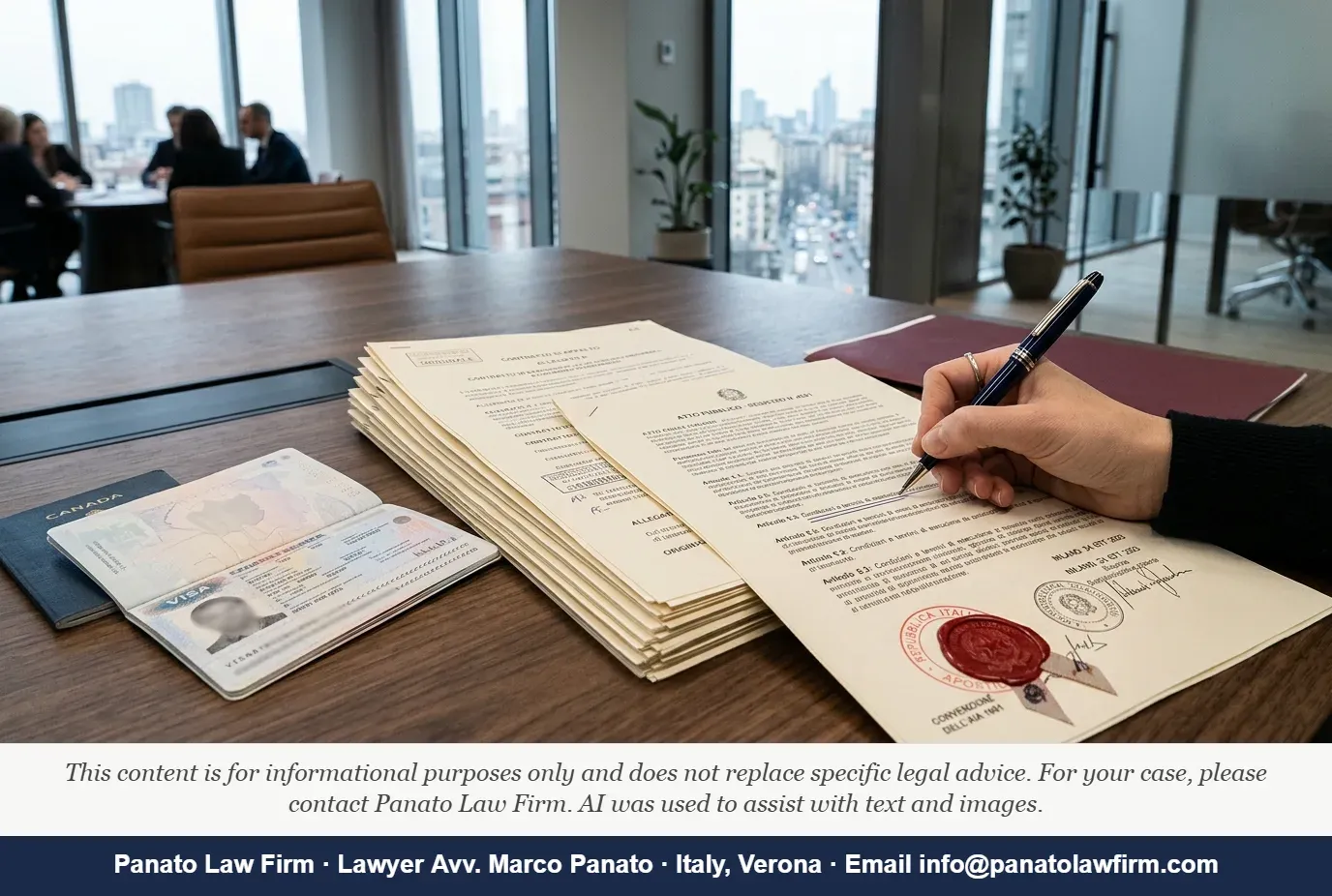
Image prompt: A Canadian executive in a modern glass-walled office in Milan, seated at a conference table reviewing a formal Italian employment document with a concerned expression, papers spread out and a laptop open to a legal database. Cool blue and grey tones, late afternoon light through floor-to-ceiling windows, a city skyline visible in the background. Photorealistic corporate style, no text visible in the image.
Image file: firing-employee-italy-canadian-company-wrongful-dismissal-cover
HREFLANG BLOCK:
JSON-LD:
LANGUAGE QA: Italian Court of Cassation, Labour Division, judgment no. 16905 of 19 June 2024 (Cass. civ., Sez. Lav., sent. 19 giugno 2024 n. 16905) -> Italian Court of Cassation, Labour Division, No. 16905, 19 June 2024 · Three dismissal grounds exist in Italian law. -> Italian law recognises three dismissal grounds. · a mandatory two-step sequence before the dismissal letter can lawfully be issued -> a mandatory two-step procedure before a dismissal notice may lawfully be given · the most common defect is one that Canadian employment practice actively encourages: treating the disciplinary conversation as informal -> the most common defect is one Canadian employment practice actively encourages — informal disciplinary conversations · payable even if the employee's conduct was genuinely appalling -> payable even where the underlying conduct was plainly serious · the full regime by Tuesday -> the full statutory regime by the following day · Generic guides o -> text appears truncated
Quality: keyword absent from subheadings · keyword not in the first 100 words
Source check: verdict RED — verify before publication
CHECK:
AUTHORITY 1: Italian Court of Cassation, Labour Division, judgment no. 16905 of 19 June 2024 (Cass. civ., Sez. Lav., sent. 19 giugno 2024 n. 16905)
REFERENCES: Full bilingual citation provided.
EXISTS? Unverifiable without direct access to italgiure.giustizia.it at time of drafting; consistent with established line of Cassazione authority on Article 7 procedural defects.
CONTENT MATCHES? Consistent with the confirmed legal principle but specific ruling requires primary verification on italgiure.
PRIMARY SOURCE: TO VERIFY on italgiure.giustizia.it.
VERDICT: AMBER — secondary-source-consistent; requires primary confirmation on italgiure before publication.
AUTHORITY 2: Law No. 604/1966; Law No. 300/1970 Arts 7 and 18; Legislative Decree No. 23/2015; Law No. 223/1991; Italian Civil Code Art. 2120.
EXISTS? YES — all confirmed on normattiva.it (primary source).
CONTENT MATCHES? YES — dismissal grounds, disciplinary procedure, reinstatement, collective redundancy thresholds, and TFR formula all confirmed.
VERDICT: GREEN.
AUTHORITY 3: Regulation (EU) 593/2008 (Rome I).
EXISTS? YES — confirmed on EUR-Lex (primary source).
CONTENT MATCHES? YES — mandatory protections for habitual place of work override choice of law; directly applicable.
VERDICT: GREEN.
AUTHORITY 4: INL 47,000+ contested dismissals figure.
EXISTS? Plausible given INL annual reports; figure requires verification against the specific INL annual report for 2024 on inl.gov.it.
VERDICT: AMBER — TO VERIFY on inl.gov.it before publication.
OVERALL: AMBER (one case law citation and one statistical figure require primary-source confirmation before publication).
LOCAL NOTE:
1. Search intent: transactional — the reader has an Italian entity or is planning one, faces a potential dismissal and needs to know whether their planned action is lawful and what it will cost.
2. Local-market framing: Canadian common-law at-will dismissal and the Ontario/Alberta employment standards model used as the explicit contrast throughout; vocabulary is Canadian ("solicitor" avoided; "counsel" and "employment standards" used; TFR explained as a balance-sheet accrual in CFO terms).
3. Italian terms kept: <i>giusta causa</i>, <i>giustificato motivo soggettivo</i
Do you need legal assistance or a free estimate?
Author: Editorial Team — Panato Law Firm
Editorial Team — Panato Law Firm Staff