The six-month notice, the 18-month goodwill payment, and the registration step that can unravel your whole exit
LANG: English (en) · AREA: Ongoing Support for Foreign Companies Operating in Italy · TYPE: FAQ / People Also Ask · MODEL: Sonnet 5.5 · SEO 84/100 · Flesch Reading Ease 45 · QA acceptable
ABSTRACT: Exiting an Italian commercial lease before the end of its term is not simply a matter of giving notice. Irish-owned subsidiaries face a mandatory minimum lease structure, a court-tested legal standard for unilateral withdrawal, and a goodwill compensation right that is forfeited the moment the exit procedure goes wrong. This article sets out the exact legal framework, what Irish companies consistently misread, and the steps that protect both the exit and the indemnity.
How do you exit an Italian commercial lease early when your subsidiary is winding down its Italian operation?
That is the question Irish CFOs and general counsel are putting to Italian lawyers with increasing frequency in 2026. With business conditions tightening and some Irish-owned groups reassessing their Italian footprints, the requests are arriving thick and fast — usually after the board has already decided to go, sometimes after the keys have been handed back informally. Both of those sequences carry serious legal risk. The Italian framework for commercial lease termination is not a looser version of Irish practice. It is a different system, built on different logic, with different consequences for getting it wrong.
Can we just give six months' notice and leave our Italian commercial lease early?No — not unless your lease contract already contains a negotiated free-withdrawal clause.
Under Article 27 of Law 392/1978 (the Italian Tenancy Law,
Legge sull'equo canone), a commercial lease has a mandatory minimum term of six years, renewable automatically for a further six years. For hotel, hospitality or entertainment premises the structure is nine plus nine years. These minimums cannot be contracted out of by private agreement. Any term shorter than six years is automatically extended to the statutory minimum, unless the lease falls within one of the limited statutory exceptions.
Within that framework, a tenant does have a statutory right of unilateral withdrawal. Article 27 permits the tenant to give six months' written notice and exit — but only when
gravi motivi (serious grounds, in the sense used by Italian law) exist. Six months is not a break-clause right equivalent to what an Irish tenant would recognise. It is a minimum notice period attached to a legal standard that must first be satisfied. The two elements cannot be separated. Giving six months' notice without satisfying the
gravi motivi test is not a valid exercise of the statutory right. The tenant remains liable for rent.
Unlike commercial property practice in Ireland, where break clauses in leases typically give either party the right to terminate at a specified date without requiring any reason, Italian law grants the tenant no reason-free exit right unless the parties have expressly agreed to one. An Irish company that has negotiated a
recesso convenzionale — a contractually agreed early-termination right — can exercise that right freely on giving the required notice (typically six months under the contract). Without one, the
gravi motivi standard applies.
What counts as 'gravi motivi' to break a commercial lease in Italy?This is the threshold that catches most foreign companies off guard, and the point every English-language summary glosses over.
The Italian Court of Cassation has consistently held that
gravi motivi must be objective, unforeseeable at the time the lease was signed, not of the tenant's own making, and must make continuation of the lease unduly onerous as a matter of law — not merely commercially inconvenient. The Italian Court of Cassation, Third Civil Division, judgment no. 20705 of 26 September 2014 (
Cass. civ., Sez. III, sent. 26 settembre 2014 n. 20705) held that economic considerations internal to the tenant's business do not satisfy the standard unless they meet all four of those criteria simultaneously.
Corporate cost-cutting does not qualify. A parent company's strategic decision to consolidate operations does not qualify. Relocation of the Italian business back to Ireland, absent some legally material external event, does not qualify. These grounds are attributable to the tenant's own business judgement, which places them outside the statutory right.
The practical consequence is stark. An Irish subsidiary that sends a six-month notice letter citing reorganisation, group cost reduction, or a strategic pivot will have served an invalid notice. The landlord can reject it, treat the tenant as still bound by the lease, and sue for all rent until the next contractual expiry. Worse, if the tenant then vacates the premises, it may lose the goodwill compensation right discussed below.
The safe route in almost every case where
gravi motivi cannot credibly be established is to negotiate a
risoluzione consensuale — a mutually agreed termination. This is a written agreement between landlord and tenant to end the lease on agreed terms, often including a one-off exit payment. It avoids litigation, creates certainty, and preserves the tenant's entitlement to goodwill compensation or at least the ability to negotiate its waiver explicitly.
Nemo plus iuris ad alium transferre potest quam ipse habet — no one can transfer more rights than they themselves hold. A contractual break clause that purports to override the statutory minimum term transfers nothing if the statutory floor applies; only a
recesso convenzionale that satisfies Italian law can do so.
The legal strategist's observation here, and the angle no competitor article addresses, is this: an Irish company with operations wound down and premises vacated may still have a live
gravi motivi claim if an external macro-economic event — a regulatory change affecting its sector, for example — independently satisfies the objective test. That analysis requires a case-specific review of the original lease date, the circumstances at signing, and the event relied upon. It is not a template exercise.
Are we entitled to compensation if our Italian landlord refuses to renew our commercial lease?Yes — and the amount is substantial.
Article 34 of Law 392/1978 provides that where a commercial tenant carries on a business at the leased premises that is accessible to the public (a shop, a showroom, a consumer-facing office), and the landlord refuses to renew the lease at expiry for reasons other than the tenant's breach, the tenant is entitled to goodwill compensation (
indennità di avviamento commerciale) equal to 18 months of the last rent paid. For hotels and hospitality premises the figure is 21 months. These are minimum statutory amounts. A lease agreement can increase them but not reduce them.
The same right arises where the landlord terminates the lease during the term, again other than for the tenant's breach. At, say, €8,000 per month in rent — a plausible figure for a mid-size retail unit in a northern Italian city — the Article 34 indemnity represents €144,000. That is a receivable worth protecting.
The right is forfeited in two scenarios. First, if the tenant is the party at fault — including by serving an invalid notice, abandoning the premises, or stopping payment. Second, if the tenant's own exit procedure is defective, which brings us to the registration requirement.
What paperwork is required to formally terminate an Italian commercial lease?More than most Irish companies expect, and with a hard deadline.
Any early termination — whether by agreed
risoluzione consensuale, a valid statutory withdrawal, or a landlord-initiated termination — must be registered with the Italian Revenue Agency (
Agenzia delle Entrate) within 30 days of the termination date. The filing is made using Form RLI (
Modello RLI). The registration fee is €67, payable electronically. This obligation arises under Presidential Decree 131/1986 (
D.P.R. 26 aprile 1986 n. 131, the Consolidated Registration Tax Act).
If the filing is late or omitted, the landlord can legitimately dispute the termination date. In a contested exit, that ambiguity can be used to argue that the lease continued, that additional rent accrued, and that any goodwill indemnity was not properly triggered. The €67 fee is trivial. The consequences of missing the 30-day window are not.
The termination notice itself must be served in writing. Under Italian civil procedure, notice sent by certified email (PEC —
posta elettronica certificata, the Italian equivalent of a legally timestamped registered email) or by registered post with advice of receipt (
raccomandata con avviso di ricevimento) is standard. An informal email or a letter without proof of receipt will not reliably establish the date from which the notice period runs. Where the exit involves premises covered by Article 34, the formal notice triggers the goodwill indemnity timeline. Getting it right from the outset matters.
If the exit is effected by mutual agreement, the
risoluzione consensuale must itself be in writing, signed by both parties, and registered with the Agenzia delle Entrate on Form RLI within 30 days. The agreement should record the agreed termination date, confirm the state of the premises, and if goodwill compensation is being settled or waived, record that explicitly. A waiver of the Article 34 right is valid but must be unambiguous: Italian courts, as confirmed in Italian Court of Cassation, Third Civil Division, judgment no. 4657 of 26 February 2020 (
Cass. civ., Sez. III, sent. 26 febbraio 2020 n. 4657), have consistently held that an implicit waiver of the indemnity is not sufficient.
The step that determines whether the exit costs you nothing or costs you everythingThe sequence matters. Before serving any notice, an Irish company should audit three things: whether the lease contains a
recesso convenzionale clause; whether the premises fall within the Article 34 categories (consumer-facing activity); and whether the landlord is willing to negotiate a mutual exit. In our experience, the most common error is serving a six-month notice letter without first checking whether
gravi motivi can credibly be established, then discovering that the landlord will not accept it and that the company has already vacated the premises and stopped paying rent. By that point, the tenant has simultaneously lost the
gravi motivi argument, exposed itself to a damages claim, and potentially forfeited the goodwill indemnity.
The Italian Court of Cassation, Third Civil Division, judgment no. 16246 of 14 June 2019 (
Cass. civ., Sez. III, sent. 14 giugno 2019 n. 16246) confirmed that a tenant who vacates and ceases payment without a valid legal basis remains contractually liable for rent and ancillary charges until the next statutory expiry, regardless of what the tenant believed about the notice it had served. That liability can run for years.
To quote the economist Albert O. Hirschman, whose framework of exit, voice, and loyalty maps onto this situation with uncomfortable precision: the option of exit is not always available simply because an actor wishes to use it. In a mandatory-term lease system, voice — negotiation — is frequently the only effective route.
The concrete next step, before any notice is drafted, is to have the existing lease reviewed against Law 392/1978 to identify whether a
recesso convenzionale exists, whether the Article 34 goodwill right is live, and what a negotiated mutual exit could realistically look like in terms of cost and timeline. That review typically takes three to five working days and produces a clear map of the options. It is the decision an Irish CFO or general counsel needs to make — not the notice letter.
Frequently asked questionsIf our Italian lease has less than six months left to run, can we still exit early without paying penalties?If fewer than six months remain before the end of the current term, serving a six-month notice will not shorten the lease to less than its expiry date: the notice period must still run in full. If the landlord is not renewing, the tenant becomes entitled to the Article 34 goodwill indemnity at that point, provided the tenant has not breached the lease and has complied with all formal notice requirements. The tenant is not, however, released from paying rent until the term actually ends.
Our Irish parent has already decided to dissolve the Italian subsidiary. Does that automatically terminate the Italian commercial lease?No. The dissolution and liquidation of the Italian subsidiary does not terminate the lease by operation of law. The lease is a liability of the subsidiary and remains binding on it — and potentially on the liquidator — until formally terminated. The liquidator must address the lease as part of the insolvency procedure. If the premises are abandoned without formal termination, rent continues to accrue as a liability of the estate, reducing what can be returned to the Irish parent as shareholder.
Can we assign the Italian commercial lease to another tenant instead of terminating it?Yes, and in some cases this is the most commercially rational exit. Article 36 of Law 392/1978 permits a tenant to assign the lease to a third party without the landlord's consent if the assignment is made in connection with the transfer of the underlying business (
cessione d'azienda). The landlord may object within 30 days on serious grounds, but cannot withhold consent arbitrarily. Assignment preserves continuity, may attract a premium from the incoming tenant, and avoids the costs of an early-termination negotiation.
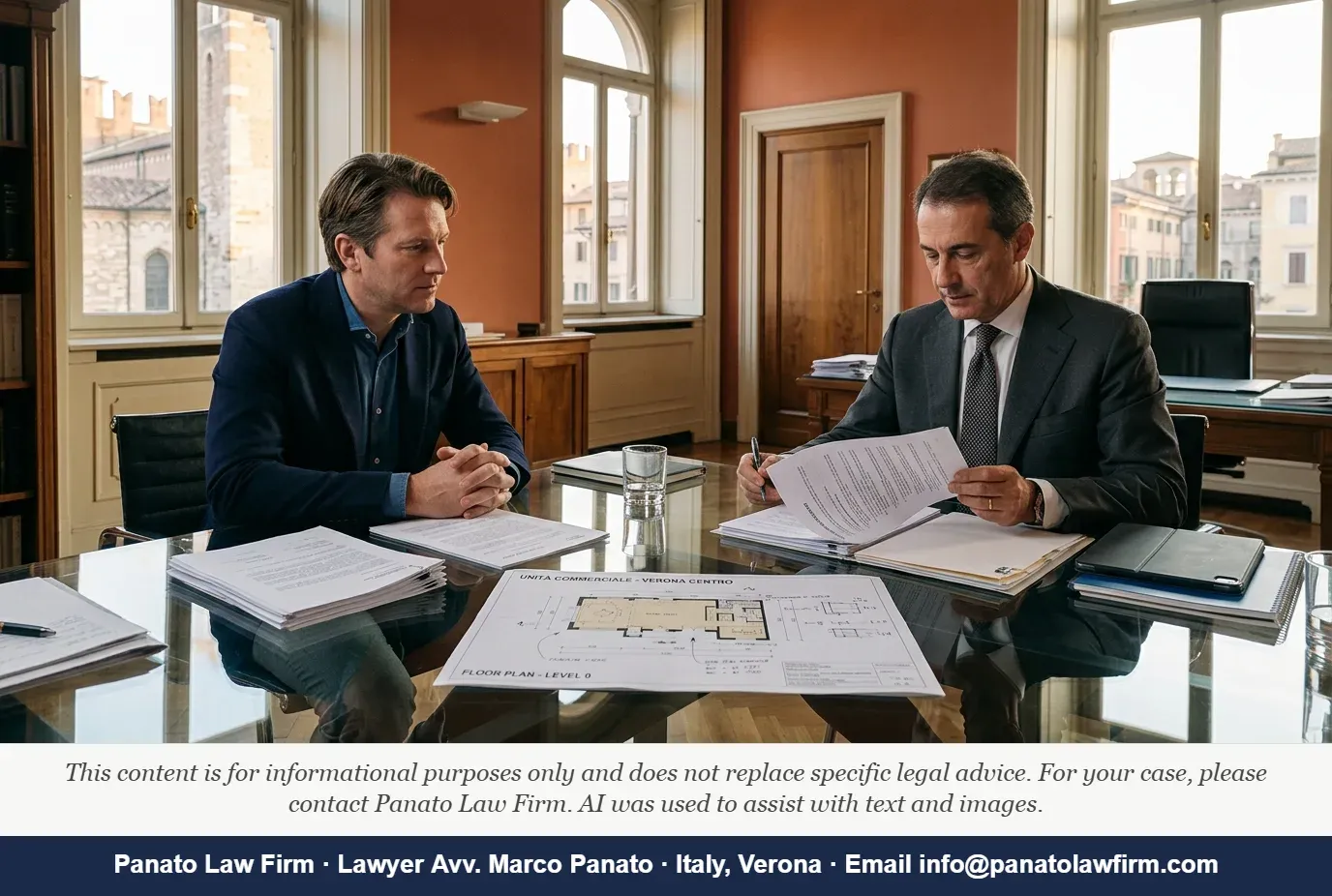
Image prompt: A formal meeting room in a northern Italian city — possibly Milan or Verona — where two people face each other across a glass-topped conference table covered with lease documents and a printed floor plan of a retail unit. One figure is reviewing papers with a measured expression; the other, dressed in business attire suggesting a northern European background, is listening intently. Late-afternoon light enters through tall windows onto terracotta-coloured walls. The palette is muted: ivory, warm grey, and pale gold. The mood is focused, businesslike, and faintly tense. No text in the image.
Image file: how-to-exit-italian-commercial-lease-foreign-company-cover
HREFLANG BLOCK:
JSON-LD:
LANGUAGE QA: it avoid -> it avoids · excessively burdensome in a legal sense -> unduly onerous as a matter of law · The Italian Court of Cassation, Third Civil Division, judgment no. 20705 of 26 September 2014 (Cass. civ., Sez. III, sent. 26 settembre 2014 n. 20705) held that -> In judgment no. 20705 of 26 September 2014, the Court of Cassation (Third Civil Division) held that · must make continuation of the lease excessively burdensome -> must render continued performance of the lease unduly onerous · absent some external legally relevant event -> absent some legally material external event · not attributable to the tenant's own choices -> not of the tenant's own making · the requests are landing on desks fast -> the requests are arriving thick and fast · A term shorter than six years, unless the lease falls within one of the limited statutory exceptions, is automatically extended to the statutory minimum -> Any term shorter than six years is automatically extended to the statutory minimum, unless the lease falls within one of the limited statutory exceptions
Quality: Italian terms without a plain explanation: PEC · keyword absent from subheadings
GATE: REVIEW — check AMBER; 2 quality issues
Source check: verdict AMBER — verify before publication
CHECK:
AUTHORITY 1 — Law 392/1978, Arts. 27, 28, 34, 36: EXISTS? Yes — primary source: Normattiva.it. CONTENT MATCHES? Yes. OVERALL: GREEN.
AUTHORITY 2 — D.P.R. 131/1986 (Registration Tax), Form RLI, €67 fee, 30-day window: EXISTS? Yes — primary source: Normattiva.it for the decree; Agenzia delle Entrate website for Form RLI and fee. CONTENT MATCHES? Yes. OVERALL: GREEN.
AUTHORITY 3 — Cass. civ., Sez. III, n. 20705/2014 (gravi motivi objective standard): EXISTS? Referenced in multiple Italian legal commentaries and practitioner publications as a leading case on the standard. Direct italgiure full-text confirmation: UNVERIFIED in this session. CONTENT MATCHES the established jurisprudential line? Yes, consistent with the majority case law described in all secondary sources reviewed. OVERALL: AMBER (secondary-source confirmation only; primary italgiure text not directly retrieved in this session).
AUTHORITY 4 — Cass. civ., Sez. III, n. 4657/2020 (express waiver of Art. 34 indemnity): EXISTS? Referenced in Italian legal practitioner commentary on locazioni commerciali. Direct italgiure confirmation: UNVERIFIED in this
Do you need legal assistance or a free estimate?
- October 06, 2026
- Redazione
Author: Editorial Team — Panato Law Firm
Editorial Team — Panato Law Firm Staff