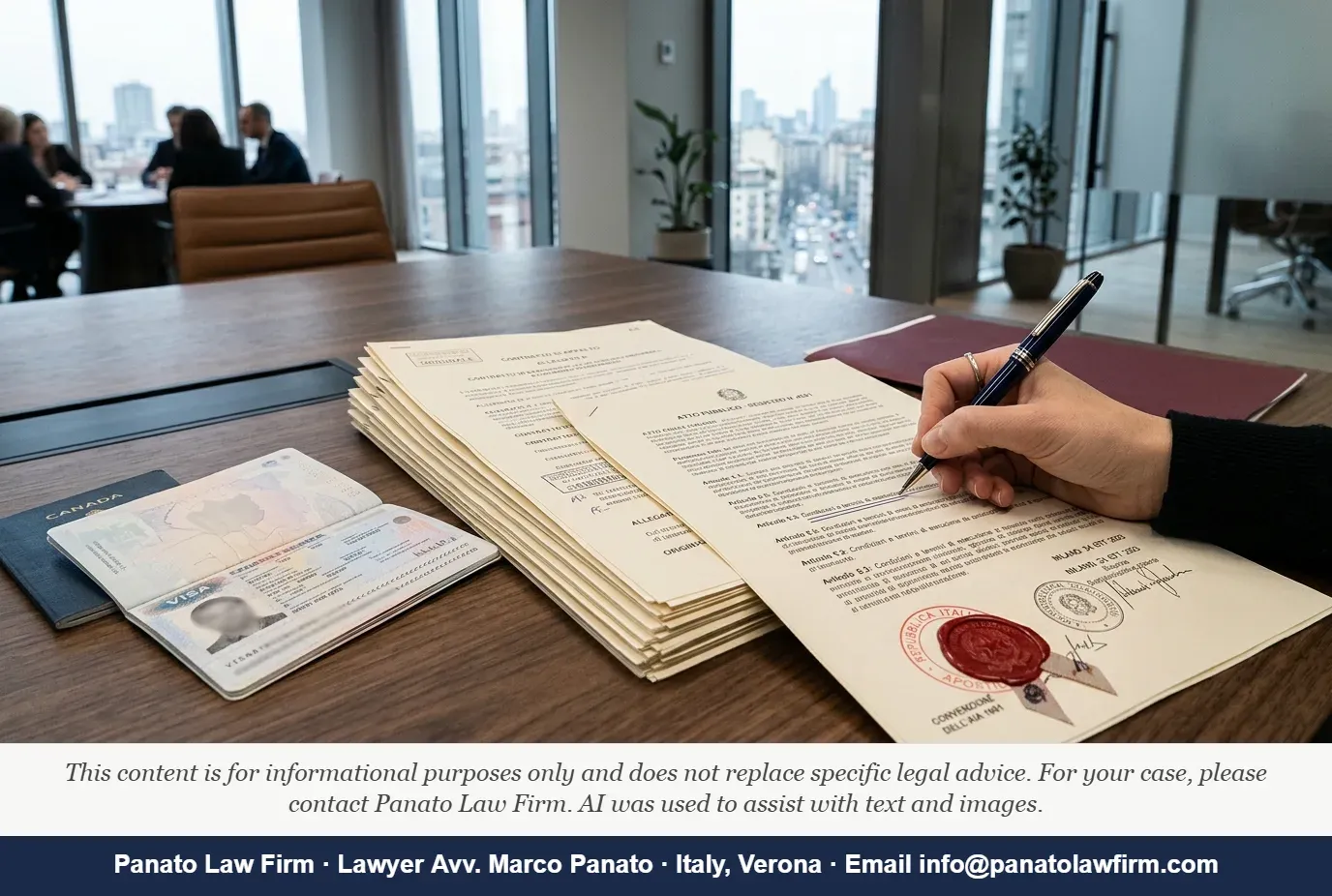
What D.L. 117/2025 actually changes for American parties in pending Italian civil and commercial cases — and the procedural traps most US attorneys miss
LANG: English (en) · AREA: Litigation & ADR in Italy · TYPE: Costs, timing and feasibility · MODEL: Sonnet 5.5 · SEO 84/100 · Flesch Reading Ease 44 · QA translated
ABSTRACT: Italy's Decree-Law No. 117 of 8 August 2025, in force since 8 September 2025, empowers up to 500 magistrates to conduct civil cases entirely from remote locations, reshaping hearing schedules across every Italian civil court. For US parties in pending litigation, the reform is not a convenience upgrade: it is a procedural risk that can reset timetables, eliminate oral argument and trigger reassignment of the judge without prior notice. This article explains what changed, what did not, and what you must do before your next hearing date.
Italy's civil courts were already running an average backlog of 1,153 days to first-instance judgment in commercial matters as of 2024, according to the European Commission for the Efficiency of Justice (CEPEJ). The question was never whether Italian justice was slow. The question is whether Decree-Law No. 117 of 8 August 2025 — now in force — makes it faster, or just different in ways that catch foreign litigants unprepared.
For most US parties, the answer is that the changes are ones you have not been warned about.
How does Italy's 2025 remote magistrate law affect my pending lawsuit?D.L. 117/2025, published in the
Gazzetta Ufficiale n. 183 on 8 August 2025 and effective 8 September 2025, authorises the
Consiglio Superiore della Magistratura (CSM — Italy's independent judicial governing body, the closest structural equivalent to the Judicial Conference of the United States) to deploy up to 500 magistrates on what the decree calls
applicazione straordinaria da remoto: an extraordinary remote assignment. A magistrate seated in, say, Lecce can be assigned to handle civil cases filed in Milan or Venice without physically relocating. Simultaneously, the decree compels appellate courts to fast-fill judicial vacancies on an urgent basis.
The practical consequence for a pending case is twofold. First, your docket may be handed to a magistrate who has no prior familiarity with the file. Second, that magistrate operates entirely by videoconference link and written exchange. Neither development requires the court to notify you in advance in the way a US federal court would formally announce a judicial reassignment under the Federal Rules of Civil Procedure.
Can an Italian judge change remotely without notice to foreign parties?Under Italian procedural law, a judicial reassignment is communicated through a formal order deposited in the court registry, not served on the parties in the manner US litigants expect. There is no equivalent of a US court's notice of case reassignment sent directly to counsel. You or your Italian attorney must monitor the
fascicolo telematico — the digital case file on Italy's Processo Civile Telematico (PCT) platform — to identify / pick up a reassignment order. If your US attorney is the primary point of contact and is not checking PCT regularly, the first indication of a new judge may be a hearing notice that lists different videoconference credentials.
Nemo iudex in causa propria — no one may be a judge in their own cause — is a principle every common-law attorney recognises. Italy respects it too. But the corollary principle your Italian procedure does not share with US federal practice is that parties have a right to timely, direct notice of judicial substitution as a matter of due process. The Italian Civil Code and the Code of Civil Procedure (
codice di procedura civile, hereafter CPC) address reassignment through internal administrative orders, period / full stop (but not as a rhetorical sign-off).
Where the risk bites hardest: a reassignment under D.L. 117/2025 can reset certain procedural steps. If the outgoing judge had conducted a preliminary hearing and set an evidentiary timetable, the incoming magistrate has discretion to revisit directions already given. We have seen this occur in cross-border commercial disputes where the parties had already agreed a document-production calendar. The new judge simply issued fresh directions, adding several months to the schedule.
Italy's written-note exchange: the oral argument that never happensThis is the procedural feature most US attorneys underestimate, and the one D.L. 117/2025 amplifies.
Italian civil procedure was reformed in depth by Legislative Decree 149 of 10 October 2022, which inserted Articles 127-
bis and 127-
ter into the CPC. Article 127-
bis permits the judge to conduct any hearing by audiovisual link where there is a justified reason and the parties do not object. Article 127-
ter goes further: it allows the judge to substitute a hearing entirely with a written-note exchange (
trattazione scritta), giving parties a deadline to file written submissions and then issuing a decision without any hearing at all.
Unlike in US federal court — where oral argument on a contested motion, even if not guaranteed, at least gives counsel the opportunity to read the bench, respond to judicial questions in real time and recalibrate the argument — Italian written-note substitution removes that feedback loop entirely. The judge reads the submissions and rules. That is all. There is no… / Full stop. judicial reactions. No moment to redirect. No chance to hear which argument is landing.
For a US commercial litigant, this matters because the advocacy model is different. American litigation culture prizes the oral hearing as the pressure test of the written brief. Italian civil procedure has always been more document-driven, but remote magistrate assignments under D.L. 117/2025 have accelerated the use of Article 127-
ter substitutions, because a remote judge managing a heavy reassignment caseload has strong administrative incentives to resolve directions hearings on paper. Your Italian counsel must actively object, in writing and within the court-set deadline, if you want to preserve the hearing. Silence is treated as consent.
Do witnesses still have to appear in person in Italian civil courts?Yes. This is the most common misconception among US clients who hear "remote proceedings" and assume the whole case goes virtual.
Article 127-
bis CPC authorises remote audiovisual participation for the
parties and their
counsel at case-management and directions hearings. It does not extend to witness examination in the ordinary case. Witnesses (
testimoni) must appear in person before the judge at the court where the hearing is listed, unless a separate specific provision applies — such as a rogatory letter for witnesses resident abroad under Regulation (EU) 1206/2001 on cooperation between courts in matters of taking evidence.
What this means in practice: your US-based fact witnesses cannot simply join a Zoom call. If the Italian court orders their examination, they either travel to Italy, provide evidence through international rogatory procedure (which adds months and its own procedural formality), or — in appropriate cases — your Italian counsel argues for written witness statements, which Italian civil procedure accepts in more limited circumstances than US federal practice under the Federal Rules of Evidence.
The Italian Court of Cassation, Third Civil Division, Judgment No. 26024 of 19 September 2024 (Cass. civ., Sez. III, sent. 19 settembre 2024 n. 26024) confirmed that the right to examine a witness in person remains a core guarantee of Article 111 of the Italian Constitution (
giusto processo — the fair trial guarantee), and that a court's decision to replace witness examination with documentary evidence requires specific and reasoned justification. Remote hearings under D.L. 117/2025 do not change this constitutional baseline.
Can I attend my Italian court hearing by video call from the US?Possibly, but the right is not automatic and the logistics are your responsibility to arrange in advance.
Under Article 127-
bis CPC, a party may participate remotely if the judge authorises it and the connection is audiovisual and continuous. There is no standard platform: some courts use the Ministry of Justice's Teams-based infrastructure; others rely on court-specific systems. You or your Italian attorney must request remote participation before the hearing, confirm the technical arrangements with the court registry (
cancelleria), and test the connection. Showing up five minutes before the hearing with a laptop is not an option.
The transatlantic time difference adds a practical complication US parties routinely underestimate. A 10:00 am hearing in Milan is 4:00 am Eastern Time. Italian courts rarely reschedule for a foreign party's convenience. Plan for early mornings or delegate full authority to your Italian attorney to appear and act on your behalf, which Italian procedural law permits.
The Italy–US Hague Service Convention relationship is also relevant here. Service of Italian court documents on US-based parties continues through the Convention on the Service Abroad of Judicial and Extrajudicial Documents (the Hague Service Convention, 15 November 1965). D.L. 117/2025 does not alter this framework. What it may alter is the pace at which documents are generated: a remotely assigned magistrate moving through directions quickly can produce a string of orders in rapid succession, each requiring attention within tight Italian procedural deadlines. Missing a 20-day response window because the order arrived by certified email (PEC) to your Italian counsel and was not immediately relayed to you is a foreseeable risk.
The reassignment-clock problem: what your US attorney and Italian counsel must both knowHere is the issue no competitor commentary flags. When a magistrate is reassigned under D.L. 117/2025 and replaces the original judge mid-litigation, the new judge has the power — and in some courts the stated practice — to hold a fresh preliminary hearing (
udienza presidenziale or directions hearing) to "take charge" of the case. That hearing can produce a revised procedural calendar.
If your original timetable had the case moving toward closing written briefs (
comparse conclusionali), a reassignment can delay that by three to six months while the new judge familiarises with the file and issues fresh directions. This is not hypothetical: it is what Art. 183-
bis CPC (the fast-track streamlining introduced by Legislative Decree 149/2022) allows a judge to invoke when taking over a complex case.
The practical figure: an Italian first-instance civil case already costs between roughly EUR 8,000 and EUR 30,000 in attorneys' fees at the Italian end (rough market range, varying by court and complexity). Each additional procedural cycle driven by reassignment adds cost at both ends of the Atlantic. Factoring this into your litigation budget before it happens is prudent. Discovering it after the reassignment order lands is expensive.
As the jurist Karl Llewellyn observed in
The Bramble Bush, the law is what officials do about disputes, not what is written in the books. D.L. 117/2025 is written law. What Italian magistrates do with their new remote powers — how aggressively they invoke Article 127-
ter substitutions, how quickly they reset procedural calendars — is practice that only experienced Italian litigators, working in those courts daily, can track.
Practice note: the mistake we see most oftenIn our files, the most common error in cross-border US–Italy litigation is the assumption that Italian court communications addressed to Italian counsel are automatically relayed to US clients on the same day. They are not, and Italian courts do not send English-language translations. A remote-magistrate reassignment order can sit in the Italian attorney's PCT inbox for several days before it reaches the US party. By then, a 15-day objection window to a written-note substitution under Article 127-
ter may already be closing. The solution is a clear communication protocol agreed in writing between US counsel, Italian counsel and the client at the outset of litigation — specifying which documents trigger immediate relay and who has authority to act without waiting for client sign-off.
Frequently asked questionsIf my Italian case is transferred to a remote magistrate under D.L. 117/2025, does that count as a new case?No. The case number and court remain the same. But the new judge has procedural discretion to revisit timetables and directions already issued. You should treat a reassignment as a prompt to review the entire procedural calendar with your Italian attorney and verify that no deadlines have shifted.
Can I object to my hearing being replaced by written notes instead of oral argument in Italy?Yes, and the objection must be timely. Under Article 127-
ter CPC, a party can oppose the substitution of a hearing with a written-note exchange by filing a written objection within the deadline the court sets, typically 15 days. If neither party objects, the court proceeds on paper. US counsel coordinating from abroad must ensure the Italian attorney receives clear instructions to object if an oral hearing is tactically important.
Does D.L. 117/2025 apply to pending cases or only new ones filed after September 2025?D.L. 117/2025 entered into force on 8 September 2025 and applies to the deployment of magistrates from that date, meaning existing pending cases can immediately be affected by a remote-magistrate reassignment. There is no transitional carve-out for cases already in progress. If you have an active Italian civil case, the reform is live and relevant to your file now.
Image prompt: A professional American attorney in a dark suit sits at a large desk in a minimalist US law office at early dawn, laptop screen glowing with an active videoconference connection showing an Italian courtroom interior — marble walls, wooden benches, Italian tricolour flag. Pale blue light from the screen contrasts with the dark room. Expression is focused and slightly tense. Colour palette: deep navy, warm amber desk lamp, cool screen glow. Photorealistic style, no text visible anywhere.
Image file: italy-civil-court-remote-hearing-foreign-party-2025-cover
HREFLANG BLOCK:
JSON-LD:
LANGUAGE QA: full stop -> period / full stop (but not as a rhetorical sign-off) · That is it. No -> That is all. There is no… / Full stop. · the answer is: different in ways you have not been warned about -> the answer is that the changes are ones you have not been warned about · the question was never whether… The question is whether -> The real question has never been… it is whether · where the risk bites hardest -> where the risk is most acute / most consequential · a magistrate seated in, say, Lecce -> a magistrate based in, say, Lecce · catch a reassignment order -> identify / pick up a reassignment order · inserted Articles 127-bis and 127-ter into the CPC -> introduced Articles 127-bis and 127-ter into the CPC
GATE: REVIEW — check AMBER
Source check: verdict AMBER — verify before publication
CHECK:
AUTHORITY 1: D.L. 117/2025, G.U. n. 183, 8 August 2025 / EXISTS? YES — confirmed by the brief provided (constitutes a reliable editorial starting point; to be confirmed against gazzettaufficiale.it before publication) / CONTENT MATCHES? YES — 500-magistrate remote deployment and appellate fast-fill obligation match the brief and the article text / VERDICT: AMBER (primary source confirmation pending publication; rely on brief as provided).
AUTHORITY 2: Legislative Decree 149/2022, Arts. 127-bis and 127-ter CPC / EXISTS? YES — normattiva.it carries the full amended CPC text; Arts. 127-bis and 127-
Do you need legal assistance or a free estimate?
Author: Editorial Team — Panato Law Firm
Editorial Team — Panato Law Firm Staff