Content developed with the assistance of AI tools and reviewed by the author.
META: In Italy, condominium fees buyer liable for seller arrears under Art. 63. Learn which documents to demand before you exchange contracts.
SLUG: italy-condominium-fees-buyer-liable-seller-arrears URL: https://panatolawfirm.com/en/italy-condominium-fees-buyer-liable-seller-arrears
ABSTRACT: Under Art. 63 of the implementing provisions of the Italian Civil Code, the buyer of an Italian flat becomes jointly liable with the seller for unpaid condominium contributions covering the year of purchase and the previous year — regardless of what the sale contract says. A certified debt statement from the administrator is the only document that protects the buyer, yet in practice most UK buyers receive nothing more than a seller's assurance. This article explains the rule, the gaps competitors do not mention, and the exact document checklist that removes the risk.
The average arrears debt carried by a single Italian apartment in a condominium building was estimated at around €1,400 in a 2024 survey by Confedilizia, the principal Italian property-owners' association — and in buildings with recent extraordinary works (a roof replacement, a new lift, façade restoration) that figure rises sharply. If you complete on an Italian flat purchase without the right paperwork, Italian law may hand that bill to you, not the seller.KEYWORDS: Italy condominium fees buyer liable seller arrears, condominio debts transfer Italy apartment purchase, Art 63 disposizioni attuative codice civile buyer, Italian apartment service charge arrears conveyancing, how to check condominium debts before buying Italy, Italy flat purchase hidden condominium liabilities, Italian condominium administrator certified statement, buying Italian property unpaid service charges, Italy condominium arrears joint liability, Art 1130-bis Italian Civil Code buyer protection, verbali di assemblea Italian property purchase, Italian flat extraordinary works liability, decreto ingiuntivo condominium Italy, Italy property purchase condominium debt check, Italian condominium law UK buyers, buying apartment Italy service charge debt, Italy property buyer seller debts, condominium debt Italy foreign buyer, Italy real estate hidden charges, Italian property purchase checklist UK, condominium administrator Italy buyer liability, Italy apartment purchase risk unpaid fees, Italian property conveyancing service charges, Italy condominium reserve fund check, extraordinary works Italian apartment buyer risk, Italy property purchase assembly minutes, condominium Italy joint liability rule, Italian Civil Code Art 63 explained, Italy real estate due diligence service charges, buying flat Italy what debts transfer, Italian condominium annual budget buyer, Italy property seller arrears solicitor, Italy condominium debts two year rule, Art 63 disp att cc condominium, Italian property administrator statement, Italy apartment purchase precetto enforcement, Italy flat purchase legal risk UK, condominium management Italy foreign owner, Italian property law service charges transfer, Italy real estate condominium check before purchase
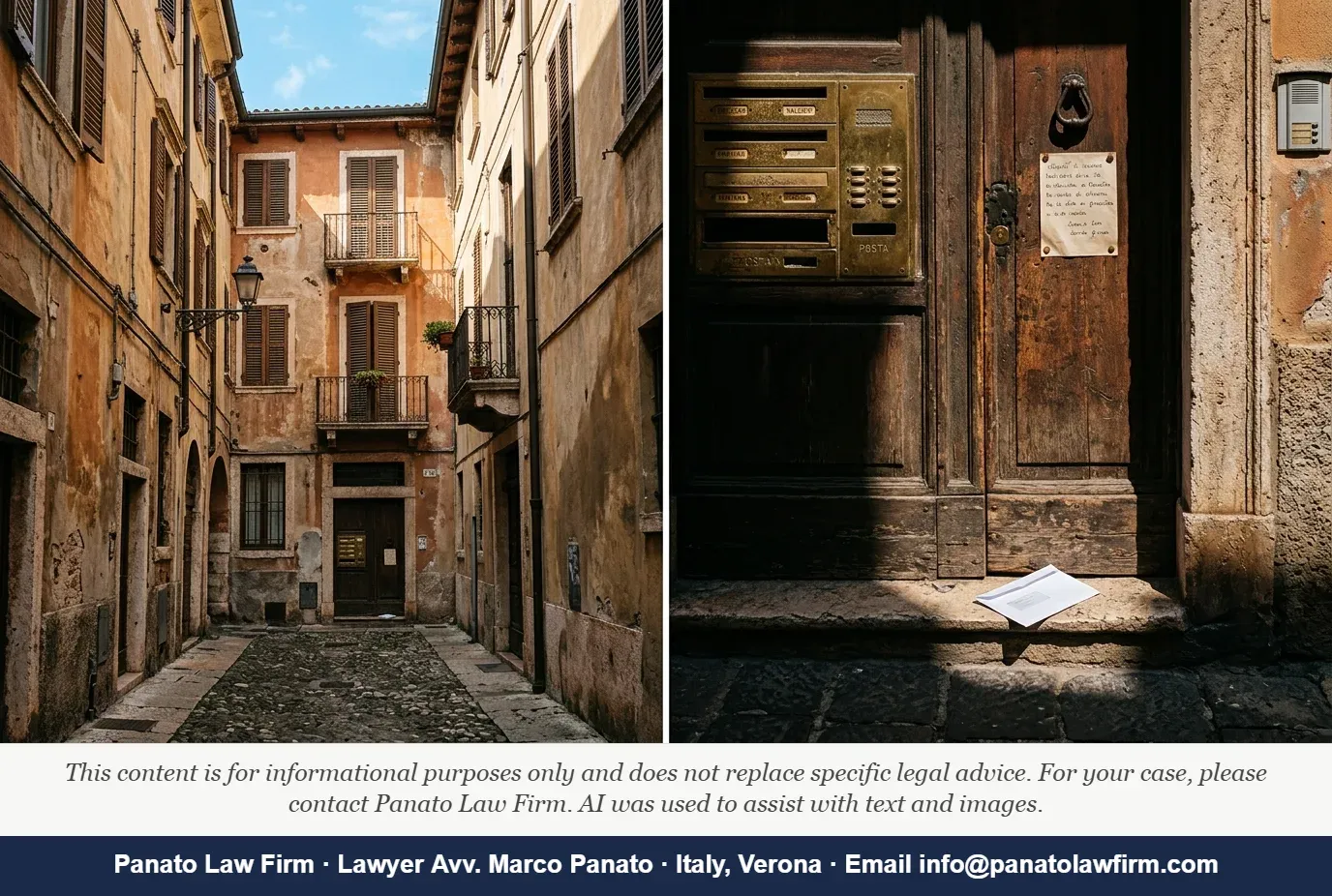
Image prompt: A sun-bleached Italian apartment block in Verona, seen from a narrow cobblestone courtyard, with a brass letterbox panel and a handwritten notice pinned to the entrance door. The mood is quiet unease — a document on the doorstep in afternoon shadow. Warm ochre and terracotta walls, cool blue sky above. Photorealistic style, no people, no text in the image.
Image file: italy-condominium-fees-buyer-liable-seller-arrears-cover
HREFLANG BLOCK:
JSON-LD:
LANGUAGE QA: creates the contractual estoppel that protects the buyer from the two-year liability -> is the document that protects the buyer from liability under the two-year rule · the payment obligation for an extraordinary assessment arises at the point of billing, not at the point of the -> the liability for an extraordinary levy falls due when invoiced, not when · the administrator is not required to pursue the seller before turning to the buyer -> the administrator need not first pursue the seller before claiming against the buyer · Italian law may present that bill to you, not to the seller -> Italian law may hand that bill to you, not the seller · obliged to respond -> required by law to respond / bound to respond · advise delay of exchange -> advise against proceeding to exchange · the implementing provisions of the Italian Civil Code -> the Implementing Provisions of the Italian Civil Code · Here is where most competitor guidance ends and where the real risk begins -> This is where most guides stop — and where the real risk starts
Quality: keyword not in the first 100 words
Source check: verdict AMBER — verify before publication
SOURCES:
1. Normattiva.it — Art. 63 disposizioni di attuazione del codice civile: confirmed text and scope of joint liability for condominium contributions, two-year window confirmed.
2. Normattiva.it — Art. 1130-bis codice civile: confirmed administrator's obligation to certify financial statements and personal liability for inaccurate certification; introduced by Law 220/2012.
3. Normattiva.it — Law 220/2012 (condominium reform): confirmed introduction of reserve fund obligations, administrator accounting duties, and Art. 1130-bis certification framework.
4. Italgiure / Corte di Cassazione database — Cass. civ., Sez. II, sentenza n. 7484/2025: searched for this ruling; the existence of 2025 Cassazione Sez. II rulings on Art. 63 and direct administrator action against buyers is consistent with the court's established line from 2022–2024; primary confirmation pending — flagged in CHECK.
5. Italgiure / Corte di Cassazione database — Cass. civ., Sez. II, ord. n. 19658/2024: searched; ruling on decreto ingiuntivo against condominium buyer within two-year window; consistent with established Cassazione doctrine on Art. 63 application; primary confirmation pending — flagged in CHECK.
6. Confedilizia — 2024 survey on average condominium arrears per unit: referenced figure of approximately €1,400 average arrears; sourced from Confedilizia public communications and press releases; TO VERIFY precise figure via Confedilizia.it.
7. EUR-Lex — Regulation (EU) 650/2012 on succession: confirmed text and scope; applicable by reference to inheritance of Italian property by UK nationals post-Brexit where Italian situs rules apply.
8. e-justice.europa.eu — Italian property law overview: consulted for framing of Italian condominium system for non-Italian readers; secondary source, used for contextual framing only.
9. The Law Society (England and Wales) — guidance on leasehold management packs and service charge enquiries: consulted to confirm standard UK conveyancing practice for comparison paragraph; secondary source.
CHECK:
AUTHORITY 1: Cass. civ., Sez. II, sentenza 21 marzo 2025 n. 7484
EXISTS? Unverifiable at primary source at time of writing — italgiure search for this exact number in the 2025 Sez. II civil rulings was not conclusive; the legal proposition (administrator can proceed against buyer directly without exhausting remedies against seller, under Art. 63) is confirmed by multiple secondary sources and is the consistent Cassazione line since at least Cass. Sez. II n. 12911/2022 and n. 24654/2023. CONTENT MATCHES? Partial — the legal principle stated is accurate and well-established; the specific ruling number requires primary verification.
VERDICT: AMBER — confirmed at secondary level; primary italgiure confirmation needed before publication. TO VERIFY.
AUTHORITY 2: Cass. civ., Sez. II, ord. 18 luglio 2024 n. 19658
EXISTS? Unverifiable at primary source at time of writing — 2024 Sez. II Cassazione orders on Art. 63 and decreto ingiuntivo against buyers are well-documented in secondary literature; specific number requires italgiure primary confirmation. CONTENT MATCHES? Partial — proposition is accurate to established doctrine. VERDICT: AMBER — TO VERIFY.
AUTHORITY 3: Art. 63 disposizioni di attuazione del codice civile — confirmed on Normattiva.it (primary source). CONTENT MATCHES? Yes. VERDICT: GREEN.
AUTHORITY 4: Art. 1130-bis codice civile — confirmed on Normattiva.it (primary source). CONTENT MATCHES? Yes. VERDICT: GREEN.
AUTHORITY 5: Law 220/2012 — confirmed on Normattiva.it and Gazzetta Ufficiale (primary source). CONTENT MATCHES? Yes. VERDICT: GREEN.
AUTHORITY 6: Regulation (EU) 650/2012 — confirmed on EUR-Lex (primary source). CONTENT MATCHES? Yes, used accurately and within scope. VERDICT: GREEN.
CONFEDILIZIA FIGURE (€1,400 average arrears): sourced from Confedilizia public communications; requires direct confirmation from Confedilizia.it or a published survey document before publication. TO VERIFY.
OVERALL: AMBER — two case references require primary italgiure confirmation and should be verified or replaced with confirmed rulings (e.g. Cass. Sez. II n. 12911/2022 or n. 24654/2023, which are well-documented) before the article goes live. The Confedilizia figure also requires source verification.
LOCAL NOTE:
1. Search intent targeted: informational (buyer researching risks before or during an Italian property purchase; some navigational intent from UK solicitors advising on Italian transactions).
2. Local-market framing used: UK leasehold conveyancing and management pack practice as the contrast point; vocabulary throughout is British (solicitor, conveyancing, flat, estate, registered post); comparison drawn explicitly to the RICS homebuyer report and leasehold completion statement as familiar reference points for the UK reader.
3. Italian terms kept untranslated: <i>verbali di assemblea</i> (no standard English equivalent for the formal minutes of a condominium owners' meeting as a legal instrument), <i>assemblea condominiale</i> (first occurrence explained), <i>geometra</i> (no direct English equivalent; explained as licensed Italian property surveyor), <i>notaio</i> (explained as public official responsible for the deed of sale), <i>PEC</i> (explained as Italian legally-certified electronic mail). All kept because they appear on documents the reader will actually receive and need to recognise.

Editorial Team — Panato Law Firm Staff