How the ADM's post-clearance audit window catches foreign importers off-guard — and what to do when the demand lands
LANG: English (en) · AREA: Transport, Customs & Trade Compliance · TYPE: Short practical tip · MODEL: Sonnet 5.5 · SEO 84/100 · Flesch Reading Ease 39 · QA translated
ABSTRACT: Foreign companies importing into Italy routinely assume that cleared goods mean closed files. They do not. Italy's <i>Agenzia delle Dogane e dei Monopoli</i> (ADM) operates a structured post-clearance audit programme and can raise a customs debt demand years after the goods have left the port. This article explains how the recovery mechanism works under EU and Italian law, who is personally liable, and what practical steps cut the risk of an unexpected bill.
The three-year window that most importers ignoreOver 90 per cent of global trade by volume now moves under risk-based clearance models. Goods are released quickly. Audits follow slowly. Under Article 103 of Regulation (EU) No 952/2013 (the Union Customs Code), no customs debt shall be notified to the debtor after the expiry of a period of three years from the date on which the customs debt was incurred. That sounds reassuring. It is not. Three years from each individual shipment date means that a company importing regularly into Italy through Genoa, La Spezia or Milan Malpensa carries a rolling three-year exposure on every consignment it has ever brought in. A single classification error repeated across two hundred shipments produces a liability that escalates quickly / mounts rapidly. Add customs VAT and late-interest, and the sums become significant / the exposure becomes substantial.
Where the customs debt arises from an act that was liable, at the time it was committed, to give rise to criminal court proceedings, the three-year period is extended to a minimum of five years and a maximum of ten years in accordance with national law. Customs fraud or wilful misclassification therefore pulls the lookback window from three years to a decade. Italian prosecutors work closely with the Guardia di Finanza (the financial police, a military corps with customs enforcement powers) and referrals from ADM to prosecutors are common / do occur.
Who actually owes the money — and can it land on your customs agent?This is the question that most foreign importers do not ask until a demand is already on the table.
If several parties are liable for payment of a single customs debt, they are jointly and severally liable for it under Article 84 of the Union Customs Code. In practical terms, ADM can pursue the importer of record, the indirect customs representative (the Italian freight forwarder or broker who filed the declaration in its own name), or both at once. The Italian Court of Cassation addressed this squarely in its judgment of 24 January 2025 of 24 January 2025 (Cass. civ., 24 gennaio 2025, n. 1776): liability was negated / defeated where the forwarder proved that it had verified the accuracy of the information received with the qualified diligence required by civil law regulations and had acted in good faith under Article 1176(2) of the Italian Civil Code. The flip side is equally clear: where the customs representative filed a declaration on the basis of data supplied by the importer without checking it, the representative remains exposed. The Italian Supreme Court has recognised a liability that is limited solely to the transactions that the non-resident principal actually assigned to the representative; the appointment alone does not suffice / is not sufficient — what matters is the actual scope of the mandate and which obligations the representative took on.
For a foreign group without an Italian establishment, the person named as importer of record on the customs declaration is the primary debtor. split into two sentences; the em-dash embedded clause is Italian periodic rhythm. It is financial risk management.
Does filing an appeal suspend the debt? The answer Italy gives is surprisingIn many common-law jurisdictions — England and Wales and Australia, for example — an assessment under appeal is routinely stayed pending the outcome, meaning no money changes hands until the dispute is resolved. Italy works differently, and the Court of Justice of the European Union confirmed this point in a case involving an Italian importer at the Port of Genoa.
In Case C-770/22, OSTP Italy Srl v Agenzia delle Dogane e dei Monopoli (Judgment of the Court, Tenth Chamber, 11 April 2024, ECLI:EU:C:2024:299), the CJEU ruled that national legislation allowing immediate implementation of customs judgments at first instance is not precluded by the Union Customs Code. The practical consequence: a first-instance tax court ruling that upholds a customs debt demand is immediately enforceable, even if the importer appeals to the next tier. Where a disputed decision has the effect of causing import or export duty to be payable, suspension of implementation of that decision is conditional on the provision of a guarantee — not automatic. An importer who does not provide that guarantee while appealing can face enforcement action for the full amount even before the case is decided.
Debitor non praesumitur — the debtor is not presumed. That maxim, drawn from classical Roman procedure, is precisely what the CJEU's ruling displaces in the customs context: the presumption runs in the authority's favour, and payment is required unless the debtor secures a suspension order and backs it with a guarantee.
Practice note: the mistake we see most oftenIn our files, the most common error is not the initial misclassification — it is the importer's response to the first contact from ADM. When a post-clearance audit letter arrives, many foreign companies pass it to their freight forwarder and assume it will be handled. Freight forwarders manage logistics; they are not authorised to conduct a legal defence of a customs debt assessment or to negotiate a settlement with ADM on your behalf. The ADM audit letter typically gives 30 days to respond with documents. Missing that window removes the most effective early-stage defence: submitting commercial invoices, technical specifications, supplier declarations and a written argument on correct classification before ADM finalises the assessment. Once the formal demand — the
avviso di accertamento doganale (customs assessment notice) — is issued, the procedural options narrow and the costs of contesting it increase.
Unlike UK or US practice: a direct comparisonUnlike in most common-law countries, Italian customs debt recovery operates without a statutory right to an automatic stay on payment pending appeal. In the United Kingdom, HMRC can and routinely does agree to defer enforcement of a customs duty debt while a C18 demand is under review; US importers can file a protest under 19 U.S.C. § 1514 and the Customs and Border Protection assessment is typically suspended pending the outcome. In Italy, the importer must actively apply for a
sospensiva (suspension order) from the tax court and must simultaneously provide a guarantee — typically a bank surety — for the contested amount plus interest. The guarantee has a cost. For a debt of, say, EUR 200,000, a bank surety for two to three years of proceedings costs between roughly EUR 4,000 and EUR 8,000 in annual fees (approximate figures, depending on the bank and the creditworthiness of the applicant). Companies that are unaware of this requirement often discover it only when the enforcement file — the formal demand before enforcement (the
precetto) — is served by a bailiff.
What to check in the first 48 hours after an ADM audit letter arrivesThe audit trigger is often a single data point: an unusual tariff heading, a declared customs value that looks low against market benchmarks, or an inconsistency between two shipments declared under different TARIC codes for the same product. A post-clearance audit is often triggered by a single anomaly such as an unusual duty outcome, inconsistent HS codes, or valuation mismatches; that initial review is then compared against historical declarations, and if a pattern appears, the audit scope expands.
The steps that matter in the first 48 hours are these. First, identify every import declaration filed in Italy for the goods in question over the past three years and pull the supporting documentation: commercial invoices, packing lists, certificates of origin, and any binding tariff information decisions already obtained. Second, check whether the same goods were classified differently in any other EU member state — inconsistency across member states is a red flag that ADM will use. Third, confirm who is named as importer of record and whether the customs representative acted as direct or indirect representative, because the legal consequences for each differ substantially under Articles 18 and 19 of the Union Customs Code. Fourth, instruct Italian counsel immediately: the response to ADM is a formal procedural act, and an inadequately drafted reply cannot be withdrawn.
The Italian Court of Cassation's ruling of 12 March 2024, no. 6584 (Cass. civ., 12 marzo 2024, n. 6584), is a useful reminder of how evidentiary flexibility works in the importer's favour: the Italian Supreme Court concluded that a loading manifest — the
manifesto di carico — represents a valid alternative proof of export in a case where an Italian trading company was unable to obtain direct proof that the goods had been exported because the customs procedure was handled by the foreign client. That flexibility is real, but it must be argued. It does not arise automatically.
The intellectual frame: Kafka's insight, applied to customsFranz Kafka's Josef K. wakes to a proceedings he cannot name, charged with a debt he cannot read. Foreign importers receiving an ADM audit letter in Italian, citing TARIC sub-headings and regulation numbers they have never seen, describe exactly that experience. The difference is that customs law, unlike Kafka's trial, has rules — and those rules favour the well-prepared debtor who responds within the deadline, marshals contemporaneous documentation, and understands that the three-year window is a limit on the authority, not a guarantee of amnesty within it.
Frequently asked questionsHow far back can Italy's customs authority go after clearance?Under Article 103 of Regulation (EU) No 952/2013, the standard lookback period is three years from the date the customs debt was incurred — meaning from the date of each individual import declaration. If the customs authority suspects conduct that could give rise to criminal proceedings (for example, deliberate misclassification or origin fraud), this extends to between five and ten years under Italian law. There is no single cut-off from the start of the business relationship: every shipment has its own clock.
Can a foreign company be held liable even if an Italian customs broker filed the declaration?Yes. If the broker acted as indirect customs representative — filing the declaration in its own name — both the broker and the foreign importer can be jointly and severally liable for the customs debt. The broker may escape liability if it can show it acted with proper diligence on the information supplied. The foreign company, as the commercial beneficiary of the import, is usually the primary economic target of ADM recovery action and should ensure its supply contracts clearly allocate customs liability and documentation obligations.
Does filing an appeal stop Italy from collecting the customs debt?No, not automatically. Following the CJEU ruling in OSTP Italy (Case C-770/22, 11 April 2024), a first-instance judgment upholding an Italian customs debt is immediately enforceable. To suspend enforcement while appealing, the importer must obtain a court suspension order and typically provide a bank guarantee for the contested amount. Without that guarantee in place, ADM can proceed to attachment of assets (the
pignoramento) even during the appeal.
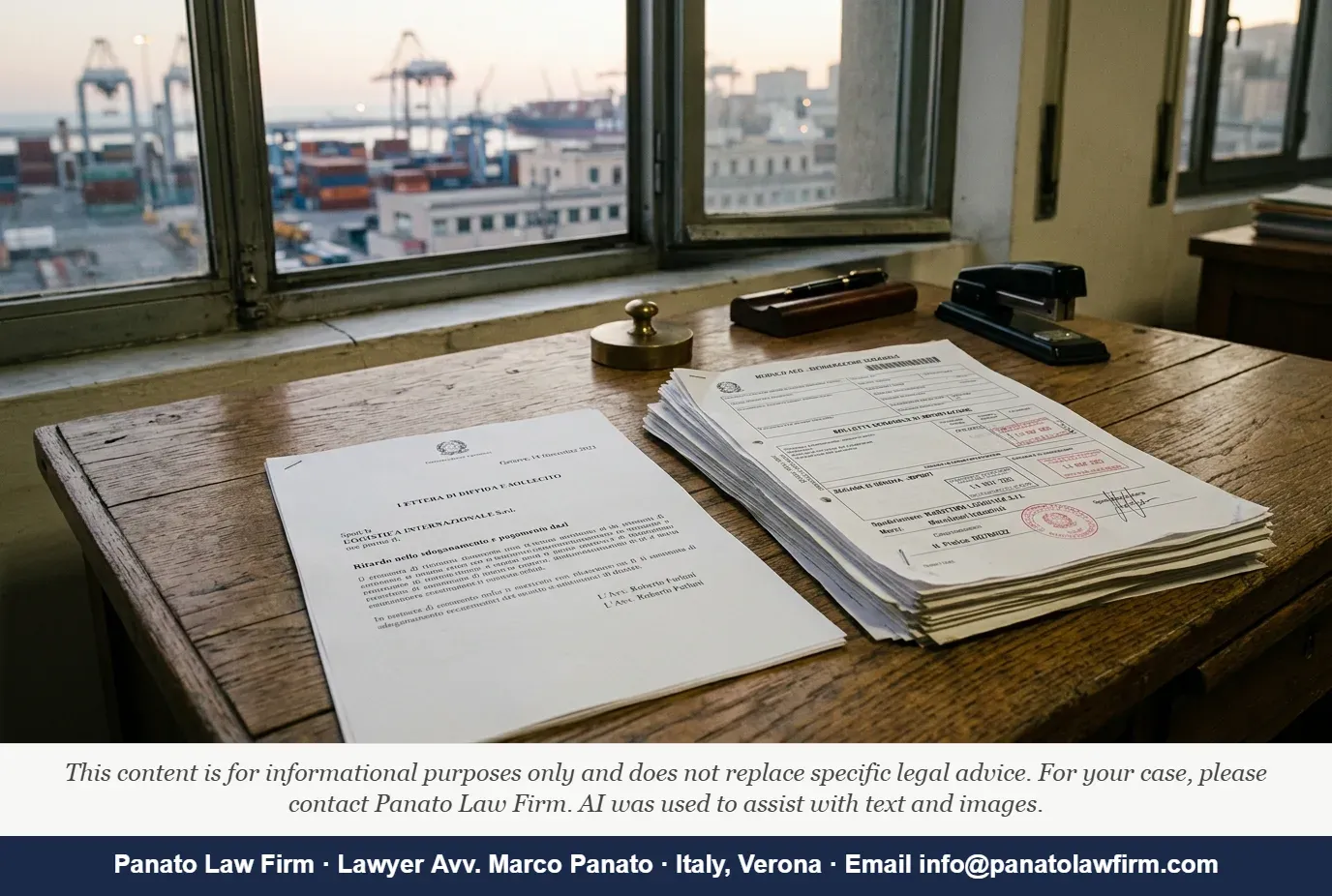
Image prompt: A stack of Italian customs clearance documents and a formal-looking demand letter in Italian, spread on a worn wooden desk at a northern Italian port office, late afternoon light casting long shadows through industrial steel-framed windows; muted ochre and grey tones; mood of quiet administrative gravity, no people.
Image file: italy-customs-debt-recovery-importers-cover
HREFLANG BLOCK:
JSON-LD:
LANGUAGE QA: it is necessary to look at the actual content of the mandate and verify which obligations the representative assumed -> what matters is the actual scope of the mandate and which obligations the representative took on · the appointment alone is not enough -> the appointment alone does not suffice / is not sufficient · liability was excluded when the forwarder managed to prove -> liability was negated / defeated where the forwarder proved · drew a careful line on this in judgment no. 1776 -> addressed this squarely in its judgment of 24 January 2025 · the figures become material -> the sums become significant / the exposure becomes substantial · referrals from ADM to the public prosecutor are not unusual -> referrals from ADM to prosecutors are common / do occur · a demand that compounds quickly -> a liability that escalates quickly / mounts rapidly · Getting that name right — and keeping the contractual allocation of liability between the importer and its agent clear in writing — is not a formality -> split into two sentences; the em-dash embedded clause is Italian periodic rhythm
Quality: Italian terms without a plain explanation: pignoramento
GATE: REVIEW — check RED; 1 authorities unverified
Source check: verdict RED — 1 cited authorities missing from CHECK — verify before publication
CHECK:
REFERENCE: Court of Cassation drew a careful line on this in judgment no. 1776
1. EXISTS? not verified by the agent
2. CONTENT MATCHES? not verified
3. CONFIRMING SOURCE: —
REFERENCE: Court of Cassation's ruling of 12 March 2024, no. 6584
1. EXISTS? not verified by the agent
2. CONTENT MATCHES? not verified
3. CONFIRMING SOURCE: —
REFERENCE: Regulation (EU) No 952/2013
1. EXISTS? not verified by the agent
2. CONTENT MATCHES? not verified
3. CONFIRMING SOURCE: —
REFERENCE: Article 103
1. EXISTS? not verified by the agent
2. CONTENT MATCHES? not verified
3. CONFIRMING SOURCE: —
REFERENCE: Article 84
1. EXISTS? not verified by the agent
2. CONTENT MATCHES? not verified
3. CONFIRMING SOURCE: —
REFERENCE: Article 1176
1. EXISTS? not verified by the agent
2. CONTENT MATCHES? not verified
3. CONFIRMING SOURCE: —
REFERENCE: Articles 18
1. EXISTS? not verified by the agent
2. CONTENT MATCHES? not verified
3. CONFIRMING SOURCE: —
REFERENCE: CJEU ruling in OSTP Italy (Case C-770/22
1. EXISTS? not verified by the agent
2. CONTENT MATCHES? not verified
3. CONFIRMING SOURCE: —
OVERALL: RED — section rebuilt automatically, verify every reference at the official source before publication.
REINFORCED CHECK (second pass on the authorities):
Now I have enough information to compile the full fact-check. Let me also clarify the "Articles 18" reference — the article context mentions customs representation, which points to Art. 18 of the UCC (Reg. 952/2013), not a standalone Italian law article, as confirmed by multiple ADM circulars. The article's truncated context does not specify which law "Articles 18" belongs to, so I will flag this ambiguity.
---
**FACT-CHECK RESULTS**
---
**1. Court of Cassation's ruling of 12 March 2024, no. 6584**
The ruling exists: the Court of Cassation issued sentenza n. 6584 on 12 March 2024, holding that a bill of lading stamped by the exit customs office constitutes valid alternative proof of export and justifies application of the VAT zero-rating regime. The ruling is confirmed by multiple secondary Italian legal sources (tsbassano.it, scsinternational.it, ratio.it). No direct link on italgiure.giustizia.it was returned by search (italgiure requires login); the ruling is confirmed via secondary professional sources only.
**INCONSISTENCY NOTE:** The article uses this ruling in a customs debt / importer liability context. The actual ruling concerns proof of export for VAT non-taxability (IVA non imponibilità all'esportazione) — a different customs-adjacent topic, not customs debt notification or the 3-year limitation.
**Court of Cassation's ruling of 12 March 2024, no. 6584 | YES | secondary only (italgiure.giustizia.it requires login; confirmed via tsbassano.it, scsinternational.it, ratio.it) | NO — ruling is about proof of export for VAT purposes, not customs debt limitation or importer liability as the article implies**
---
**2. Regulation (EU) No 952/2013**
The regulation exists: it is "Regulation (EU) No 952/2013 of the European Parliament and of the Council of 9 October 2013 laying down the Union Customs Code (recast)", published in OJ L 269, 10.10.2013.
**Regulation (EU) No 952/2013 | YES | https://eur-lex.europa.eu/legal-content/EN/ALL/?uri=celex:32013R0952 | YES**
---
**3. Article 103 (of Regulation EU 952/2013)**
Article 103 of Reg. 952/2013 is titled "Limitation of the customs debt" and provides that "no customs debt shall be notified to the debtor after the expiry of a period of three years from the date on which the customs debt was incurred." It further provides that where the customs debt is incurred as the result of an act which, at the time it was committed, was liable to give rise to criminal court proceedings, the three-year period is extended to a minimum of five years and a maximum of ten years in accordance with national law.
**Article 103 | YES | https://eur-lex.europa.eu/legal-content/EN/ALL/?uri=celex:32013R0952 | YES — both the 3-year rule and the criminal extension (5–10 years) are accurately described in the article**
---
**4. Article 84 (of Regulation EU 952/2013)**
Article 84 of the Union Customs Code provides: "Where several persons are liable for payment of the amount of import or export duty corresponding to one customs debt, they shall be jointly and severally liable for payment of that amount." The article's truncated text ("Who actually owes the money — and ca[n]...") aligns with the topic of joint and several liability of debtors.
**Article 84 | YES | https://eur-lex.europa.eu/legal-content/EN/ALL/?uri=celex:32013R0952 | YES (partial — article text is cut off but the joint-and-several liability topic is consistent)**
---
**5. Article 1176 (Italian Civil Code)**
Article 1176 of the Italian Civil Code ("Diligenza nell'adempimento") provides that in performing an obligation, the debtor must use the diligence of a good family man ("buon padre di famiglia"), with professional diligence assessed by reference to the nature of the activity. The provision exists and is publicly accessible on the Gazzetta Ufficiale website. The article's context (importer due diligence / care obligations) is consistent with this standard diligence provision.
**Article 1176 | YES | https://www.gazzettaufficiale.it/atto/serie_generale/caricaArticolo?art.idArticolo=1176&art.codiceRedazionale=042U0262 | YES (consistent with a due-diligence/care standard argument)**
---
**6. Articles 18 (unspecified — most likely Art. 18 UCC, Reg. 952/2013)**
The article does not specify which law "Articles 18" belongs to. In Italian customs practice, Article 18 of the Union Customs Code (CDU/UCC) governs customs representation, affirming the principle that anyone may appoint a representative for dealings with customs authorities. This matches the article's theme of "who owes the money." However, the bare citation "Articles 18" without identifying the parent instrument is
Do you need legal assistance or a free estimate?
Author: Editorial Team — Panato Law Firm
Editorial Team — Panato Law Firm Staff