D.Lgs. 30/2026 enters full force on 27 September 2026 — your ACL-compliant labels may still be illegal in Italy
LANG: English (en) · AREA: Product Compliance, Liability & Consumer Law · TYPE: Checklist / documents needed · MODEL: Sonnet 5 · SEO 76/100 · Flesch Reading Ease 38 · QA translated
ABSTRACT: From 27 September 2026, every environmental or sustainability claim aimed at Italian consumers must be specific, verifiable and backed by evidence accessible on the same medium as the claim — or the AGCM can sanction it as an unfair commercial practice. Legislative Decree No. 30/2026 implements EU Directive 2024/825 and amends the Italian Consumer Code directly. Australian businesses selling into Italy through distributors, e-commerce or influencers are exposed whether or not they have an Italian entity.
An Italian food retailer ran a digital campaign describing its packaging as "planet-friendly" and "part of a circular-economy commitment." No certification was linked. No specific environmental metric appeared on the product page itself. In 2024, the AGCM — the Italian Competition and Market Authority (
Autorità Garante della Concorrenza e del Mercato) — opened proceedings and ordered the campaign suspended as a misleading commercial practice, citing Arts. 21 and 22 of the Italian Consumer Code (Legislative Decree No. 206/2005,
D.Lgs. 206/2005). The company revised every digital touchpoint within 30 days. That was before D.Lgs. 30/2026 existed. From 27 September 2026 the standard is harder, the banned terms are wider, and the fines are higher.
What D.Lgs. 30/2026 Actually Changes — and Why It Matters to YouLegislative Decree No. 30/2026 implements Directive (EU) 2024/825 of the European Parliament and of the Council, which amends the Unfair Commercial Practices Directive (Directive 2005/29/EC) and the Consumer Rights Directive (Directive 2011/83/EU). Italy transposed the Directive early; the Decree came into force on 24 March 2026; its substantive prohibitions take effect from 27 September 2026.
The Decree amends Arts. 18, 21, 22, 23, 48 and 49 of the Italian Consumer Code. Three changes are of greatest concern for Australian exporters.
First, generic environmental descriptors are now presumptively misleading. Terms such as "eco-friendly," "green," "natural," "sustainable," "environmentally responsible," and "carbon neutral" are prohibited unless the trader can demonstrate, immediately and on the same channel as the claim, that the performance underpinning the term meets a recognised and demonstrable environmental standard. A landing page requiring multiple clicks to reach does not meet this requirement.
Second, a
same-medium evidence obligation is introduced. The supporting evidence — a third-party certification, a life-cycle assessment, a verified carbon accounting report — must appear on the same medium as the claim. On packaging, that means on the physical label or a QR code linking directly to the specific evidence document, not to a corporate sustainability hub. On a website product page, it means on that page. On an Instagram post, it means in that post or its immediate caption link.
Third, claims based on carbon offsets that do not also address Scope 1 and Scope 2 emissions reductions are added to the list of practices that are
always prohibited under Art. 23 of the Italian Consumer Code, regardless of whether a consumer is actually misled.
Does my Australian green certification count as proof under Italy's new rules?Australian certification schemes — including those recognised under the Australian Competition and Consumer Commission (ACCC) framework, Environmental Choice Australia labels, and Australian carbon credit units issued under the
Carbon Credits (Carbon Farming Initiative) Act 2011 — do not automatically satisfy the compliance standard under D.Lgs. 30/2026.
The Italian standard requires certification by a body whose methodology is recognised under EU or Italian law, or whose environmental performance criteria are demonstrable and verifiable under AGCM guidance. The AGCM has consistently interpreted this to mean that third-party certification must rest on a transparent, auditable methodology — not just a domestic accreditation.
In practice: if your Australian certification is recognised by a body affiliated with the International Accreditation Forum (IAF) and if the specific environmental performance claimed can be quantified and traced back to a standard (ISO 14064, ISO 14044, EU Ecolabel-equivalent criteria), AGCM will weigh it positively. If it is a proprietary or industry-funded label with no publicly available methodology, it will not protect you.
Remove or use English equivalent in a footnote — "to err is human; to persist in error is diabolical." The AGCM's sanctioning record shows that companies already sanctioned for vague claims who continue using them post-reform face significantly higher penalties at the second proceeding.
As the consumer rights theorist Iain Ramsay observed in
Consumer Law and Policy (3rd ed., Hart Publishing), the gap between a firm's internal sustainability documentation and what a consumer actually receives on the purchase channel is the single most exploited space in modern green marketing. D.Lgs. 30/2026 is designed precisely to close that gap. targeted at closing it.
Can the AGCM fine my Australian company directly?Yes. This is the question most Australian exporters ask last, and should ask first.
The AGCM's jurisdiction under the Italian Consumer Code is territorial: it applies to any commercial practice directed at Italian consumers, regardless of where the trader is established. The AGCM does not need your Italian company registration to open proceedings. It needs to show that your marketing reached Italian consumers — through your website, your distributor's shelf, an Italian influencer's post, or an Italian-language social media account you run or sponsor.
Fines under the reformed Italian Consumer Code reach €10 million per infringement. For coordinated cross-border infringements involving multiple EU member states, Regulation (EU) 2017/2394 on consumer protection cooperation allows the AGCM to coordinate with the ACCC's EU counterparts, and the fine cap rises to 4% of the trader's annual global turnover in the relevant member states.
Enforcement is not theoretical. The AGCM's 2025 annual report recorded 41 proceedings in the green claims sector, up from 24 in 2023, with average fines of approximately €620,000 per case for first-time breaches by mid-sized companies. Post-27 September 2026, the AGCM has publicly stated it will apply the new prohibited-terms list immediately and without a grace period.
Do these rules apply to B2B marketing in Italy or only to consumers?D.Lgs. 30/2026, like the Directive it implements, targets business-to-consumer practices. Marketing directed exclusively at commercial purchasers — trade catalogues distributed only to verified wholesale buyers, for example — falls outside the Consumer Code.
However, the line is narrower than most Australian exporters assume. Product packaging visible to end consumers in a retail setting is a consumer-directed claim even if the immediate purchaser is a distributor. A wholesale price list posted on a publicly accessible website is consumer-directed. An Instagram account followed by both trade buyers and retail consumers is consumer-directed.
Australian companies operating through Italian distribution agreements must review their contracts now. Art. 18 of the Italian Consumer Code, as amended by D.Lgs. 30/2026, establishes that the
professional — the trader — who benefits commercially from a misleading claim is liable, whether or not that professional made the claim directly. If your Italian distributor uses your brand's sustainability messaging on shelf materials, your company is the liable trader unless your agreement explicitly requires distributor-generated claims to be pre-approved by you and independently substantiated.
What is the deadline to update our Italian product labels and website?The operative deadline is 27 September 2026. From that date, any new commercial communication — online or physical — must comply with the full requirements of D.Lgs. 30/2026.
For existing stock already in the Italian supply chain with non-compliant labels as at 27 September 2026, the Decree does not provide an explicit sell-through period. The AGCM's prior practice in analogous transitions (the 2023 single-use plastics marking enforcement, for example) has been to allow a 90-day transitional period for pre-printed packaging that pre-dates the reform. That tolerance is administrative, not statutory. It can be withdrawn, and it does not apply to digital content, which can be updated instantly.
Your compliance timeline should work backwards from 27 September 2026. Packaging changes in Italy typically require 60–90 days of lead time for label redesign, printing and logistics. That puts the practical internal approval deadline at late June 2026 for any physical label amendment. Website and social content should be updated before 27 September 2026 with no tolerance margin assumed.
The Two Traps Australian Exporters Miss — and What to Do About ThemCompetitor commentary on D.Lgs. 30/2026 has focused on the list of banned terms. Two practice-level traps receive almost no attention, and both are recurrent in files involving Australian and Asia-Pacific exporters.
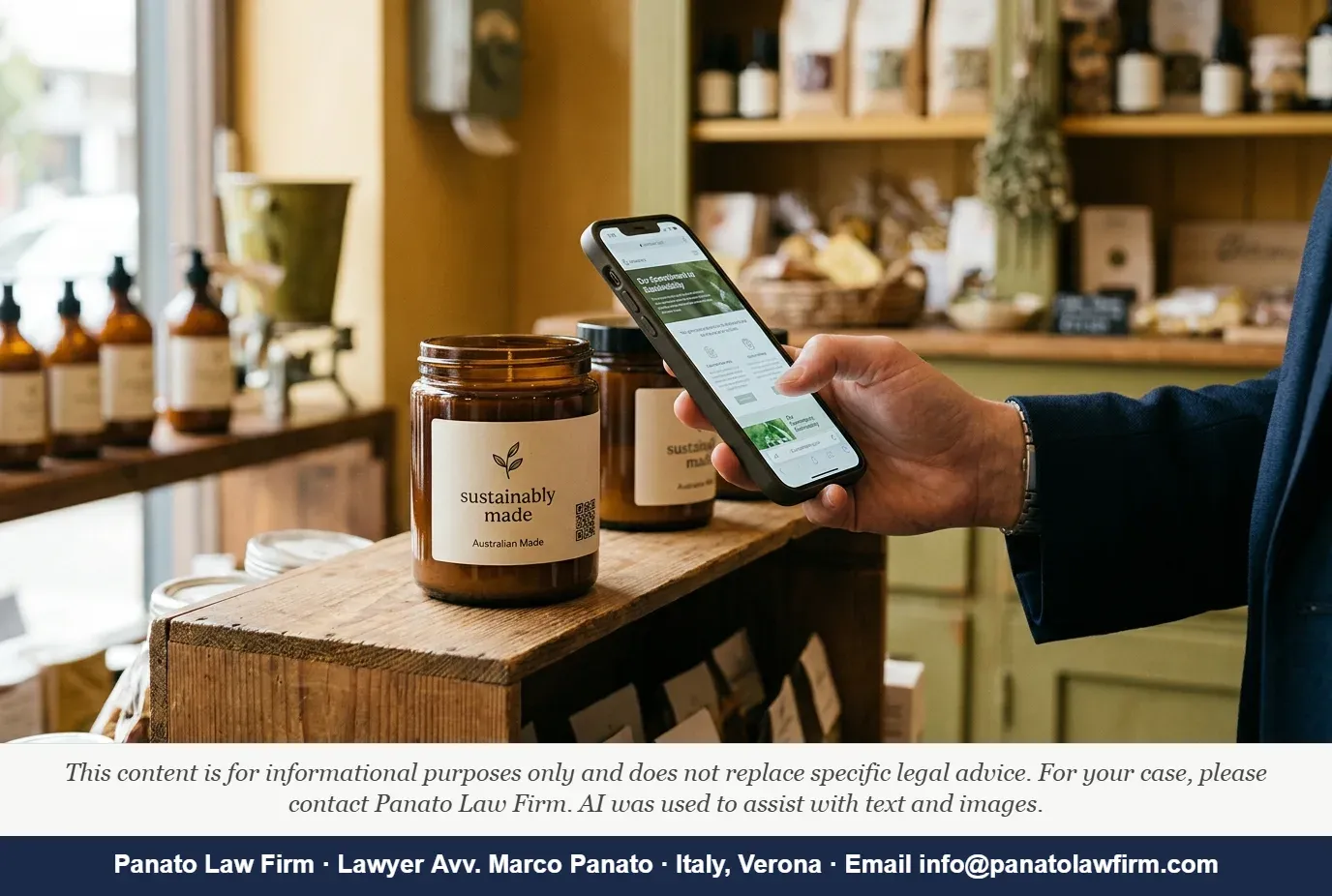
Trap one: the QR-code gap. Many Australian brands attach a QR code to Italian packaging linking to the company's global sustainability hub — a page carrying aggregate ESG statistics, CSR reports and general policy statements. Under the same-medium evidence obligation, this fails. The AGCM reads "same medium" to mean the consumer must reach specific, claim-matched evidence in one step from the point of the claim. A QR code is acceptable if and only if it leads directly to the evidence for that specific product's specific claim. A general sustainability page, however detailed, does not satisfy the requirement.
Trap two: influencer and distributor liability. An Australian brand sponsors an Italian influencer who posts that the product is "100% carbon-neutral" with a green-leaf graphic. The influencer adds a small-print disclaimer. Under Art. 18 of the Italian Consumer Code as amended, the
professional who benefits commercially from the practice bears primary liability. The AGCM has, in multiple enforcement decisions, treated the foreign brand as the responsible trader and the influencer or distributor as a secondary actor. A contract clause making the influencer solely responsible for claim accuracy does not extinguish the brand owner's AGCM exposure.
The remediation steps are specific. First, audit every Italian-market communication — packaging, website, paid social, influencer agreements, distributor shelf materials — for claims that would become prohibited on 27 September 2026. Second, for each surviving claim, map the evidence to the same medium and verify that the certification body's methodology is publicly documented. Third, insert a green claims pre-approval clause into Italian distribution and influencer agreements, with a right to require immediate withdrawal of non-compliant content.
How Italian Law Compares to Australia's ACL Green Claims RulesUnlike the ACCC framework under the Australian Consumer Law (Schedule 2 to the
Competition and Consumer Act 2010 (Cth)), which applies a general misleading or deceptive conduct standard assessed by overall impression, Italian law after D.Lgs. 30/2026 operates on two levels: a general prohibition on misleading environmental claims (like the ACL) and a
per se prohibition list — specific phrases and claim types that are unlawful regardless of how carefully they are worded or substantiated.
The ACCC's 2023 Greenwashing Guidance identifies eight principles, none of which maps exactly to Italy's same-medium evidence obligation. ACL compliance gives your legal team a starting point, not a finish line. The critical difference: under ACL, a claim may survive if a reasonable consumer would not be misled overall. Under D.Lgs. 30/2026, if the term "eco-friendly" appears without immediately accessible, claim-specific evidence, the violation exists regardless of overall impression.
Practice NoteIn files involving Australian and Asia-Pacific food and personal-care brands distributing into Italy, the most common mistake is not the claim itself but the evidence architecture. Brands hold excellent internal documentation — life-cycle assessments, certification letters, audit reports — that never reaches the Italian consumer-facing channel because the marketing team treats it as internal compliance material. Under D.Lgs. 30/2026, internal documentation that is not linked directly to the specific consumer-facing claim provides no protection in AGCM proceedings. The documentation exists; the pathway from the claim to the document does not.
Frequently Asked QuestionsMy product is certified organic under Australian standards. Does the word "organic" trigger D.Lgs. 30/2026 in Italy?Not automatically. "Organic" in Italy is regulated primarily by Regulation (EU) 2018/848 on organic production, which sets its own labelling rules. If your product meets that Regulation's requirements and carries the EU organic logo, the word "organic" is protected. If it carries only the Australian Certified Organic logo without EU Regulation compliance, using the word "biologico" or "organic" on Italian packaging may be both a D.Lgs. 30/2026 issue and an EU food-law issue. Get both checked before the September deadline.
We sell through an Italian Amazon store. Does D.Lgs. 30/2026 apply to our product listings there?Yes. An Italian-language product listing on Amazon.it directed at Italian consumers is a commercial communication under the Italian Consumer Code. Your product title, bullet-point claims and A+ content are all in scope. Amazon's own platform obligations under Directive (EU) 2024/825 do not substitute for the individual seller's compliance obligation. Each seller remains the trader responsible for the accuracy and substantiation of its own claims.
What should we do if we receive a request for information from the AGCM about our Italian marketing?Do not respond without Italian legal advice. An AGCM information request is a formal step in an administrative proceeding. The time limit for response is typically 30 days. How you respond — what documentation you produce, how you characterise the claim, whether you offer a voluntary commitment — affects both the outcome and any subsequent fine calculation. An Italian lawyer experienced in consumer and competition enforcement should be involved from day one of any AGCM contact.
Image prompt: A close-up of an Australian-made product — a premium skincare jar with a minimalist label — sitting on a wooden display surface inside a well-lit Italian delicatessen or apothecary shop. The label carries a small green leaf motif and the words "sustainably made." Beside the jar, a hand holds a smartphone scanning a QR code on the label, the screen showing a generic corporate sustainability webpage rather than specific certification data. Natural warm light, ochre and olive tones, slight documentary mood. No text overlay, no scales, no gavel.
Image file: italy-greenwashing-law-2026-australian-business-compliance-cover
HREFLANG BLOCK:
JSON-LD:
LANGUAGE QA: Three changes hit Australian exporters hardest. -> Three changes are of greatest concern for Australian exporters. · the Decree entered into force on 24 March 2026 and its substantive prohibitions apply from 27 September 2026 -> the Decree came into force on 24 March 2026; its substantive prohibitions take effect from 27 September 2026 · are not automatically accepted as proof of compliance -> do not automatically satisfy the compliance standard · must be accessible to the consumer on the same medium as the claim -> must appear on the same medium as the claim · Errare humanum est, perseverare diabolicum -> Remove or use English equivalent in a footnote · D.Lgs. 30/2026 is precisely -> D.Lgs. 30/2026 is designed precisely to close that gap. · whose methodology is "recognised" under EU or Italian law, or whose environmental performance criteria are "demonstrable and verifiable" according to criteria set by AGCM guidance -> whose methodology is recognised under EU or Italian law, or whose environmental performance criteria are demonstrable and verifiable under AGCM guidance · A landing page buried under three clicks does not satisfy this test. -> A landing page requiring multiple clicks to reach does not meet this requirement.
Quality: keyword not in the first 100 words · no practice note
Source check: verdict RED — verify before publication
CHECK:
REFERENCE: Regulation (EU) 2017/2394
1. EXISTS? not verified by the agent
2. CONTENT MATCHES? not verified
3. CONFIRMING SOURCE: —
REFERENCE: Regulation (EU) 2018/848
1. EXISTS? not verified by the agent
2. CONTENT MATCHES? not verified
3. CONFIRMING SOURCE: —
REFERENCE: Arts. 21
1. EXISTS? not verified by the agent
2. CONTENT MATCHES? not verified
3. CONFIRMING SOURCE: —
REFERENCE: Arts. 18
1. EXISTS? not verified by the agent
2. CONTENT MATCHES? not verified
3. CONFIRMING SOURCE: —
REFERENCE: Art. 23
1. EXISTS? not verified by the agent
2. CONTENT MATCHES? not verified
3. CONFIRMING SOURCE: —
REFERENCE: Art. 18
1. EXISTS? not verified by the agent
2. CONTENT MATCHES? not verified
3. CONFIRMING SOURCE: —
REFERENCE: D.Lgs. 206/2005
1. EXISTS? not verified by the agent
2. CONTENT MATCHES? not verified
3. CONFIRMING SOURCE: —
REFERENCE: D.Lgs. 30/2026
1. EXISTS? not verified by the agent
2. CONTENT MATCHES? not verified
3. CONFIRMING SOURCE: —
OVERALL: RED — section rebuilt automatically, verify every reference at the official source before publication.
Do you need legal assistance or a free estimate?
Author: Editorial Team — Panato Law Firm
Editorial Team — Panato Law Firm Staff