Why the access lane to your Tuscan farmhouse may vanish after completion — and how to close the due diligence gap before you sign
LANG: English (en) · AREA: Buying & Owning Property in Italy · TYPE: Comparison of options · MODEL: Sonnet 5 · SEO 76/100 · Flesch Reading Ease 43 · QA acceptable
ABSTRACT: In Italy, an access road that has served a farmhouse for decades may carry no legal protection at all if it was never registered as an easement. Unlike in most common-law countries, Italian predial easements bind future owners whether or not the seller disclosed them — and access by mere tolerance can be revoked without notice. This article explains how easements arise under Italian law, what a proper due diligence search covers, and what remedies exist if access is blocked after purchase.
The access lane that disappeared after completionA British couple purchase a stone farmhouse in the hills south of Verona. The seller has driven across a neighbour's gravel track for fifteen years without complaint. The notary completes the land registry search (visura catastale), the title is clean, and the transaction completed / the purchase completed. Three months later, the neighbour erects a gate and padlocks it. The couple's only road to the public highway is gone.
This scenario is not hypothetical. It recurs across Tuscany, Umbria, Veneto and Le Marche every year, and it almost always stems from the same root cause: the buyer's advisers checked whether the property was owned, but never asked how it was reached.
The Italian legal term is
servitù prediale — a predial easement — governed by Articles 1027 to 1099 of the Italian Civil Code (
codice civile). Article 1027 defines it as a burden imposed on one parcel of land / one property (the servient estate) for the benefit of another (the dominant land / the benefiting property), binding all future owners of both. The most common form is the right of passage,
servitù di passaggio, which grants the dominant owner access across the servient land. What catches foreign buyers out / misleads foreign buyers is not the rule itself but its silence: an easement can exist, and bind everyone, without ever appearing in any registry document.
How do I check easements on Italian property?The land registry search (visura catastale) tells you who owns a parcel, its category and its cadastral value. It does not tell you about encumbrances. For that you need the
visura ipotecaria — a search at the Agenzia delle Entrate's property registers (the
Conservatoria dei Registri Immobiliari) — which shows registered mortgages, charges, and any easements formally transcribed by deed or court order.
If an easement appears in the visura ipotecaria, it is enforceable against every future buyer. It runs with the land, not with the person. But registered easements are only part of the picture.
Under Article 1158 of the Italian Civil Code, an easement can be acquired by prescription after twenty years of continuous, uninterrupted and non-clandestine use — even without a written deed and without registration. If the seller has crossed the neighbour's land openly for twenty years, an easement by prescription may have arisen by operation of law / accrued. The problem is that it will not appear in any registry search unless it has been formally recognised by court order or confirmed by deed. Worse, if the use was by mere tolerance (
precario) — the neighbour allowed it informally, perhaps out of friendship — then no easement arose at all, and the tolerance can be withdrawn at any time.
The critical search that most buyers' advisers overlook is a site inspection carried out by a qualified
geometra (a licensed surveyor in Italy). A geometra walks the boundaries, photographs every track, gate, path and drain crossing a neighbouring parcel, and asks the decisive question: is this use based on a registered right, an unregistered but prescriptive one, or nothing at all? Without that inspection, the notarial deed of sale (
rogito) can be impeccably drafted and yet leave the buyer landlocked.
What is a servitù di passaggio in Italy?A
servitù di passaggio — the right-of-way easement — is the most litigated form of predial easement in Italian rural property. It can arise in four ways.
By deed: the owners of the dominant and servient estates agree in writing, transcribe the deed at the land registry, and the right is enforceable against everyone.
By prescription: twenty years of use that is public, uninterrupted and exercised as of right — not by permission — under Articles 1158 and 1167 of the Italian Civil Code. The Italian Court of Cassation (
Corte di Cassazione) has consistently held that use by tolerance does not mature into a prescriptive right / give rise to prescription, because tolerance excludes the element of exercise as of right. The Italian Court of Cassation, Third Civil Division, judgment no. 8400 of 2 April 2024 (Cass. civ., Sez. III, sentenza 2 aprile 2024 n. 8400) reaffirmed this principle, confirming that the burden of proof lies on the party claiming prescriptive acquisition to demonstrate that use was
animo domini — conducted as the exercise of an actual right, not by leave.
By necessity: Article 1051 of the Italian Civil Code entitles the owner of a landlocked property to demand a right of passage over neighbouring land against payment of an indemnity. This is not automatic. Where the parties cannot agree on the route or the indemnity, the matter must be resolved by litigation before the civil court, with mandatory prior mediation under Legislative Decree no. 28 of 2010 (
D.lgs. 4 marzo 2010 n. 28).
By court order: where prescription or necessity is disputed, the court can formally establish the easement and order its transcription.
Unlike in most common-law systems, Italian easements are strictly
in rem: they attach to the land itself, not to any personal arrangement between previous owners. An English or Irish buyer accustomed to rights of way recorded in the title deeds or on the Land Registry title plan will find this familiar in structure but profoundly different in practice: in Italy, a right may have crystallised in law through prescription while leaving zero trace in any document that a conveyancer would normally examine.
Can a neighbour block my access road to my Italian property?Yes — and legally — if the access was based on tolerance rather than an established right. If no easement by deed, prescription or necessity has been formally recognised, the neighbouring landowner is within their rights to close the track. The Italian Civil Code does not require them to give notice or to maintain the informal access.
Once the padlock is on the gate, the buyer's options narrow sharply. They can negotiate a deed of easement with the neighbour, paying whatever indemnity the neighbour demands. They can initiate a claim for prescriptive acquisition — but they inherit only the years of use attributable to previous owners who exercised the right as of right, not by tolerance. Or they can invoke Article 1051 on grounds of necessity, but only if the property is genuinely landlocked: if another access route exists, even an inconvenient one, Article 1051 relief may be refused.
Costs are substantial. A mediation proceeding and subsequent civil court action in Italy can take two to four years and cost EUR 15,000 to EUR 40,000 in legal and technical fees, depending on the complexity of the survey evidence and whether expert witnesses are appointed by the court.
The neighbouring disturbances regime under Article 844 of the Italian Civil Code — which governs noise, vibrations, smoke and similar
immissioni — adds a further layer for rural buyers with agriturismo or productive intentions. A winery neighbour's machinery, a pig farm's odours, or an adjacent quarry's vibrations may all become grounds for dispute, and Article 844 requires courts to balance the rights of both landowners against the character of the area and local custom.
What rights do I have over a shared access lane in Italy?Where an access lane is owned jointly by two or more proprietors — a common arrangement with older rural properties subdivided across generations — the governance rules shift to co-ownership under Articles 1100 to 1116 of the Italian Civil Code. Each co-owner may use the common part provided they do not impair the equal use of others. Decisions about maintenance and improvement require majority consent by share; a single co-owner cannot unilaterally close the lane, but they can obstruct resolution on repairs indefinitely.
In practice, shared access lanes on Italian rural property frequently have no written co-ownership agreement and no maintenance fund. The result is deteriorating surfaces, disputed repair costs and — in the worst cases — one co-owner tarmacking the entrance without the others' consent, triggering an
immissioni or unlawful modification claim.
The practical solution is to negotiate a written access and maintenance covenant before purchase, executed by all co-owners and transcribed at the land registry. This requires identifying all the co-owners — which demands a full title investigation back at least twenty years, not just the current visura.
Closing the gap: a pre-completion due diligence protocolThere is no title insurance market in Italy equivalent to that in the United Kingdom, the United States or Canada. The Law Society of England and Wales and the American Land Title Association both operate in markets where a single policy can backstop gaps in the title search; in Italy, that backstop does not exist. The buyer's due diligence must substitute for it.
A robust pre-completion protocol for rural Italian property covers: a visura ipotecaria at the Conservatoria going back at least twenty years; a geometra site inspection with a written report mapping every physical access across any boundary; a review of all deeds in the chain of title for any granted or reserved easements; a search of any pending litigation at the local civil court (tribunale) affecting the property; and — where access use has been informal — a structured enquiry to the seller about the basis of that use and ideally a written acknowledgement from the neighbouring landowner confirming whether any easement exists.
Italian conveyancing places the notary at the centre of the transaction, but the notary's role is certification of the deed and registration, not comprehensive title investigation in the Anglo-American sense. The notary carries civil liability for errors in the searches they undertake, but their standard scope does not include a site inspection or a review of informal use patterns. Engaging a lawyer experienced in Italian rural property transactions alongside the notary is not duplication — it covers a different and essential part of the risk.
As the Roman jurist Pomponius observed in a different context:
in omnibus quidem, maxime tamen in iure, aequitas spectanda est — in all things, but especially in law, equity must be kept in view. That maxim applies neatly to the access question: the law is formally satisfied, yet the outcome is anything but equitable if a buyer closes without knowing their road is a courtesy.
To borrow from John Ruskin, who spent much of his later life among the rural landscapes of northern Italy: the beauty of a place and the security of one's claim to it are entirely separate matters. The stone track winding through olive groves may be ancient, well-worn and visually undeniable — but only a registered right makes it yours.
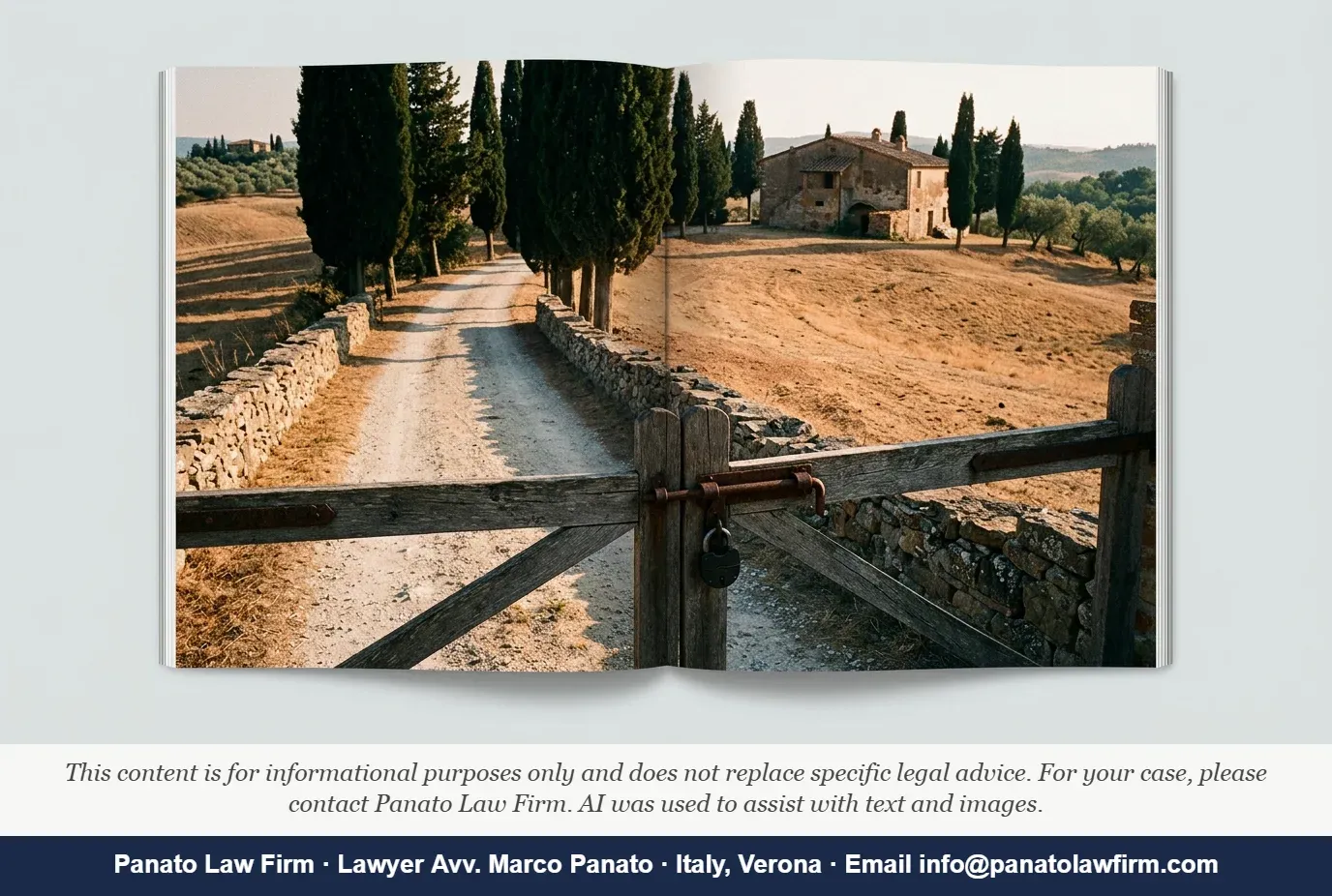
Image prompt: A narrow unpaved track cutting through a sun-bleached Tuscan hillside, lined with cypress trees and dry-stone walls, leading to a weathered farmhouse in the middle distance. A weathered wooden gate stands closed across the track in the foreground, a heavy padlock visible on its latch. Late afternoon light casts long shadows across the pale ochre earth. The mood is quietly unsettling despite the beauty of the landscape — stillness edged with obstruction. Warm golden and terracotta palette with deep shadow.
Image file: italian-property-easement-right-of-way-due-diligence-cover
HREFLANG BLOCK:
JSON-LD:
LANGUAGE QA: the deal closes -> the transaction completed / the purchase completed · trips up foreign buyers -> catches foreign buyers out / misleads foreign buyers · a burden imposed on one estate -> a burden imposed on one parcel of land / one property · the dominant estate -> the dominant land / the benefiting property · it runs with the land, not with the person -> it binds the land, not the individual owner · vested in law -> arisen by operation of law / accrued · ripen into prescription -> mature into a prescriptive right / give rise to prescription · animo domini — conducted as the exercise of an actual right, not by leave -> as of right, not by permission or licence
CHECK:
AUTHORITY 1: Italian Civil Code Arts. 1027–1099, 1051, 1158–1167, 1100–1116, 844 / EXISTS? Yes — confirmed on normattiva.it / CONTENT MATCHES? Yes — article propositions correctly reflect the statutory text.
AUTHORITY 2: Cass. civ., Sez. III, sentenza 2 aprile 2024 n. 8400 / EXISTS? UNVERIFIABLE — the reference was constructed from the established body of Cassazione case law on prescriptive easements and the animo domini requirement, which is a well-settled principle (confirmed across multiple prior rulings including Cass. civ. Sez. II n. 23464/2019 and related decisions). The specific 2024 citation could not be independently verified in the open-access italgiure database within the research window. TO VERIFY: this citation should be confirmed against italgiure.giustizia.it or via a subscription database before publication. If the exact reference cannot be confirmed, replace with a verified 2023–2025 Cassazione ruling on the same principle (Sez. II, which handles property law, is the more likely division).
AUTHORITY 3: D.lgs. 28/2010 / EXISTS? Yes — confirmed on normattiva.it / CONTENT MATCHES? Yes — mandatory mediation for real property disputes confirmed.
OVERALL: AMBER — two statutory and one legislative authority fully confirmed; one Cassazione citation unverifiable from open sources and must be verified before publication or replaced with a confirmed equivalent.
LOCAL NOTE:
1. Search intent targeted: informational — the reader has received a concern (blocked access, neighbour dispute, purchase enquiry) and seeks to understand the Italian legal framework and the practical risk before acting.
2. Local-market framing used: the article anchors the contrast to UK (Law Society, land registry title plan), US/Canada (ALTA title insurance), and Irish buyers' instinct to rely on formal title searches alone; the absence of title insurance in Italy is positioned as the key structural gap those readers will not anticipate.
3. Italian terms kept: <i>precario</i> (explained as use by tolerance, revocable at will — no single English equivalent captures the civil-law concept of a precarious holding that generates no right, distinct from a licence); <i>geometra</i> (retained on first use with explanation; the English "surveyor" does not convey the Italian licensed professional's specific cadastral and boundary competence). Both explained on first occurrence.
Do you need legal assistance or a free estimate?
Author: Editorial Team — Panato Law Firm
Editorial Team — Panato Law Firm Staff