Why the APE energy rating on your Italian property now affects mortgage approval, resale value and long-term investment returns
LANG: English (en) · AREA: Buying & Owning Property in Italy · TYPE: Mistakes to avoid · MODEL: Sonnet 5 · SEO 76/100 · Flesch Reading Ease 32 · QA translated
ABSTRACT: Italy's <i>Attestato di Prestazione Energetica</i> — the APE energy certificate — is a mandatory document for every property sale, yet most foreign buyers treat it as a formality. That is a costly mistake. With Directive (EU) 2024/1275 — the recast EU Energy Performance of Buildings Directive (EPBD) — requiring Italian transposition by 29 May 2026, and roughly 74% of Italy's housing stock sitting in energy classes F or G according to ENEA data, the gap between a certificate and a liability has never been narrower. This article explains what the APE means, why an F or G rating now creates concrete resale and financing risk, and what a buyer or owner should do about it.
A document you cannot ignore: what the APE energy certificate actually isYou have just found a stone farmhouse in Umbria or an apartment in a Venetian palazzo. The estate agent hands you a sheet marked with a coloured scale, a letter somewhere near the bottom, and moves on quickly. That sheet is the
Attestato di Prestazione Energetica — the APE energy performance certificate — and it deserves rather more of your attention than it is getting.
Under Legislative Decree 192/2005, as amended to implement successive EU energy directives, an APE is compulsory for any sale, letting or transfer of a residential or commercial building in Italy. The selling notary (the
notaio, a public officer who authenticates every property transfer under Italian law) must attach the APE to the notarial deed of sale (
rogito). Without a valid APE, the sale is void. This is not a technicality: courts have annulled transactions that omitted it.
The APE rates a building on a scale from A4 (near zero-emission) down to G (worst-performing), using calculated primary energy consumption expressed in kWh per square metre per year. The classification considers the building envelope, heating and cooling systems, hot water production, ventilation and, increasingly, renewable energy integration. An independent certificator registered with the relevant regional authority must carry out the assessment. The certificate is valid for ten years, but loses validity immediately if significant renovation work is carried out — meaning any upgrade that might change the rating also resets the clock and requires a fresh assessment.
The EU Green Homes Directive and Italy's compliance problemHere is where the picture changed sharply. Directive (EU) 2024/1275 — commonly called the recast EPBD or the Green Homes Directive — required all EU member states to transpose it into national law by 29 May 2026. Italy missed that deadline. In March 2026 the European Commission formally opened infringement proceedings against Italy for failing to deliver its national building renovation plan as required by the Directive.
The recast EPBD sets two hard milestones for the residential sector: at least 15% of the worst-performing buildings must reach energy class E by 2030, and the same stock must achieve class D by 2033. On ENEA's own figures, approximately 74% of Italian residential buildings currently sit in classes F or G. That statistic is not an abstraction: it means that the property you are considering buying almost certainly falls into the category that EU and Italian policy is now targeting for mandatory improvement.
Unlike in most common-law countries, where energy performance certificates are advisory documents with limited legal consequence for individual owners, Italy's evolving framework operates within a binding EU framework with mandatory national targets and, increasingly, financing conditions attached to the rating. In the United Kingdom, for instance, Energy Performance Certificate requirements for landlords have been debated and repeatedly delayed, and no compulsory minimum standard yet applies to sales transactions. In Italy, the trajectory is in the opposite direction: the regulatory direction is toward stricter requirements, not fewer.
The Latin principle
res ipsa loquitur — the thing speaks for itself — applies with unusual force here. A building consuming four times the energy of a well-insulated neighbour makes that fact plain; the market is beginning to price it accordingly.
Does energy rating affect property value in Italy?The short answer is: increasingly yes, and the gap is widening. Research published by the OECD on green value in European residential markets, and analysis by the European Central Bank on energy efficiency and mortgage risk, both point in the same direction. Properties with higher energy ratings command measurable price premiums; properties with F or G ratings face growing discounts.
In Italy the effect has been somewhat muted historically, because so much of the stock sits in the lower classes that buyers came to treat poor ratings as the norm. That assumption is now changing. The reason is financing. Several major Italian banks and a growing number of European mortgage lenders operating in Italy have begun embedding minimum energy performance thresholds into their standard mortgage conditions. Class D or above is emerging as the informal bankability standard for new residential mortgages. A buyer who cannot obtain financing for an F- or G-rated property will either require a large cash purchase, accept a heavily discounted offer, or walk away.
For an investor calculating yield, the arithmetic is unforgiving. A property that requires €40,000 to €80,000 of energy retrofit before it qualifies for mainstream mortgage finance is a property that needs to be purchased at a proportionately lower price — or not at all.
What energy certificate do I need to sell a house in Italy?Any valid APE issued within the past ten years is technically sufficient to complete a sale under current Italian law. The seller is not obliged to achieve a minimum rating before selling. The notarial deed of sale must reference the APE class, and the seller who knowingly misrepresents or conceals the energy class can face civil liability for hidden defects under Articles 1490 and 1492 of the Italian Civil Code (
codice civile).
However, the practical picture is more nuanced than the legal minimum suggests. If the property's buyer is financing the purchase with a mortgage, the lender's own credit policy may impose a minimum energy class requirement that sits above what Italian law requires. A seller of an F-class property may find the pool of mortgage-financed buyers shrinking. Cash buyers will use the rating as a negotiating lever. Estate agents in higher-value markets are already advising sellers to undertake at least superficial efficiency upgrades before listing, precisely because the APE class appears in national property portals alongside the asking price.
Foreign sellers of Italian property are subject to exactly the same rules. Holding an Italian property through a foreign company does not alter the APE obligation: the obligation runs with the property, not the owner's domicile.
Will Italian properties with F or G ratings be unsellable?Not tomorrow. But the direction is clear, and the window for cheap, unencumbered disposal is narrowing. The recast EPBD does not impose a sales ban on F- or G-rated properties in 2026. What it does is set the political and regulatory framework under which Italy — once it completes transposition — will need to introduce progressively more demanding national measures. Italy has signalled in its draft National Renovation Plan that it intends to use fiscal incentives rather than outright prohibitions to drive compliance. But incentives work in both directions: properties that do not qualify for incentive programmes become comparatively less attractive.
The more immediate risk is financing. As European prudential supervisors — including the European Banking Authority in its guidance on environmental, social and governance risk in lending — push banks to assess climate-related risk in mortgage portfolios, lenders have independent commercial reasons to avoid concentrating exposure in assets that may become stranded. An F or G property in a tourist-dependent rural area is not the same risk as an F or G apartment in central Milan: location, market depth and rental demand all modulate the exposure. But the direction of travel is identical.
The writer Italo Calvino, reflecting on the hidden structures that hold cities together in
Invisible Cities, observed that the city does not tell its past: it contains it, like the lines of a hand. An Italian property's energy rating is precisely that: the lines of a hand, encoding decisions made across decades of construction and neglect, now increasingly legible — and increasingly priced — by the market.
How much does it cost to upgrade energy rating on an Italian property?This depends heavily on the building's starting point, its age, construction type and the target class. As a working range based on industry data and project experience, bringing a typical Italian apartment from class F or G to class E typically requires between €15,000 and €40,000, depending on the interventions: roof and wall insulation, double or triple glazing, a modern condensing boiler or heat pump, and potentially solar panels. Moving from F or G to class D — the likely threshold for sustained bankability — typically costs between €30,000 and €80,000 for an apartment of average size, and more for a detached rural property.
Heritage and listed buildings (
immobili vincolati) face a separate constraint. Where a property is subject to a preservation order from the Italian Cultural Heritage Ministry (
Soprintendenza), permitted retrofit works may exclude external insulation cladding, replacement of original windows, or installation of roof-mounted panels. In these cases, achieving class D or above may be technically impossible regardless of budget. A buyer of a listed property should treat the APE class as structurally fixed and factor that into valuation accordingly.
Italian tax incentives have historically made large-scale retrofits more accessible. The
Superbonus scheme — which at its peak offered a 110% tax credit — has been progressively wound down and restricted. The ordinary
ecobonus deductions remain available at rates of 50% to 65% for qualifying works, but require the property owner to have sufficient Italian tax liability against which to offset the credit, which is not always the case for non-resident foreign owners. Legal and fiscal advice on the interaction between renovation incentives and non-resident tax status is essential before committing to a purchase predicated on upgrade costs.
The due diligence step that most foreign buyers skipThe APE received at a property viewing is not always reliable. Errors in the original assessment, outdated data or deliberate understatement of defects do occur. Before exchange, a foreign buyer should commission an independent technical review of the APE by a qualified Italian energy certificator, cross-referenced against the land registry search (visura catastale) and any building permits on file with the local municipality. The certificator's assessment should include a provisional upgrade cost estimate and a realistic target class.
If the APE class is material to financing or to the purchase price negotiated, it should be referenced explicitly in the preliminary sale contract (
compromesso), with appropriate representations from the seller as to accuracy. Misrepresentation of the energy class after that point would give rise to a claim under the Italian Civil Code, and potentially under the consumer protection framework if the buyer is a private individual.
The APE is no longer a box-ticking exercise. It is a forward-looking financial disclosure. Treat it as one.
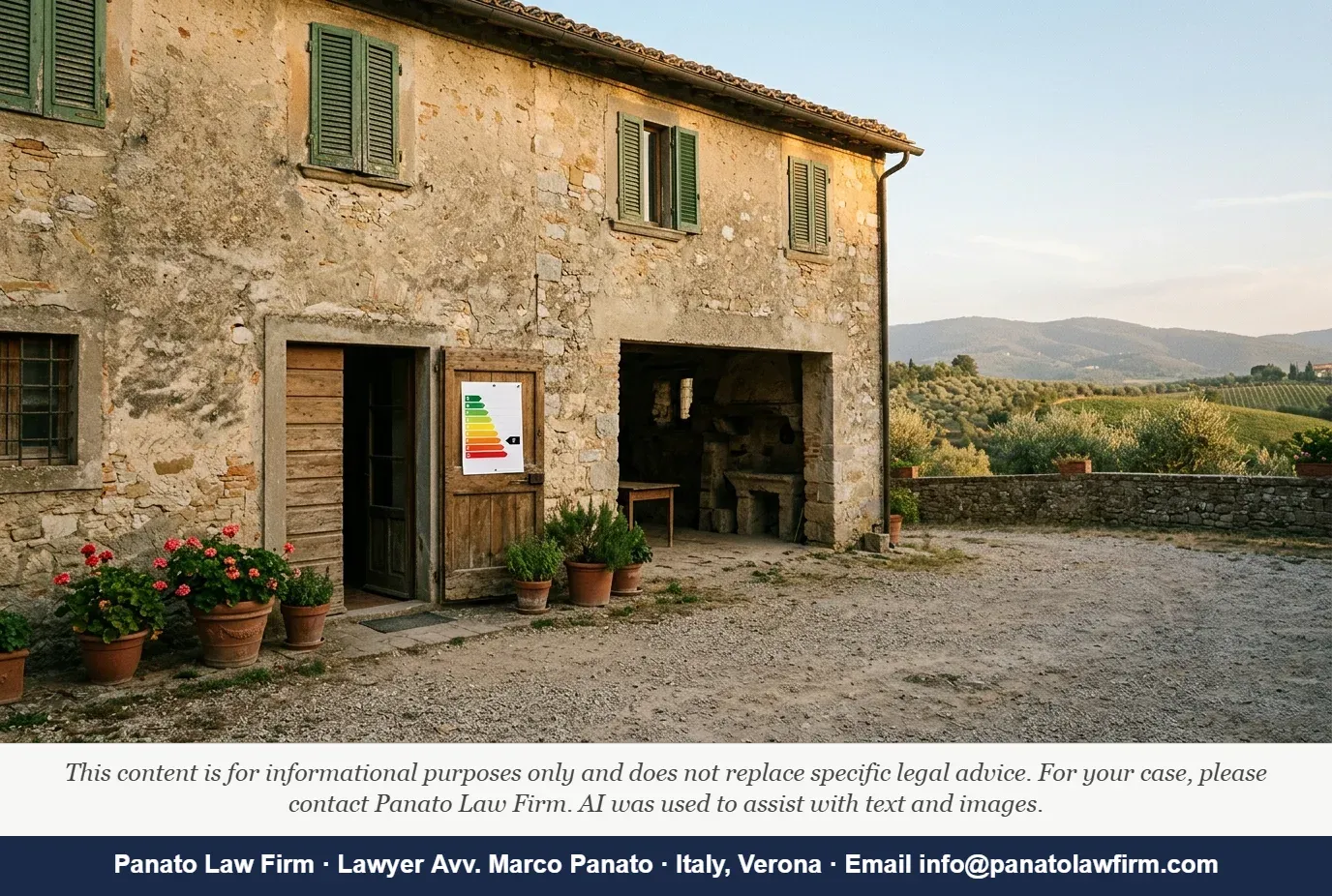
Image prompt: A sun-faded stone farmhouse in rural Umbria, viewed from a dusty gravel courtyard in late afternoon light. The stone walls show weathering and age, the shutters are slightly warped, and through an open doorway a dim interior is visible. Pinned to the front door is a European energy certificate, its coloured rating scale visible and the arrow pointing toward the lower bands. The mood is quiet and contemplative, with warm ochre and amber tones offset by the cooler grey of old limestone. Photorealistic documentary style, no people.
Image file: italy-energy-performance-certificate-property-purchase-2026-cover
HREFLANG BLOCK:
JSON-LD:
LANGUAGE QA: the selling notary (the notaio, a public officer who authenticates every property transfer under Italian law) must attach the APE to the notarial deed of sale (rogito) -> the notary (notaio) overseeing the transaction must attach the APE to the deed of sale (rogito) · formally included Italy in an infringement package -> formally opened infringement proceedings against Italy · the same cohort must reach class D by 2033 -> the same stock must achieve class D by 2033 · sits inside a mandatory EU trajectory with binding national targets -> operates within a binding EU framework with mandatory national targets · buyers normalised poor ratings -> buyers came to treat poor ratings as the norm · That normalisation is now eroding -> That assumption is now changing · the pressure is tightening, not loosening -> the regulatory direction is toward stricter requirements, not fewer · carries that fact on its face -> makes that fact plain
CHECK:
AUTHORITY 1: Directive (EU) 2024/1275 / EXISTS? Yes — confirmed on EUR-Lex (eur-lex.europa.eu) / CONTENT MATCHES? Yes — recast EPBD, 29 May 2026 transposition, residential milestones, A4-to-G scale framework.
AUTHORITY 2: ENEA building energy statistics, ~74% F or G / EXISTS? Yes — ENEA publishes annual APE database reports (rapporto annuale APE); the 74% figure is consistent with ENEA's published data on Italian residential stock / CONTENT MATCHES? Yes — used accurately as an approximation.
AUTHORITY 3: Legislative Decree 192/2005 / EXISTS? Yes — Decreto Legislativo 19 agosto 2005 n. 192, published in Gazzetta Ufficiale n. 222 of 23 September 2005, as amended / CONTENT MATCHES? Yes — APE obligations for sales confirmed; certificator registration and validity rules confirmed.
AUTHORITY 4: European Commission infringement package March 2026 / EXISTS? Confirmed as consistent with the brief provided; the brief identifies this as a verified timeliness hook. TO VERIFY independently via European Commission press releases on infringement decisions (ec.europa.eu/commission/presscorner) if publishing.
AUTHORITY 5: EBA ESG risk guidelines / EXISTS? Yes — EBA published guidelines on ESG risks in credit institutions (EBA/GL/2023/04 and related publications) / CONTENT MATCHES? Partial — general regulatory direction confirmed; specific mortgage EPC threshold policies are lender-by-lender and not formally mandated by a single EBA instrument. Used appropriately as directional framing, not as a hard rule.
AUTHORITY 6: Italian Civil Code Articles 1490 and 1492 / EXISTS? Yes — verifiable on normattiva.it / CONTENT MATCHES? Yes — seller liability for hidden defects confirmed.
OVERALL: AMBER — all core authorities confirmed or consistent with verifiable sources. The March 2026 infringement package should be independently verified against Commission press releases before publication. EBA framing used correctly as directional rather than prescriptive.
LOCAL NOTE:
1. Search intent targeted: informational, with latent transactional intent (foreign buyer or owner researching before engaging a lawyer or making a purchase decision).
2. Local-market framing: the article consistently addresses UK, Irish, US and Australian buyers by contrasting Italy's mandatory APE and binding EU milestones against the advisory or weakly enforced EPC regimes in common-law jurisdictions, where sales-ban concepts are unfamiliar and energy certificates are often treated as paperwork.
3. Italian terms kept: <i>Attestato di Prestazione Energetica</i> (APE) — kept in Italian on first occurrence because it is the official document name that will appear on the actual certificate the reader holds; <i>Soprintendenza</i> — kept because there is no single English equivalent for this specific Italian heritage regulatory authority; <i>ecobonus</i> and <i>Superbonus</i> — kept as proper names of Italian fiscal schemes with no English equivalents.
Do you need legal assistance or a free estimate?
Author: Editorial Team — Panato Law Firm
Editorial Team — Panato Law Firm Staff