META: Italy hidden defects property purchase legal claim explained: why 'as seen' clauses fail and what the 2025 Court of Cassation ruling means for buyers.
SLUG: italy-hidden-defects-property-purchase-legal-claim URL: https://panatolawfirm.com/en/italy-hidden-defects-property-purchase-legal-claim
ABSTRACT: A fresh coat of paint over a damp wall. That is the fact pattern the Italian Court of Cassation keeps ruling on — and the court keeps ruling against the seller. US buyers who discovered structural dampness, concealed plumbing faults, or undisclosed roof infiltrations years after closing may have more time to sue than their attorney assumed, following a significant 2025 ruling on deliberate concealment. The standard <i>visto e piaciuto</i> clause printed in almost every Italian estate-agent contract gives sellers far less protection than they believe.
A buyer purchases a house in Ancona. Months later, damp spreads across the bedroom walls. The seller protests: the contract said visto e piaciuto — "as seen and approved." The Italian Court of Cassation, Second Civil Division, decided otherwise. In its judgment no. 22918 of 8 August 2025 (Cass. civ., Sez. II, sent. 8 agosto 2025, n. 22918), the court confirmed that structural defects deliberately concealed by the seller — including through fresh rendering over damp masonry — stop the limitation period in its tracks. If the seller has deliberately concealed the defect, the picture changes entirely: the limitation period under Art. 1495 does not begin to run until the buyer actually discovers the defect. For US buyers who closed on Italian property years ago and are only now seeing evidence of concealed faults, that is a material change from the strict annual deadline most attorneys assumed applied.
Can I sue the seller of my Italian property for defects discovered after closing?
Yes, in most cases. The Italian Civil Code (codice civile) imposes on every seller a mandatory warranty against hidden defects under Arts. 1490 to 1497. Article 1490 of the Italian Civil Code establishes that the seller must guarantee that the item sold is free from defects that render it unsuitable for its intended use or significantly reduce its value. That warranty applies whether the buyer is Italian or foreign, whether the property is new or decades old, and whether the sale was conducted in English or through an interpreter. Liability under this provision is strict: it arises from the defect alone, regardless of the seller's fault; the buyer need only prove the presence of the defect and its pre-existence at the time of delivery.
Three remedies are available. First, riduzione del prezzo (price reduction): available for any qualifying defect, minor or serious. Second, risoluzione del contratto (termination of the contract): reserved for defects serious enough to render the property substantially unfit for its intended use. Third, risarcimento danni (damages): available when the seller knew of the defect or deliberately concealed it, requiring proof of subjective fault or deliberate conduct. You do not need to choose all three; experienced Italian attorneys typically plead price reduction as the primary claim and damages in the alternative, because rescission is harder to obtain and requires returning the property.
What is the time limit to claim for hidden defects in Italy?
This is where US buyers most often go wrong — and where the 2025 case law makes the biggest practical difference. The default rule gives the buyer eight days from discovery of the defect to report it to the seller, and one year from delivery to commence legal proceedings. Miss either deadline and the warranty is lost. Those are brutal deadlines by American standards, where statutes of limitations for construction defects typically run three to six years.
The point most buyers miss concerns the dies a quo — the day from which the eight days begin to run. "Discovery," under Art. 1495, does not mean the first visible sign of a problem: it means objective and complete knowledge of the defect, its extent, and its cause. The Italian Court of Cassation reaffirmed this in its order no. 30932 of 25 November 2025 (Cass. civ., ord. 25 novembre 2025, n. 30932): where the nature of a defect requires specialist expertise — as is routine for structural faults — that certainty arises only once the expert's report is received. A damp patch on the ceiling in October does not trigger the eight-day clock. The technical report from the independent surveyor does.
More significantly, deliberate concealment changes the position entirely. A seller who hides a defect through positive action — not mere silence, but conduct actively designed to prevent discovery — cannot rely on the annual limitation period as a barrier to the buyer's claims. This is the core holding of Cassazione n. 22918/2025, and it aligns with the Latin principle fraus omnia corrumpit — fraud corrupts every act it touches, stripping the fraudster of the very protections the law would otherwise afford.
Does the 'as seen' clause in an Italian property contract protect the seller?
No — not for hidden defects, and not at all when the seller acted in bad faith. Italian courts classify the visto e piaciuto clause as a clausola di stile — a standard boilerplate provision. It excludes the warranty only for defects that a visit conducted with ordinary diligence would have revealed; it does not cover defects that emerge only once the buyer moves in, and it has no effect whatsoever where the seller concealed the defect in bad faith or physically masked it — the fresh paint over a damp wall being the recurring example — by express operation of Art. 1490, paragraph 2.
A concrete recent application comes from the Tribunale di Milano, judgment of 6 December 2025, no. 9399 (Trib. Milano, Sez. IV civ., 6 dicembre 2025, n. 9399): a house sold with the visto e piaciuto formula in both the preliminary contract and the notarial deed of sale (rogito), with roof and terrace infiltrations emerging in the months after delivery. The court treated the clause as irrelevant to the hidden defects and ordered the sellers to refund over €20,000 as a price reduction.
The short answer: yes, you can still enforce the warranty, because the clause has precise limits and does not cover defects that were hidden or withheld in bad faith by the seller.
The concealment trap: what Italian courts actually look for
This is the analysis competitor content consistently omits. Most English-language guides recite the eight-day and one-year deadlines and move on. What Italian litigation attorneys see in the actual files is a very different story.
The leading fact pattern is ritinteggiatura fresca — fresh rendering applied to a damp wall immediately before the property is shown to buyers. The Tribunale di Catanzaro, judgment no. 2877 of 29 December 2025 (Trib. Catanzaro, sent. 29 dicembre 2025, n. 2877), found that extensive rising damp masked by fresh paintwork applied before the sale constituted a vizio occulto (hidden defect) warranting a price reduction, confirming that a buyer denied a second pre-completion access visit could not reasonably have detected the defect with ordinary diligence.
The Italian Court of Cassation has confirmed in n. 22918/2025 that deliberate concealment is not limited to cosmetic cover-ups. In that case, the buyer sued the seller, the architect responsible for the renovation works, and the construction company, claiming that serious structural faults had been deliberately concealed. The court drew a clear line between ordinary hidden defects — which trigger the standard eight-day and one-year deadlines — and deliberately masked defects, where the limitation clock does not start until actual discovery.
For the US buyer, the evidential burden is the critical practical challenge. Proving the seller's subjective knowledge requires contemporaneous documents: prior building permits showing undisclosed works (the SCIA, CILA, or DIA obtained from the local authority, the comune), previous insurance claims linked to the property, condominium maintenance records noting damp or structural faults, and any informal communications in which the seller acknowledged the problem. As the Tribunale di Milano noted in the 6 December 2025 judgment, informal messages in which a seller offered to contribute to repair costs were treated as an implicit recognition of the defect's existence. Screenshot those messages before you litigate.
What counts as a hidden defect in an Italian property sale?
A defect qualifies when it either renders the property unsuitable for its intended residential use or appreciably reduces its market value, and when it was not visible — or not reasonably discoverable by ordinary inspection — at the time of the notarial deed of sale. Water infiltrations arising at short intervals across several interior rooms, attributable to defects in waterproofing of terraces and roof structures, constitute hidden defects not attributable to mere age of the property. This brings the case within the line of authority that, in the presence of structural defects that are not immediately perceptible, affirms the operation of the warranty even for older buildings.
Defects that typically qualify include: structural dampness rising from foundations; roof infiltration linked to incorrect gradients or failed membrane waterproofing; concealed plumbing or electrical systems that fail safety codes; and illegal structural alterations carried out without building permits and never disclosed. Defects that typically do not qualify: cosmetic wear, visible cracks noted in the inspection report, or issues the buyer's own surveyor flagged before closing.
How Italian property defect claims differ from US real estate law
Unlike most US states, where a buyer's primary recourse after closing runs through tort theories — misrepresentation, fraud, or breach of express warranty in the seller's disclosure statement — Italian law grounds the claim directly in contract, under Arts. 1490 to 1495 of the Italian Civil Code, without requiring the buyer to prove the seller's negligence to obtain a price reduction. In the US, the implied warranty of habitability typically applies only to new construction sold by a builder; private resale transactions in most states are governed by the caveat emptor doctrine unless the seller made affirmative misrepresentations. In Italy, the opposite presumption operates: unlike the US position for private resales, liability under Art. 1490 of the Italian Civil Code is not mandatory and may be contractually excluded — but that exclusion is void and the warranty applies in full where the seller has fraudulently concealed known defects. The warranty attaches automatically, and only deliberate exclusion by an informed buyer can waive it. No seller's disclosure form exists in the Italian system; the burden of the investigation falls entirely on the buyer's pre-purchase due diligence.
This also means that the US attorney's instinct — to rely on a seller disclosure statement or a home inspection contingency in the purchase contract — does not translate. There is no statutory disclosure form. The equivalent protection must be built from scratch into the preliminary sale contract (compromesso) and, crucially, obtained through an independent technical inspection before the notarial deed is signed.
The pre-purchase steps that actually protect you
The time to build your evidentiary position is before the rogito, not after the damp appears. Four steps are non-negotiable.
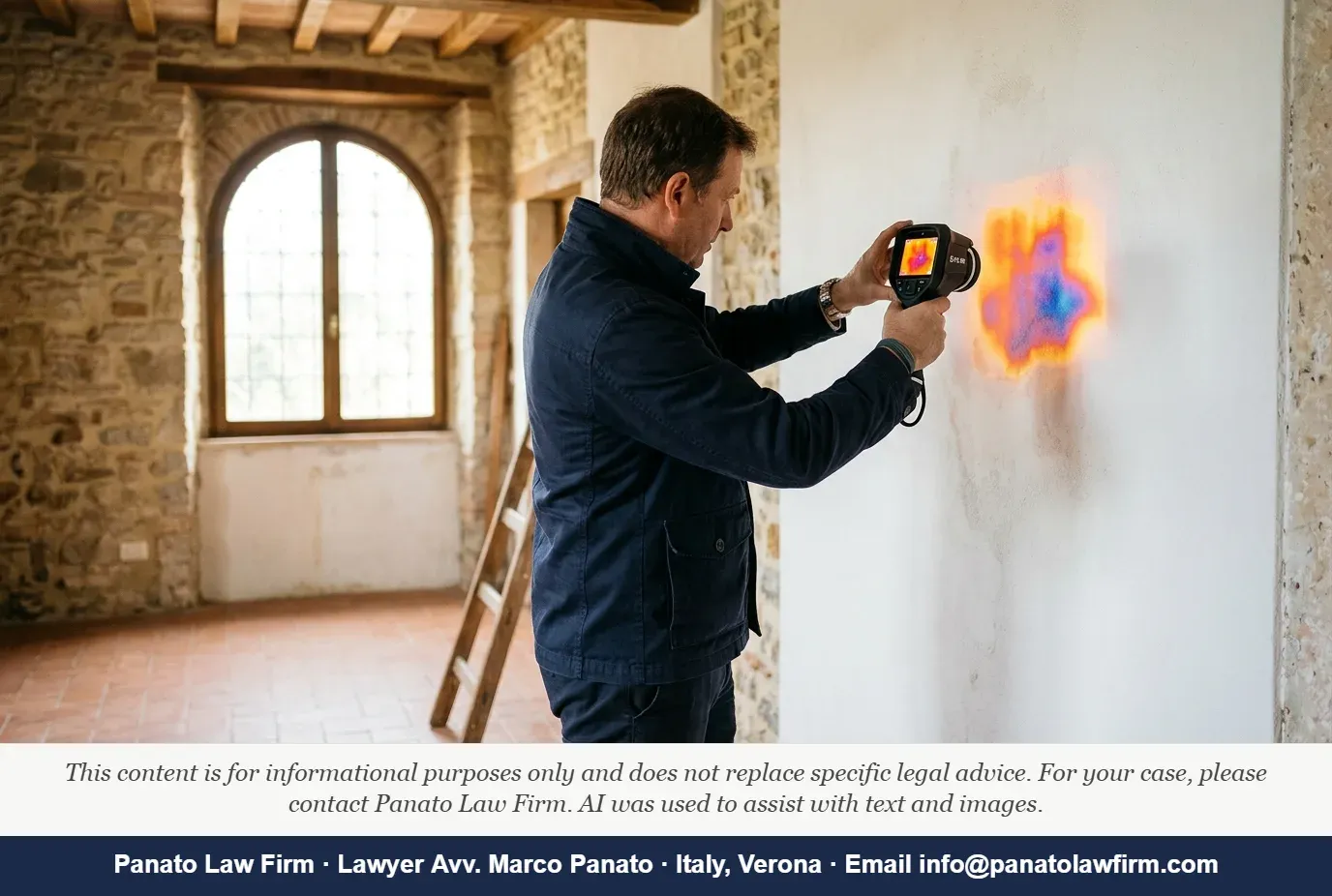
First, commission a thermal imaging survey. Not the agent's floor-plan visit. An independent geometra (a licensed Italian building surveyor) using thermal imaging equipment can detect moisture behind plaster that no visual inspection will reveal. The report becomes your primary evidence in any subsequent claim, and it documents the pre-closing condition of the property.
Second, obtain the building permit history from the local authority. A formal access request — accesso agli atti — to the comune (the Italian municipality) will produce the SCIA (segnalazione certificata di inizio attività), CILA, and DIA filings for the property. Undisclosed alterations appear here. Any gap between what was permitted and what exists on site is both a defect argument and, potentially, a criminal disclosure issue for the seller.
Third, check the land registry search (visura catastale) against the actual floor plan. Discrepancies indicate unlicensed works. A mismatch between the registered plan and the property as built is itself a structural legal defect affecting your ability to resell.
Fourth, negotiate a specific representations clause into the preliminary sale contract. Italian standard form contracts rarely include seller representations about defects. A well-drafted clause shifts the contractual burden and creates an independent breach-of-contract claim alongside the statutory warranty — with a longer limitation period.
Practice note
In our experience, the most common mistake US buyers make is relying on the Italian estate agent's description of the property condition as though it were a seller's disclosure statement. It is not. Agents in Italy act for the transaction, not exclusively for the buyer, and their descriptions carry no contractual force against the seller. We regularly see buyers who received a glowing agent description discover, months post-closing, that the agent had no access to the building permit file, never commissioned a structural survey, and had no knowledge of prior damp remediation. The evidentiary gap at that stage is large. Commissioning an independent geometra report before the rogito costs between €500 and €1,500 depending on property size; litigating a concealed-defect claim through to the Italian Court of Cassation typically costs twenty to fifty times that, and takes years.
The French novelist Stendhal, who lived in Italy and wrote about it more perceptively than most, noted that Italians excel at the art of concealment when it serves their interests. He was writing about emotion. He might equally have been writing about damp.
Frequently asked questions
I bought an Italian property three years ago and have just found serious structural damp. Am I out of time to claim?
Not necessarily. The standard one-year limitation from delivery under Art. 1495 of the Italian Civil Code is suspended where you can show the seller deliberately concealed the defect — through fresh paintwork, denied access, or prior remediation attempts that were never disclosed. Italian Court of Cassation judgment no. 22918/2025 confirmed this principle. Your attorney will need to gather evidence of the seller's prior knowledge: building permit records, condominium minutes, or prior correspondence are the starting points.
Does a 'visto e piaciuto' clause in my Italian purchase contract prevent me from suing?
No. Italian courts treat it as standard boilerplate that only excludes warranty claims for defects a careful visual inspection would have revealed. It cannot exclude liability for hidden defects or for any defect the seller concealed in bad faith, by express operation of Art. 1490, paragraph 2, of the Italian Civil Code. The Tribunale di Milano confirmed this in its December 2025 judgment, awarding buyers over €20,000 in price reduction despite the clause appearing in both the preliminary contract and the notarial deed.
What evidence do I need to bring a hidden-defect claim in Italy?
You need: (1) a technical expert's report — ideally an accertamento tecnico preventivo (a pre-litigation court-appointed survey) — establishing that the defect existed at the time of delivery; (2) proof of timely notification to the seller within eight days of the date on which you had full knowledge of the defect's nature and extent; and (3) if you are claiming damages beyond a simple price reduction, evidence of the seller's prior knowledge, such as building permit records, condominium maintenance records, or prior insurance claims. Documents obtainable before closing through an accesso agli atti request to the comune are the most powerful tools.
KEYWORDS: Italy hidden defects property purchase legal claim, visto e piaciuto clause Italy property defects, Italian property latent defects time limit claim, damp mould Italy house purchase claim attorney, Art 1490 Italian civil code hidden defects, Italy property bought as seen clause defect claim, Italian seller warranty defects property, sue seller Italian property defects, Italy property defect claim time limit, hidden defects Italian real estate law, Italy property purchase concealed defects, rogito Italy defects discovered after closing, Italian property warranty claim US buyer, vizio occulto Italy property English, Italy house purchase damp structural defect, Italian property law buyer rights defects, Italy property resale concealed defects attorney, Italian civil code property buyer warranty, how to claim hidden defects Italy property, Italian property disclosure law foreign buyers, time limit hidden defects Italy real estate, Italy property law latent defects expat, Italy real estate purchase inspection rights, Italian property defect statute of limitations, hidden defects Italy compensation claim, Italian property law buyer remedies defects, Italy notarial deed defects legal rights, Italian property purchase survey hidden defects, vizi occulti Italy English explained, Italy buy house defects years after purchase, Italy property purchase legal advice defects, Italian real estate attorney hidden faults, how to sue Italian property seller defects, Italy property hidden defects evidence pre-purchase, structural damp Italy property legal claim, concealed defects Italian property fraudulent seller, Italian property purchase inspection geometra, comune building permit Italy property defects, Italy property price reduction defects law, Art 1495 Italian civil code limitation period defects
Image prompt: A building surveyor in a cotton work jacket holds a thermal imaging camera up to the freshly painted interior wall of a sun-lit Veronese stone farmhouse; the camera screen glows orange and red behind a patch of bright white plaster, revealing hidden moisture invisible to the eye. Soft afternoon light from a tall arched window; earthy ochre and terracotta tones. The mood is clinical and precise against warm, aged architecture.
Image file: italy-hidden-defects-property-purchase-legal-claim-cover
HREFLANG BLOCK:
JSON-LD:
LANGUAGE QA: suspend the limitation period that sellers rely on to kill claims dead -> stop the limitation period in its tracks · the limitation period under Art. 1495 of the Italian Civil Code is suspended until the buyer actually discovers the defect -> the limitation period under Art. 1495 does not begin to run until the buyer actually discovers the defect · that certainty matures only when the expert's report is delivered -> that certainty arises only once the expert's report is received · deliberate concealment changes the calculus entirely -> deliberate concealment changes the position entirely · Liability under this provision arises solely from the existence of a defect, irrespective of the seller's fault or negligence -> Liability under this provision is strict: it arises from the defect alone, regardless of the seller's fault · rescission of the contract -> termination of the contract · Miss either deadline and the warranty lapses -> Miss either deadline and the warranty is lost · where a three- or six-year statute of limitations for construction defects is common in most states -> where statutes of limitations for construction defects typically run three to six years
Quality: Italian terms without a plain explanation: visura catastale, codice civile, PEC · keyword not in the first 100 words
SOURCES:
1. studiolegalemp.info/blog/vizi-occulti-compravendita-responsabilita-venditore.html — confirmed existence and content of Cass. civ., Sez. II, n. 22918/2025 and Tribunale di Catanzaro n. 2877/2025; cited text on dolus suspension of limitation and ritinteggiatura fresca pattern. PRIMARY-adjacent (law firm analysis with full references).
2. lexced.com/giurisprudenza-civile/vizi-occulti-no-aliud-pro-alio-costruttore-non-paga — confirmed Cass. civ., Sez. II, n. 22918/2025 heading references and subject matter (structural concealment, vizi occulti, deliberate concealment by seller and contractor). SECONDARY source.
3. intercodex.net/vizi-occulti-casa-appena-comprata-otto-giorni-denuncia — confirmed Tribunale di Milano, sent. 6 dicembre 2025, n. 9399; confirmed Cass. civ., ord. 25 novembre 2025, n. 30932 on dies a quo and specialist expertise requirement. SECONDARY source with full references.
4. condominioweb.com/casa-acquistata-con-infiltrazioni — confirmed Tribunale di Milano, sent. 6 dicembre 2025, RG n. 34238/2022, Quarta Sezione Civile: price reduction for roof/terrace infiltrations as hidden defects. Content matches description of vizi occulti and Art. 1490–1495 application. SECONDARY.
5. brocardi.it/notizie-giuridiche/casa-infiltrazioni — secondary confirmation of Trib. Milano 6 dicembre 2025, n. 9399, award of over €20,000 price reduction.
6. studiolegalemp.info/blog/vizi-occulti-appartamento-condominio — confirmed Trib. La Spezia, sent. 31 ottobre 2025, n. 545 (cited for completeness in research, not included in article body); confirmed reference to Cass. n. 15633/2026.
7. avvocatocivilista.net/sentenza/la-clausola-visto-e-piaciuto — confirmed October 2025 Cassazione ordinance on visto e piaciuto clause interpretation; historical precedents Cass. n. 3741/1979 and n. 21204/2016.
8. gianlucasicchiero.it/vizi-occulti-negli-immobili-e-clausola-contrattuale-visto-e-piaciuto — confirmed Cass. n. 27968/2025 on visto e piaciuto and bad-faith concealment; fresh-paint-over-damp-wall pattern.
9. studioavvocatiroma.it/clausola-visto-piaciuto — confirmed Cass. n. 27968/2025; confirmed that visto e piaciuto does not bar warranty where seller concealed defect in bad faith.
10. cms.law/en/int/expert-guides/product-liability/italy — confirmed Art. 1490 Italian Civil Code text and the rule that exclusion of warranty is void where seller fraudulently concealed known defects. PRIMARY-adjacent (CMS law firm, English translation of Italian codice civile provisions).
11. mimit.gov.it/en/single-digital-market/legal-guarantee — official Italian government source confirming Art. 1490 Italian Civil Code text. PRIMARY.
12. studiomontinaro.it/danni-da-infiltrazioni — confirmed Art. 1495 c.c. eight-day rule and one-year limitation; seller's decadence argument; tacit recognition of defect. SECONDARY.
CHECK:
AUTHORITY 1: Italian Court of Cassation, Second Civil Division, judgment no. 22918 of 8 August 2025 (Cass. civ., Sez. II, sent. 8 agosto 2025, n. 22918)
REFERENCES: Cass. civ., Sez. II, n. 22918/2025
EXISTS? YES — confirmed at lexced.com (heading: "Civile
Do you need legal assistance or a free estimate?
Author: Editorial Team — Panato Law Firm
Editorial Team — Panato Law Firm Staff