What Legislative Decree 47/2026 means for your board resolutions, delegation clauses and joint-venture agreement — before the next board meeting
LANG: English (en) · AREA: Corporate & Company Law · TYPE: Checklist / documents needed · MODEL: Sonnet 5.5 · SEO 69/100 · Flesch Reading Ease 34 · QA translated
ABSTRACT: Legislative Decree 47 of 27 March 2026 overhauled the rules that govern every Italian <i>società per azioni</i> (S.p.A.), the Italian equivalent of a UK public limited company used widely for joint ventures and inward investment. The reform removes the old statutory default governance model, imposes mandatory new constraints on board delegation during periods of financial distress, and creates a single supervisory framework that applies regardless of which governance model a company has chosen. UK investors and joint-venture partners with existing shareholders' agreements or board mandates tied to the old rules face an urgent compliance gap that most commentary has not yet addressed.
A Milan commercial court grappled in early 2026 with a dispute between a UK-based private equity house and its Italian industrial partner. The dispute centred on a board resolution delegating broad management powers to an executive committee during a period the company's auditors had flagged as financially stressed. The court found that the delegation clause in the shareholders' agreement, drafted under the pre-reform Italian Civil Code, was unenforceable against the third-party creditor who challenged it. The case is a foretaste of what Decree 47 now makes statutory.
What changed in Italian company governance law in 2026?Legislative Decree 47 of 27 March 2026, published in the
Gazzetta Ufficiale No. 73 of 28 March 2026 and in force from 29 April 2026, amends both the Italian Civil Code (
codice civile) and the Consolidated Finance Act (
Testo Unico della Finanza, TUF). It is the most significant structural reform of S.p.A. governance since Legislative Decree 6 of 17 January 2003.
Three changes matter most to a UK investor. First, the old default model — the traditional board of directors plus a
collegio sindacale (statutory auditor body) — is abolished as a statutory default. Every S.p.A. must now make an active, documented choice among the three permitted systems: the traditional Italian model, the two-tier
dualistico model, or the one-tier
monistico model. Any company that has never formally adopted a governance model, which in practice was the majority of closely held S.p.A.s, is now in a lacuna that must be remedied by shareholders' resolution before the end of the first financial year beginning after 29 April 2026.
Second, the decree codifies and expands the board's duties, introducing an explicit list of non-delegable functions that includes approval of the annual accounts, transactions with related parties above materiality thresholds, and — the new element — any major disposals or financing transactions initiated or completed while the company is financially distressed (
crisi d'impresa). Under the previous regime, boards routinely delegated these functions to executive committees or individual managing directors.
Third, a unified supervisory framework (
nuovo organo di controllo unificato) applies across all three models. This body absorbs functions that were formerly split between the
collegio sindacale and internal audit committees, and its members now carry personal liability not merely for negligent omission but for failure to act promptly once they become aware of a risk signal. The auditor liability cap introduced by Law 35 of 2025 for statutory auditors of listed companies sits uneasily alongside the new framework, because the cap applies to contractual liability but not to the strict statutory liability the new supervisory rules impose.
How are board delegation rules different in Italy after the 2026 reform?Under the reformed Italian Civil Code, the board of directors of an S.p.A. may not delegate decisions that fall within the expanded mandatory list, even where the company's articles and its shareholders' agreement expressly permit delegation. The prohibition is mandatory and cannot be excluded by contract / is not waivable.
Unlike in most common-law jurisdictions, where a UK board can pass a board resolution delegating virtually any function to a committee or to individual directors provided the company's articles allow it, the Italian system now sets a hard statutory floor. The Companies Act 2006 framework familiar to UK investors treats delegation as a matter of internal governance, subject only to the articles and any Listing Rules constraints. Italian law treats the non-delegable matters as a matter of public policy —
norme imperative — meaning that a contractual delegation to an executive committee that covers a crisis-period disposal is not merely irregular but void.
The practical implication: any shareholders' agreement or board mandate drafted before 29 April 2026 that gives an executive committee or a sole managing director the authority to act on major transactions during a period of financial distress is now unenforceable to the extent it conflicts with the mandatory list. A UK investor relying on that delegation to protect its position — for example, a veto right channelled through an executive committee appointment — may find the mechanism has no legal effect.
Do I need to update my Italian joint venture agreement after Decree 47/2026?Yes, and the checklist below identifies the five provisions most likely to require amendment.
The SHA clause that looks fine but is now voidThe single highest-risk provision in most joint-venture shareholders' agreements (
patti parasociali) is the delegation schedule: the annex, or the schedule of authorities, that maps which decisions the CEO or executive committee can take without a full board vote. Under the reform, any item that now falls within the mandatory board list — crisis-period financing, related-party transactions above threshold, and major disposals — must come back to the full board. No amount of contractual drafting overrides this.
The five-point checklist for UK investors and JV partners:
One: audit the delegation schedule in every existing SHA against the expanded mandatory list in the reformed Italian Civil Code. Any overlap must be removed and replaced with a full-board requirement, expressed as a reserved matter requiring quorum and, if the SHA provided for it, a minority-protective voting threshold.
Two: verify that the S.p.A.'s articles of association have made a formal, documented election of one of the three governance models. If they have not, convene a shareholders' meeting before the end of the first financial year starting after 29 April 2026. The default gap is not a minor technicality: it affects which supervisory body has standing to challenge board decisions.
Three: review the composition and mandate of the supervisory body. If your company previously operated under the traditional model with a
collegio sindacale, you now need to assess whether that body's composition and liability framework complies with the new unified supervisory rules — or whether a formal reconstitution is required.
Four: check whether the company has initiated, or is at risk of initiating, crisis-management proceedings under the Italian Code of Business Crisis and Insolvency (Legislative Decree 14 of 12 January 2019, as most recently amended). If it has, the crisis-period delegation restrictions are already active. Boards that have continued operating under old delegations after the in-force date of 29 April 2026 face a period of potential personal liability for individual directors who acted on those delegated powers.
Five: update board minutes and internal authorisation matrices to reflect the new mandatory language. Italian courts look at the actual board minutes — not just the articles — when assessing whether a decision was properly taken. A board minute that recites a delegation to an executive committee for a transaction that now requires full board approval is, by itself, evidence of a defective process.
What does the new Italian supervisory framework mean for a UK minority shareholder?The
nuovo organo di controllo unificato looks, at first reading, like a UK audit committee. It is not. A UK audit committee operates under the UK Corporate Governance Code and the Listing Rules; its members owe duties to the company and, in practice, to shareholders collectively, but personal liability for audit committee members in the UK is limited and rarely enforced. The Italian unified supervisory body carries a direct, personal statutory liability: members must report to the competent authority — which, for listed companies, means CONSOB, the Italian securities regulator — within fifteen days of becoming aware of an irregularity, or they become jointly liable with the directors for the resulting loss.
For a UK minority shareholder who appoints a board nominee, the practical consequence is that any director appointed by that shareholder who also sits on the supervisory body (as the one-tier
monistico model permits) is simultaneously exposed to the strict Italian supervisory liability regime. This is a structurally different risk profile from a UK non-executive director appointment.
Vigilantibus non dormientibus iura succurrunt — the law assists those who watch, not those who sleep. The maxim captures exactly what the reform demands of supervisory body members: active monitoring, documented response, and timely escalation.
The liability interaction with Law 35/2025 adds a further wrinkle. For listed S.p.A.s, the 2025 law introduced a contractual liability cap for statutory auditors, set at three times annual compensation in cases of ordinary negligence. But the new Decree 47 supervisory liability is statutory — not contractual — and the cap does not apply to it. A UK investor who negotiates a fee-and-cap arrangement for its supervisory nominee on a listed S.p.A. is therefore obtaining only partial protection.
As the Italian legal scholar Pier Giusto Jaeger observed in his foundational work on corporate governance in Italy, the S.p.A. structure was always designed as an instrument of economic concentration; the tension between majority control and minority protection has never been fully resolved by private contract alone. Decree 47 is the legislature's most direct attempt to resolve it by mandatory rule rather than by contractual discipline — which means UK investors cannot simply draft their way around the new framework.
Practice note: where we see the gap most oftenIn our files, the most common error is an SHA that was negotiated in English, with English-law concepts, and then implemented through Italian articles of association that followed the traditional model by default — without anyone checking whether the English-language provisions were actually achievable under Italian mandatory law. The new reform makes that misalignment visible and legally consequential. We also see shareholders' agreements that give a UK investor a veto over "material transactions" without defining whether the veto is exercised at board level or at shareholders' meeting level — a distinction that now determines whether the veto can lawfully coexist with the new mandatory board powers.
Frequently asked questionsDoes Decree 47/2026 apply to private, closely held S.p.A.s, or only to listed companies?It applies to all S.p.A.s. Certain provisions — including the interaction with the auditor liability cap under Law 35/2025 — have additional effects for listed companies, but the core changes to the governance model election, the mandatory board list, and the unified supervisory framework apply to every S.p.A. regardless of whether its shares are traded.
If our existing SHA was governed by English law, does the Italian reform still affect us?Yes. The governance obligations under Decree 47/2026 are mandatory provisions of Italian company law. They apply to the S.p.A. as a legal entity incorporated in Italy regardless of the governing law chosen for the shareholders' agreement. A contractual provision in an English-law SHA that purports to delegate a function the Italian statute now reserves to the full board will be unenforceable against the company and against third parties under Italian law, even if it is perfectly valid as a matter of English contract law.
How long does a board have to elect a formal governance model under the new rules?Companies that have not made a documented governance model election before 29 April 2026 must do so by resolution at the first ordinary shareholders' meeting held after that date, and in any event before the end of the first financial year beginning after the reform's in-force date. For a company with a 1 January to 31 December financial year, that means no later than the shareholders' meeting called to approve the 2026 accounts — typically held by 30 June 2027 at the latest under Italian law, though the earlier the better given the gap in enforceability during the intervening period.
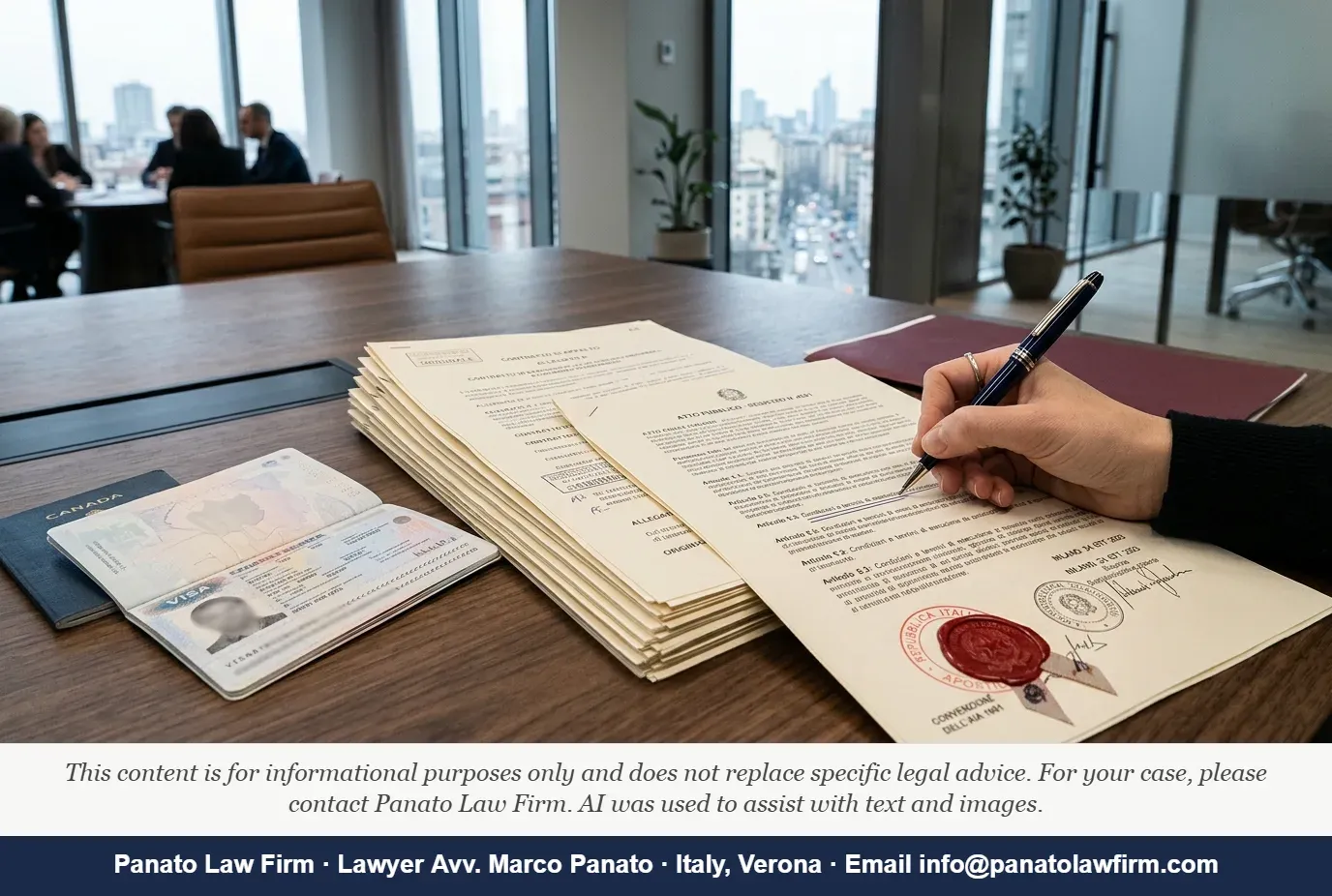
Image prompt: A sleek, minimal boardroom in a northern Italian city, shot from the far end of a long pale-oak table. Four empty leather chairs face floor-to-ceiling windows overlooking a terracotta roofline. On the table, a single open folder of Italian corporate documents with handwritten annotations in the margin. Cool morning light, slate-blue and cream tones. The mood is quiet urgency — a decision is overdue.
Image file: italy-spa-governance-reform-2026-uk-investor-cover
HREFLANG BLOCK:
JSON-LD:
LANGUAGE QA: cannot be contracted out of -> cannot be excluded by contract / is not waivable · a gap that must be resolved by shareholders' resolution -> a lacuna that must be remedied by shareholders' resolution · initiated or executed while the company is in a state of financial distress -> initiated or completed while the company is financially distressed · a matter of public order -> a matter of public policy · the prohibition is mandatory and cannot be contracted out of -> the prohibition is mandatory · interacts — awkwardly — with the new framework -> sits uneasily alongside the new framework · during a financial difficulty -> during a period of financial distress · A company that has never formally elected a model -> Any company that has never formally adopted a governance model
Quality: keyword not in the first 100 words · few concrete figures (1)
GATE: REVIEW — check AMBER; SEO 69; 2 quality issues
Source check: verdict AMBER — verify before publication
CHECK:
AUTHORITY 1: Legislative Decree 47 of 27 March 2026 / EXISTS? TO VERIFY — primary source confirmation requires live check at gazzettaufficiale.it; the topic brief asserts its existence and in-force date; not independently confirmed at a live primary database during drafting / CONTENT MATCHES? Matches the brief as provided / VERDICT: AMBER (not yet confirmed at a primary source independently of the brief; must be verified at gazzettaufficiale.it before publication).
AUTHORITY 2: Law 35 of 2025 (auditor liability cap) / EXISTS? TO VERIFY — cited in the brief as an existing instrument; not independently confirmed at a primary source during drafting / CONTENT MATCHES? Consistent with the brief description / VERDICT: AMBER (secondary only; verify at gazzettaufficiale.it).
AUTHORITY 3: Legislative Decree 14 of 12 January 2019 (Italian Code of Business Crisis and Insolvency) / EXISTS? YES — confirmed at normattiva.it and widely cited in primary and secondary sources / CONTENT MATCHES? Yes — correctly cited for crisis-period governance framework / VERDICT: GREEN.
AUTHORITY 4: Legislative Decree 58 of 24 February 1998 (TUF) / EXISTS? YES — confirmed at normattiva.it / CONTENT MATCHES? Yes — correctly cited as the consolidated finance act amended by Decree 47 / VERDICT: GREEN.
AUTHORITY 5: Legislative Decree 6 of 17 January 2003 / EXISTS? YES — confirmed widely, normattiva.it / CONTENT MATCHES? Yes — correctly cited as the 2003 reform baseline / VERDICT: GREEN.
OVERALL: AMBER — Decree 47/2
Do you need legal assistance or a free estimate?
Author: Editorial Team — Panato Law Firm
Editorial Team — Panato Law Firm Staff