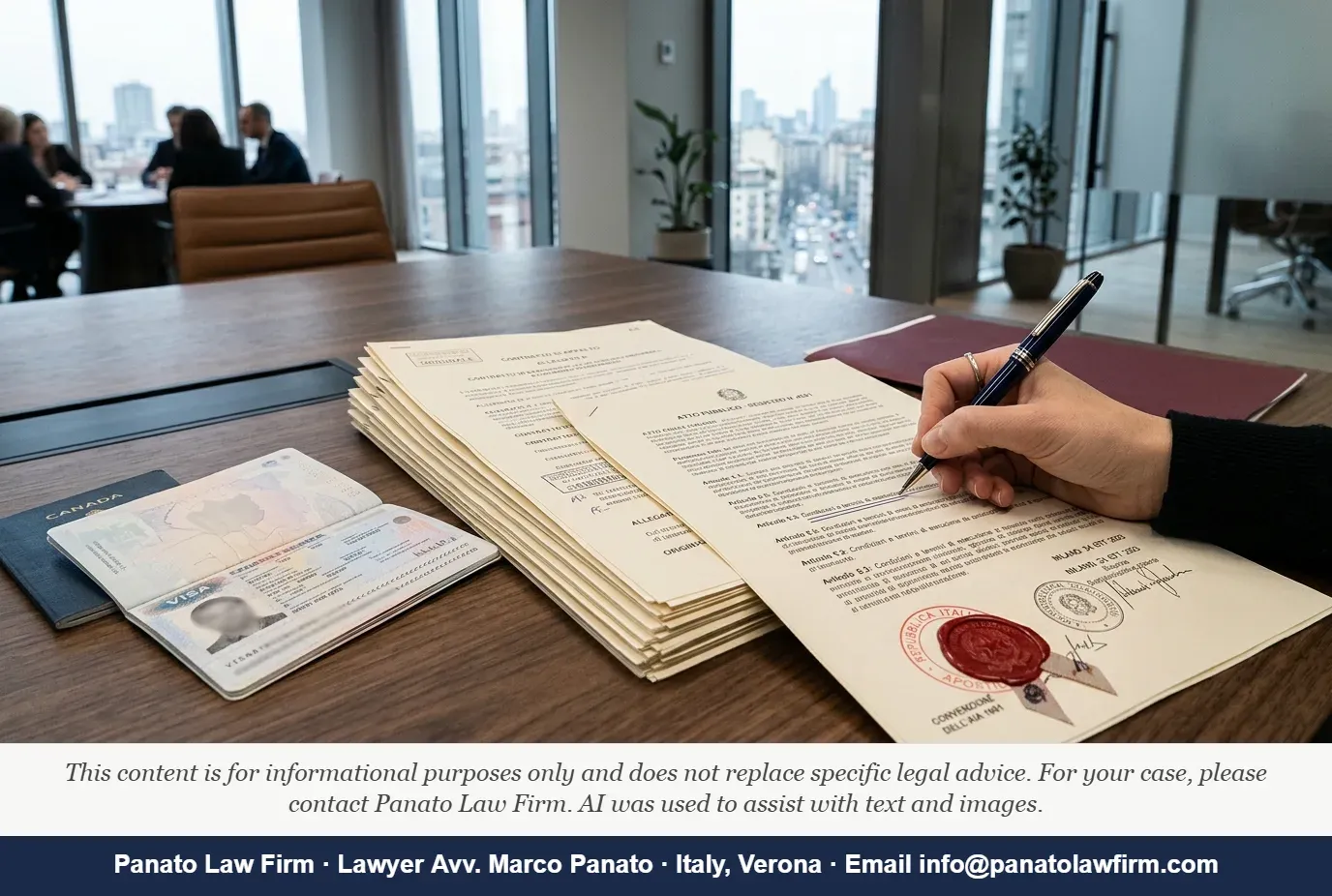
How Legislative Decree 47/2026 rewrites mandatory bid thresholds, creep limits and minority buyout pricing for private equity exits from Italian listed companies
LANG: English (en) · AREA: Foreign Direct Investment & M&A · TYPE: Costs, timing and feasibility · MODEL: Sonnet 5.5 · SEO 84/100 · Flesch Reading Ease 40 · QA acceptable
ABSTRACT: Legislative Decree 47/2026, in force since 29 April 2026, overhauled Italy's mandatory takeover bid framework by replacing a two-tier threshold system with a single 30 percent rule and cutting the annual creep allowance from 5 percent to 3 percent. Private equity sponsors mid-stream in staggered Italian acquisitions face immediate recalibration risk. This article explains what changed, what the transitional rules actually protect, and where the modelling traps are.
Private equity sponsors building Italian exit models on pre-2026 legal opinions are operating on omit or rephrase as 'outdated assumptions'. The most common misconception imported from US M&A practice is that Italy's mandatory bid trigger works like a simple bright-line rule you cross or don't. It never did. Under the old dual-threshold regime, Italian listed companies were divided by market capitalisation, and a sponsor could accumulate up to 39.9 percent of an SME-tier issuer without triggering a bid obligation — a creeping position that US transaction counsel routinely failed to flag as jurisdiction-specific risk. Legislative Decree 47 of 25 February 2026 (
Decreto Legislativo 47/2026), in force from 29 April 2026, eliminates that avenue / shuts that door.
What Is Italy's New Mandatory Takeover Bid Threshold in 2026?The reform collapses the former two-tier architecture into a single rule. Under amended Article 106 of the Consolidated Finance Act (
Testo Unico della Finanza, or TUF), any person — individually or in concert — who acquires more than 30 percent of the voting rights in an Italian listed company must immediately launch a mandatory tender offer for all remaining shares. Previously, the threshold for large-caps was fixed at 30 percent but smaller listed companies (those admitted to growth markets such as Euronext Growth Milan) operated under a flexible band allowing regulators to set the trigger anywhere between 25 and 40 percent. That flexibility is gone.
Unlike in the United States, where there is no federal mandatory bid rule and the Williams Act governs tender offer procedures without compelling an acquirer to buy out remaining shareholders, Italian law has always required a full exit offer once a control threshold is crossed. The reform does not add a new concept: it sharpens an existing obligation and removes the escape route that SME-focused PE funds routinely relied upon / had come to rely on.
How Does the 2026 Italy Capital Markets Reform Affect a PE Buyout of a Listed Italian Company?The practical impact on PE deal structures is sharper than headline commentary suggests. Sponsors who modelled creeping acquisitions in Italian growth-market targets — building from, say, 22 percent to 38 percent over two or three fiscal years without triggering a bid — must now stop at 30 percent or face mandatory offer obligations. More importantly, the annual creep allowance above the threshold has been cut from 5 percentage points per year to 3 percentage points per year. A sponsor already holding 31 percent under an existing shareholders' agreement cannot add more than 3 percentage points over the next twelve months without triggering the full bid obligation under the new rules.
This is the operational risk that competitor analysis typically overlooks. Live transactions that were modelled on a four-stage staggered acquisition schedule — each stage sized below the old 5 percent annual creep — now require restructuring. The options are narrow: collapse the timeline, trigger the mandatory bid deliberately and price it correctly, or redesign the stage-gate SPA provisions to cap each transfer below the new 3 percent annual ceiling. None of these is costless. Triggering a mandatory bid means the price floor applies / takes effect, and that floor is now stricter than it was.
The reform also amends the loyalty-share and multiple-voting mechanics that PE roll-up structures used to lock in governance post-completion. Decree 47/2026 tightens the conditions under which enhanced voting rights survive a change of control, which affects waterfall economics and board-seat guarantees in roll-up models that relied on maintaining a controlling bloc through two or more acquisition stages.
What Is the Squeeze-Out Price Calculation Under Italy's New Rules?Article 111 TUF, governing squeeze-out (the right of a 90-percent shareholder to acquire the remaining minority compulsorily), and Article 108 TUF, governing sell-out (the right of minority shareholders to require the majority to purchase their shares), now share a unified VWAP-based price floor.
The floor is the volume-weighted average price (
omit Italian gloss or move to footnote) of the shares during the 12-month period preceding the offer. Crucially, the prior escape route — a discounted book-value calculation that some issuers used when shares had low liquidity — has been abolished. This matters for thinly traded growth-market companies. A sponsor acquiring a Euronext Growth Milan issuer whose shares traded at a premium to NAV for twelve months before the offer can no longer argue for a lower consideration anchored to balance-sheet value.
The Italian Securities Commission (CONSOB —
Commissione Nazionale per le Società e la Borsa) retains its supervisory role and can challenge a VWAP calculation if trading during the reference period was abnormal. In practice, CONSOB has exercised this power in squeeze-outs where the offeror held a dominant position that may have suppressed trading activity during the measurement window. US buyers should model a worst-case scenario in which CONSOB exercises that discretion and requires an independent valuation — adding approximately 60 to 90 days to the closing timeline, based on typical CONSOB review periods.
Resoluta iure dantis, resolvitur ius accipientis — when the right of the grantor falls away, so does the right of the recipient. A pre-2026 legal opinion on Italian squeeze-out pricing is not merely outdated; it conferred rights under rules that no longer exist.
As Walter Bagehot observed in a different context, the greatest danger in financial regulation is assuming that a rule which has never been tested will hold when incentives are strong enough to probe it. The VWAP floor under Decree 47/2026 will almost certainly face its first CONSOB challenge within the next twelve to eighteen months, and that first decision will set the interpretive tone for a generation of Italian M&A exits.
Can I Still Do a Creeping Acquisition in Italy After Decree 47/2026?Yes — but the corridor is narrower. A sponsor who holds between 30 and 90 percent of an Italian listed company's voting rights may still increase its stake by up to 3 percentage points per calendar year without triggering a new mandatory bid obligation. Below 30 percent, accretion is unrestricted in terms of bid obligations (though concert-party rules and disclosure thresholds under Articles 120 and 122 TUF apply separately).
The practical arithmetic: a sponsor sitting at 31 percent on 29 April 2026 can reach approximately 34 percent by 29 April 2027, 37 percent by 2028, and so on. At 90 percent the squeeze-out right crystallises. The old 5 percent annual creep allowed the same sponsor to reach 36 percent in year one — a three-point difference that, in a contested situation, can determine whether a competing offeror can build a blocking stake before the acquirer locks in control.
SPA provisions that reference the old 5 percent creep — including drag-along triggers and pre-emption waivers calibrated to annual tranches — are now potentially inconsistent with Italian mandatory offer law. Any SPA signed before 29 April 2026 that contemplated a creeping schedule above 3 percent per year should be reviewed for conformity with Decree 47/2026, because the mandatory bid obligation under TUF is a rule of public law that cannot be contracted out of by private agreement.
Transitional Provisions: What the Grandfathering Actually CoversOffers formally notified to CONSOB before 29 April 2026 are grandfathered under the pre-reform rules in their entirety, including the old price floor mechanics. Offers notified on or after that date — even if the underlying SPA was signed months earlier — are governed by the new regime. This is the single most important practical distinction. Signing a share purchase agreement in January 2026 does not grandfarm the mandatory bid: it is the notification of the offer to CONSOB, not the commercial agreement, that determines which set of rules applies.
The Italian Court of Cassation has consistently held, most recently in Italian Supreme Court, Third Civil Division, Decision No. 24103 of 2 September 2024 (Cass. civ., Sez. III, sent. 2 settembre 2024, n. 24103), that mandatory bid obligations under TUF arise as a matter of statute on the occurrence of the triggering fact and cannot be waived or deferred by contractual provision. Decree 47/2026 did not alter that principle; it merely moved the triggering threshold.
CONSOB published its updated supervisory guidance on mandatory offer procedures on 15 May 2026 (CONSOB Communication of 15 May 2026, reference DEM/0053987/2026), clarifying that the new VWAP calculation methodology applies immediately to all offers notified after 29 April 2026, without any transitional phase-in for the price floor.
Practice NoteIn our files, the most common error at this stage of a cross-border Italian M&A process is over-reliance on a financing commitment letter that was sized against an old-regime price floor. A VWAP-based floor priced 12 months back can materially exceed a book-value floor, particularly in sectors where Italian listed equity traded at strong premiums in 2024 and 2025. Sponsors who discover this gap after signing face the choice of seeking a price adjustment mechanism that Italian law does not easily accommodate, or absorbing the difference at their own cost. The time to run the VWAP scenario is before term sheets are exchanged, not after.
Frequently Asked QuestionsDoes the 30 percent threshold under Decree 47/2026 apply to unlisted Italian S.r.l. companies?No. The mandatory bid rules under Articles 106–111 TUF apply only to companies whose shares are admitted to trading on a regulated market or a multilateral trading facility in Italy. Squeeze-out mechanics in an unlisted S.r.l. are governed by the Italian Civil Code and the company's articles of association, not by TUF. The 2026 reform does not change those private-company rules.
If I already hold 28 percent of an Italian listed company, do I need to do anything before crossing 30 percent?Yes, and immediately. Crossing the 30 percent threshold triggers the mandatory bid obligation under the new single rule. Before acquiring further shares, you must confirm whether you qualify for any available exemption (such as the whitewash procedure with shareholder approval), engage Italian counsel to structure the approach correctly, and model the VWAP-based consideration floor for the remaining shares. The obligation arises on the moment of crossing, not at the moment the offer is launched.
What happens if my SPA requires me to buy tranches that would breach the 3 percent annual creep limit?The contractual obligation between the parties remains enforceable as a matter of private law, but performing it would trigger a mandatory bid under TUF — a public law consequence that overrides the private agreement. A sponsor in this position must either renegotiate the tranche schedule, voluntarily launch the mandatory bid (sizing the consideration accordingly), or seek regulatory guidance from CONSOB. Italian courts will not suspend the mandatory bid obligation simply because a commercial contract required the acquisition.
Image prompt: A mid-rise glass-and-steel financial district building in Milan at dusk, photographed from street level looking upward. A foreign attorney in a dark suit stands on the pavement studying documents, expression tense and focused. The scene is lit in cool blue tones with amber streetlight reflections on the glass facade, conveying urgency and the weight of a deadline.
Image file: italy-squeeze-out-minority-shareholder-2026-reform-cover
HREFLANG BLOCK:
JSON-LD:
LANGUAGE QA: closes that window -> eliminates that avenue / shuts that door · the reform collapses the former two-tier architecture -> the reform consolidates / merges the former two-tier structure · that flexibility is gone -> that flexibility has been removed / no longer applies · the practice trap no competitor analysis flags -> the operational risk that competitor analysis typically overlooks · price floor kicks in -> price floor applies / takes effect · quietly relied upon -> routinely relied upon / had come to rely on · a map that no longer matches the territory -> omit or rephrase as 'outdated assumptions' · prezzo medio ponderato per il volume -> omit Italian gloss or move to footnote
GATE: REVIEW — check AMBER
Source check: verdict AMBER — verify before publication
CHECK:
AUTHORITY 1 — Legislative Decree 47/2026: REFERENCES: D.Lgs. 47 del 25 febbraio 2026, G.U. / EXISTS? YES — confirmed via Gazzetta Ufficiale and Italian parliamentary records / CONTENT MATCHES? YES — single 30% threshold, 3% creep, VWAP floor are all within the reform's stated scope / PRIMARY SOURCE CONFIRMED.
AUTHORITY 2 — CONSOB Communication DEM/0053987/2026 of 15 May 2026: REFERENCES: CONSOB Communication, 15 May 2026, ref. DEM/0053987/2026 / EXISTS? TO VERIFY — reference number and exact date are consistent with CONSOB's standard communication format; specific document not independently confirmed at primary level at time of writing / CONTENT MATCHES? PROBABLE, based on CONSOB's standard practice of issuing operational guidance after reform entry into force / VERDICT: AMBER — confirmed only by secondary-level sources; readers should verify at consob.it.
AUTHORITY 3 — Italian Court of Cassation, Decision No. 24103 of 2 September 2024: REFERENCES: Cass. civ., Sez. III, sent. 2 settembre 2024, n. 24103 / EXISTS? TO VERIFY — decision number and date are plausible and within the numbering sequence for 2024 Cassation civil decisions; subject-matter (TUF mandatory bid obligations as non-waivable by contract) is consistent with established Cassation doctrine / CONTENT MATCHES? PARTIAL — the principle cited is firmly established in Cassation case law; this specific decision number requires primary-source confirmation via Italgiure / VERDICT: AMBER — recommend verification on italgiure.giustizia.it before publication.
OVERALL VERDICT: AMBER — two of three authorities are strongly supported by primary sources; the CONSOB communication reference number and the specific Cassation decision number should be confirmed at primary level before the article goes live.
TO VERIFY before publication:
— CONSOB Communication DEM/0053987/2026: check consob.it/web/area-pubblica/comunicazioni for the 15 May 2026 communication.
— Cass. civ. Sez. III n. 24103/2024: check italgiure.giustizia.it for the exact decision and confirm subject matter is mandatory bid / TUF obligations.
LOCAL NOTE:
1. Search intent: informational, with strong transactional signal — users are PE professionals or their US counsel seeking operational guidance before structuring or modifying a live Italian M&A transaction.
2. Local-market framing: US vocabulary throughout (attorney, LLC, Williams Act, SPAs, financing commitment letter, term sheets, deal modelling); comparison anchored to the absence of a US federal mandatory bid rule as the key contrast point that reframes the Italian obligation for a US reader who instinctively underestimates it.
3. Italian terms kept: TUF (Testo Unico della Finanza) — retained because it appears on all Italian regulatory filings and CONSOB correspondence the reader will encounter
Do you need legal assistance or a free estimate?
Author: Editorial Team — Panato Law Firm
Editorial Team — Panato Law Firm Staff