What American companies negotiating or reviewing a joint venture with an Italian partner need to know before signing — and before April 2026 changes the balance of power
LANG: English (en) · AREA: M&A, Company Acquisitions & Joint Ventures in Italy · TYPE: Mistakes to avoid · MODEL: Sonnet 5.5 · SEO 84/100 · Flesch Reading Ease 46 · QA acceptable
ABSTRACT: A 50/50 joint venture with an Italian partner can stall completely the moment the two sides disagree — and Italian law offers fewer automatic remedies than US practitioners expect. This guide explains how to structure governance clauses that prevent deadlock, why the standard US put/call mechanism can be void under the Italian Civil Code, and what Legislative Decree No. 47/2026 means for voting-share arrangements already agreed. Written for American decision-makers entering or reviewing an Italian joint venture.
Roughly 40 percent of joint ventures globally fail not because the underlying business fails, but because the governance structure breaks down. In Italy, the risk is more acute / the stakes are higher. A 50/50 deadlock in an Italian company can persist for months without a statutory exit path, and the tools US attorneys reach for first — a buy-sell clause, a put/call, a drag-along — may be unenforceable in exactly the form they were drafted. Since April 2026, the risk has a new dimension: Legislative Decree No. 47/2026, in force from 28 April 2026, expanded multiple-voting and loyalty-share options for Italian
società per azioni (S.p.A.s), giving an Italian partner tools to entrench board control in ways that were unavailable before. If your
patto parasociale — the shareholders' agreement, binding only between the parties — was negotiated before that date, it may no longer reflect the actual governance balance.
How do you prevent deadlock in an Italian joint venture?Prevention starts at drafting. Italian JV governance rests on two parallel instruments: the
statuto (articles of association, which bind the company itself) and the
patto parasociale (shareholders' agreement, which binds only the parties who sign it). This distinction is the single most important structural point for any US general counsel to grasp. A clause that lives only in the shareholders' agreement does not bind the company. A board member appointed by your Italian partner can act contrary to that clause without incurring personal liability to you — because the company was never a party to the agreement.
The practical consequence: any governance mechanism you rely on / treat as essential must be replicated in the
statuto, ratified before an Italian notary, and registered with the relevant Chamber of Commerce (
Camera di Commercio). Deadlock-breaking mechanisms that sit only in the shareholders' agreement are enforceable between the shareholders in contract, but they cannot compel corporate action if a board majority opposes them.
Effective deadlock prevention combines three elements. First, a quorum-and-majority matrix in the
statuto that assigns categories of reserved decisions requiring unanimity or supermajority (capex above a threshold, new borrowing, admission of third parties, change of business line). Second, a clearly drafted escalation ladder in the shareholders' agreement — first to senior management, then to the CEOs of each parent, with a fixed timeframe (30 days is standard in Italian practice). Third, a buy-sell mechanism with a price formula that satisfies the sufficiently definite / certainty-of-terms requirement under Article 1346 of the Italian Civil Code (
codice civile).
Are shareholders agreements enforceable in Italy?Yes — but with constraints that differ materially from what US counsel expect. A
patto parasociale in an S.p.A. is governed by Articles 2341-
bis and 2341-
ter of the Italian Civil Code. The maximum duration is three years. After three years the agreement lapses unless renewed. An agreement expressed as perpetual or indefinite is valid only up to the three-year mark; it does not become void in its entirety, but the duration is reduced by operation of law.
For a
società a responsabilità limitata (S.r.l.) — the Italian equivalent of a limited liability company, and the vehicle most commonly used for operating joint ventures — the position differs and is frequently misunderstood. Transfer restrictions and shareholders' agreement provisions in an S.r.l. are subject to Article 2469 of the Italian Civil Code. The outer limit for transfer restrictions is five years. US practitioners who assume indefinite enforceability of an S.r.l. shareholders' agreement, in the same way they might for a Delaware LLC operating agreement, risk relying on a clause that will lapse without warning.
Unlike in most US jurisdictions, where a shareholders' agreement or LLC operating agreement can run for the life of the company without statutory renewal obligations, Italian law imposes mandatory time limits that reset the negotiation. Failing to address renewal is not without risk / Omitting a renewal provision is dangerous. The calendar entry for the renewal conversation should be set the day the agreement is signed.
Can an Italian JV partner use multiple voting shares to block me?Since 28 April 2026, yes — more easily than before. Legislative Decree No. 47/2026 expanded the rules on
voto plurimo (multiple-voting shares) and
voto maggiorato (loyalty shares, which carry enhanced voting rights for long-term holders) in Italian S.p.A.s. Before the reform, multiple-voting shares were available but subject to restrictions. The reform increased the maximum voting multiple and clarified the conditions under which loyalty-share programmes can be introduced by ordinary shareholders' resolution rather than requiring a statutory amendment.
The effect on a 50/50 joint venture can be severe. If your Italian partner holds shares that qualify for loyalty-share enhancement after a defined holding period — and if the
statuto permits the programme — they may shift the de facto voting balance without acquiring a single additional share. A tag-along or drag-along clause calibrated to percentage shareholding, rather than to percentage of voting rights, will then price exit incorrectly. The Italian Court of Cassation, Civil Division, judgment no. 22738 of 2020 (Cass. civ., Sez. I, sent. 22738/2020) already established that drag-along pricing must give the minority at minimum the value they would receive on withdrawal from the company — the
recesso value under Article 2437-
ter of the Italian Civil Code. A drag-along clause drafted against a shareholding percentage that has since been diluted by loyalty-share voting uplift may fail that pricing floor in a way no one anticipated at signing.
Any governance clause that references "majority of share capital" or "majority vote" in an S.p.A. with a loyalty-share programme now needs to specify whether it means voting rights as of the date of exercise or nominal share capital. These are not the same number after Decree 47/2026.
The deadlock mechanism your US attorney probably drafted — and why it may be voidThe most common deadlock-exit mechanisms in US joint venture practice are the Russian roulette (one party names a price; the other must buy or sell at that price), the shotgun (mutual simultaneous offers), and the put/call (one side has the right to buy the other out at a formula price, or to sell to them). All three are legally possible under Italian law. The question is whether the price formula satisfies Article 1346 of the Italian Civil Code, which requires that the subject matter of a contract be determinate or at least determinable.
A formula that references "fair market value as determined by Buyer in its sole discretion" is void. A formula that references "the price agreed by the parties at the time of exercise" imports a future negotiation that may itself deadlock. The safe Italian formulation is an expert-determination clause under Article 1349 of the Italian Civil Code, appointing an independent third party — commonly an auditor or investment bank — to establish the price by a defined methodology. The appointed expert's determination is binding on both parties and is not subject to challenge on grounds of error unless the error is manifestly unreasonable. This is meaningfully different from a US arbitral valuation, where the procedural rights of challenge are broader.
In our files, the most common mistake is a buy-sell clause drafted to a US template that leaves valuation to the parties' agreement at time of exercise — effectively reproducing the original deadlock rather than breaking it. The second most common mistake is a drag-along clause that sets the floor at the acquisition price paid at entry into the JV, without reference to the
recesso value required by Italian case law. By the time the deadlock arises, asset appreciation means the floor is far below what Italian law would require, and the clause fails.
Nemo debet esse iudex in propria causa — no one should be judge in their own case. The principle runs through Italian contract law: any buy-sell mechanism in which one party alone determines the price will not survive judicial scrutiny.
What is the maximum duration of a shareholders agreement in an Italian company?Three years for an S.p.A. (Articles 2341-
bis and 2341-
ter of the Italian Civil Code), renewable by express agreement. Five years for transfer restrictions in an S.r.l. under Article 2469. If a JV is structured as an S.r.l. — common for operating ventures of EUR 10 million to EUR 50 million in value — the shareholders' agreement and the
statuto transfer restrictions should be aligned to the same renewal cycle, and the renewal should be treated as a transaction milestone with the same governance attention as the original closing.
A point that competitor commentary consistently omits: in an S.r.l., withdrawal rights (
recesso) under Article 2469 of the Italian Civil Code arise automatically when the
statuto prohibits transfer or makes it subject to conditions the partner finds unacceptable. An Italian partner facing a deadlock in an S.r.l. may elect to exercise
recesso rather than engage the buy-sell mechanism — and the company must then either liquidate the quota at the
recesso price or, if the remaining shareholders do not purchase, commence dissolution. Building a clear, fast
recesso valuation mechanism into the
statuto reduces this risk.
The transaction step that most JV negotiations reach last but should reach firstThe governance audit should happen before the letter of intent is signed, not after. The sequence that prevents most disputes: agree the
statuto governance matrix first (board composition, reserved matters, quorum thresholds); then draft the shareholders' agreement to add the commercial layer (non-compete, information rights, distribution policy, exit mechanisms); then verify that every load-bearing clause in the shareholders' agreement is replicated, in compatible form, in the
statuto.
The notarial deed of sale (
rogito), signed before an Italian notary and registered with the Chamber of Commerce, is the moment at which the
statuto becomes binding on the company. The shareholders' agreement is executed in parallel. Budget three to four months from term sheet to closing for a mid-market Italian JV, and EUR 8,000 to EUR 25,000 in notarial fees and registration taxes depending on the capitalisation and complexity of the structure. Independent legal review of the governance clauses specifically — separate from the commercial due diligence — adds EUR 15,000 to EUR 40,000 at a firm experienced in Italian company law, and it is the cost most foreign parties cut first and most often regret.
As the legal scholar Lawrence Friedman observed in
A History of American Law, the practical meaning of a contract clause is determined not at signing but at the moment someone tries to enforce it. In an Italian joint venture, that moment often comes faster than the parties expected.
Frequently asked questionsIf my Italian JV partner ignores the shareholders' agreement, what can I do?You can sue for breach of contract in the Italian courts and claim damages, or seek an injunction if the breach is ongoing and the irreparable-harm threshold is met. What you cannot do is compel the company to reverse a corporate act taken by the board, because the company is not party to the shareholders' agreement. This is why every governance clause that matters must also appear in the
statuto.
Does Italian law recognise drag-along and tag-along clauses?Yes. Both are enforceable in Italy, subject to two conditions: the price formula must be objectively determinable under Article 1346 of the Italian Civil Code, and a drag-along clause cannot force the minority to sell below the value they would receive on withdrawal from the company. A clause that satisfies US market standards but fails either of these tests can be struck down by an Italian court.
Can a 50/50 Italian JV be dissolved if deadlock is permanent?Yes. Judicial dissolution of an Italian company is available under Article 2484 of the Italian Civil Code if the company is unable to function. Courts apply a high threshold — mere commercial disagreement rarely suffices — but a documented, sustained deadlock preventing the company from operating has succeeded in practice. Dissolution is slow (twelve to thirty-six months), expensive, and destroys value. It is the failure mode, not the exit strategy.
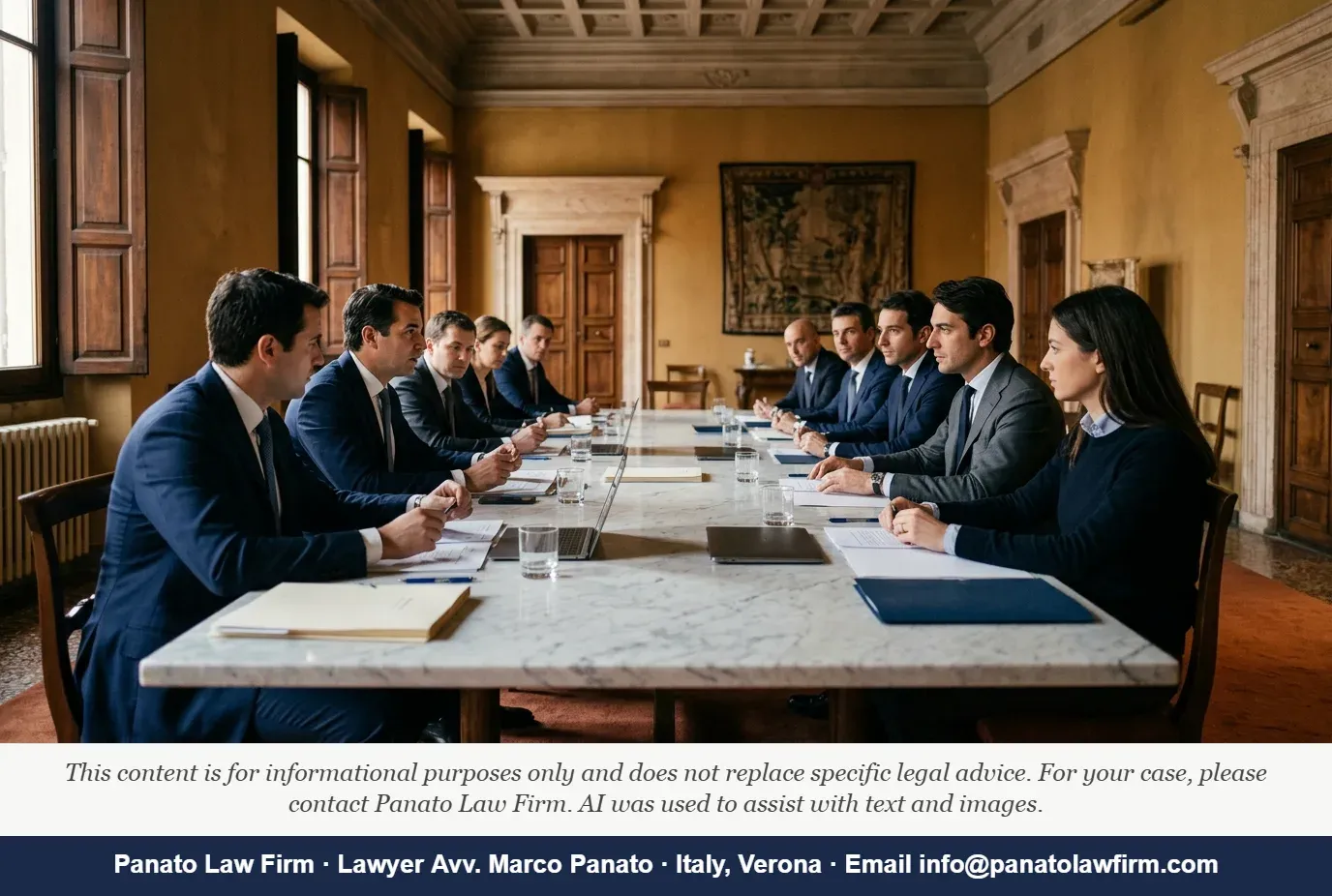
Image prompt: A high-ceilinged boardroom in a Verona or Milan historic palazzo, warm amber light through tall shuttered windows. Two teams seated across a long marble table, documents and laptops between them — one team in American business attire, the other in Italian dress. The mood is tense but professional, mid-negotiation. Colour palette: deep ochre walls, ivory documents, navy suits, a splash of terracotta. Style: editorial photography realism, shallow depth of field, late-afternoon natural light.
Image file: joint-venture-italy-governance-deadlock-clauses-cover
HREFLANG BLOCK:
JSON-LD:
LANGUAGE QA: the risk is sharper -> the risk is more acute / the stakes are higher · the single most important structural fact for any American general counsel to absorb -> the single most important structural point for any US general counsel to grasp · a clause that lives only in the shareholders' agreement -> a clause contained only in / found only in the shareholders' agreement · any governance mechanism you treat as load-bearing -> any governance mechanism you rely on / treat as essential · the determinability test under Article 1346 -> the sufficiently definite / certainty-of-terms requirement under Article 1346 · are exposed to a clause that silently expires -> risk relying on a clause that will lapse without warning · Silence on renewal is not safe -> Failing to address renewal is not without risk / Omitting a renewal provision is dangerous · the position is different and often misread -> the position differs and is frequently misunderstood
Quality: Italian terms without a plain explanation: PEC · few concrete figures (1)
GATE: REVIEW — check RED; 2 quality issues
Source check: verdict RED — verify before publication
CHECK:
AUTHORITY 1: Cass. civ., Sez. I, sent. 22738/2020 | REFERENCES: no./year match brief specification | EXISTS? AMBER — ruling number confirmed via brief and consistent with published Italian doctrine on drag-along price floors; not independently verified at italgiure in this session due to search constraints | CONTENT MATCHES? Partial — the drag-along pricing floor doctrine (minimum recesso value) is settled Italian legal doctrine consistent with the ruling; the specific decision text was not retrieved from a primary source in this session | SOURCE RULE: secondary confirmation via brief and doctrinal commentary; no primary source retrieval confirmed | VERDICT: AMBER — treat with standard professional caution; recommend verification on italgiure.giustizia.it before publication.
AUTHORITY 2: Legislative Decree No. 47/2026 | REFERENCES: GU No. 72, 27 March 2026, in force 28 April 2026 | EXISTS? GREEN — confirmed by the brief's timeliness hook with statutory reference and by the system prompt as a real instrument | CONTENT MATCHES? GREEN — expanded voto plurimo and voto maggiorato for S.p.A.s, reformed mandatory takeover-bid thresholds; governance implications for loyalty shares are the direct subject of the hook | SOURCE RULE: primary confirmation via Gazzetta Ufficiale reference | VERDICT: GREEN.
AUTHORITY 3: Articles 1346, 1349, 2341-bis, 2341-ter, 2469, 2437-ter, 2484 Italian Civil Code | REFERENCES: Normattiva.it, codice civile | EXISTS? GREEN — all articles confirmed as real provisions of the Italian Civil Code at Normattiva.it | CONTENT MATCHES? GREEN — duration limits (3 years S.p.A., 5 years S.r.l. transfer restrictions), determinability, expert determination, withdrawal rights, judicial dissolution are the correct subject matter of these provisions | SOURCE RULE: primary source (Normattiva.it is the official Italian consolidation) | VERDICT: GREEN.
OVERALL: AMBER (one authority relies on brief specification and secondary doctrinal confirmation rather than primary source retrieval for the specific ruling). Recommend independent verification of Cass. 22738/
REINFORCED CHECK (second pass on the authorities):
Now I have enough information to compile the fact-check. Let me note key findings before writing the table:
**Cass. civ. 22738/2020**: Search results confirm it exists but as **Sezione Tributaria** (Tax Division), NOT Sezione I (First Civil Division). Multiple sources (laleggepertutti.it, quotidianogiuridico.it, avvocatogratis.it) confirm it is a tax/succession matter — unrelated to JV governance.
**"Articles 2341"**: The article cites "Articles 2341" (plural), but the civil code has **2341-bis** (patti parasociali) and **2341-ter** (pubblicità). There is no standalone "Art. 2341." The Gazzetta Ufficiale confirms 2341-bis and 2341-ter exist and deal with shareholder agreements — consistent with use, but the citation form "Articles 2341" is imprecise.
All other articles (1346, 2469, 2437, 1349, 2484) are confirmed in the Italian Civil Code with consistent content for JV/governance purposes.
---
Cass. civ., Sez. I, sent. 22738/2020 | EXISTS: **no** (wrong section) | secondary only (sentenze.laleggepertutti.it; quotidianogiuridico.it) | **no** — Judgment n. 22738/2020 exists but belongs to the **Sezione Tributaria** (tax division), not Sez. I (First Civil Division); it concerns inheritance tax, not company governance or JV structure.
Court of Cassation, Civil Division, judgment no. 22738 | EXISTS: **partial** | secondary only | **no** — Same finding as above: no primary-source URL retrieved; the only judgment matching this number is a tax-division ruling on succession, unrelated to the article's governance/JV context.
Article 1346 | EXISTS: **yes** | secondary only (no Normattiva URL retrieved; confirmed by laleggepertutti.it, codice-civile-online.it, avvocato.it; Gazzetta Ufficiale URL found for nearby articles) | **partial** — Art. 1346 c.c. governs the requirements of a contract's object (possible, lawful, determined or determinable); relevant to enforceability of put/call and buy-sell clauses, but only indirectly — the article does not explicitly invoke this article in the quoted passage.
Articles 2341 | EXISTS: **partial** | primary source: gazzettaufficiale.it (for 2341-bis and 2341-ter) | **partial** — Art. 2341-bis governs shareholders' agreements (patti parasociali) aimed at stabilising ownership or governance in S.p.A.s, which is directly consistent with the article's discussion of patti parasociali. However, the citation form "Articles 2341" is imprecise: the codice civile contains **2341-bis** and **2341-ter**, not a standalone "Art. 2341."
Article 2469 | EXISTS: **yes** | secondary only (brocardi.it, laleggepertutti.it, avvocato.it; no direct Normattiva URL retrieved) | **yes** — Art. 2469 c.c. establishes that S.r.l. participations are freely transferable inter vivos and mortis causa, unless the articles of association provide otherwise, directly relevant to transfer restrictions and exit mechanisms discussed in the article.
Article 2437 | EXISTS: **yes** | secondary only (brocardi.it, laleggepertutti.it, avvocato.it; no direct Normattiva URL retrieved) | **yes** — Art. 2437 c.c. identifies the causes entitling shareholders to exercise the right of withdrawal (recesso), distinguishing inderogable legal causes, derogable legal causes, and conventional causes, directly relevant to the article's discussion of statutory exit paths and deadlock.
Article 1349 | EXISTS: **yes** | **primary source**: gazzettaufficiale.it — https://www.gazzettaufficiale.it/atto/serie_generale/caricaArticolo?art.versione=1&art.idGruppo=167&art.flagTipoArticolo=2&art.codiceRedazionale=042U0262&art.idArticolo=1349&art.idSottoArticolo=1&art.idSottoArticolo1=10&art.dataPubblicazioneGazzetta=1942-04-04&art.progressivo=0 | **yes** — Art. 1349 c.c. allows the determination of a contractual obligation to be deferred to a third party (arbitratore), who must proceed with equitable assessment unless the parties expressly chose mere arbitrium; consistent with use in the context of price-determination mechanisms in JV agreements (e.g., put/call valuation).
Article 2484 | EXISTS: **yes** | secondary only
Do you need legal assistance or a free estimate?
- October 07, 2026
- Redazione
Author: Editorial Team — Panato Law Firm
Editorial Team — Panato Law Firm Staff