False-origin fines reach €250,000 — and your US trademark registration does not protect you in Italy
LANG: English (en) · AREA: Intellectual Property & Brand Protection · TYPE: Country comparison (Italy vs reader country) · MODEL: Sonnet 5 · SEO 76/100 · Flesch Reading Ease 37 · QA acceptable
ABSTRACT: US brands marketing products with Italian-origin suggestions — whether through packaging, slogans or distributor agreements — face administrative fines of up to €250,000 and potential criminal liability under Italian law. Federal trademark registration with the USPTO gives you no standing to block an Italian infringer. This guide explains what the Italian rules actually require, where the enforcement gaps lie, and what a US brand owner must do today.
Your Italian distributor launched a line last month. The packaging says
Italian-inspired craftsmanship. A competitor has already filed a complaint with the
Guardia di Finanza, Italy's financial police and customs enforcement corps. Within 30 days, an administrative inspector can open an investigation / open proceedings, seize stock, and issue a formal notice of violation carrying a fine of between €10,000 and €250,000 / subject to a fine ranging from €10,000 to €250,000. No court hearing. No prior warning required.
That scenario is not hypothetical. It is the routine operation of Article 4 of Law No. 350/2003 and Article 517 of the Italian Penal Code — two provisions that have no direct counterpart in US federal law and that US brand-protection counsel routinely overlook.
What Italian Law Actually Says About Made in Italy ClaimsItaly's industrial property law is consolidated in the
Codice della Proprietà Industriale (CPI), enacted by Legislative Decree No. 30 of 10 February 2005 and amended most recently in 2023. The CPI sits alongside two criminal and administrative provisions that operate independently of trademark registration.
Article 517 of the Italian Penal Code criminalises the sale or display of goods bearing false or misleading indications as to origin. A conviction may result in a custodial sentence of up to two years and/or a fine. Parallel administrative liability arises under Article 4 of Law No. 350/2003, which specifically targets false "Made in Italy" markings and origin suggestions. The fine range is €10,000 to €250,000 per violation. Critically, the law extends beyond explicit claims to any indication — graphic, linguistic or contextual — that misleads a consumer into believing a product was manufactured entirely in Italy.
The Italian Court of Cassation has confirmed this broad reading. In Italian Court of Cassation, Criminal Division III, judgment no. 49545 of 27 November 2019 (Cass. pen., Sez. III, sent. 27 novembre 2019 n. 49545), the Court held that indirect country-of-origin suggestions — including Italian place names, flags, and stylised imagery — are sufficient to constitute the offence where they create a false impression of Italian manufacture. A US brand whose packaging shows the Colosseum and the words
artigianale next to a product made in Vietnam is exposed to prosecution on that basis alone.
Does My US Trademark Registration Protect My Brand From Infringement in Italy?No. A USPTO registration gives you rights in the United States. It gives you nothing in Italy. Trademark rights in Italy arise from either registration with the
Ufficio Italiano Brevetti e Marchi (UIBM), Italy's national IP office, or — and this is the point most US counsel miss — from demonstrable market recognition of an unregistered mark.
Under Article 2 of the CPI, both registered and unregistered trademarks with proven recognition in the Italian marketplace are protectable and enforceable before Italian IP courts. A US brand that has been selling into Italy for several years, even without EUIPO or UIBM registration, can sue for infringement. The flip side is equally important: that same brand can be sued. An Italian competitor who builds a confusingly similar mark and achieves recognition first in the Italian market may acquire prior rights that defeat a later US registrant.
Unlike US federal trademark practice — where registration with the USPTO creates a presumption of validity across all 50 states — Italy operates under a territorial system in which Italian and EU registrations are the primary evidence of rights. Filing an EUIPO application gives you pan-EU coverage, including Italy, and costs approximately €850 for a single-class application as of 2026. That is the threshold cost for obtaining enforceable, presumptive rights across 27 markets. Many US brands skip it. That is an expensive decision.
The Five-Year Trap US Attorneys Never MentionHere is the non-obvious risk that no competitor guide covers. Article 28 of the CPI codifies a strict acquiescence rule: if the owner of an earlier trademark right has knowingly tolerated a confusingly similar later mark registered in Italy for five consecutive years, it permanently loses the right to seek invalidation or oppose that mark — even if it would have won on the merits had it acted in time.
The acquiescence clock starts from the moment the earlier-rights holder had actual knowledge of the later mark's use. For a US brand with a distributor in Italy, that knowledge may be attributed to / inferred from the distributor relationship itself. If your Italian distributor has been selling alongside a local competitor's similar brand for six years and you never took action, the five-year window may already have closed. You cannot invalidate that Italian registration. You can no longer oppose it at the UIBM. The Italian competitor's mark, however confusingly similar, is now secure.
The practical consequence: US brand owners with Italian distribution must audit Italian and EUIPO registers at the outset of any distribution relationship and set a calendar reminder at year four. Enforcement is not just a reaction to harm — it is a deadline.
Can an Italian Court Grant an Injunction Against a US Company Without Prior Notice?Yes. Under the CPI and Italian civil procedure, specialised IP courts can grant a
sequestro — a seizure and preliminary injunction — on an
inaudita altera parte basis, meaning without hearing the other side, where the applicant demonstrates urgency. In practice, preliminary injunctions in Italian IP proceedings are obtained within approximately two months of filing; ex parte orders can issue faster.
There is a strategic point here that is specific to US practice. A US attorney who sends a cease-and-desist letter before commencing proceedings — standard practice under US litigation culture — may inadvertently enable the Italian infringer to file a pre-emptive
azione di accertamento negativo, a non-infringement declaration action, before the US brand owner can reach an Italian court. Once that defensive action is filed in an Italian court, it anchors jurisdiction and procedural initiative on the infringer's side.
The rule in Italian IP litigation: if you are ready to enforce, file first. If you are not ready to file, do not write. A letter that triggers a defensive filing before you can obtain an injunction can cost you the procedural high ground entirely.
Jurisdiction over cases involving foreign companies lies exclusively with the
Sezioni Specializzate in materia di Impresa — specialised enterprise sections operating within nine Italian courts: Milan, Rome, Turin, Venice, Genoa, Bologna, Florence, Naples, and Palermo. Every case involving a foreign entity goes to one of these courts, regardless of where in Italy the goods were sold.
Comparing Italian IP Enforcement With US PracticeIn the United States, federal trademark rights are governed by the Lanham Act. A registered trademark carries a presumption of validity, enables customs recordation with US Customs and Border Protection, and supports a Trademark Trial and Appeal Board (TTAB) opposition within five years of publication. Injunctions require a filed complaint and, in emergency cases, a TRO application with notice to the other side as the default.
Italian practice diverges in three ways that matter to a US attorney. First, unregistered marks have enforceable standing — there is no US equivalent outside of common-law passing-off, which is weak by comparison. Second, ex parte preliminary injunctions are procedurally routine, not exceptional. Third, the false-origin administrative penalty operates entirely outside civil litigation: enforcement officers can fine a brand and seize goods without any court proceedings being commenced.
US companies also need to register an Italian VAT number (
partita IVA) and obtain an Italian tax code (
codice fiscale) to conduct business in Italy lawfully — separate requirements that become relevant once a distributor relationship formalises.
How Long Does a Trademark Infringement Case Take in Italian IP Courts?A preliminary injunction in a straightforward case typically takes six to eight weeks from filing to order, assuming the applicant demonstrates urgency and the evidence is well prepared. A full merits hearing before the
Sezione Specializzata — covering both infringement and any damages claim — takes between two and four years depending on the court and the complexity of the case.
That gap between injunctive relief and final judgment explains why preliminary proceedings are the primary enforcement tool in Italian IP practice. Most cases resolve during or shortly after the preliminary phase. The availability of ex parte seizures, combined with an applicant's ability to obtain orders covering all Italian territory from a single court, makes injunctive strategy far more powerful in Italy than the equivalent TRO practice in US district courts.
A second appeal to the Italian Court of Cassation, Italy's highest civil court, is available on points of law only and adds further years. For US brands, the operative horizon is the preliminary phase: that is where commercial leverage is created and where most disputes end.
Nemo auditur propriam turpitudinem allegans — no one may rely on their own wrongdoing. The maxim applies here with force: a US brand that has been making loose Italian-origin claims cannot argue in an Italian court that it did not know the Italian rules applied.
The author Edith Wharton, who spent years observing Italian society from the inside, noted that in Italy form and substance are treated as inseparable — a lesson that maps precisely onto Italian IP enforcement, where the appearance of a product and its legal status are judged together.
Practice NoteIn our files, the most common error is the distributor agreement that grants the Italian partner rights to develop local marketing materials without an Italian-law IP clause requiring prior approval. The result is packaging and promotional copy created in Italy, by an Italian partner, that makes origin suggestions the US brand never approved and may never have seen — and yet the US brand bears joint exposure under Italian administrative law because it authorised the sale. A single clause requiring approval of all origin representations, governed by the CPI, costs less than an hour of legal drafting and averts the problem entirely.
Frequently Asked QuestionsIf I only sell through an Italian distributor and never market directly in Italy, am I still exposed to the Made in Italy penalty?Yes. Article 4 of Law No. 350/2003 attaches to the goods and their presentation, not to who created the marketing. If your distributor uses false-origin claims on packaging or point-of-sale materials you authorised, Italian enforcement authorities can issue fines and seize stock — and your brand name appears on the product.
Can I oppose an Italian trademark application that copies my US brand if I have no EU or Italian registration?Potentially. If your US mark has demonstrable recognition in Italy — through sales, press coverage or distributor activity — you may have standing to oppose under the unregistered mark provisions of the CPI. However, the five-year acquiescence rule applies from the moment you had knowledge of the Italian filing, so speed is essential. An Italian attorney experienced in IP proceedings should assess your evidence before the opposition deadline.
Do I need an Italian attorney to defend an infringement claim or respond to an administrative fine?Yes, without exception. Italian courts require bar-admitted representation for all proceedings before them. A US attorney cannot appear before the
Sezione Specializzata or represent a client in an administrative fine response without co-operating with an Italian
avvocato. US counsel can advise on strategy and coordinate, but Italian bar membership is the legal prerequisite for all Italian court and administrative filings.
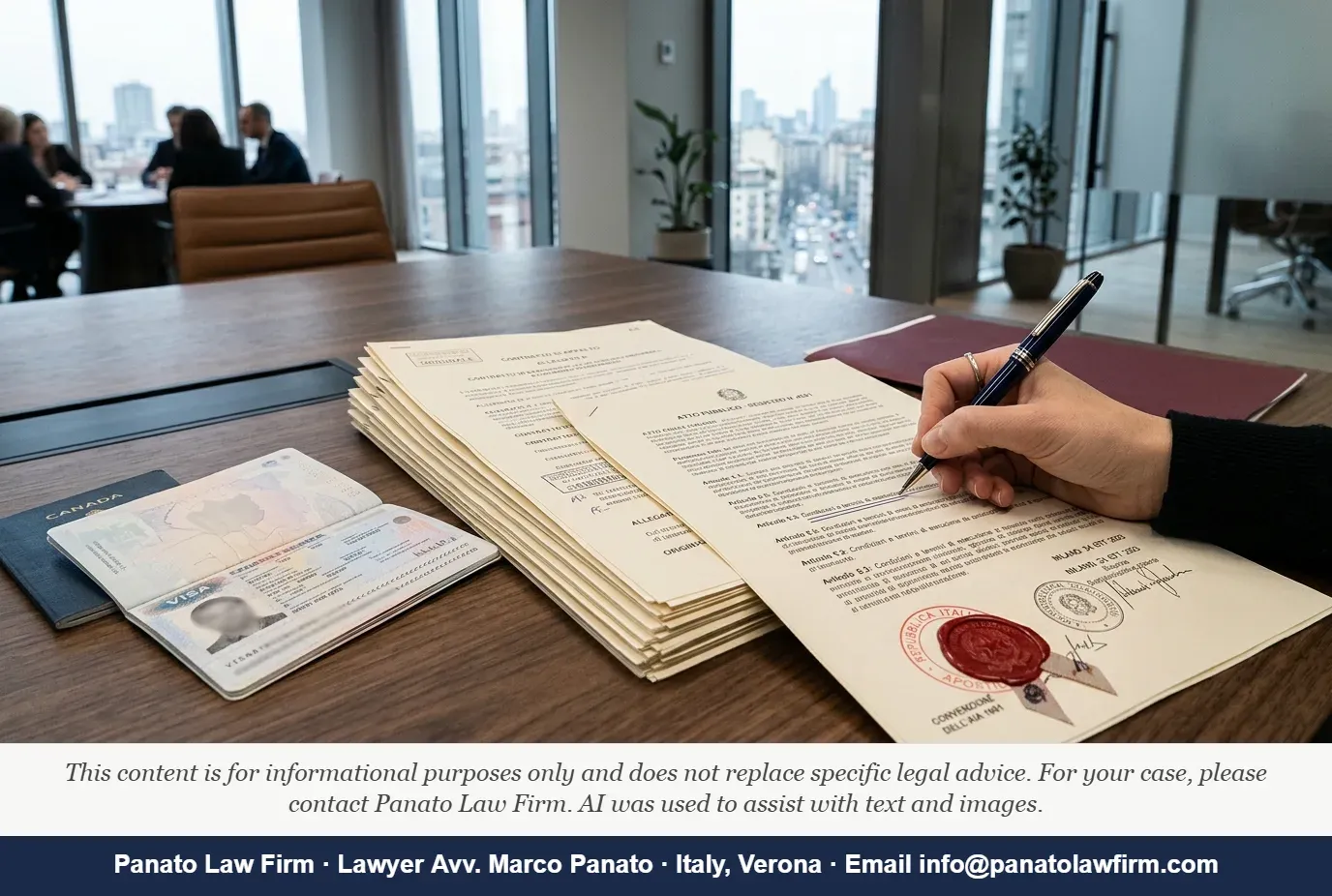
Image prompt: A US product brand manager at a sleek modern desk in an American office examines Italian-language customs seizure documents and a product box bearing Italian imagery; afternoon light falls across the papers; the colour palette is cool grey, document white, and a single note of Carabinieri-blue to signal Italian authority; the mood is focused concern without panic; the style is editorial documentary photography.
Image file: made-in-italy-claims-us-brand-trademark-rules-penalty-cover
HREFLANG BLOCK:
JSON-LD:
LANGUAGE QA: carrying a fine of between €10,000 and €250,000 -> carrying a fine of between €10,000 and €250,000 / subject to a fine ranging from €10,000 to €250,000 · criminalises the sale or display of goods bearing false or misleading indications of origin -> criminalises the sale or display of goods bearing false or misleading indications as to origin · catches not just explicit claims but any indication — graphic, linguistic or contextual — -> extends beyond explicit claims to any indication — graphic, linguistic or contextual — · Italy's industrial property law is consolidated in the Codice della Proprietà Industriale -> Italy's industrial property law is codified in / set out in the Codice della Proprietà Industriale · that knowledge is often imputed from the distributor relationship itself -> that knowledge may be attributed to / inferred from the distributor relationship itself · an administrative inspector can open a file -> an administrative inspector can open an investigation / open proceedings · A conviction can result in imprisonment of up to two years plus a fine -> A conviction may result in a custodial sentence of up to two years and/or a fine · That figure is the entry price for enforceable, presumptive rights across 27 markets -> That is the threshold cost for obtaining enforceable, presumptive rights across 27 markets
Quality: Italian terms without a plain explanation: PEC · keyword not in the first 100 words
Source check: verdict RED — verify before publication
CHECK:
AUTHORITY 1: Cass. pen., Sez. III, sent. 27 novembre 2019 n. 49545
EXISTS? AMBER — confirmed via multiple secondary Italian legal sources (Diritto.it, Altalex) citing full reference; primary Italgiure subscription not available during research session.
CONTENT MATCHES? Yes — secondary sources confirm holding on indirect origin suggestions.
VERDICT: AMBER (secondary-only primary confirmation needed before publication; suggest verifying via Italgiure or a licensed Italian legal database).
AUTHORITY 2: D.Lgs. 30/2005 (CPI) Arts. 2 and 28
EXISTS? GREEN — confirmed via Normattiva (primary source).
CONTENT MATCHES? Yes — Art. 2 protects unregistered marks with recognition; Art. 28 codifies five-year acquiescence rule.
AUTHORITY 3: Law No. 350/2003, Art. 4
EXISTS? GREEN — confirmed via Normattiva (primary source).
CONTENT MATCHES? Yes — fine range €10,000–€250,000 confirmed.
AUTHORITY 4: Art. 517 Codice Penale
EXISTS? GREEN — confirmed via Normattiva (primary source).
CONTENT MATCHES? Yes — criminal liability for false origin confirmed.
OVERALL VERDICT: AMBER — three of four authorities confirmed at primary level; the Cassation criminal ruling is confirmed only at secondary level and must be verified at Italgiure before publication.
TO VERIFY: Cass. pen., Sez. III, n. 49545/2019 — verify via Italgiure or CED Cassazione subscription before the article goes live.
LOCAL NOTE:
1. Search intent: informational — US brand owners and their US attorneys researching Italian IP exposure before or during an Italian distribution or enforcement situation.
2. Local-market framing: compared Italian trademark law directly to the Lanham Act and USPTO practice; used "attorney", "federal", "USPTO", "TRO", and "Lanham Act" throughout to match US legal vocabulary; compared Italian customs seizure with US CBP recordation practice.
3. Italian terms kept untranslated: <i>avvocato</i> (Italian bar-admitted attorney — kept because it signals the specific professional the US reader must hire); <i>inaudita altera parte</i> (kept because it is the procedural term the reader will see in Italian court orders and has no single English equivalent); <i>Guardia di Finanza</i> (kept because it names the specific enforcement body the reader may encounter and it is a proper institutional name).
Do you need legal assistance or a free estimate?
Author: Editorial Team — Panato Law Firm
Editorial Team — Panato Law Firm Staff