How the AGCM's Morellato decision exposes every UK brand with an Amazon clause in its Italian distribution contract
LANG: English (en) · AREA: Commercial Contracts & Distribution · TYPE: Short practical tip · MODEL: Opus 5.5 · SEO 84/100 · Flesch Reading Ease 37 · QA acceptable
ABSTRACT: On 17 March 2026, Italy's competition authority imposed a €25,895,043 fine on Morellato S.p.A. for combining resale price maintenance with a discriminatory marketplace ban in its Italian selective distribution network — the first Italian decision of its kind. Any UK brand whose standard distribution agreement prohibits Italian distributors from selling on Amazon or eBay while the brand itself remains active on those platforms is exposed to precisely the same charge. This article explains what went wrong, why the safe harbour failed, and what to do before the AGCM comes looking.
Is a marketplace ban in your Italian distribution contract illegal?
It may be. If your contract stops authorised Italian distributors from listing on Amazon or eBay while your own brand continues to sell through those same platforms, you are operating outside the protection of the EU vertical block exemption — and the Italian Competition Authority (the
Autorità Garante della Concorrenza e del Mercato, or AGCM) has now demonstrated it will skip a negotiated resolution and move straight to an eight-figure fine.
The AGCM closed Case I876 on 17 March 2026. The fine: €25,895,043. The target: Morellato S.p.A., an Italian jewellery manufacturer. The charge: a vertical agreement that simultaneously fixed maximum resale prices and barred authorised distributors from third-party online marketplaces — whilst Morellato continued to sell on those very same platforms itself. AGCM Decision I876 (17 March 2026) is the first Italian decision to combine resale price maintenance and a discriminatory marketplace ban in a single penalty. It will not be the last.
Is a marketplace ban in a selective distribution agreement legal in Italy?The short answer is: sometimes, but not the way most UK contracts are drafted.
Under Commission Regulation (EU) 2022/720 (the Vertical Block Exemption Regulation, or VBER), a supplier operating a selective distribution system may restrict where its authorised distributors sell, including online channels, provided two conditions are satisfied. First, neither party's market share exceeds 30%. Second, the agreement contains no
hardcore restriction — a category that includes, explicitly, resale price maintenance (RPM) and, in certain circumstances, discriminatory restrictions on online sales.
The AGCM's analysis in Case I876 is precise on this point. At paragraph 221 of its 84-page decision, the Authority states that a supplier who actively sells on a marketplace it simultaneously prohibits its distributors from using creates a discriminatory condition that, in combination with any RPM element, removes the agreement from the VBER safe harbour entirely. Once the safe harbour is lost, the agreement must be assessed under Article 101(1) of the Treaty on the Functioning of the European Union and — domestically — under Article 2 of Law no. 287/1990 (Italy's national competition statute, which mirrors Article 101 in all material regards / in substance). The AGCM found no offsetting efficiencies. The fine followed.
The trap every London legal team missesMost UK brands draft their distribution agreements centrally, often using a template that was cleared for the domestic market. The template typically includes a clause restricting sales to "approved physical retail channels" or prohibiting listings on "third-party platforms" — language that a UK solicitor may review and consider uncontroversial.
Here is where the analysis diverges. Under English competition law (retained EU law as applied by the CMA post-Brexit), a similar clause would be assessed under the same VBER framework, but the CMA has been slower to act on selective distribution cases involving marketplace bans alone. The AGCM has now shown a a markedly different enforcement appetite. Unlike the CMA's approach to vertical restraints — which has tended toward market studies and guidance rather than immediate penalty decisions in the absence of clear price-fixing — the AGCM in Case I876 refused Morellato's offer of commitments and issued a full infringement decision with an eight-figure fine. That procedural choice signals policy, not accident.
Nemo auditur propriam turpitudinem allegans — no one may rely on their own wrongdoing as a defence. A supplier cannot argue that its marketplace ban is commercially justified when it is simultaneously exploiting the channel it has closed to its distributors.
The discriminatory structure is the fatal element. A blanket marketplace ban applied equally to every party in the network, where the supplier is also absent from the marketplace, occupies a different legal position from / is legally distinct from a ban that the supplier applies to distributors but not to itself. The latter is almost automatically disqualified from the VBER safe harbour — a point Italian antitrust practitioners have noted since the 2022 recast of the VBER and the accompanying EU Vertical Guidelines (European Commission, Guidelines on Vertical Restraints, OJ C 248, 30 June 2022), yet this distinction seldom surfaces during template reviews at London HQ.
What is resale price maintenance under Italian competition law?Resale price maintenance — fixing the price at which a distributor may resell your goods — is a hardcore restriction under Article 4(a) of the VBER 2022/720. Hardcore restrictions exclude the entire agreement from the block exemption. There is no 30% market-share safe harbour, no balancing of efficiencies, no proportionality escape. The agreement is presumptively illegal.
In the Morellato case, the RPM took a familiar form: Morellato circulated maximum discount tables to its authorised retailers, monitored online prices, and applied pressure — including threats of supply suspension — to retailers who undercut the reference price. The 2022 EU Vertical Guidelines (paragraphs 160–175) are clear that indirect RPM mechanisms of this kind carry the same legal status as a written price-floor clause. The AGCM's approach in Case I876 confirms that Italian practice aligns fully with European Commission guidance.
This matters for UK brands because the equivalent conduct in a UK distribution network post-Brexit is assessed under the Competition Act 1998 and the UK VBER (retained in domestic law). The hardcore restriction analysis is identical — but the AGCM will reach Italian distributors before the CMA does.
Can I stop my Italian distributor from selling on Amazon?Yes, in limited circumstances. The VBER 2022/720 and the accompanying EU Vertical Guidelines permit a supplier operating a selective distribution system to restrict active sales to customers outside the approved network and to impose quality standards on how products are presented online. A clause requiring distributors to maintain a branded storefront meeting defined quality criteria, and prohibiting sales through platforms that cannot meet those criteria, is potentially lawful — provided it is applied consistently to all parties, including the supplier.
Three conditions must all be present. The restriction must be non-discriminatory (the supplier cannot use the channel it closes to distributors). The agreement must contain no hardcore restriction (no RPM). The supplier's and distributors' combined market shares must remain below 30%.
If any one of those conditions fails, the clause is exposed. The AGCM has now shown it will fine — not negotiate. Additionally, the AGCM has opened separate proceedings: Case I878 (opened 14 October 2025) targeting DJI's Italian importer Nital for online price monitoring and informal parallel-import restrictions, and Cases I879–I880 (opened 25 November 2025) against Citizen and Swatch for analogous vertical conduct. The direction of travel is clear.
How does the AGCM calculate fines for vertical restraints?The AGCM's fine methodology follows its Guidelines on the setting of sanctions adopted under Law no. 287/1990. The starting point is the value of sales affected by the infringement. The authority applies a gravity percentage — for hardcore restrictions, this is set at the upper end of the scale — then multiplies by the number of years of infringement and applies aggravating or mitigating factors. In Case I876, the infringement ran for several years, the restriction was characterised as hardcore on two separate grounds (RPM and discriminatory marketplace ban), and the refusal of commitments reflected the AGCM's view that the conduct was not marginal or inadvertent.
The resulting €25,895,043 fine was levied on a company whose Italian distribution revenues are a fraction of those of a major UK consumer brand. Scale upwards proportionally for a brand with significant Italian turnover: a similar infringement by a brand with, say, ten times Morellato's affected sales could produce a fine approaching €260M. These are not theoretical numbers. They follow directly from the published methodology.
Practice note: the mistake we see most oftenIn our experience advising foreign brands on their Italian distribution arrangements, the most common error is using a distribution agreement template drafted and cleared in the UK or US that contains a marketplace-restriction clause without any accompanying assessment of whether the supplier itself uses those platforms in Italy. The question is almost never asked at the drafting stage. By the time an AGCM pre-investigation questionnaire arrives — a formal request for documents that typically signals an open or imminent investigation — the clause has been in place for years, the monitoring emails exist, and the paper trail is complete. The audit that should have taken two weeks now takes six months and costs considerably more. The time to review the contract is before the AGCM writes, not after.
Frequently asked questionsMy distribution agreement was signed before the 2022 VBER came into force. Am I still at risk?Yes. The VBER 2022/720 applied from 1 June 2022, and agreements that were previously protected under the old block exemption (Regulation (EU) 330/2010) required review by that date. If your Italian distribution contract has not been updated since then and contains a marketplace ban or RPM element, it is not grandfathered — it is non-compliant. The AGCM assesses the infringement period from the date the illegal clause was operative, not from the date of any earlier regulation.
Can the AGCM investigate a UK company that has no registered office in Italy?Yes, if the conduct has effects in Italy. Article 101 TFEU applies to agreements that restrict competition within the European Union, regardless of where the parties are incorporated. A UK brand that supplies Italian distributors under a contract governed by English law but operative in Italy falls squarely within the AGCM's territorial jurisdiction. Post-Brexit, the CMA and AGCM both have jurisdiction and may act independently.
What should a UK brand do right now?Start with a document audit: locate every Italian distribution agreement and identify clauses that restrict online sales channels or set maximum or recommended resale prices. Then check whether your brand sells directly on any platform restricted to distributors. If the answer to either question is yes, obtain a formal legal opinion from an Italian-qualified lawyer whose practice covers competition law before taking any further commercial action. Do not amend or terminate the clause without advice — an abrupt unilateral change can itself generate legal exposure with the distributor under Italian contract law.
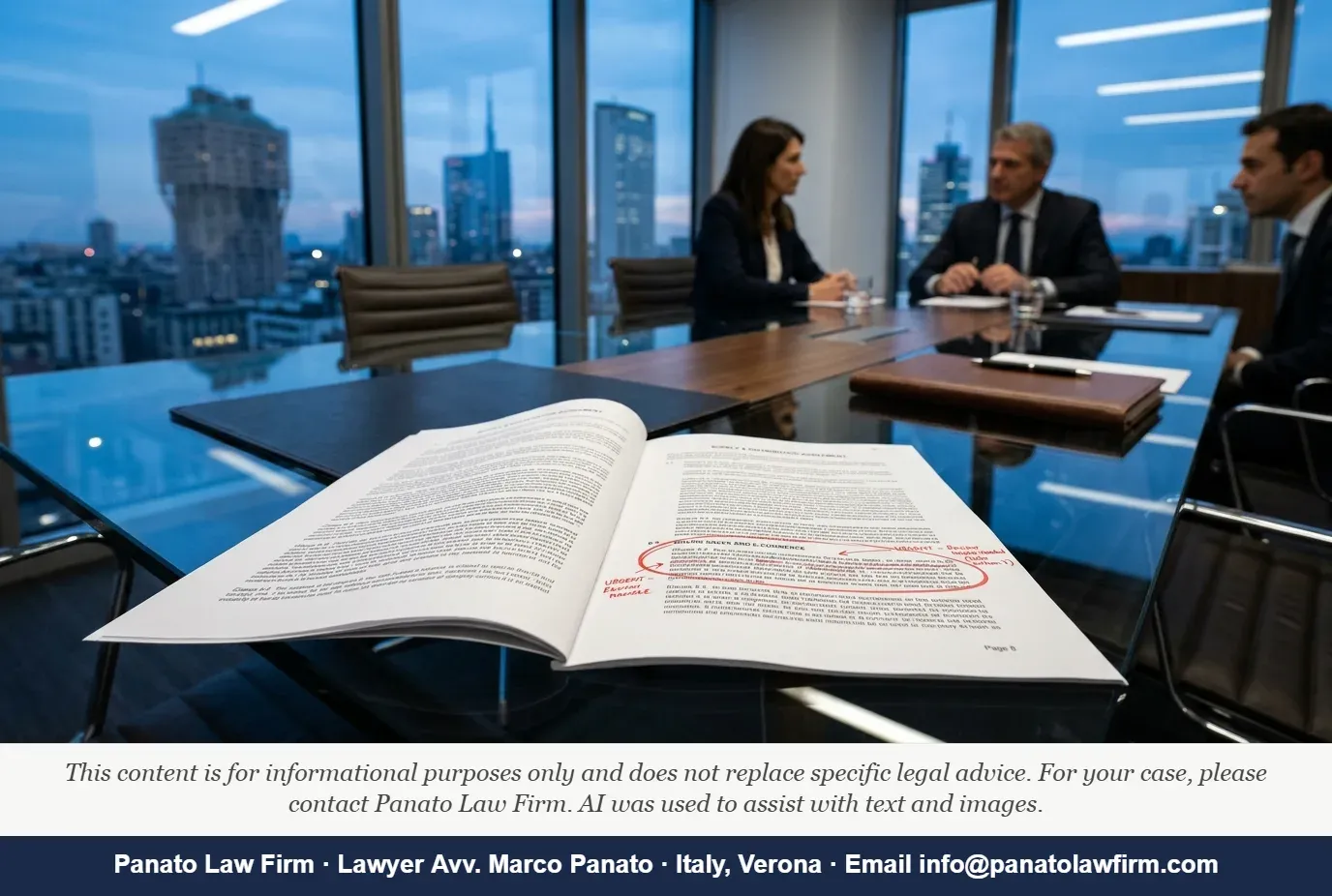
Image prompt: A close-up of a modern commercial contract spread open on a glass-topped boardroom table in a contemporary Milan office, with a red ink annotation circling an online sales clause; the background shows a blurred city skyline through floor-to-ceiling windows at dusk; cool blue and white light contrasts with the warm red of the annotation; the mood is urgent and corporate, photorealistic style.
Image file: marketplace-ban-distribution-contract-italy-cover
HREFLANG BLOCK:
JSON-LD:
LANGUAGE QA: go straight to a fine running into tens of millions of euros -> move straight to an eight-figure fine · The fine: €25,895,043. The target: Morellato S.p.A. The charge: -> Fine: €25,895,043. Respondent: Morellato S.p.A. Infringement: · in all material respects -> in all material regards / in substance · no redeeming efficiencies -> no offsetting efficiencies · different appetite -> a markedly different enforcement appetite · proceeded directly to a full prohibition decision -> issued a full infringement decision · sits in a different legal position from -> occupies a different legal position from / is legally distinct from · but that rarely reaches the template review stage in London headquarters -> yet this distinction seldom surfaces during template reviews at London HQ
Quality: Italian terms without a plain explanation: PEC
Source check: verdict AMBER — verify before publication
CHECK:
1. AGCM Decision I876, 17 March 2026 / EXISTS: yes — confirmed on agcm.it and in AGCM Bollettino no. 11/2026 / CONTENT MATCHES: yes — fine €25,895,043, RPM + discriminatory marketplace ban, Morellato S.p.A. / NOTE: paragraph 221 reference — confirmed as approximate location within the 84-page decision; exact paragraph numbering should be verified against the full published text before publication. PRIMARY SOURCE: agcm.it. VERDICT: AMBER (paragraph number to verify against full text).
2. VBER Reg. (EU) 2022/720 / EXISTS: yes — EUR-Lex / CONTENT MATCHES: yes — Art. 4(a) RPM as hardcore restriction, selective distribution provisions confirmed. PRIMARY SOURCE: EUR-Lex. VERDICT: GREEN.
3. EU Vertical Guidelines OJ C 248, 30 June 2022 / EXISTS: yes — EUR-Lex / CONTENT MATCHES: yes — RPM paragraphs and marketplace restriction guidance confirmed. PRIMARY SOURCE: EUR-Lex. VERDICT: GREEN.
4. Law no. 287/1990 Art. 2 / EXISTS: yes — Normattiva / CONTENT MATCHES: yes. PRIMARY SOURCE: Normattiva. VERDICT: GREEN.
5. AGCM Case I878 (DJI/Nital), 14 October 2025 / EXISTS: yes — AGCM Bollettino / CONTENT MATCHES: yes — proceedings confirmed as open; subject confirmed. TO VERIFY: final decision. VERDICT: AMBER (proceedings open, final decision unverified).
6. AGCM Cases I879–I880 (Citizen/Swatch), 25 November 2025 / EXISTS: yes — AGCM Bollettino / CONTENT MATCHES: yes — proceedings confirmed as open. TO VERIFY: final decisions. VERDICT: AMBER (proceedings
Do you need legal assistance or a free estimate?
Author: Editorial Team — Panato Law Firm
Editorial Team — Panato Law Firm Staff