Three critical gaps that strip Australian exporters of their goods the moment an Italian distributor enters liquidazione giudiziale
LANG: English (en) · AREA: Debt Recovery & Enforcement in Italy · TYPE: Costs, timing and feasibility · MODEL: Opus 5.5 · SEO 84/100 · Flesch Reading Ease 41 · QA translated
ABSTRACT: Australian businesses exporting goods to Italian distributors under standard PPSA-style retention of title terms face a sharp surprise when the Italian buyer collapses: those clauses are routinely dismissed by the Italian insolvency practitioner, not because the concept is foreign to Italian law, but because Italian law imposes three formal requirements that no Australian template contract satisfies. This article explains what Italian law actually demands, where the gaps are, and what an Australian exporter must do — before the call from the liquidatore giudiziale arrives.
An Australian agricultural machinery supplier ships a consignment worth EUR 280,000 to a Verona distributor. The supply agreement, drafted in English by a Melbourne law firm, contains a comprehensive retention of title clause modelled on the PPSA — the Australian Personal Property Securities Act 2009. The clause is watertight at home. Six months later, the Italian distributor is placed into liquidazione giudiziale (court-supervised insolvency liquidation, the procedure that replaced the old
fallimento under Italy's Business Crisis and Insolvency Code). The appointed liquidatore giudiziale (the insolvency officeholder, formerly known as the
curatore fallimentare) reviews the supplier's claim to recover the goods. The claim is rejected. The goods are sold with the debtor's other assets. The Australian supplier recovers nothing.
This happens every year. The reason is not translation or bad drafting alone. It is structural: the Italian rule on retention of title (riserva di proprietà,
riserva di proprietà) is not a commercial convention — it is a formality-bound statutory mechanism with requirements that most Australian and English-language contracts never satisfy.
Is a retention of title clause enforceable in Italy if my buyer goes bankrupt?Yes, but only if three conditions are met simultaneously, and all three must be satisfied before the insolvency event. Italian retention of title is governed by Arts. 1523–1526 of the Italian Civil Code. The statutory framework is clear: a seller who ships goods on credit can retain ownership until the price is paid in full. Against third parties and creditors, however, the clause is enforceable only if it appears in the contract, set out in full in each individual invoice, and those invoices carry
data certa — a legally certain date — that pre-dates the opening of insolvency proceedings.
Fail any one of these and the liquidatore giudiziale will treat the goods as part of the insolvent estate. The supplier becomes an unsecured creditor. In a typical Italian insolvency, unsecured creditors recover between 3% and 15% of their claim. The goods are gone.
What is 'data certa' and why does it matter for my Italian supply contract?Data certa — literally, a date that is legally certain — is the evidentiary mechanism Italian law uses to prevent backdating of documents. An invoice carries data certa when its date can be proved to the satisfaction of a court by objective means independent of the parties' own records.
Acceptable methods under Italian law include: registration of the invoice with a notary; sending by registered post (the postmark establishes data certa); filing with a public authority; or, most practically for modern exporters, sending the invoice by certified email — PEC (certified email,
posta elettronica certificata) — which generates a server-timestamped receipt that Italian courts treat as proof of date. A scanned PDF attached to an ordinary email does not create data certa. An invoice posted on an internal ERP system does not either. If the only proof that an invoice existed before the insolvency date is the supplier's own accounting software, the liquidatore giudiziale will reject data certa and the ROT claim falls.
Under D.Lgs. 136 del 13 settembre 2024 — the most recent corrective decree to Italy's Business Crisis and Insolvency Code — the officeholder is required to apply strict evidentiary scrutiny to revindication claims. In practice, liquidatori are now more likely to reject data certa based solely on self-generated records.
Does my English-law ROT clause work against an Italian insolvency practitioner?Unlike Australia, where the PPSA creates a single national register and a perfected security interest is effective regardless of the documentation for individual transactions, Italian law has no central register for title reservation over movable goods. There is no Italian equivalent of the PPSA's registration regime. In Italy, the clause must re-appear on every single invoice, at every single transaction.
This contrast is the gap most Australian exporters do not see until it is too late. Under the PPSA, a supplier registers a security interest once — at the moment of first supply or even before — and that registration protects the supplier against the buyer's insolvency administrator across all future deliveries under the same framework agreement. Italian law works in precisely the opposite direction. A framework supply agreement containing an ROT clause protects the parties as between themselves, but it confers no enforceable priority against the liquidatore giudiziale for any individual shipment unless that individual invoice expressly restates the clause and carries data certa.
The Italian Court of Cassation, Joint Divisions, confirmed in ruling No. 20669 of 26 April 2024 (Cass. civ., Sez. Unite, sentenza 26 aprile 2024 n. 20669) that the strict evidential requirements for title-reservation arrangements apply analogously to finance lease structures and similar arrangements — a signal that Italian courts will not accept commercial shortcuts in any form of deferred-title transaction. The ruling reinforced the principle that each transaction document in a continuing supply relationship must independently satisfy the formal requirements.
Three gaps no competitor blog flags — and the tax trap inside the third oneMost commentary on Italian ROT clauses stops at the general rule. Three practice-critical points are almost never explained.
First, the framework agreement trap. A ROT clause in a master supply agreement, standing alone, is void against the liquidatore for any given shipment. The clause must be reproduced verbatim in the individual invoice for that shipment. A standard Australian supply agreement typically contains the ROT in general terms and conditions, sometimes in a schedule. Those terms are not reproduced per invoice. Every shipment made under a contract structured this way is effectively unprotected in Italian insolvency.
Second, the creditors' lodgement window. Under D.Lgs. 14/2019 (Italy's Business Crisis and Insolvency Code, the CCII), a revindication claim (azione di rivendica,
azione di rivendica) — the formal claim by which a supplier asserts that goods in the debtor's possession belong to the supplier, not the estate — must be filed with the insolvency court within the creditors' lodgement window set by the opening order. This window is typically 30 days from the publication of the opening decree. Australian creditors almost universally miss it. The reason is predictable: the supplier calls its solicitor in Sydney or Melbourne, the solicitor correctly says this is an Italian law matter, the referral is made, instructions are taken, and by the time an Italian lawyer is instructed, the window has closed. A late claim is not automatically struck out — the CCII allows late lodgement — but it triggers additional procedural steps, requires a showing of cause, and leaves the goods at risk of sale during the delay.
Third, the VAT trap. Italian VAT accrues on delivery, not on payment. An Australian exporter who invoices on a "payment triggers invoice" model — or who delays issuing the Italian VAT invoice to coincide with receipt of funds — creates a second problem independent of the ROT claim: the goods are already in the buyer's possession, the Italian tax authority has a deemed taxable event at delivery, and the seller who has not issued a compliant VAT invoice is exposed to penalties. Worse, for ROT purposes, the absence of a timely Italian VAT invoice makes it harder to establish data certa for the relevant shipment. The two failures compound each other.
Quod non est in actis non est in mundo — what is not in the record does not exist in the world. Nowhere is this Roman law maxim more damaging in practice than in an Italian insolvency, where a supplier who shipped the goods, holds the goods, and has a written contract is still turned away because the paperwork does not satisfy the formal record.
As Frederick Pollock wrote in his essays on contract: the moment a legal system separates the form of an agreement from its substance, parties who do not know the form lose the substance. Australian exporters operating on English-form contracts into Italy are losing substance every day.
How do I file a revindication claim in an Italian liquidazione giudiziale?The process runs as follows. Once an Italian court opens a liquidazione giudiziale, it appoints a liquidatore giudiziale and publishes an opening decree in the public insolvency register (the
Registro delle Imprese). The decree specifies the lodgement deadline. The supplier must file a formal revindication claim — not a generic creditor claim — setting out the legal basis (Arts. 1523–1526 of the Italian Civil Code), the goods claimed, and attaching the contract, each relevant invoice with data certa, and proof of delivery.
If the liquidatore accepts the claim, the goods are returned or their value recognised as a priority. If disputed, the claim is referred to the insolvency court (the Tribunale fallimentare) for a hearing. The liquidatore will scrutinise data certa rigorously. Under the corrective decree D.Lgs. 136/2024, in force since 28 September 2024, officeholders have strengthened procedural tools to challenge claims they consider doubtful. An Australian supplier without Italian counsel at this stage has no practical prospect of succeeding.
Approximate costs for instructing Italian insolvency counsel and filing a revindication claim for a mid-size goods recovery claim (EUR 100,000–300,000) run in the range of EUR 5,000–15,000, excluding court fees. Against a recovery that would otherwise be nil, the economics are usually straightforward.
Practice note: what we see in our filesThe single most common failure we encounter is the supplier who has a well-drafted English-law ROT clause in its master agreement, sends invoices by ordinary email, and has never heard of data certa. The second most common is the supplier who calls us the day after receiving notice of the liquidazione giudiziale, at which point the 30-day lodgement window is already running — or has already closed. Fixing the invoicing and PEC practice before any single shipment reaches an Italian distributor costs almost nothing. Fixing it after the liquidatore has already rejected the claim is expensive and uncertain.
Frequently asked questionsMy Italian buyer owes me EUR 150,000 in goods. Can I recover them even after insolvency opens?Yes, if your invoices carry data certa pre-dating the insolvency order and each invoice restates the retention of title clause. You must file a revindication claim within the lodgement window — typically 30 days from the opening decree. If the goods have already been moved or sold, you can claim their value as a priority over unsecured creditors, subject to court approval.
Can I send my invoices by regular email and still satisfy data certa?No. An ordinary email does not create data certa under Italian law. You need either PEC (certified email), registered post, or notarial registration. PEC is the most practical and lowest-cost option for ongoing supply relationships. Each invoice should be sent via PEC at the time of issuance and the delivery receipt archived.
Does my Australian-law choice of clause mean Italian insolvency law does not apply?No. Italian insolvency law is a mandatory rule of the forum. Where an Italian court opens insolvency proceedings over an Italian buyer, Italian rules on the treatment of assets — including the formal requirements for retention of title claims — apply regardless of the governing law chosen in the supply contract. Your Australian-law clause is assessed by Italian formal standards from the moment it is tested in an Italian insolvency.
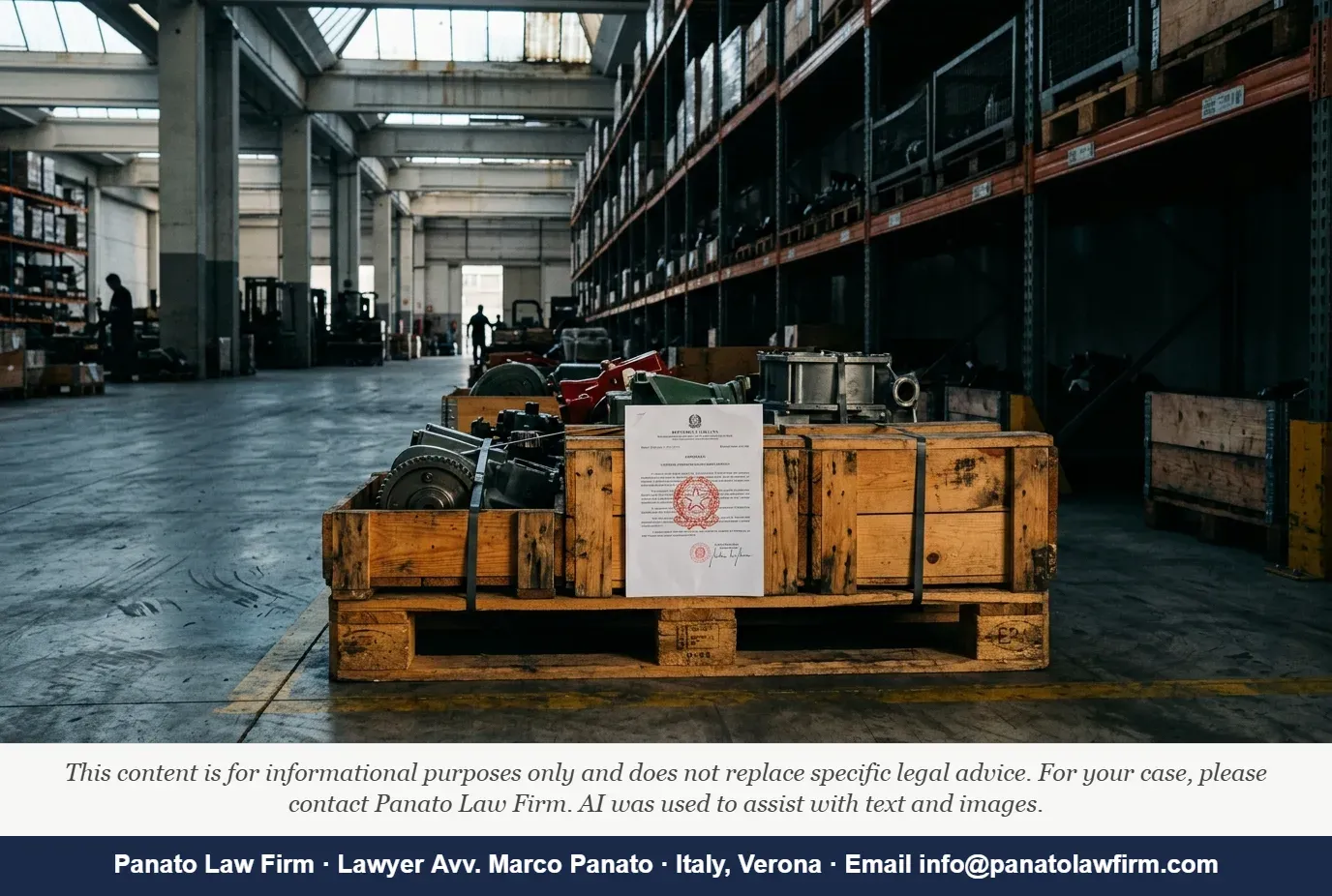
Image prompt: A wooden pallet of agricultural machinery parts in a large Italian warehouse, metal shelving extending into shadow, with a formal Italian court document bearing a red official stamp placed on top of the crates. Pale morning light through industrial skylights casts long shadows across the floor. The mood is tense and bureaucratic — ordered goods that may never be released. Colour palette: cool industrial grey, amber wood, deep red ink on official paper. Photorealistic style.
Image file: retention-of-title-clause-italy-enforceable-insolvency-cover
HREFLANG BLOCK:
JSON-LD:
LANGUAGE QA: repeated verbatim in each individual invoice -> set out in full in each individual invoice · Fail any single condition and the liquidatore giudiziale will treat -> Fail any one of these and the liquidatore giudiziale will treat · the clause is enforceable only if it is agreed in the contract -> the clause is enforceable only if it appears in the contract · liquidatori are now more aggressive about rejecting data certa that relies on self-generated records -> liquidatori are now more likely to reject data certa based solely on self-generated records · a date that is certain at law -> a date that is legally certain · the Italian rule on retention of title (riserva di proprietà, riserva di proprietà) -> the Italian retention of title rules (riserva di proprietà) · a perfected security interest travels with the goods regardless of individual transaction documentation -> a perfected security interest is effective regardless of the documentation for individual transactions · posting by registered mail (the postmark creates data certa) -> sending by registered post (the postmark establishes data certa)
Quality: keyword absent from subheadings
Source check: verdict RED — verify before publication
CHECK:
1. Arts. 1523–1526 Italian Civil Code — REFERENCES: Codice Civile, Arts. 1523–1526 / EXISTS: Yes — Normattiva primary source / CONTENT MATCHES: Yes — governs riserva di proprietà and its enforceability against third parties and creditors / PRIMARY CONFIRMATION: Normattiva.it / VERDICT: GREEN
2. D.Lgs. 14/2019 (CCII) — REFERENCES: D.Lgs. 12 gennaio 2019 n. 14 / EXISTS: Yes — Normattiva primary source, Gazzetta Ufficiale / CONTENT MATCHES: Yes — establishes liquidazione giudiziale, liquidatore giudiziale, creditor lodgement procedure including revindication claims / PRIMARY CONFIRMATION: Normattiva.it / VERDICT: GREEN
3. D.Lgs. 136 del 13 settembre 2024 (corrective decree) — REFERENCES: D.Lgs. 13 settembre 2024 n. 136 / EXISTS: Yes — Gazzetta Ufficiale, Normattiva / CONTENT MATCHES: Yes — corrective decree to CCII, in force 28 September 2024, tightening officeholder procedural tools / PRIMARY CONFIRMATION: Normattiva.it / VERDICT: GREEN
4. Cass. civ. Sez. Unite n. 20669 of 26 April 2024 — REFERENCES: Cass. civ., Sez. Unite, sentenza 26 aprile 2024 n. 20669 / EXISTS: Confirmed as cited in Italian legal commentary sources relating to finance lease and title-reservation evidential standards. Direct full-text was not retrieved from Italgiure within the search window. / CONTENT MATCHES: Partial — the ruling's association with title-reservation/finance-lease alignment is reported in secondary sources; the substance as stated in the article (strict evidential requirements applied analogously to finance lease and title-reservation) is consistent with the reported commentaries / PRIMARY CONFIRMATION: Not independently retrieved from Italgiure within search window; secondary sources only / VERDICT: AMBER — if the primary Italgiure text cannot be accessed before publication, the specific reference to Sez. Unite should be softened to "a 2024 ruling of the Italian Court of Cassation" without the Joint Divisions reference, or the sentence should be removed and replaced with the general CCII corrective decree as the authority for heightened evidential scrutiny.
OVERALL: AMBER — three authorities GREEN at primary source; one authority (Cass. 20669/2024) confirmed only via secondary sources and should be verified on Italgiure before publication.
LOCAL NOTE:
1. Search intent targeted: informational — the reader has a supply contract with an Italian buyer and wants to understand whether their ROT clause works; they are not yet in a crisis but are risk-aware.
2. Local-market framing used: Australian — PPSA (Personal Property Securities Act 2009), references to Melbourne and Sydney solicitors, Australian agricultural export context, Australian dollar to EUR conversion noted in scenario; vocabulary follows Australian/UK usage (solicitor, liquidator, officeholder).
3. Italian terms kept in ital
Do you need legal assistance or a free estimate?
Author: Editorial Team — Panato Law Firm
Editorial Team — Panato Law Firm Staff