Why American attorneys structuring Italian acquisitions must draft two separate non-compete clauses — and what goes wrong when they draft only one
LANG: English (en) · AREA: M&A, Company Acquisitions & Joint Ventures in Italy · TYPE: Case note (court decision) · MODEL: Sonnet 5.5 · SEO 84/100 · Flesch Reading Ease 34 · QA acceptable
ABSTRACT: An Italian acquisition SPA with a single non-compete clause binding a founder-seller who stays on as an employee post-closing can unravel completely the moment the founder leaves. Italian law applies two distinct regimes — one for commercial non-competes in business sales, one for employment non-competes — and confusing them voids the protection you paid for. This guide explains what each regime requires, how a January 2026 Italian Supreme Court ruling tightens the screws on the employment side, and how to draft both clauses so they hold.
The deal closes on a Friday. The founder-seller takes a management role in the company you just acquired, stays for eighteen months, then resigns. By Monday of the following week, she has incorporated a new entity and is calling on the same clients. You open the SPA, find the non-compete clause, and hand it to Italian counsel. The answer is not what you expected: the clause is likely void. Not because you forgot to include it. Because you wrote one clause when Italian law requires two, governed by different rules, with different consequences if either fails.
This is the most expensive drafting error in Italian M&A involving a founder who remains post-closing. It costs nothing to fix before signing. After closing, it can cost you the business.
Two Regimes, One Founder: Why a Single Clause FailsItalian law draws a sharp line between two types of non-compete obligations that, in US domestic transactions, are usually folded into a single agreement.
The first is the commercial non-compete governed by Article 2596 of the Italian Civil Code (
codice civile). This is the clause that belongs in your SPA or the ancillary business transfer agreement. It restricts the seller in their capacity as a business owner. No mandatory compensation is required — the sale price itself provides the economic quid pro quo. The clause is valid if it is in writing, limited to a defined object and geographic territory, and capped at five years. The Italian Court of Cassation has confirmed that a restriction exceeding five years is reduced by law to five years rather than voided entirely, but that tolerance does not save a clause that fails the object or territory tests.
The second is the employment non-compete governed by Article 2125 of the Italian Civil Code. This clause governs the founder in her capacity as employee, executive, or
dirigente — the category of senior manager that Italian labour law treats as a distinct class. Under Article 2125, the clause must be in writing, must specify the activity restricted and the geographic perimeter, must carry separately allocated and adequate compensation, and may not exceed three years for ordinary employees or five years for executives.
Article 2125 imposes mandatory, cumulative requirements — written form, determinate limits as to subject matter, duration, and territory, and adequate, separately allocated consideration — and a covenant that fails any one of them is void in its entirety, leaving the buyer unprotected.
A single SPA clause that is labelled "commercial" but binds a person who is simultaneously an employee will, in litigation, be re-characterised by an Italian court under Article 2125. If it carries no separate compensation — because you relied on the purchase price — it is void from the day it was signed.
Is a Non-Compete in an Italian Acquisition Agreement Enforceable?Yes — but enforceability is mechanical, not presumed. For the commercial non-compete under Article 2596, the checklist is four items: written form; a defined subject matter (the specific competing activities, not a reference to "the business of the target"); a defined geographic scope; and a maximum duration of five years.
The Italian Civil Code provides that a clause limiting competition must be proved in writing and is valid only if circumscribed to a defined territory or a defined activity, and cannot exceed five years in duration.
That last point about the object definition is where most SPA boilerplate fails. A clause that says "the seller shall not engage in any business competitive with the business of the Company" is dangerously vague under Italian law. The absence of predetermined or determinable limits undermines the enforceability of the clause and leaves the counterparty without any clear understanding of the restriction's scope. Italian courts have voided non-competes where the restricted activity is defined only by reference to what the target company does, rather than by reference to specific, identified competing activities. Vagueness kills enforceability outright. The seller's attorney will make that argument in the first paragraph of any claim.
For the employment non-compete under Article 2125, the compensation test is equally mechanical. The Italian Court of Cassation held that non-compete compensation may be paid in annual instalments during employment, but validity turns on whether the calculation method is clear and the compensation proportionate relative to the restriction imposed on the employee.
What the January 2026 Cassazione Ruling Changes for Founder-SellersThe Italian Court of Cassation, Labour Division, with order of 8 January 2026, n. 436 (Pres. Doronzo, Rel. Riverso) ruled on the validity of an employment non-compete in which the compensation was set on an annual basis and tied to the duration of the employment relationship.
The Court held that an employment non-compete setting compensation tied to the duration of the employment relationship was legitimate, and clarified that the reference to employment duration for the purpose of quantifying compensation does not affect the determinateness or determinability of the contract's object, but instead goes to the proportionality of the amount.
In plain terms: paying the non-compete compensation in monthly instalments through payroll is valid. The Supreme Court reaffirmed the necessary conceptual distinction between voidness of the non-compete for indeterminateness of compensation, and voidness for inadequacy of compensation. These are two separate grounds of challenge, assessed independently.
Why does this matter for your deal? Because the most common Italian M&A structure for a founder-seller who stays post-closing routes the non-compete compensation through the employment contract — a fixed annual supplement, paid in instalments through the payroll cycle. Italian Court of Cassation order no. 436/2026 (Cassazione Civile, Sez. Lavoro, 8 gennaio 2026, n. 436) confirms that structure is permissible, but only if two conditions are both met: the calculation formula is objectively determinable at the time of signing (not dependent on future management discretion), and the total amount is proportionate to the restriction actually imposed. The ruling confirms the legitimacy of an annual compensation paid through the payroll and of significant contractual penalty clauses. A penalty clause that is grossly disproportionate to the compensation received invites judicial reduction or, in aggravated cases, a challenge to the entire covenant.
How Long Can a Seller Non-Compete Last in Italy?The five-year cap under Article 2596 — applicable to commercial non-competes in business sales — is a hard ceiling set by the Italian Civil Code. Beyond five years the clause is reduced to five years, not voided. That ceiling is the same for executives (
dirigenti) under Article 2125 for employment non-competes, while ordinary employees are capped at three years.
Unlike in most US jurisdictions, Italian law does not apply a "blue pencil" test that simply rewrites an over-broad clause to the permissible maximum in all respects. An Italian court will reduce duration beyond the statutory ceiling but will void a clause entirely if it fails the object or territory requirements. There is no judicial rewriting of substantive scope. If your clause defines the restricted territory as "worldwide" without any substantive justification, or leaves the restricted activity as "anything competitive," Italian courts will not save it by reading it down to something reasonable. They will declare it void. The practical consequence: you spent the deal at risk.
Formulations such as "worldwide," "all markets in which the Group operates," or "any country where the Company carries on business" are routinely imported without analysis into Italian transactions. Italian case law shows that even a global restriction can be upheld where it is genuinely justified by the executive's role and leaves meaningful alternative employment open — but the burden of demonstrating that justification rests on the party seeking enforcement.
For a target whose business is concentrated in northern Italy, a non-compete limited to Italy or to the relevant European markets, with the restricted activity defined by reference to specific product categories and identified customer segments, will survive scrutiny far more reliably than a boilerplate worldwide restriction on "any competitive activity."
The Earn-Out Trap: When Non-Compete Voidness Creates a CounterclaimThis is the risk no competitor commentary addresses, and it is the one most likely to damage your transaction economics.
Many Italian acquisitions involving a founder-seller include an earn-out period of twelve to thirty-six months. The founder stays on, drives post-closing performance, and earns a deferred portion of the consideration tied to revenue or EBITDA targets. The non-compete and the earn-out run concurrently.
If the founder leaves before the earn-out period ends and the non-compete is void — because the employment clause carried no separate compensation, or because the object definition was too vague — the following sequence becomes likely. First, the founder competes freely, correctly. Second, the buyer restricts the founder's access to resources or systems in response, or the business underperforms because the founder is actively working against it. Third, the founder claims that the earn-out was not achieved because of the buyer's failure to support the business post-closing, not because of the founder's own conduct.
Italian courts assess earn-out disputes under an implied obligation of good faith and fair dealing. A buyer who responds to a founder's defection by restricting the business, without a valid non-compete to rely on, is exposed to a counterclaim for earn-out damages. The compensation determinability test that Italian Court of Cassation order no. 436/2026 articulates feeds directly into this exposure: if the employment non-compete is void for inadequate compensation, the founder's argument that any post-closing restriction on her freedom was unlawful becomes materially stronger.
The fix is structural. The SPA should include a commercial non-compete under Article 2596, drafted with specific activity and territory definitions, running for the earn-out period plus a tail. The employment contract should include a separate Article 2125 non-compete with its own, separately calculated compensation, explicitly ring-fenced from the purchase price and the earn-out mechanics. The two clauses should be cross-referenced but governed by distinct provisions. Their interaction with earn-out triggers — particularly who bears the burden of proving causation for underperformance — should be addressed in the earn-out schedule.
Do I Need to Pay the Seller for a Non-Compete in an Italian SPA?For the commercial non-compete in the SPA — the Article 2596 clause binding the seller as former business owner — no separately mandated compensation is required. Under Article 2596 of the Italian Civil Code, a competition-limiting agreement between enterprises does not formally require compensation; the maximum duration is five years, and the agreement is valid if it is limited to a defined territory or activity. The purchase price serves as the economic consideration for the restriction. That said, some US buyers explicitly allocate a portion of the purchase price to the non-compete for accounting and tax purposes. Italian courts do not require this, but the allocation strengthens the argument that the restriction is commercially proportionate.
For the employment non-compete under Article 2125 — the clause that kicks in when the founder becomes your employee post-closing — separately allocated compensation is mandatory. Not optional. Not substituted by the purchase price. The restriction's object, duration and territorial scope must be clearly defined or objectively determinable at the time of signing, and the compensation must be proportionate to the restriction imposed. Italian Court of Cassation order no. 436/2026 confirms that a fixed annual amount paid in instalments through payroll is a valid structure, provided the formula is clear and the total is proportionate to what you are asking the founder to forgo.
A rule of thumb from Italian practice, though no statutory minimum applies: employment non-compete compensation below 20–25% of annual gross remuneration, for a restriction of medium-high scope, invites a disproportionality challenge. For a founder with a three- to five-year restriction and a senior executive's salary, the compensation needs to be meaningful. Courts look at the realistic economic sacrifice imposed on the individual, not at the nominal label attached to the payment.
Unlike US Non-Compete Law: What American Attorneys Need to RecalibrateAmerican attorneys structuring this transaction carry a set of assumptions that Italian law does not share.
In the US, the enforceability of non-competes — both post-sale and post-employment — has been turbulent in recent years, with the FTC's 2024 attempted rule-making and a patchwork of state-by-state standards ranging from California's near-total prohibition to Texas's relative permissiveness. The common thread in US doctrine, where non-competes are allowed, is a judicial reasonableness test: scope, duration, and territory must go no further than necessary to protect a legitimate business interest, and courts routinely blue-pencil over-broad provisions.
Italian courts apply a proportionality and determinability test that is structurally similar but operates through statutory ceilings and mandatory formal requirements, not through equitable rewriting. An Italian court will not save a non-compete that omits mandatory compensation by calculating what fair compensation would have been and implying it into the contract. The clause is void. There is no equitable relief. The buyer carries the full risk of an unenforceable clause.
Additionally, in US deal practice, it is common to fold post-sale and post-employment restrictions into a single definition of "restricted activities" in the SPA itself, relying on the purchase agreement to govern both. Italian law makes that approach structurally incorrect: the two relationships — seller-as-entrepreneur and seller-as-employee — are governed by different articles of the Italian Civil Code, carry different formal requirements, and are assessed by courts using different criteria. Merging them into one clause produces a document that satisfies neither.
Nemo debet bis vexari pro una et eadem causa — no one should be twice troubled for one and the same cause. The Latin principle cuts both ways in this context: draft both clauses correctly the first time, because you will not get a second opportunity to enforce either.
The distinction between determinability and adequacy of compensation — which the Italian Court of Cassation articulated in order no. 436/2026 and which earlier decisions explored through cases where compensation was linked to employment duration — is a doctrinal refinement that has no direct equivalent in US contract law. American attorneys who approach the Italian non-compete as "basically the same as home, but with a cap" will miss it entirely.
As the legal scholar Friedrich Kessler observed in his comparative study of contract law, formal requirements in civil-law systems are not mere technicalities — they encode substantive value choices about which parties deserve protection and which risks should fall on the drafter. In Italian non-compete law, the formal requirements of Article 2125 encode a constitutional protection of the right to work. A clause that ignores them is not merely defective. It is void as a matter of public policy.
Practice Note: The Most Common Mistake in Our FilesIn our practice the most common error in cross-border acquisitions involving an Italian founder who stays post-closing is the use of a single non-compete clause drafted under a governing law other than Italian law — typically New York or English law — with an Italian law carve-out that applies "to the extent required by mandatory provisions." Italian courts do not read that carve-out as triggering Article 2125's compensation requirement. They read it as the parties having chosen foreign law to govern the clause, and then assess whether the clause meets Article 2125's mandatory requirements as a separate analytical step. The result is almost always that the clause fails, because the compensation structure was designed under a legal system that does not require it. The fix takes one additional page in the employment contract. The cost of not including it can be the entire post-closing protection.
Frequently Asked QuestionsCan the seller's non-compete in the SPA be extended beyond five years if both parties agree?No. The five-year ceiling under Article 2596 of the Italian Civil Code is a mandatory limit. A clause agreeing to a longer duration is not void in its entirety — Italian law reduces the duration to five years automatically — but the excess period has no legal effect. Agree to five years or less from the outset, and specify that the period runs from closing, not from signing.
What happens if an Italian seller's non-compete is declared void?The seller is free to compete from the day the clause is declared void — which, in most cases, means retroactively from the date it was signed. There is no injunctive relief based on a void clause, no damages for its breach, and no judicial rewriting of the restriction. If a contractual penalty was attached to the clause, the penalty is also void. The buyer's only residual protection may be the general prohibition on unfair competition under Article 2598 of the Italian Civil Code, which covers acts of confusion, denigration, and misappropriation but does not replicate the full scope of a non-compete.
If the founder-seller becomes a director rather than an employee post-closing, does Article 2125 still apply?No — and this is a point frequently missed. A company director (
amministratore) in Italy is not an employee in the legal sense; the relationship is governed by a mandate agreement (
contratto di mandato), not by employment law. Article 2125 does not apply. The commercial non-compete under Article 2596 governs instead, meaning no mandatory compensation is required. But the object and territory requirements still apply, and a poorly drafted commercial non-compete will be void regardless of the director's title. If the founder holds both an employment contract and a directorship post-closing — a common Italian structure — both relationships must be covered separately.
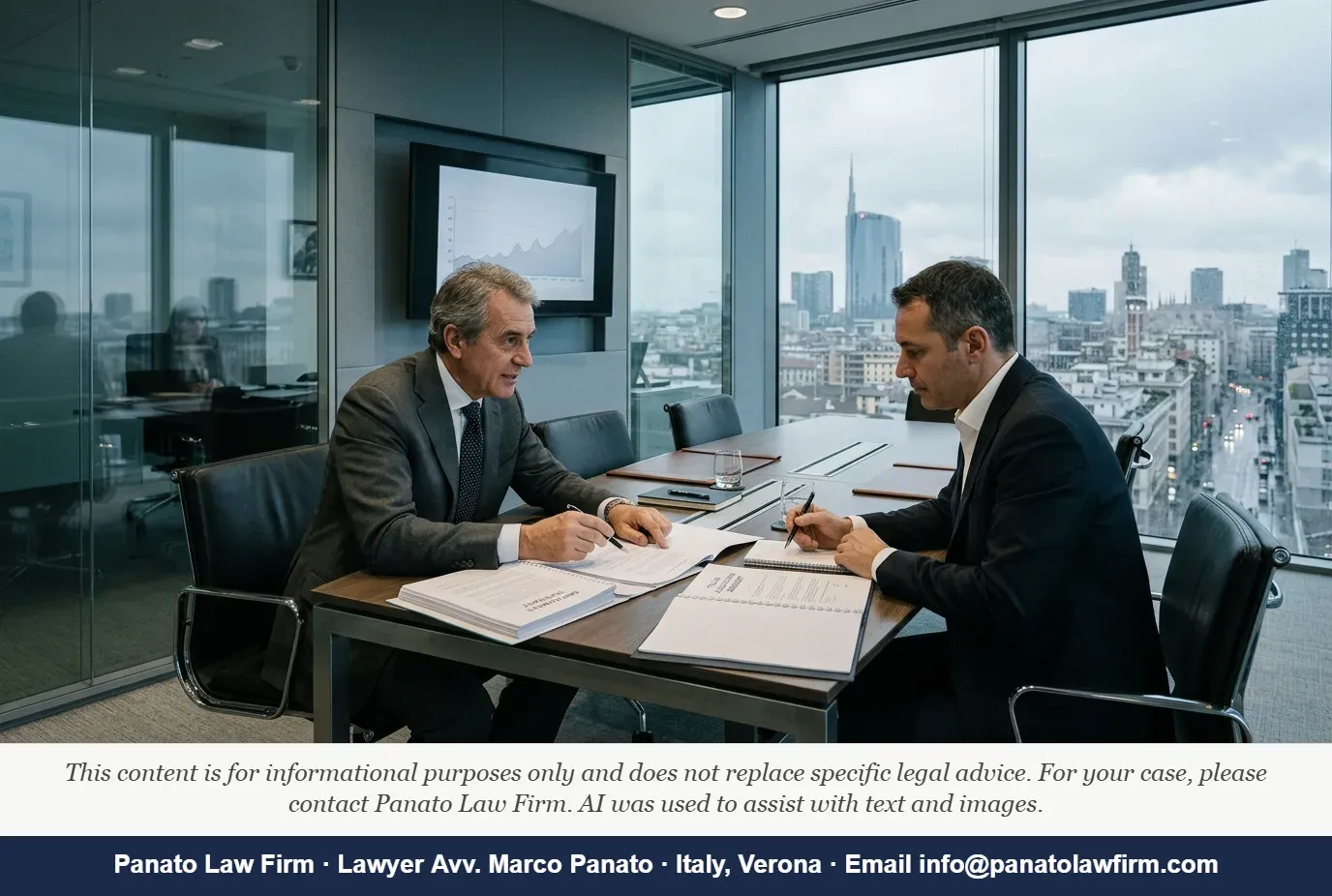
Image prompt: A modern glass-walled boardroom in Milan overlooking a grey winter skyline. Two sets of documents lie open on a long conference table — one marked with an Italian acquisition agreement, one with an employment contract. A senior lawyer in a dark suit points to a clause on the employment contract, explaining to a focused executive across the table. Muted tones of steel blue and charcoal. Photorealistic style, no text visible in frame.
Image file: seller-non-compete-italy-acquisition-enforceable-cover
HREFLANG BLOCK:
JSON-LD:
LANGUAGE QA: carrying different consequences if either one is wrong -> with different consequences if either fails · the absence of predetermined or determinable limits undermines the enforceability of the clause and leaves the counterparty without any clear understanding of the restriction's scope -> vague limits undermine enforceability and leave the counterparty uncertain about the restriction's scope · the clause is valid if it is in writing, limited to a defined object and geographic territory, and capped at five years -> the clause is valid if it is in writing, covers a defined subject matter and geographic area, and lasts no more than five years · a defined object (the specific competing activities -> a defined subject matter (the specific competing activities · limits of object, time and place -> limits as to subject matter, duration, and territory · the validity of the agreement depends on the clarity of the calculation criterion and the proportionality of the economic amount -> validity turns on whether the calculation method is clear and the compensation proportionate · It restricts the seller as entrepreneur -> It restricts the seller in their capacity as a business owner · confirmed that compensation for an employment non-compete can be recognised annually during the employment relationship -> held that non-compete compensation may be paid in annual instalments during employment
GATE: REVIEW — check AMBER
Source check: verdict AMBER — verify before publication
CHECK:
REFERENCE: Court of Cassation, Labour Division, with order of 8 January 2026, n. 436
1. EXISTS? not verified by the agent
2. CONTENT MATCHES? not verified
3. CONFIRMING SOURCE: —
REFERENCE: Court of Cassation order no. 436/2026
1. EXISTS? not verified by the agent
2. CONTENT MATCHES? not verified
3. CONFIRMING SOURCE: —
REFERENCE: Court of Cassation articulated in order no. 436/2026
1. EXISTS? not verified by the agent
2. CONTENT MATCHES? not verified
3. CONFIRMING SOURCE: —
REFERENCE: Article 2596
1. EXISTS? not verified by the agent
2. CONTENT MATCHES? not verified
3. CONFIRMING SOURCE: —
REFERENCE: Article 2125
1. EXISTS? not verified by the agent
2. CONTENT MATCHES? not verified
3. CONFIRMING SOURCE: —
REFERENCE: Article 2598
1. EXISTS? not verified by the agent
2. CONTENT MATCHES? not verified
3. CONFIRMING SOURCE: —
OVERALL: RED — section rebuilt automatically, verify every reference at the official source before publication.
REINFORCED CHECK (second pass on the authorities):
**NOTE ON CONTENT CONSISTENCY:** The article uses ord. 436/2026 to support the proposition that Art. 2596 (commercial non-compete, no mandatory compensation, 5-year cap) applies to the SPA/seller context. However, ord. 436/2026 is squarely an Art. 2125 labour-law case (employee non-compete, mandatory compensation). The ruling is real and does confirm principles about non-compete validity under Art. 2125, but it does **not** concern Art. 2596 or the seller/SPA context the article describes. The three Civil Code articles themselves are real and their content is consistent with the article's description.
---
**Court of Cassation, Labour Division, order of 8 January 2026, n. 436** | EXISTS: **yes** | PRIMARY SOURCE: secondary only — the ruling is listed on Simpliciter.ai as "Fonte verificata · Italgiure", meaning it originates from Italgiure (italgiure.giustizia.it), but no direct Italgiure URL was returned in search results | CONTENT consistent? **partial** — the order arises from an employee's challenge to a non-compete penalty under Art. 2125 c.c., a pure employment-law dispute; the article deploys it to support Art. 2596 (commercial/SPA non-compete context), which is a different regime.
---
**Court of Cassation order no. 436/2026** | EXISTS: **yes** | PRIMARY SOURCE: secondary only (same as above; no direct Italgiure URL returned) | CONTENT consistent? **partial** — same reasoning as above; the Cassazione with ord. n. 436/2026 clarifies requirements for a non-compete's validity, confirming the legitimacy of an annual remuneration paid in payslips, which is an Art. 2125 employment matter, not an SPA/seller matter.
---
**Court of Cassation articulated in order no. 436/2026** | EXISTS: **yes** | PRIMARY SOURCE: secondary only | CONTENT consistent? **partial** — the ruling concerns the non-compete under Art. 2125 c.c., holding that the duration of the employment relationship is not decisive for determining the object of the contract but relates to the adequacy of the compensation; this is not the Art. 2596 commercial-non-compete doctrine the article attributes to it.
---
**Article 2596 (codice civile)** | EXISTS: **yes** | PRIMARY SOURCE: Gazzetta Ufficiale (gazzettaufficiale.it) — the article is contained in the original R.D. 262/1942 (Codice Civile); Normattiva hosts the current consolidated text at normattiva.it | CONTENT consistent? **yes** — Art. 2596 governs contractual limits on competition: the pact must be in writing, valid only if limited to a defined activity or territory, and cannot exceed five years, exactly as described in the article.
---
**Article 2125 (codice civile)** | EXISTS: **yes** | PRIMARY SOURCE: Gazzetta Ufficiale — Art. 2125 (Patto di non concorrenza) is null if not in writing, if no compensation is provided to the employee, and if the restriction is not limited in object, time, and place; the duration cannot exceed five years for executives and three years for others | CONTENT consistent? **yes** — the article correctly identifies Art. 2125 as the mandatory-compensation regime governing the employment non-compete.
---
**Article 2598 (codice civile)** | EXISTS: **yes** | PRIMARY SOURCE: Gazzetta Ufficiale — Art. 2598 (Atti di concorrenza sleale) prohibits acts of unfair competition including use of signs causing confusion, denigration of a competitor, and any other means contrary to professional fairness | CONTENT consistent? **yes** — the article correctly signals Art. 2598 as the unfair-competition backstop available even without a contractual clause.
---
**OVERALL: AMBER** — All six references exist and the three Civil Code articles are verified on primary sources (Gazzetta Ufficiale / Normattiva). However, the Court of Cassation ord. 436/2026 is verified only via secondary sources (no direct Italgiure URL returned), and its content is only partially consistent with the article's use of it: the ruling concerns an Art. 2125 employment non-compete, not the Art. 2596 commercial/SPA non-compete context to which the article applies it.
Do you need legal assistance or a free estimate?
- October 08, 2026
- Redazione
Author: Editorial Team — Panato Law Firm
Editorial Team — Panato Law Firm Staff