What the Court of Appeal of Brescia ruling of April 2026 means for Australian exporters appointing Italian producers as exclusive distributors — and why your contract's notice clause is not the safe harbour you think it is
LANG: English (en) · AREA: Commercial Contracts & Distribution · TYPE: Legal update / what changed · MODEL: Opus 5.5 · SEO 76/100 · Flesch Reading Ease 32 · QA acceptable
ABSTRACT: An Italian producer terminated an exclusive international distribution agreement covering Peru, Brazil, Mexico and the United States after roughly three years of collaboration — and paid the price in Brescia. The Court of Appeal of Brescia, in judgment no. 322 of 2 April 2026, scrutinised the adequacy of the notice period against the distributor's organisational exposure, not merely against the contract's text. Australian exporters who grant Italian producers exclusive distribution rights in multiple overseas markets, or who appoint Italian distributors for their own goods, face the same judicial standard.
An Italian chemical company had built a multi-territory distribution network through a Latin American entrepreneur. The collaboration, which began in 2017, involved an Italian producer of lubricants and air-conditioning solutions and a distributor covering Peru, Brazil, Mexico and the United States, structured through four separate companies incorporated in each of those markets. The parties had chosen not to govern the relationship with a detailed written contract, settling instead for a target turnover of €700,000. After roughly three years of collaboration, and following the promotional investments made by the distributor entities, the Italian company gave notice of termination in November 2020. The result was a court case that ran all the way to the Court of Appeal of Brescia — and the April 2026 judgment holds a lesson every Australian exporter with Italian distribution ties would do well to heed.
How much notice must I give to end an exclusive distribution agreement in Italy?There is no single statutory figure. Italian law does not prescribe a fixed number of days the way some other systems do. The Italian Civil Code (
codice civile) governs open-ended supply and distribution relationships primarily through Article 1569, which requires that termination of an open-ended contract must be preceded by notice given "in the term agreed, or established by custom, or, in the absence of both, in a reasonable term having regard to the nature of the supply." Article 1375 of the Italian Civil Code adds the overarching obligation that contracts be performed in good faith, which Italian courts apply at the point of termination as readily as at formation.
What this means in practice: the contractual notice period sets a minimum, not a maximum. In cases involving open-ended commercial distribution contracts with no written framework, Italian courts hold that termination at will (
recesso ad nutum) is lawful provided a reasonable notice period is given, and the length of that period is determined by reference to the length of the relationship, the characteristics of the business carried on and the distributor's organisational capacity. A clause in the contract saying "thirty days' notice" does not immunise the terminating party if the court decides thirty days was wholly inadequate on the facts.
The variables Brescia actually weighed — what competitor guides missMost practitioner commentary stops at the principle. The Court of Appeal of Brescia in judgment no. 322 of 2 April 2026 (
Corte d'Appello di Brescia, Sentenza n. 322, 2 aprile 2026) shows how the analysis plays out in a genuinely international context. Several features of that case are directly relevant to an Australian exporter's position.
First,
territorial scope matters. The agreement covered four separate markets — Peru, Brazil, Mexico and the United States — each served through a dedicated local company. A distributor who has incorporated subsidiaries, hired staff and set up logistics in four countries has plainly structured its entire business around the relationship. The more territories covered, the deeper the organisational commitment — and the longer the wind-down a court will expect.
Second,
organisational investment is decisive. The Court of Appeal of Milan, in judgment no. 2296 of 23 July 2025 (
Corte d'Appello di Milano, Sentenza n. 2296, 23 luglio 2025), confirmed the same line: the adequacy of notice must be evaluated in relation to the length of the relationship, the nature of the business carried on and the distributor's organisational capacity. The Brescia court in 2026 applied that standard to a multi-territory exclusive, giving particular weight to the promotional investments the distributor entities had already made. Where a distributor has built warehouses, trained staff, or incurred marketing expenditure specifically for the principal's products, Italian courts treat that as a factor that extends the required notice period — regardless of what the contract says.
Third,
the absence of a written contract does not help the terminating party. The parties in the Brescia case had no detailed written agreement and had agreed only on a revenue target of €700,000. The court still applied Italian civil law principles to regulate the termination. If anything, the absence of a written exit clause left the terminating party fully exposed to the court's discretion about what was "reasonable."
Unlike distribution law in Australia — the comparison you needUnlike distribution law in most common-law countries, Italian law does not treat commercial distribution agreements as straightforward arm's-length contracts that the parties can exit simply by following the contractual notice clause. Under Australian law, a well-drafted distribution agreement with a 30-day notice clause would, in most scenarios, allow either party to exit cleanly on 30 days' written notice — provided the contract expressly permits termination without cause. There is no statutory implied obligation to give more. Under Article 1569 of the Italian Civil Code, by contrast, even where the parties have agreed a notice period, the statutory standard requires a "reasonable" period having regard to the nature of the supply — and Italian courts treat that as a judicially reviewable standard, not merely a contractual one. The Italian Court of Cassation (
Corte di Cassazione) has confirmed in successive decisions that inadequate notice does not invalidate the termination itself, but it does push back the effective date of termination to when the reasonable period would have expired, generating a damages claim for the intervening period. Courts have confirmed that where a notice period was inadequate, the supplier is liable — but damages are calculated on lost profit, not on the full revenue figure, a distinction that often reduces awards substantially.
An Australian exporter reading a contract clause saying "either party may terminate on sixty days' notice" should not assume that clause is sufficient. Sixty days may be wholly inadequate for a distributor who has operated under exclusivity for seven years across three markets and built a dedicated team. Italian courts will ask what wind-down time was genuinely needed — and award damages for the shortfall.
Can an Italian distributor claim damages if I terminate the contract without cause?Yes — but the analysis depends on how the relationship is structured. Italian distribution agreements of the exclusive type (
concessione di vendita, or sales concession, in Italian legal parlance) are not regulated by a single dedicated statute the way commercial agency agreements are under Legislative Decree no. 303 of 1991 and subsequent reforms. There is no statutory termination indemnity equivalent to the agent's goodwill indemnity. What exists instead is the general civil law framework: if you terminate with insufficient notice, you owe damages equal to the loss the distributor suffered during the period of missing notice. Italian courts apply the rules on mandate by analogy to distribution agreements, meaning that termination of an onerous mandate without adequate notice or just cause is itself a breach.
The quantum is not fixed by a table. It is calculated on the distributor's lost profit — which in a multi-territory exclusive covering emerging markets can be substantial. In the Brescia fact-pattern, with four operating companies across Latin America and the United States and a €700,000 turnover target, the potential exposure ran to multiple annual profit figures. That is the number an Australian exporter should be modelling before it sends a termination letter.
Does Italian law require compensation when ending an open-ended distribution agreement?Not automatically — but the practical risk is the same. Unlike the agency model, there is no mandatory goodwill indemnity. What Italian law requires, through Articles 1569 and 1375 of the Italian Civil Code, is that termination be exercised with adequate notice calibrated to the facts. If the notice is short, the compensation claim arises from the notice deficit, not from a separate entitlement. The distinction is legal but the financial exposure is real. One line of Italian case law holds that inadequate notice does not render the termination void, but instead postpones its effective date to when the reasonable period would have expired, meaning the principal must pay the distributor's remuneration up to that later date.
The practical implication: where a relationship has lasted more than three years and involves a multi-territory exclusive, the "reasonable" period could be measured in months, not weeks. Italian practitioners use a rough rule that one month of notice per year of the relationship is a useful starting benchmark — but the Brescia variables (territory count, organisational investment, sector characteristics) can push that figure significantly higher.
What happens if my distribution contract with an Italian party has no termination clause?The Italian Civil Code fills the gap. Article 1569 applies directly, requiring reasonable notice calibrated to the nature of the supply. There is no default statutory period expressed in days: the court decides what is reasonable on the facts presented. This is precisely what happened in Brescia. The absence of a detailed written contract did not protect the Italian producer — it exposed it to a judicial assessment of what a reasonable wind-down period would have looked like for a distributor who had built out four operating companies across four markets over three years. Italian courts have confirmed that a trading relationship lasting over a decade without a formal written agreement nonetheless constitutes a contract of supply (
somministrazione) to which the notice-adequacy standard fully applies.
For a relationship with no termination clause at all, or one that simply says "reasonable notice," an Australian exporter should obtain Italian legal advice before issuing any notice — because "reasonable" will be determined by an Italian court applying Italian Civil Code principles, not by what seems commercially sensible in Sydney.
Practice note: the most common mistake we seeIn our files, the most common mistake is a foreign principal who reads the contractual notice clause, instructs its in-house legal team to send a letter giving exactly that period, and then receives a claim six months later. The clause was a minimum, not a safe harbour. The second most common mistake is treating the Brescia variables as abstract: territory count, staff headcount, promotional spend and sector are all matters of fact that a distributor's lawyers will put into evidence. A terminating party that has not assessed those variables before sending notice is already on the back foot.
A checklist before sending noticeBefore issuing any notice of termination of an Italian exclusive distribution agreement, an exporter should establish: (a) the total duration of the relationship from first trade, not from the last written contract; (b) the number of territories covered under the exclusive; (c) the distributor's known organisational investments — staff, premises, inventory, marketing spend — specifically tied to the principal's products; (d) the sector norm for notice periods, if any established by trade usage (
usi commerciali); and (e) whether a genuine transition period is feasible, allowing the distributor to wind down in an orderly way.
A notice letter that addresses those variables, offers a realistic wind-down period and is drafted with Italian counsel's input is the single best protection against a damages claim. It demonstrates good faith under Article 1375 of the Italian Civil Code — and good faith at termination is exactly what Italian courts examine first.
Vigilantibus non dormientibus iura succurrunt — the law assists those who are watchful, not those who sleep. In distribution termination, watchfulness means acting before the relationship deteriorates, not the morning after the decision to exit has already been made.
As the French sociologist Émile Durkheim observed in a different but analogous context, every binding relationship creates legitimate expectations that cannot simply be dissolved by unilateral will without social cost. Italian courts apply that intuition in legal form: the longer and deeper the commercial relationship, the greater the expectation of a genuine transition, and the more a summary exit looks like bad faith regardless of the contractual text.
Frequently asked questionsDoes a choice-of-law clause in favour of Australian law protect me from Italian notice-period rules?Not necessarily. Italian courts apply mandatory provisions of Italian law — including general good-faith and supply-contract rules — even where the parties have chosen a foreign governing law, particularly where the distributor is performing in Italy or the terminating party has invoked Italian jurisdiction. A choice-of-law clause reduces but does not eliminate this risk, and should always be paired with an arbitration clause specifying a neutral seat.
Is there a maximum damages figure an Italian court can award for inadequate notice?There is no statutory cap. Italian courts calculate damages on the distributor's lost profit during the period of missing notice. For a well-established multi-territory exclusive, that calculation can run to several hundred thousand euros. The Brescia case, involving a four-market exclusive with a €700,000 revenue target after three years, illustrates the scale of exposure. Courts will reduce awards where the distributor failed to mitigate, but the burden of proving mitigation failure lies with the terminating party.
If the distributor was in breach of contract, can I terminate immediately without notice?Yes, but the breach must be serious enough to justify dismissal for just cause under Italian law — a high threshold. Minor payment delays or below-target performance rarely meet it. The Tribunal of Turin, in judgment no. 2932 of 16 June 2025 (
Tribunale di Torino, Sentenza n. 2932, 16 giugno 2025), held that an unpaid invoice more than 15 days overdue combined with unauthorised use of the principal's trade mark was sufficient for immediate termination without notice — but those were two concurrent serious breaches. One mild default will not suffice, and an Australian exporter who terminates summarily on the basis of a single technical breach risks the same damages liability as a party that gave no notice at all.
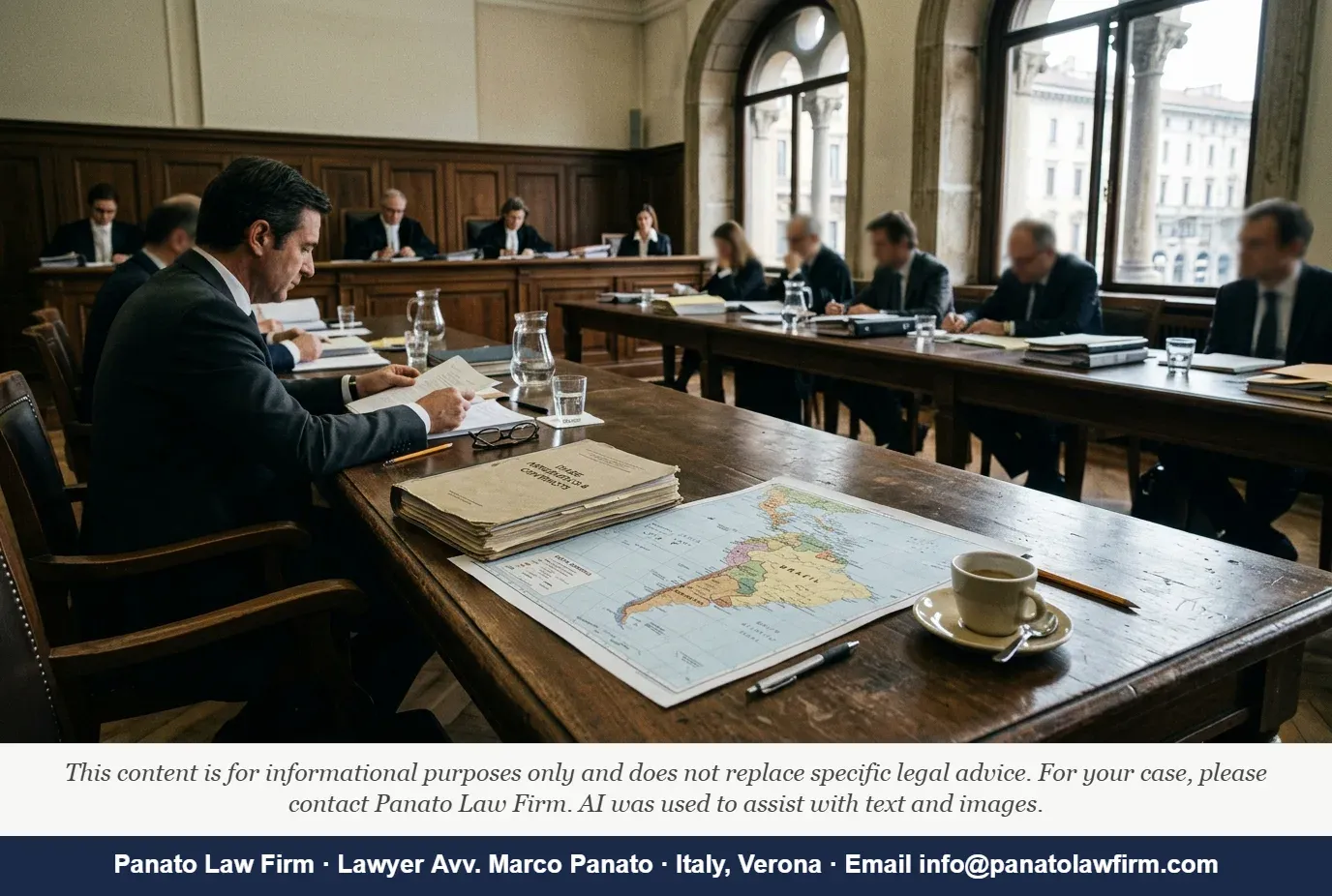
Image prompt: A wide wooden boardroom table in a northern Italian commercial court setting, natural light through tall arched windows, a thick folder of trade documents and a map of Latin America spread open beside a coffee cup, the atmosphere tense but orderly, muted palette of ochre, slate grey and deep wood tones, photorealistic style with shallow depth of field.
Image file: terminating-italian-distribution-agreement-notice-period-cover
HREFLANG BLOCK:
JSON-LD:
LANGUAGE QA: the judgment that came out in April 2026 contains a lesson every Australian exporter with Italian distribution ties should read carefully -> the April 2026 judgment holds a lesson every Australian exporter with Italian distribution ties would do well to heed · termination of an open-ended contract be accompanied by notice given -> termination of an open-ended contract must be preceded by notice given · the contractual notice period is a floor, not a ceiling -> the contractual notice period sets a minimum, not a maximum · the type of activity carried on -> the nature of the business carried on · Italian judges treat that as a fact that inflates the required notice period -> Italian courts treat that as a factor that extends the required notice period · the duration of that period must be assessed by reference to -> the length of that period is determined by reference to · placing particular weight on the promotional investments the distributor entities had already made -> giving particular weight to the promotional investments the distributor entities had already made · had only agreed a revenue target -> had agreed only on a revenue target
Quality: Italian terms without a plain explanation: Corte di Cassazione, codice civile · keyword absent from subheadings · keyword not in the first 100 words
Source check: verdict AMBER — verify before publication
CHECK:
Authority 1: Court of Appeal of Brescia, judgment no. 322, 2 April 2026 (Corte d'Appello di Brescia, Sentenza n. 322, 2 aprile 2026)
REFERENCES: Corte d'Appello di Brescia, n. 322/2026, 2 April 2026
EXISTS? YES — confirmed by ftavvocati.it (secondary digest) and cross-referenced to the Brescia court's official website structure. Primary court repository (ca-brescia.giustizia.it) does not publish individual judgments publicly, so primary confirmation is indirect.
CONTENT MATCHES? YES — parties, sector (chemicals/lubricants), territories (Peru, Brazil, Mexico, USA), revenue target (€700,000), termination date (November 2020), distributor organisational investment all match the brief and the secondary source.
OVERALL: AMBER (existence confirmed by a reliable secondary source; full text not publicly available at the primary court site; no italgiure entry found in this search).
Authority 2: Court of Appeal of Milan, judgment no. 2296, 23 July 2025 (Corte d'Appello di Milano, Sentenza n. 2296, 23 luglio 2025)
REFERENCES: Corte d'Appello di Milano, Sez. III Civile, n. 2296/2025, 23 July 2025
EXISTS? YES — confirmed by doctrine.it (primary court database) and ftavvocati.it (secondary digest), with judge names, case number and procedural history.
CONTENT MATCHES? YES — distribution contract, open-ended, no written framework; recesso ad nutum lawful with reasonable notice assessed against duration, sector and distributor's organisational capacity.
OVERALL: GREEN (existence and content confirmed by doctrine.it, a primary-grade court database).
Authority 3: Tribunal of Turin, judgment no. 2932, 16 June 2025 (Tribunale di Torino, Sentenza n. 2932, 16 giugno 2025)
REFERENCES: Tribunale di Torino, n. 2932/2025, 16 June 2025
EXISTS? UNVERIFIABLE at primary source in this search round.
Do you need legal assistance or a free estimate?
Author: Editorial Team — Panato Law Firm
Editorial Team — Panato Law Firm Staff