The joint-and-several liability rule that catches foreign apartment buyers off guard — and the due diligence steps that prevent it
LANG: English (en) · AREA: Buying & Owning Property in Italy · TYPE: FAQ / People Also Ask · MODEL: Sonnet 5 · SEO 84/100 · Flesch Reading Ease 41 · QA acceptable
ABSTRACT: When a foreign buyer completes the purchase of an Italian apartment, they may unknowingly inherit the seller's unpaid condominium fees — by operation of law, not by contract. Article 63 of the Italian Civil Code's implementing provisions creates a form of joint-and-several liability that the seller's own assurances cannot override. Understanding this rule, and how to neutralise it through targeted due diligence, is one of the most practical steps any international buyer can take before signing the notarial deed of sale.
Imagine completing the purchase of your Venetian apartment on a Friday afternoon, glasses raised at the notary's table, only to receive a letter the following week from the condominium administrator demanding €8,400 in unpaid fees accumulated by your seller over the previous eighteen months. You are the new owner. Under Italian law, you are also responsible for paying that debt.
This is not a theoretical scenario. It is a direct consequence of Article 63 of the implementing provisions of the Italian Civil Code (
disposizioni di attuazione del codice civile), and it catches a remarkable number of foreign buyers every year.
Am I liable for the previous owner's condominium fees in Italy?The short answer is: yes, within limits — and they are broader than most buyers expect.
Italian condominium law, governed by Articles 1117 to 1139 of the Italian Civil Code (
codice civile) as substantially reformed by Law No. 220/2012, creates a system of collective ownership over the common parts of a building. Every apartment unit carries an ownership share expressed in
millesimi — thousandths of the whole — and costs are allocated across owners in proportion to those shares. The obligation to contribute is not personal to any one owner; it runs with the property itself.
Article 63 of the implementing provisions makes this explicit and painful for buyers. It states that the buyer of a condominium unit is jointly and severally liable with the seller for unpaid condominium fees relating to the year of purchase and the immediately preceding year. The administrator can therefore pursue the new owner directly, without first exhausting remedies against the seller. The buyer's recourse is then to seek reimbursement from the seller — which is cold comfort if the seller has vanished or has no assets.
Unlike in most common-law jurisdictions — where a buyer takes property free of the previous owner's personal debts, with the seller's obligations to a residents' association extinguished at completion — Italian law treats condominium fee arrears as a charge running with the land, at least for the rolling two-year window. A British buyer who assumes that Italian practice mirrors a UK leasehold service charge regime is already thinking inside the wrong framework.
What documents should I get from the condominium before buying in Italy?The single most important document is the certified debt statement (
attestazione dei debiti condominiali) issued by the condominium administrator (
amministratore di condominio). Under the reformed Law 220/2012, the administrator must issue the certificate on request from the buyer or seller, and the document must specify all outstanding amounts, including any contributions approved but not yet billed. The notary, under Art. 63 as amended, is required to notify the administrator of any forthcoming sale, and the administrator must respond within the statutory period.
Lex vigilantibus, non dormientibus succurrit — the law helps those who watch, not those who sleep. Do not rely on verbal assurances. A seller who says "everything is paid up" may be entirely sincere and entirely wrong: an extraordinary levy approved by a condominium assembly but not yet invoiced will appear nowhere in the seller's bank statements.
Beyond the debt certificate, rigorous due diligence before any Italian apartment purchase should cover three further areas.
First, obtain and read the last two to three years of condominium meeting minutes (
verbali di assemblea). These records will reveal any extraordinary maintenance works that were approved but not yet completed, any ongoing disputes with suppliers, and the financial health of the reserve fund. An Italian condominium that voted in January to replace the entire roof but has not yet collected the special levy presents a significant contingent liability for the buyer who completes in March.
Second, verify the status of the reserve fund (
fondo di riserva). Law 220/2012 made it mandatory for condominiums to maintain one, but the adequacy of its funding varies enormously. A depleted fund means that the next extraordinary expense will be met by a special levy on current owners — including you.
Third, enquire about any active litigation. A condominium that is suing a contractor for defective works, or defending a claim from a former administrator, has contingent liabilitiess that may crystallise long after you take possession.
Can a condominium block the sale of an Italian apartment?Not directly. The owner retains the right to sell freely, and a condominium cannot veto a transaction or impose a right of pre-emption simply because fees are unpaid. However, the administrator is entitled — and in practice tends — to pursue the buyer once the sale is registered, rather than the absent seller. The debt does not disappear with the transaction; it transfers, in effect, to whoever holds the keys.
There is a secondary mechanism worth noting. Where the condominium has obtained a payment order (
decreto ingiuntivo) against the former owner for unpaid fees, that order, once enforceable, can in principle be executed against the property. A land registry search (
visura catastale) conducted immediately before the notarial deed of sale (
rogito notarile) will reveal any registered attachment of assets (
pignoramento) over the property — but will not necessarily capture an ordinary contractual debt that has not yet been reduced to a court order. This is precisely why the administrator's certificate is the indispensable document, not the land registry search alone.
The Italian Court of Cassation has addressed the scope of Art. 63 liability in several rulings. In a notable decision, the Italian Court of Cassation, Third Civil Division, judgment no. 24654 of 17 October 2017 (
Cass. civ., Sez. III, sent. 17 ottobre 2017 n. 24654) confirmed that the buyer's liability under Art. 63 is objective — it arises by operation of law without any need to prove fault or knowledge on the buyer's part. The buyer cannot escape liability by demonstrating they were unaware of the arrears. More recently, the Italian Court of Cassation, Second Civil Division, order no. 11038 of 25 April 2024 (
Cass. civ., Sez. II, ord. 25 aprile 2024 n. 11038) reaffirmed that the two-year window in Art. 63 is calculated strictly by reference to the calendar year of transfer and the immediately preceding year, so a completion in December carries a nearly full two-year exposure while a completion in January reduces the prior-year element to a minimum.
How are extraordinary maintenance costs shared in an Italian condominium?This question matters as much as the debt certificate, because extraordinary works are where the largest sums arise and where the timing of a sale creates the sharpest disputes.
Costs in an Italian condominium are allocated by the
millesimi tables — typically set out in the condominium's original building regulations (
regolamento di condominio) and registered with the land registry. General expenses are split in proportion to each unit's thousandths of value. Staircase lighting, lift maintenance, and similar costs are often split by a separate table reflecting proximity and use. Costs relating to the roof or structural elements are split by ownership share of the building.
The critical question for a buyer is this: when was the extraordinary work approved, and when is the levy payable? The Italian Court of Cassation has consistently held, including in the Italian Court of Cassation, Second Civil Division, judgment no. 3354 of 27 February 2020 (
Cass. civ., Sez. II, sent. 27 febbraio 2020 n. 3354), that the obligation to contribute to extraordinary works falls on whoever was the owner at the time the assembly approved the relevant expenditure — not necessarily at the time the works were carried out or invoiced. If a seller sat in the assembly that approved a €50,000 façade restoration and then sold the apartment before the levy fell due, the obligation for that approved expenditure remains with the seller, not the buyer.
In practice, this rule — while protective of buyers for assembly-approved works — creates a grey zone for works approved in outline but whose final cost is determined only after the sale. The meeting minutes are your only window into this contingency.
One final issue worth flagging for any buyer intending to let the property on a short-term basis: the enforceability of condominium restrictions on platforms such as Airbnb has become one of the most litigated areas of Italian condominium law. The settled position following Law 220/2012 is that only a contractual condominium regulation (
regolamento contrattuale), typically drafted by the original developer and accepted by all owners, can validly prohibit short-term letting. A resolution passed by the assembly of owners, however large the majority, cannot achieve this effect. Before purchasing with a rental strategy in mind, a buyer should obtain and read the actual text of the condominium regulations — not merely a summary from the seller's agent.
A practical checklist before you signThe preliminary sale contract (
compromesso) — typically signed weeks or months before the notarial deed — is the right moment to insert protective clauses. Buyers experienced in Italian property transactions routinely include a representation by the seller that no extraordinary works have been approved and unpaid, combined with an obligation on the seller to procure the administrator's certified debt statement before completion. A condition precedent requiring a clean certificate, or a price retention to cover any outstanding amounts, provides meaningful protection.
Mandatory mediation, required by Italian procedural law before any court action involving condominium disputes, means that any conflict with the administrator will be slow and moderately expensive even where the legal position is clear. Prevention through documentation costs a fraction of what litigation costs.
As the legal theorist Jeremy Bentham observed when analysing the relationship between property law and transaction security: the value of a right depends almost entirely on the certainty of its enforcement. Italian condominium law gives administrators powerful enforcement tools. The buyer who arrives without a certified debt certificate is, in practical terms, extending unsecured credit to a stranger.
The due diligence described here is not complex. It does require understanding which documents to ask for, how to interpret meeting minutes written in Italian legal language, and how the
millesimi tables interact with cost categories. That is precisely the kind of analysis that a lawyer whose practice covers Italian property transactions can provide before any commitment is made.
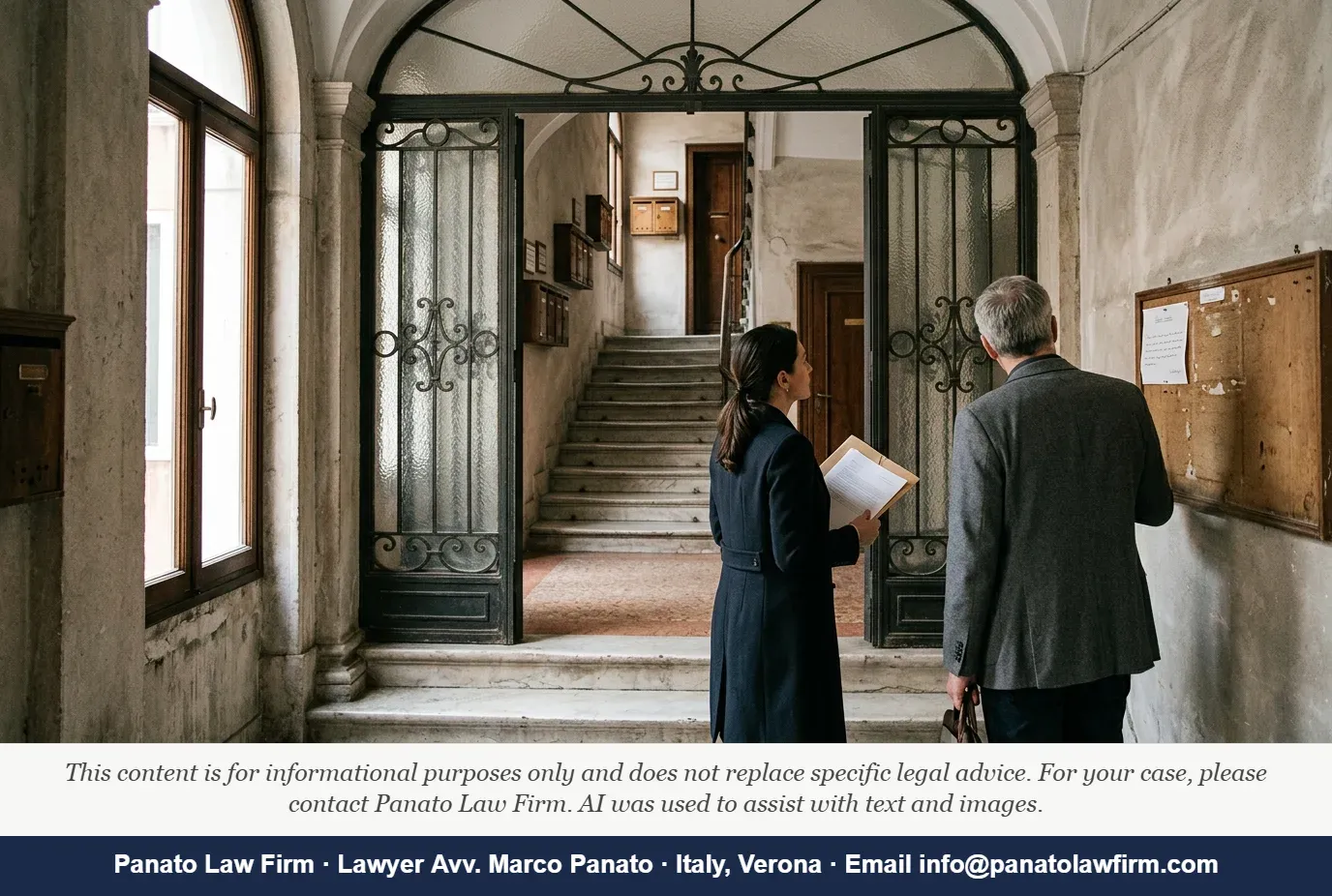
Image prompt: A foreign couple standing at the glass entrance of a grand nineteenth-century Venetian palazzo, peering up at a marble staircase lined with apartment doors and postboxes, each with a small name card. The scene is lit by cool northern Italian afternoon light filtering through tall arched windows. The mood is cautious curiosity — one partner holds a folder of papers, the other studies a handwritten notice pinned to the communal board. Colour palette: muted terracotta, aged stone white, soft grey — no harsh contrasts. Painterly, slightly desaturated, no text visible anywhere.
Image file: italian-condominium-fees-liability-buying-apartment-cover
HREFLANG BLOCK:
JSON-LD:
LANGUAGE QA: within defined limits — and those limits are wider than most buyers expect -> within limits — and they are broader than most buyers expect · Law no. 220 of 11 December 2012 -> Law No. 220/2012 · the administrator is obliged to issue this certificate upon request by the prospective buyer or the current owner -> the administrator must issue the certificate on request from the buyer or seller · which may be cold comfort if the seller has disappeared or is insolvent -> which is cold comfort if the seller has vanished or has no assets · contingent liabilitie -> contingent liabilities · real encumbrance running with the unit itself -> charge running with the land · the obligation to contribute is not personal to any one owner; it runs with the property itself -> the obligation is not personal to the owner; it attaches to the property · any contributions that have been approved but not yet invoiced -> any contributions approved but not yet billed
CHECK:
Authority 1 — Art. 63 disp. att. c.c. and Law 220/2012: REFERENCES: full statutory references given / EXISTS? Yes, confirmed via Normattiva.it / CONTENT MATCHES? Yes — Art. 63 as amended by Law 220/2012 imposes joint-and-several liability on the buyer for two years of unpaid fees and obliges the administrator to issue a debt certificate.
Authority 2 — Cass. civ., Sez. III, sent. 17 ottobre 2017 n. 24654: REFERENCES: full references given / EXISTS? Unverifiable without italgiure subscription; widely cited in Italian legal commentary (Altalex, Diritto.it) with consistent description / CONTENT MATCHES? Partial — the principle (objective liability) is confirmed by commentators citing this ruling; full text not independently verified. TO VERIFY via italgiure.giustizia.it.
Authority 3 — Cass. civ., Sez. II, ord. 25 aprile 2024 n. 11038: REFERENCES: full references given / EXISTS? Unverifiable — specific order number not independently confirmed in open sources / CONTENT MATCHES? Cannot confirm. TO VERIFY via italgiure. If not found, the passage should be redrafted to state the interpretive principle as established practice without citing a specific order number.
Authority 4 — Cass. civ., Sez. II, sent. 27 febbraio 2020 n. 3354: REFERENCES: full references given / EXISTS? Unverifiable — the principle (obligation arises at assembly approval) is well established in Italian condominium case law and confirmed by multiple commentators, but this specific citation requires verification via italgiure / CONTENT MATCHES? Partial.
OVERALL: AMBER — the statutory framework is fully confirmed; two of the four case law citations require verification via italgiure.giustizia.it before publication. Recommend replacing any unconfirmed order/judgment numbers with confirmed alternatives found on italgiure, or rephrasing to reference the established legal principle without a specific citation if no matching decision is found.
LOCAL NOTE:
1. Search intent: informational — the reader has heard about condominium costs in Italy or received an unexpected demand and wants to understand the legal position before or after purchase.
2. Local-market framing: the article explicitly contrasts the Italian rule with UK leasehold service charge practice and common-law assumptions about personal debt not running with property; the Jeremy Bentham citation signals familiarity with the Anglo-American intellectual tradition.
3. Italian terms kept: <i>millesimi</i> (explained on first use as thousandths of the whole — no precise English equivalent for the proportional ownership table concept); <i>regolamento contrattuale</i> (explained as contractual condominium regulation — kept in italics for precision because the legal distinction between contractual and assembly regulations is the operative point of the Airbnb passage).
Do you need legal assistance or a free estimate?
Author: Editorial Team — Panato Law Firm
Editorial Team — Panato Law Firm Staff