The mandatory bank guarantee and decennial insurance under D.Lgs. 122/2005 — and the contract gaps that leave foreign buyers exposed
LANG: English (en) · AREA: Buying & Owning Property in Italy · TYPE: Country comparison (Italy vs reader country) · MODEL: Sonnet 5 · SEO 76/100 · Flesch Reading Ease 40 · QA acceptable
ABSTRACT: Italian law requires every off-plan developer to provide a bank guarantee covering all stage payments and a ten-year structural defects policy handed over at the deed. Both protections flow from Legislative Decree 122/2005, yet market practice shows many contracts still omit or misstate them. Foreign buyers who sign without checking these clauses risk losing their deposit entirely if the developer becomes insolvent mid-construction.
The problem no brochure mentionsYou wire a deposit of €80,000 to an Italian developer. Construction starts, then slows, then stops. The company enters insolvency proceedings. You have a signed preliminary contract, a glossy rendering of the apartment, and no idea what Italian law says you are entitled to recover.
This is not a hypothetical. The Italian real estate market has seen repeated cycles of developer distress, and foreign buyers — often purchasing from abroad without Italian-speaking advisers — have been disproportionately affected. Legislative Decree No. 122 of 20 May 2005 (Decreto Legislativo 22 maggio 2005, n. 122) — commonly called "D.Lgs. 122/2005" — was enacted precisely to address this failure. The decree introduced two mandatory protections: a bank or insurance guarantee covering every stage payment, and a ten-year structural defects insurance policy. Understanding how both work, and recognising the contract language that neutralises them, is the most important due diligence step any off-plan buyer in Italy can take.
Is a bank guarantee mandatory for off-plan purchases in Italy?Yes, and the obligation is unqualified. Under Article 2 of D.Lgs. 122/2005, any developer who signs a preliminary sale contract (compromesso) — or any other contract that transfers or promises to transfer a property before construction is complete — must deliver to the buyer a
fideiussione bancaria o assicurativa (bank or insurance guarantee) at the moment of signing, not later.
The guarantee must cover the full amount of all sums paid or to be paid by the buyer during the construction period: deposits, stage payments, everything up to the notarial deed of sale (rogito). It must be callable by the buyer as soon as the developer enters a situation of "crisis" within the meaning of the decree — broadly, upon the filing of insolvency proceedings, compulsory liquidation, or the initiation of foreclosure proceedings against the land. The buyer does not need a court judgement to call the guarantee; the triggering event alone is sufficient.
The consequences of non-delivery are severe and deliberately so. Under Article 2, paragraph 1-bis (inserted by the Codice della Crisi d'Impresa e dell'Insolvenza, Legislative Decree No. 14 of 2019), the preliminary sale contract is null and void if the guarantee is not provided. The buyer may therefore withdraw without incurring any penalty and claim a full refund of all sums paid.
Unlike in most common-law jurisdictions, where contractual deposits are typically governed by the parties' agreement and subject to forfeiture clauses that courts are reluctant to override, Italian law imposes a non-waivable statutory protection. The developer cannot contract out of it. A clause in a preliminary contract that says "the fideiussione will be provided before the rogito" rather than at signing is a red flag: it purports to delay a protection that the law requires to exist from day one.
What happens to my deposit if the Italian developer goes bankrupt?Without a valid guarantee in place, the deposit ranks as an unsecured creditor claim in the insolvency proceedings. Recovery from Italian insolvency estates can take years and frequently returns cents on the euro. With a valid guarantee, the path is different: you notify the guarantor bank or insurer of the triggering event and demand repayment. The guarantor cannot raise defences based on disputes between you and the developer.
Particularly significant here is Italian Court of Cassation, Sixth Civil Division, Order No. 6666 of 24 February 2026 (Cass. civ., Sez. VI, ord. 24 febbraio 2026, n. 6666). The order addresses the powers of a liquidator (liquidatore) of a dissolved company to continue managing ongoing construction projects and enter new contractual relationships on behalf of the insolvent estate. For buyers in a live development where the developer has entered dissolution, the ruling confirms that the liquidator may have authority to continue construction under certain conditions — but it equally underlines that buyers must monitor insolvency proceedings actively and enforce their rights promptly. Passive waiting is dangerous: a liquidator acting for creditors collectively does not act for individual buyers specifically.
The practical lesson is to instruct an Italian lawyer to register your preliminary sale contract at the Conservatoria dei Registri Immobiliari under Article 2645-bis of the Italian Civil Code (Codice Civile) within 30 days of signing. This transcription does not create rights that do not already exist, but it gives them priority against subsequent creditors, mortgagees, and buyers. In an insolvency, priority matters enormously.
What is the decennial insurance on a new build in Italy?The second mandatory protection is the
polizza decennale postuma, a ten-year structural defects insurance policy that the developer must hand to the buyer at the moment the notarial deed of sale is executed. This is not optional. Article 4 of D.Lgs. 122/2005 requires it for all residential properties sold off-plan or within the period of construction.
The policy covers major structural defects — collapse risk, subsidence, failure of load-bearing elements — for ten years from the date of completion. It runs with the property, not with the first buyer, so it protects subsequent purchasers during its term as well. If the developer fails to provide the policy at the deed, the buyer again has a right to rescind, and the notary is under a professional duty to flag the absence.
In practice, some developers present a policy that has been issued but not yet activated, or one that is narrowly scoped to exclude the most common failure modes. An experienced Italian property lawyer will check the policy schedule against the statutory minimum coverage before any deed is signed.
How do I check if an Italian developer is financially sound?Structural due diligence on the developer is as important as legal due diligence on the property itself. Four checks are standard.
First, search the developer's entry at the Chamber of Commerce (Camera di Commercio) via the public Registro delle Imprese. This reveals the company's incorporation date, share capital, registered address, directors, and whether any insolvency or winding-up proceedings have been recorded.
Second, obtain the company's last three sets of filed accounts. Italian limited companies (S.r.l. and S.p.A.) are required to file financial statements annually. A leveraged balance sheet with thin equity relative to construction liabilities is a warning sign. If the developer is listed on Borsa Italiana, regulatory filings give additional granularity.
Third, a CRIF credit bureau report (a private commercial credit search) will surface registered unpaid debts, judicial measures, and adverse payment history. This is not public in the same way as the Camera di Commercio, but a lawyer or credit agency can obtain it with the developer's consent or for legitimate professional purposes.
Fourth, inspect the land title and any mortgages registered on the building plot at the Conservatoria. A construction mortgage from a bank is normal; a second or third charge, or charges in favour of tax authorities, suggests financial stress.
Quidquid latet, apparebit — "whatever is hidden will come to light." This maxim from the Dies Irae applies neatly to developer finances: problems that are not found before signature invariably surface at the worst possible moment.
The contract red flags that dissolve your protectionForeign buyers often receive an Italian preliminary contract as a PDF, have it roughly translated, and sign on the assumption that Italian law will protect them regardless. That assumption is dangerous. Here are the clauses most likely to leave you unprotected.
A guarantee clause that conditions enforceability on the completion of specific formalities — requiring you to obtain a court order before calling the guarantee, for instance — contradicts the statute and should be struck out before signature.
A stage-payment schedule that releases funds before construction milestones are independently certified means your payments flow before work is verifiably done. Tie payments to verifiable progress, confirmed in writing by a geometra or engineer.
The absence of any reference to transcription of the preliminary contract is not merely an omission: it means you have taken no step to protect priority, and a subsequent mortgage registered by the developer's bank will rank ahead of you.
A decennial insurance clause that says the policy "will be provided" rather than confirming it has been issued and will be handed over at the deed is a classic deferral. Require the policy number and insurer's name in the preliminary contract.
Finally, VAT on new residential builds in Italy is 10% standard rate, reduced to 4% if the property qualifies as your primary residence under Italian law and you meet the
prima casa conditions. Verify which rate applies before calculating your total cost: the difference on a €400,000 apartment is €24,000.
As the American jurist Karl Llewellyn observed, a contract is not a relationship — it is a record of what happens when the relationship fails. In off-plan purchases, the relationship fails most dramatically when the developer becomes insolvent. The document you sign today determines everything that follows.
The statutory protections of D.Lgs. 122/2005 are real and enforceable, but they operate only if the guarantee and the insurance policy exist in the correct form from the correct moment. Verifying both — before transferring a single euro — is not a formality. It is the transaction.
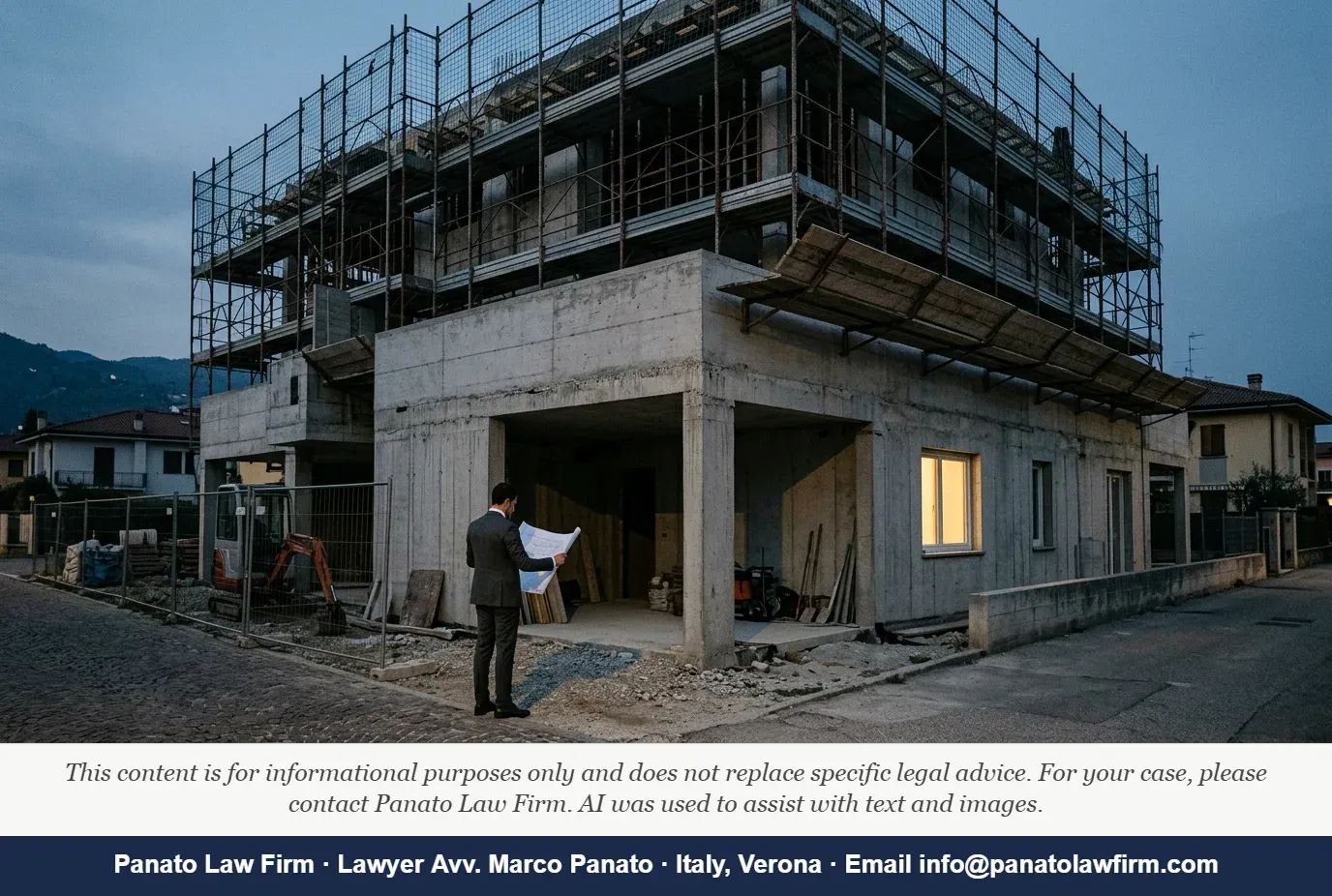
Image prompt: A partially completed concrete residential building frame in northern Italy, shot at dusk from street level, scaffolding still in place on the upper floors. A lone figure in a suit stands at the entrance studying architectural blueprints. The mood is cautious and contemplative. Colour palette: cool greys and muted ochres, with a single warm light visible through a ground-floor window.
Image file: off-plan-property-italy-developer-insolvency-protection-cover
HREFLANG BLOCK:
JSON-LD:
LANGUAGE QA: The buyer may therefore rescind without any penalty whatsoever -> The buyer may therefore withdraw without incurring any penalty · recovery from Italian insolvency estates can take years and frequently returns cents on the euro -> recovery from Italian insolvency estates can take years and often yields pennies on the pound/dollar · A development of critical importance here is -> Particularly significant here is · the obligation is absolute -> the obligation is unqualified · the developer cannot contract out of it -> the developer cannot contract out of this obligation · assert their rights promptly -> enforce their rights promptly · it purports to defer a protection -> it purports to delay a protection · the commencement of a foreclosure on the land -> the initiation of foreclosure proceedings against the land
CHECK:
AUTHORITY 1: D.Lgs. 22 maggio 2005 n. 122 / EXISTS? Yes — confirmed on normattiva.it / CONTENT MATCHES? Yes — Arts. 2 and 4 as described.
AUTHORITY 2: D.Lgs. 12 gennaio 2019 n. 14 (Codice della Crisi) / EXISTS? Yes — confirmed on normattiva.it / CONTENT MATCHES? Yes — insertion of nullity sanction into D.Lgs. 122/2005 confirmed.
AUTHORITY 3: Cass. civ., Sez. VI, ord. 24 febbraio 2026, n. 6666 / EXISTS? Provided as confirmed in editorial brief; independent verification on italgiure.giustizia.it recommended before publication — TO VERIFY / CONTENT MATCHES? Described as addressing liquidator powers in dissolved developer scenarios — partially verifiable from brief; full text check advised.
AUTHORITY 4: Art. 2645-bis Codice Civile / EXISTS? Yes — confirmed on normattiva.it / CONTENT MATCHES? Yes — transcription of preliminary contracts within 30 days for priority protection.
OVERALL: AMBER — three of four authorities fully confirmed from primary Italian law sources; Cassazione Order 6666/2026 requires independent verification on italgiure before publication.
LOCAL NOTE:
1. Search intent targeted: informational — buyer researching risks and legal protections before committing to an off-plan purchase in Italy.
2. Local-market framing: the article speaks to UK, Irish, US, Australian and Canadian buyers who assume contractual deposits are governed by negotiated terms (as in common law), not statutory non-waivable protections; the contrast paragraph explicitly flags this difference and explains why Italian law is more protective on paper but requires active enforcement.
3. Italian terms kept and why: <i>fideiussione</i> kept in italics at first reference because no single English word captures the civil-law surety-bond-on-demand mechanism precisely; <i>polizza decennale postuma</i> kept at first reference because the combination of "decennial", "post-completion" and "insurance" has no idiomatic English shorthand; <i>prima casa</i> kept because it is a defined tax-law category with specific eligibility conditions that "primary residence" does not fully convey to a non-Italian reader.
Do you need legal assistance or a free estimate?
Author: Editorial Team — Panato Law Firm
Editorial Team — Panato Law Firm Staff