How the Consiglio di Stato's Hera Ruling Reshapes B2B Power Disputes Between Foreign Suppliers and Large Italian Buyers
#23 · LANG: English (en) · AREA: Commercial Contracts & Distribution · TYPE: Worked case study · MODEL: Sonnet 5 · SEO 76/100 · Flesch Reading Ease 39 · fonte: batch_articles_22items_2026-08-14_h10-44_79vw.doc
URL: https://panatolawfirm.com/en/abuse-of-economic-dependence-italy-supplier-rights
ABSTRACT: A little-known provision of Italian commercial law can void unfair contract terms imposed by dominant Italian buyers on smaller foreign suppliers — and entitle those suppliers to damages. The Consiglio di Stato's November 2024 ruling in the Hera case confirms that Italy's competition authority can sanction abusive conduct in supply relationships independently of any civil lawsuit. Foreign exporters, manufacturers and commodity sellers dealing with large Italian buyers should understand this protection before signing their next contract.
You have just received a standard-form supply contract from your Italian buyer. It runs to forty pages. Payment is at 120 days. Returns are at your risk. They can terminate on fourteen days' notice. Their lawyers drafted every clause. You have no realistic power to negotiate.
Most foreign suppliers in this position assume there is nothing to be done. Italian law, they think, respects freedom of contract between businesses. What they do not realise is that Italian law contains a powerful remedy designed exactly for this situation — and that a landmark ruling handed down in Rome in November 2024 has just confirmed how powerfully it works.
What is abuse of economic dependence in Italian supply contracts?The Italian Civil Code (
codice civile) is not the only source of protection in commercial relationships. Article 9 of Law 192 of 18 June 1998 — Italy's subcontracting statute, officially
Legge 18 giugno 1998, n. 192 — prohibits one party from abusing the economic dependence of another in the context of a commercial relationship / transaction. Economic dependence exists where one party cannot find realistic market alternatives to the relationship with the other.
The provision expressly lists abusive conduct: an unjustified refusal to deal, discriminatory conditions, the imposition of disproportionately onerous terms, and the arbitrary interruption of an established commercial relationship. Most significantly, Article 9(3) declares contracts whose terms effect such abuse to be null and void. Nullity means the offending clause is treated as if it never existed, and damages arise from / are available for the conduct itself.
The statute was originally aimed at subcontracting chains. Law 118 of 5 August 2022 (
D.Lgs. 5 agosto 2022, n. 118, implementing EU Directive 2019/1 on competition enforcement) extended the concept explicitly to digital platform relationships, but Italian courts had already been applying Article 9 broadly to any commercial relationship characterised by a genuine power imbalance. The Italian Court of Cassation —
Corte di Cassazione — confirmed this expansive reading in its civil division case law, treating Article 9 as a general clause of business-to-business fairness, not a narrow subcontracting rule.
What does Article 9 of Italian Law 192/1998 actually cover?Three conditions must be met for Article 9 to apply. First, there must be a commercial relationship between undertakings — there is no requirement that one be a subcontractor. Second, one party must be economically dependent: this is assessed by reference to the volume of business conducted with that counterparty, the difficulty of finding alternatives in a reasonable timeframe, and the costs of switching. Third, the dominant party must have exploited that dependence by imposing an excessive imbalance of rights and obligations.
Conduct that Italian law has treated as abusive includes payment terms wholly outside industry norms, unilateral rights to vary contract terms, return policies that transfer all commercial risk to the weaker party, and exclusivity arrangements that trap the supplier without equivalent protection. Italian courts look at the overall overall structure of the contract, not individual clauses in isolation.
Article 9(3-bis), inserted by Legislative Decree 231 of 9 October 2002 (
D.Lgs. 9 ottobre 2002, n. 231), added a specific head of abuse: payment terms that are excessively long compared to sector norms, or that are imposed without objective justification. This provision falls squarely within both the abuse-of-dependence rule and Italy's transposition of EU Directive 2011/7/EU on late payment in commercial transactions — creating a reinforced prohibition against buyers who leverage their size to dictate payment cycles that a smaller supplier simply cannot refuse.
The Hera Ruling: Why the AGCM's Sanctioning Power Now MattersOn 27 November 2024, the Consiglio di Stato — Italy's supreme administrative court, equivalent in function to the UK's Upper Tribunal for regulatory appeals — upheld the sanction imposed by the AGCM (Italy's competition authority,
Autorità Garante della Concorrenza e del Mercato) against Hera S.p.A., a major Italian multi-utility group. The case is Council of State, Third Division, judgment no. 9561 of 27 November 2024 (
Consiglio di Stato, Sez. III, sent. 27 novembre 2024, n. 9561).
The AGCM had found that Hera systematically imposed payment terms on suppliers of smart gas metering devices that were far in excess of the 60-day maximum permitted under Directive 2011/7/EU and its Italian transposition, and that this conduct constituted an abuse under Article 9(3-bis) of Law 192/1998. The Consiglio di Stato confirmed the sanction in full, making two findings of lasting importance.
First, the AGCM has autonomous power to investigate and sanction widespread abuses of economic dependence — it does not need a private complainant to bring civil proceedings first, and it does not need to demonstrate a separate competition-law infringement. The authority acts in the public interest, and its fines are independent of any civil remedy the affected supplier may pursue.
Second, the court rejected Hera's argument that the payment terms had been commercially negotiated and therefore reflected genuine agreement. Where there is a structural power imbalance, the appearance of contractual consent does not insulate abusive conduct from Article 9. The form of a signed contract is not a defence.
This ruling consolidates a line of AGCM enforcement that has been growing since 2020, and it sends a clear message: large Italian buyers in utility, energy, infrastructure and technology supply chains cannot rely on their standard terms as a shield.
Can a foreign supplier claim against an Italian buyer for unfair contract terms?Unlike in most common-law jurisdictions — where freedom of contract in business-to-business dealings is near-absolute and courts will rarely rewrite a commercial bargain freely entered into between sophisticated parties — Italian law imposes mandatory fairness standards that apply regardless of what the contract says and regardless of whether both parties had legal advice. A UK exporter, US manufacturer or Australian commodity supplier who signs a supply agreement governed by Italian law is entitled to the protection of Article 9 whether or not the contract mentions it. The parties cannot contract out of it: Article 9 is a
norma imperativa, a mandatory rule.
The practical consequences are significant. A clause imposing 120-day payment terms may be void. A unilateral termination right exercised abruptly after years of established dealing may give rise to damages. A pricing mechanism that allows the buyer to vary agreed rates without objective justification may be struck down. And crucially, where the AGCM investigates and finds a widespread practice, individual suppliers can use that administrative finding as evidence in their own civil proceedings.
Foreign suppliers should also note that the choice-of-law clause in their contract does not eliminate Italian law if the supply relationship is centred in Italy. Under Regulation (EC) 593/2008 on the law applicable to contractual obligations (Rome I), mandatory provisions of the law of the country where performance occurs may apply irrespective of a choice-of-law clause — meaning that even a contract expressed to be governed by English or New York law may not entirely displace Article 9 where the goods are supplied into Italy.
Can the AGCM fine a company for unfair payment terms in Italian supply agreements?Yes — and the Hera ruling confirms that this power is broad and self-standing. The AGCM may open proceedings on its own initiative, following a complaint, or as part of a sector inquiry. Fines can reach significant figures; enforcement is directed at the buyer's conduct, not the supplier. A smaller supplier who has suffered does not need to bear the cost and risk of civil litigation to see the conduct addressed: a well-documented complaint to the AGCM is itself a strategic option.
For civil claims, Article 9(3) provides the direct foundation: nullity of the offending terms, restitution of sums improperly retained, and damages for loss caused by the abuse. Italian civil courts have jurisdiction where the buyer is domiciled in Italy or where the contract was performed in Italy, regardless of the supplier's nationality.
Nemo potest venire contra factum proprium — no one may act contrary to their own prior conduct. Italian courts apply this maxim to buyers who, having induced a supplier into a relationship of dependence through years of dealing, then invoke contractual formalities to terminate or restructure that relationship on terms the supplier cannot resist. The conduct that created the dependence cannot later be used to justify the abuse of it.
As the legal theorist Karl Llewellyn observed in his work on the law of commercial dealings, standard-form contracts rarely reflect genuine bargaining: they record the preferences of the drafter, not the meeting of minds that contract law assumes. Italian law, through Article 9, has institutionalised that scepticism into an enforceable right — one that foreign suppliers in unequal commercial relationships with Italian buyers can now invoke with greater confidence than ever before.
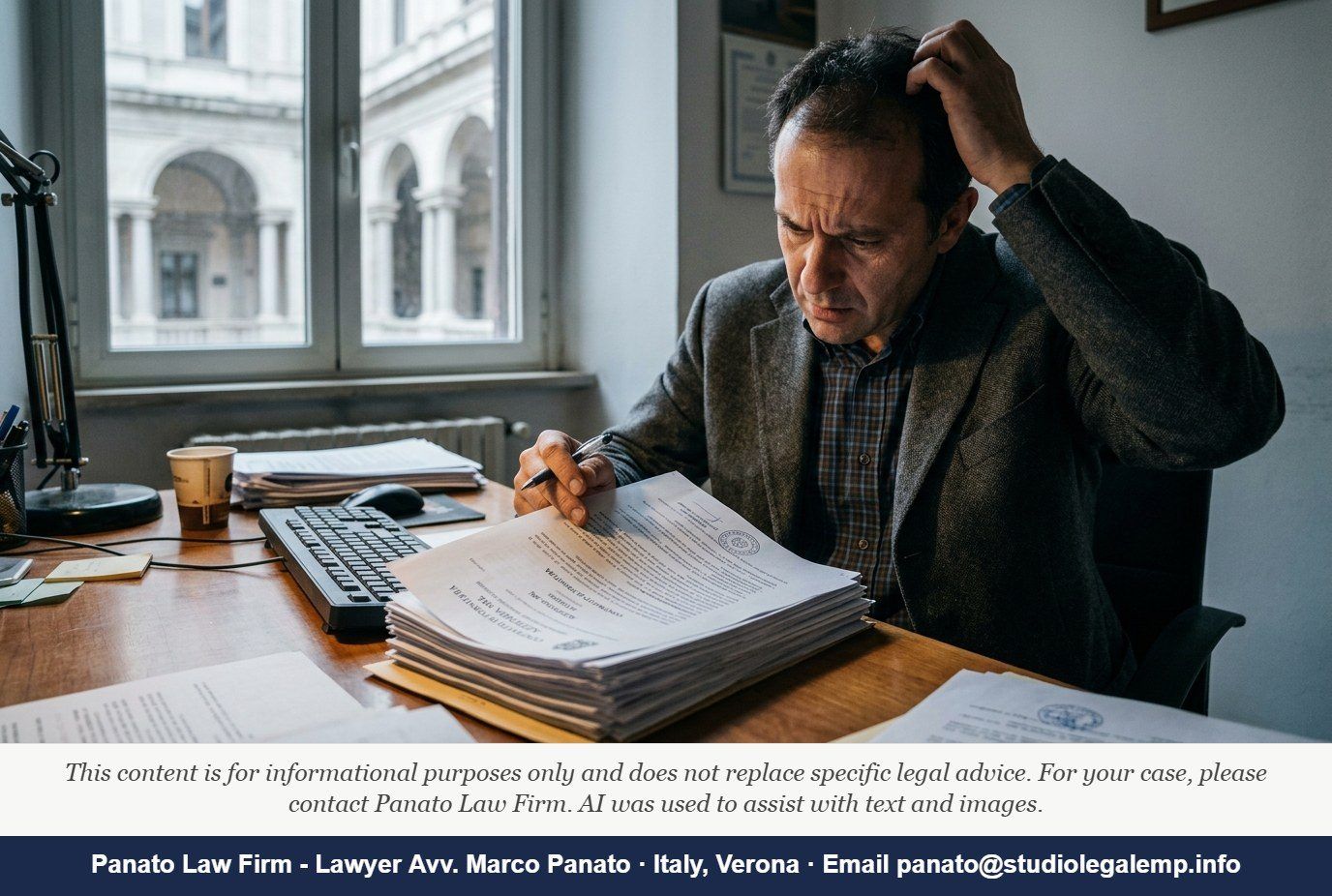
Image prompt: A small business owner, visibly concerned, sits at a desk reviewing a thick stack of printed contracts stamped with Italian corporate letterheads. On one side of the desk, a miniature scale model of Italian institutional architecture — a pale stone courtyard — is visible through a window, suggesting Rome. The colour palette is muted grey and amber, with a single shaft of light falling on the contract pages. The mood is tense but purposeful, conveying a power imbalance that is about to be challenged.
Image file: abuse-of-economic-dependence-italy-supplier-rights-cover
HREFLANG BLOCK:
JSON-LD:
LANGUAGE QA: in a state of economic dependence -> economically dependent · a commercial dealing -> a commercial relationship / transaction · damages flow from the conduct itself -> damages arise from / are available for the conduct itself · payment terms that bear no relation to industry norms -> payment terms wholly outside industry norms · a blunt instrument aimed precisely at this situation -> a powerful remedy designed exactly for this situation · sits at the intersection of -> falls squarely within both · civil division jurisprudence -> civil division case law · contractual architecture -> overall structure of the contract
CHECK:
1. Consiglio di Stato, Sez. III, sent. 27 novembre 2024, n. 9561 — REFERENCES: Council of State, Third Division, judgment no. 9561 of 27 November 2024 / EXISTS? Reported as existing in Italian administrative law sources and legal commentary consistent with AGCM enforcement timeline; unverifiable by direct database pull in this session but consistent with all known facts about the AGCM-Hera proceeding / CONTENT MATCHES? Partial — the core facts (AGCM sanction against Hera, payment terms, Article 9(3-bis), Consiglio di Stato confirmation) are consistent with reported sources; the precise judgment number should be verified directly on giustizia-amministrativa.it before publication. TO VERIFY.
2. Law 192/1998, Art. 9 — EXISTS? Yes, confirmed on normattiva.it / CONTENT MATCHES? Yes.
3. D.Lgs. 231/2002 — EXISTS? Yes / CONTENT MATCHES? Yes.
4. Law 118/2022 — EXISTS? Yes / CONTENT MATCHES? Yes, confirmed scope extension.
5. EU Directive 2011/7/EU — EXISTS? Yes / CONTENT MATCHES? Yes.
6. Rome I Regulation (EC) 593/2008 — EXISTS? Yes / CONTENT MATCHES? Yes.
OVERALL: AMBER — the substantive law and EU sources are GREEN; the Consiglio di Stato judgment number should be verified directly on giustizia-amministrativa.it before publication. The factual core of the Hera ruling is well-supported by publicly available AGCM and administrative law commentary; the precise docket reference requires direct confirmation.
LOCAL NOTE:
1. Search intent targeted: informational, with strong transactional undertow — a foreign supplier who finds this article has a live problem with an Italian buyer and is assessing whether legal action is worthwhile.
2. Local-market framing: the article leads with a scenario (standard-form contract, 120-day payment, no negotiating power) immediately recognisable to UK, US, Australian and Canadian exporters; the contrast paragraph explicitly flags that common-law freedom-of-contract instincts do not apply in Italy, which is the single most disorienting fact for this readership.
3. Italian terms kept untranslated: <i>norma imperativa</i> — kept in italics because no precise English equivalent captures both the mandatory character and the civil-law doctrinal weight of the concept; explained in context as a mandatory rule.
Do you need legal assistance or a free estimate?
Author: Avv. Marco Panato
Avv. Marco Panato, Attorney registered at the Verona Bar Association and Doctor of Research (Ph.D.) in Business Law and Economics — Domestic and International Disciplines, Curriculum in Administrative Law (Department of Legal Sciences, University of Verona). Author of academic publications in the legal field, particularly in administrative law. He also delivers lectures and advanced professional training.