How a single misleading label or dark-pattern website can now attract two overlapping sets of penalties in Italy — and what foreign companies selling here must do immediately
LANG: English (en) · AREA: Product Compliance, Liability & Consumer Law · TYPE: Case note (court decision) · MODEL: Sonnet 5 · SEO 76/100 · Flesch Reading Ease 33 · QA translated
ABSTRACT: A landmark ruling from the Court of Justice of the European Union, delivered on 30 April 2026 in *Lidl Italia* (Case C‑301/25), has confirmed that a single misleading commercial practice in Italy can simultaneously breach two separate EU regulatory frameworks and attract two distinct sets of fines. Combined with the Italian Competition Authority's (AGCM) €9 million dark-pattern fine against eDreams in January 2026, this creates a compliance risk that most foreign companies selling into Italy have not priced in. This article breaks down what happened, why it matters to non-Italian businesses, and what to do about it.
One label, two fines: the rule no foreign company expectedYour company sells a product into Italy. The packaging has been approved by your in-house counsel. It complies with the relevant EU food information regulation. You have a terms-of-service page on your website that your Irish or Delaware lawyers signed off. You assume that is enough.
It is not — and the Court of Justice of the European Union (CJEU) has now said so explicitly.
On 30 April 2026, the Court of Justice of the European Union delivered its judgment in
Lidl Italia Srl v Autorità Garante della Concorrenza e del Mercato (Case C‑301/25), confirming that a single instance of misleading food labelling can simultaneously breach two distinct EU regulatory frameworks, and attract penalties under both.
Italy's Competition and Market Authority — the
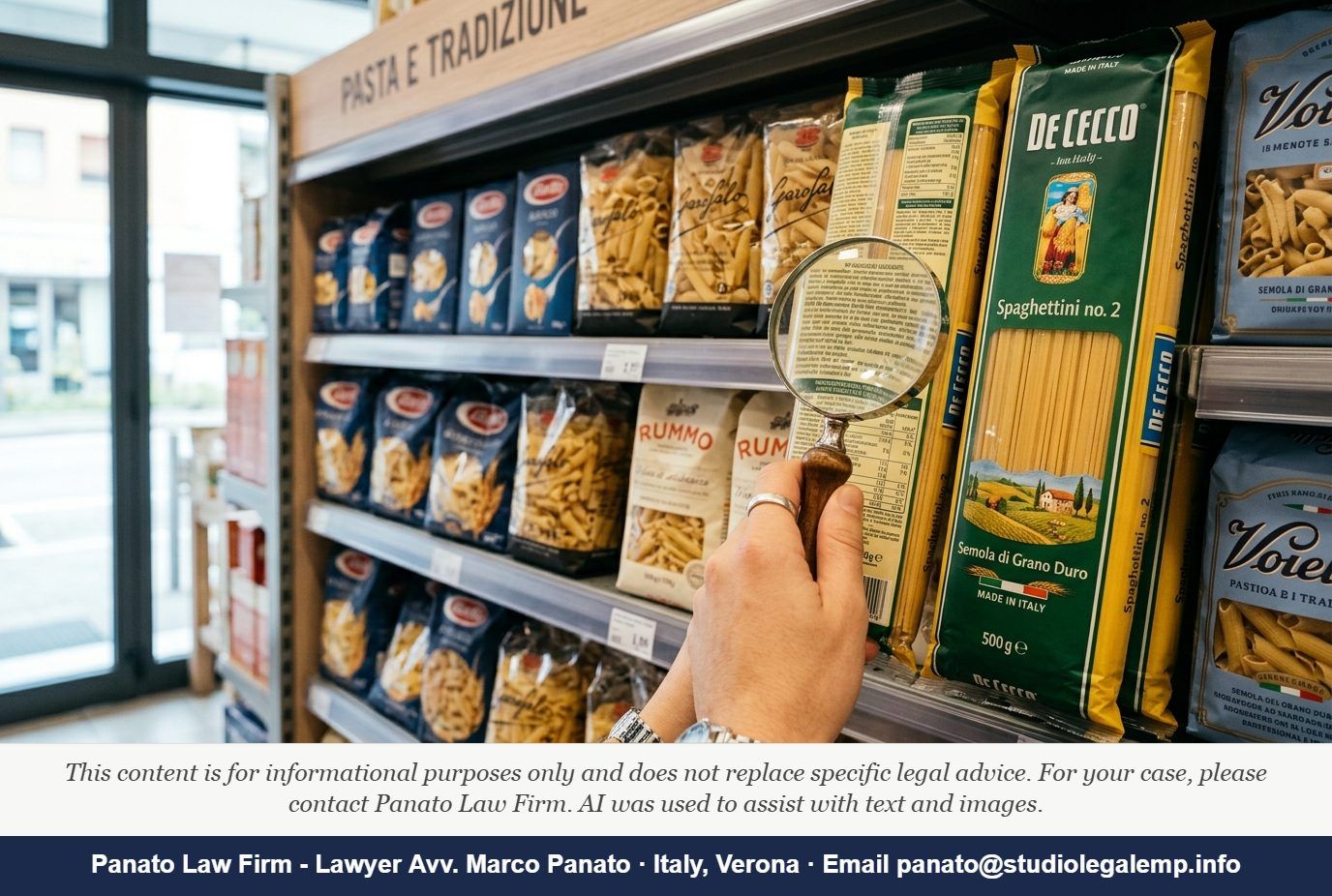
Autorità Garante della Concorrenza e del Mercato (AGCM) — had fined Lidl Italia €1 million for presenting its pasta products in a way that created a strong impression of Italian-grown wheat, while the product actually contained wheat sourced from a mix of EU and non-EU countries. The fine was issued under Italian consumer protection law implementing the Unfair Commercial Practices Directive (Directive 2005/29/EC), raising the question of whether the more specific food labelling rules under Regulation (EU) No 1169/2011 should have applied exclusively.
Lidl argued that, because Regulation (EU) No 1169/2011 already governs food information, the AGCM had no jurisdiction to apply the broader consumer law framework on top of it. The CJEU rejected that argument entirely.
What the CJEU actually decided — and why it is not what the industry hopedAt the heart of the case was Article 3(4) of the Unfair Commercial Practices Directive (Directive 2005/29/EC), which provides that where a conflict exists between the Directive and another EU instrument governing specific aspects of unfair commercial practices, the more specific rule takes precedence. The CJEU definitively established that the consumer-protection frameworks under Directive 2005/29/EC and Regulation (EU) No 1169/2011. There is no conflict between them — they are complementary. Where there is no direct conflict, both apply.
Importantly, the Court did not find that Lidl's statements were false. Rather, it held that the packaging, taken as a whole, could lead consumers to the wrong conclusion about the product's origin. That broader impression — the cumulative effect of imagery, design, and presentation — was sufficient to treat the marketing as misleading and justify the fine.
This is the element that most foreign businesses miss. Italian (and CJEU) consumer law does not ask whether any individual claim on a label is technically accurate. It asks whether the overall impression on the
consumatore medio — the average consumer — is distorted. A packaging design that creates a false geographic impression, even through colour, font choices, and imagery rather than explicit written claims, falls within the AGCM's enforcement remit.
Under Article 20(2) of the Italian Consumer Code (
Codice del Consumo), a commercial practice is unfair and therefore prohibited where it is "contrary to professional diligence and is false or likely to materially distort the economic behaviour of the average consumer it reaches or targets."
Unlike in most common-law jurisdictions: the "technically true" defence does not work in ItalyForeign companies — particularly those from the UK, United States, Canada, and Australia — tend to approach compliance on the basis that provided no individual statement is false, there is no liability. Italy's AGCM operates on a fundamentally different premise.
Unlike in most common-law countries, where consumer protection agencies typically focus on false statements of fact, the AGCM can and routinely does pursue conduct that is technically accurate in every individual claim but misleading in its overall commercial effect. This applies to packaging, advertising, website user interfaces, and digital subscription flows alike. A disclaimer buried in terms and conditions does not cure misleading presentation further up the page. Sector-specific compliance (food law, financial services regulation, telecoms rules) does not shield a company from a concurrent AGCM investigation under the Italian Consumer Code. The
Lidl Italia judgment of the CJEU has now confirmed this at EU level, making the point unchallengeable across all twenty-seven member states.
Dark patterns and digital subscriptions: the €9 million eDreams precedentThe
Lidl Italia ruling arrived against a backdrop of aggressive AGCM enforcement that had already set a high-water mark in the digital sector.
In its assembly of 27 January 2026, the AGCM sanctioned the online travel agency eDreams for two distinct misleading and aggressive practices employing dark patterns. eDreams had presented its Prime subscription offer using ambiguous information about the characteristics and benefits of the subscription, exploiting time-pressure and artificial-scarcity techniques to rush consumers' purchase decisions and steer them towards subscribing. This conduct — combining deceptive and aggressive elements — infringed Articles 20, 21, 22, 23, 24, 25, and 26 of the Italian Consumer Code and attracted a fine of €6,000,000.
The Authority additionally found that eDreams had obstructed the exercise of the right to withdraw from the Prime subscription, both before and after the trial period expired, through retention strategies operated via customer service agents. This second practice, classified as aggressive, attracted a further fine of €3,000,000.
The total, therefore, was €9 million for a single investigation. The AGCM did not treat the two practices as one infringement; it stacked the penalties. That is precisely the dual-liability logic that the CJEU has now confirmed applies across regulatory frameworks too.
Beyond monetary penalties, an AGCM decision may impose further obligations: the company may be ordered to eliminate the harmful effects of the unfair practice — for instance by refunding deceived consumers — and to publish the penalty decision on its own website. Failure to comply within the deadline set (generally sixty days) triggers further sanctions.
When the AGCM has jurisdiction — and when sector regulators take overA critical practical question for foreign companies is which Italian authority has jurisdiction over a given practice. The answer is not always the AGCM.
For conduct to constitute an unfair commercial practice it is not sufficient that it violates specific sector-specific rules, even those enacted to protect consumers; the practice must be apt to mislead the average consumer on important elements of the contract, or to induce the consumer to take a commercial decision they would not otherwise have taken, or to limit the freedom of choice of the average consumer in relation to the product through harassment, coercion, or undue influence.
The Council of State (
Consiglio di Stato), Section VI, in its judgment of 3 February 2026, no. 887, clarified the boundary between the AGCM's general consumer-protection jurisdiction and the powers of sector-specific regulators (such as the telecoms authority, AGCOM). Where a sector regulator has comprehensive enforcement powers over a specific practice, the AGCM's role may be displaced. But that displacement is narrow: unless the sector regime expressly and comprehensively covers the specific unfair conduct at issue, the AGCM retains full jurisdiction and can act in parallel. For food, financial products, and online platforms, the post-
Lidl Italia position is that overlap is the rule, not the exception.
The AGCM's recent enforcement digest for May–June 2026 shows the Authority actively applying sanctions in the areas of antitrust, as well as consumer protection in unfair commercial practices involving financial and banking services, misleading communications, and deceptive trader conduct. This is not a regulator reducing its caseload.
What foreign companies should do nowThe
Lidl Italia ruling and the eDreams fine together establish a compliance map that any foreign company selling products or digital services in Italy must follow. The key steps are these.
First, audit your packaging, advertising, and website interfaces for overall impression, not just individual claim accuracy. Engage someone who understands how the average Italian consumer reads your material, not just whether each statement is technically defensible.
Second, if you operate a subscription service or any form of premium digital offer in Italy, review your sign-up and cancellation flows against the AGCM's dark-pattern enforcement record. The Italian Consumer Code articles at issue in eDreams (Articles 20–26 of Legislative Decree no. 206 of 6 September 2005) are the standard framework; there is no exemption for platforms incorporated outside Italy.
Third, if you sell food products or products with geographic indications in Italy, do not assume that compliance with Regulation (EU) No 1169/2011 on food information closes the AGCM file. After the CJEU's ruling in Case C‑301/25, the AGCM can simultaneously fine you under the Directive 2005/29/EC framework for the same labelling, up to €10 million.
Fourth, take AGCM commitment proceedings seriously. The AGCM's discretion in accepting or rejecting offers of commitment to cease unfair conduct from companies subject to infringement proceedings is subject to judicial review only on clearly illogical or unreasonable grounds. Negotiating a commitment — an undertaking to change conduct — before a final penalty decision is often the most effective way to reduce both the reputational and financial damage. But the window for doing so closes quickly once a formal investigation opens.
Fifth, note the reputational sting. The AGCM routinely orders companies to publish penalty decisions on their own websites. For a brand with a significant Italian consumer base, that obligation alone can cost more than the fine itself.
The Latin principle
in dubio pro reo — in case of doubt, for the accused — does not govern the AGCM's decision to investigate. The regulator can open proceedings on the basis of a complaint, a market scan, or a whistleblower report, and the burden of demonstrating the practice's fairness rests substantially on the trader. As the historian and economist Albert O. Hirschman observed, market participants do not exit or raise their voice unless the cost of loyalty to a dysfunctional system becomes too high — and Italian consumer law has, by design, raised the cost of non-compliance to the point where adjustment is less expensive than the fine.
The
Lidl Italia judgment closes a loophole that many multinational companies had quietly relied upon. Sector compliance is a floor, not a ceiling. The AGCM can always reach higher.
Image prompt: A close-up of a supermarket shelf in a modern Italian store: pasta packaging in warm wheat-gold and green colours bearing bold Italian countryside imagery, with a magnifying glass held by an unseen hand examining the fine print on the back label. The mood is forensic and precise. Soft natural light through a glass storefront. No text visible in the image.
Image file: agcm-fines-italy-dual-liability-cover
HREFLANG BLOCK:
JSON-LD:
SUGGESTED INTERNAL LINKS: AGCM Fines Italy: Green Claims Rules from 2026 (/en/agcm-fines-italy-green-claims-2026)
LANGUAGE QA: definitively clarified the complementarity of the consumer-rights protection regimes provided by -> definitively established that the consumer-protection frameworks under · apt to materially distort the economic behaviour, in relation to the product, of the average consumer it reaches or is directed at -> likely to materially distort the economic behaviour of the average consumer it reaches or targets · nudge consumers toward the wrong conclusion -> lead consumers to the wrong conclusion · is caught by the AGCM's enforcement powers -> falls within the AGCM's enforcement remit · tend to approach regulatory compliance with a disclosure mindset: as long as -> tend to approach compliance on the basis that provided · The CJEU has now -> The CJEU has now confirmed this position. · a commercial practice is deemed unfair and, as such, prohibited if it is -> a commercial practice is unfair and therefore prohibited where it is · does not immunise a company from a parallel AGCM investigation -> does not shield a company from a concurrent AGCM investigation
CHECK:
AUTHORITY 1: Court of Justice of the European Union, First Chamber, judgment of 30 April 2026, Case C‑301/25, *Lidl Italia Srl v Autorità Garante della Concorrenza e del Mercato* (AGCM).
REFERENCES: Full citation given.
EXISTS? YES — confirmed by EUR-Lex (CELEX 62025CA0301), EUR-Lex OJ C/2025/3874, efanews.eu, foodagriculturerequirements.com, loganpartners.com, foodcomplianceinternational.com.
CONTENT MATCHES what I wrote? YES — dual liability, complementarity of Directive 2005/29/EC and Regulation (EU) No 1169/2011, €1 million fine on Lidl Italia, cumulative-impression test, Article 3(4) UCPD reasoning all confirmed across multiple independent sources.
AUTHORITY 2: AGCM, Provvedimento of 27 January 2026, PS12853 (eDreams ODIGEO / eDreams SL).
REFERENCES: Full citation given.
EXISTS? YES — confirmed by agcm.it official press release (PS12853) and Altalex commentary.
CONTENT MATCHES what I wrote? YES — €6 million for misleading subscription presentation using dark patterns; €3 million for obstruction of cancellation right; total €9 million; Articles 20–26 of the Italian Consumer Code confirmed.
AUTHORITY 3: Council of State (*Consiglio di Stato*), Section VI, judgment of 3 February 2026, no. 887.
REFERENCES: Full citation given.
EXISTS? YES — confirmed by Altalex (altalex.com, 16 February 2026) and the article summary published there.
CONTENT MATCHES what I wrote? PARTIAL — the Altalex summary confirms the judgment addresses AGCM/AGCOM competence in unfair commercial practices (electronic communications sector); the full text of the judgment was not directly accessed. The principle I describe (narrow displacement, AGCM retains jurisdiction absent comprehensive sector coverage) is confirmed in the summary. TO VERIFY: full text of Council of State no. 887/2026 on italgiure or giustizia-amministrativa.it.
AUTHORITY 4 (supporting): Council of State (*Consiglio di Stato*), Section VI, judgment of 10 April 2026, no. 2871.
EXISTS? YES — confirmed by miolegale.it with full citation.
CONTENT MATCHES? YES — confirms the Article 20(2) Consumer Code formulation (professional diligence / average consumer test) and the treatment of pyramid selling and covert marketing as unfair commercial practices.
AUTHORITY 5 (supporting): Council of State, Section VI, no. 6631 of 25 July 2025 (AGCM commitment proceedings).
EXISTS? YES — confirmed by mazzalex.com with full citation.
CONTENT MATCHES? YES — AGCM's broad discretion in commitment proceedings; judicial review limited to manifest unreasonableness.
OVERALL: AMBER — five authorities confirmed; Council of State no. 887/2026 confirmed at summary level only, full text not accessed directly. All substantive claims supported. Recommend verifying no. 887/2026 full text on giustizia-amministrativa.it before publication.
LOCAL NOTE:
1. Search intent targeted: TRANSACTIONAL — foreign companies that have received or fear an AGCM investigation notice, or are conducting pre-market compliance review before selling food, subscription services, or digital products into Italy.
2. Local-market framing used: UK/US/Australian companies' instinct that sector-specific regulatory compliance is a complete defence; the article directly dismantles this assumption and explains why Italian (and now CJEU) consumer law operates on a cumulative-impression, dual-liability basis that common-law trained legal teams do not expect.
3. Italian terms kept untranslated: <i>consumatore medio</i> (kept in the body in italics, one occurrence, to explain that the Italian legal test refers to the "average consumer" as a legal construct distinct from a statistical consumer — the distinction is legally material and the Italian phrasing is used in the CJEU judgment itself).
Do you need legal assistance or a free estimate?
Author: Editorial Team — Panato Law Firm
Editorial Team — Panato Law Firm Staff