Fideiussione guarantees, advance payment protection and what the 2026 Insolvency Code ruling means for foreign buyers
LANG: English (en) · AREA: Buying & Owning Property in Italy · TYPE: Mistakes to avoid · MODEL: Sonnet 5 · SEO 64/100 · Flesch Reading Ease 41 · QA acceptable
ABSTRACT: Purchasing a new-build or off-plan property in Italy carries a specific legal risk that catches foreign buyers off guard: developer insolvency before completion. Italian law — most recently reinforced by a landmark 2026 Italian Court of Cassation ruling — provides a structured protection regime for advance payments, but only if the buyer knows what to demand and when. This guide explains the guarantee framework, where it fails in practice, and what steps protect your position from the moment you sign a preliminary contract.
You have found a new-build apartment in Verona, a villa under construction in Tuscany, or a lakeside development on Lago di Garda. The developer's brochure is glossy, the completion date is eighteen months away, and the agent asks for a deposit of 20–30 per cent of the purchase price before work is finished. At that moment, one question matters above all others: if the developer goes insolvent before you ever get your keys, how much of your money can you actually recover?
The answer depends almost entirely on two things: whether you were given a valid
fideiussione and whether your preliminary sale contract (compromesso) was properly transcribed at the land registry. In February 2026 the Italian Court of Cassation clarified precisely how the insolvency rules bite on those two variables — and the ruling is not comfortable reading for buyers who skipped either step.
What is a fideiussione in an Italian property purchase?A
fideiussione is a personal guarantee issued by a bank or insurance company. In the off-plan context it functions as a first-demand guarantee: if the developer fails to deliver, you can call on the guarantor directly to recover every sum you have advanced — deposits, stage payments, VAT — without first suing the developer.
Legislative Decree 122 of 20 June 2005 (D.Lgs. 122/2005) made the fideiussione compulsory. Any developer who sells a property that does not yet have a certificate of habitability must hand the buyer a valid fideiussione before or when the preliminary contract is signed. The guarantee must cover the total of all sums paid by the buyer up to the date of the notarial deed of sale (rogito). It remains live until the rogito is executed, at which point title passes and the guarantee lapses / expires. The same decree also requires the developer to deliver a ten-year structural insurance policy (
polizza decennale postuma) at the rogito, covering latent defects in the building fabric.
If the developer does not provide the fideiussione, the buyer may rescind the contract under D.Lgs. 122/2005 art. 2. That right of rescission is powerful, but it must be exercised actively: the contract is not automatically void, and a buyer who does nothing may find themselves bound by it.
Is my deposit safe when buying off-plan in Italy?In theory, yes — provided the guarantee is genuine and correctly issued. In practice, three traps swallow the protection for buyers who do not check carefully.
First, the guarantee must name the correct guarantor and must be issued in the correct form. Guarantees that cap recovery at the deposit rather than all advance payments, or that include conditions allowing the bank to challenge a claim, fall short of what D.Lgs. 122/2005 requires. Courts have consistently treated a non-conforming fideiussione as equivalent to none.
Second, the guarantee must remain in force. Some developers use renewable annual guarantees and allow them to lapse while construction continues. If your guarantee expires in month twelve of an eighteen-month build, you are unprotected for the final six months.
Third — and this is the trap that catches foreign buyers most often — the guarantee is worthless on paper if you never verify that the issuing institution actually holds the document and will honour a demand. Calling the bank to confirm the guarantee's existence before you sign costs nothing. Not calling can cost you everything.
Unlike in most common-law countries, where a developer's insolvency is primarily governed by contract law and the terms of any escrow or trust arrangement the parties have agreed, Italian law imposes a statutory mandatory guarantee with criminal-law consequences for non-compliance. A developer who deliberately fails to provide the fideiussione is criminally liable under D.Lgs. 122/2005. The guarantee is not optional or a negotiating point, and an agent who tells you it can be waived is giving you wrong advice. That said, the statutory regime covers only buyers who purchase from developers as defined in D.Lgs. 122/2005 — namely professional builders and property developers. A private individual selling an unfinished self-build is outside the regime, as is a developer selling a property for which an agibilità certificate has already been issued before the compromesso is signed.
What protection do I have if an Italian property developer goes bankrupt?When a developer enters insolvency under Italy's Business Crisis and Insolvency Code, Legislative Decree 14 of 12 January 2019 (D.Lgs. 14/2019, known as the CCII), a liquidator takes control of the company's assets. Your position in the queue of creditors depends almost entirely on whether your preliminary sale contract was transcribed at the Italian land registry (the
Conservatoria dei Registri Immobiliari).
Transcription of a preliminary sale contract — which requires the contract to be in notarial deed form or to have the signatures authenticated by a notary — gives the buyer a priority right (
effetto prenotativo) over the specific property. Article 2775-bis of the Italian Civil Code, read together with D.Lgs. 122/2005, confers on the buyer whose compromesso has been transcribed a privileged credit on that specific asset, ranking ahead of mortgage lenders who registered their charge after the transcription date. If no transcription exists, the buyer ranks as an unsecured creditor in the insolvency — typically receiving pennies in the euro.
Nemo auditur propriam turpitudinem allegans. No one may rely on their own wrongdoing for their own benefit. Italian courts apply this maxim to developers who argue that the buyer's own failure to insist on transcription should deprive them of relief: where the developer actively discouraged transcription to avoid the notary's fee, equity requires the court to look beyond the bare facts.
Does Italian law protect off-plan buyers from developer insolvency? The 2026 ruling that changes the calculationOn 24 February 2026 the Italian Court of Cassation issued Order No. 6666 (Cass. civ., ord. 24 febbraio 2026, n. 6666). The ruling addressed the scope of the liquidator's power to disclaim or continue executory contracts under the CCII — a power roughly equivalent to what English law calls the administrator's right to adopt or disclaim a contract in administration.
The court held that a liquidator's election to disclaim a transcribed preliminary sale contract does not extinguish the buyer's priority credit on the specific property. The buyer's privileged claim survives the disclaimer and attaches to the proceeds of any subsequent sale of that unit in the insolvency proceedings. This is significant because liquidators had in some cases argued that disclaimer of the compromesso also extinguished the buyer's priority, reducing them to an ordinary unsecured creditor. The Court of Cassation rejected that reading. The effect of transcription — and the priority it creates — is a matter of property law, not merely of contract, and the CCII cannot be read to strip a buyer of a property-law right simply because the liquidator elects to walk away from the contractual obligation.
For buyers without a transcribed compromesso, the ruling offers nothing. The court was explicit: the priority protection is conditional on transcription. An untranscribed preliminary sale contract, even if accompanied by a valid fideiussione, leaves the buyer as an unsecured creditor for any sums that cannot be recovered under the guarantee.
The practical conclusion is that the fideiussione and the transcribed compromesso are complementary, not alternatives. The guarantee is your first line of recovery — call on it immediately when insolvency proceedings open. The transcribed compromesso is your fallback, securing your priority claim on the specific property if the guarantee is challenged, delayed or insufficient.
Practical steps before you commit to an off-plan purchase in ItalyAs the legal philosopher Lon L. Fuller observed in his analysis of contract formalities, the formality requirement serves a cautionary function: it forces the parties to pause and consider the consequences of their undertaking before they are bound. D.Lgs. 122/2005 operates in precisely this way — its mandatory fideiussione requirement is a built-in pause, a moment at which the law compels both developer and buyer to confront the risk of non-completion.
Acting on that principle, here is the sequence that experienced Italian property advisers follow for off-plan transactions.
Before signing anything, verify the developer's financial standing: obtain a company search at the
Registro delle Imprese (the Italian Companies Register), check for pending insolvency filings, and confirm that the development has full planning permission. Confirm with the issuing bank or insurer that the fideiussione has been issued and is in the correct amount. Ask the notary whether the preliminary contract will be transcribed, and instruct accordingly — a non-notarised compromesso cannot be transcribed. Stage payments beyond a minor reservation fee should never be made before the guarantee is in your hands.
At the rogito, check the polizza decennale is issued and handed to you. The ten-year structural policy is non-negotiable and its absence is itself a ground for refusing to complete.
Budget for the cost of notarisation and transcription of the compromesso: in a typical transaction this adds EUR 1,500–3,000 to your costs, a trivial sum against the risk of losing six or seven figures in an insolvency. Italian legal fees for reviewing the guarantee and the preliminary contract typically range from EUR 1,500 to EUR 3,500 for a standard off-plan unit, depending on complexity and the value of the transaction.
The window between a developer's first signs of financial difficulty and the formal opening of insolvency proceedings can be very short under the CCII's early-intervention tools. If you hear rumours of problems — contractor disputes, missed payment notices, site stoppages — do not wait. A lawyer experienced in Italian property and insolvency law can take immediate steps to protect your position, including calling on the fideiussione and lodging a claim in any proceedings before the relevant deadline passes.
The 2026 Cassazione ruling confirms that Italian law does offer real protection to off-plan buyers — but only to those who claimed it properly before the crisis arrived.
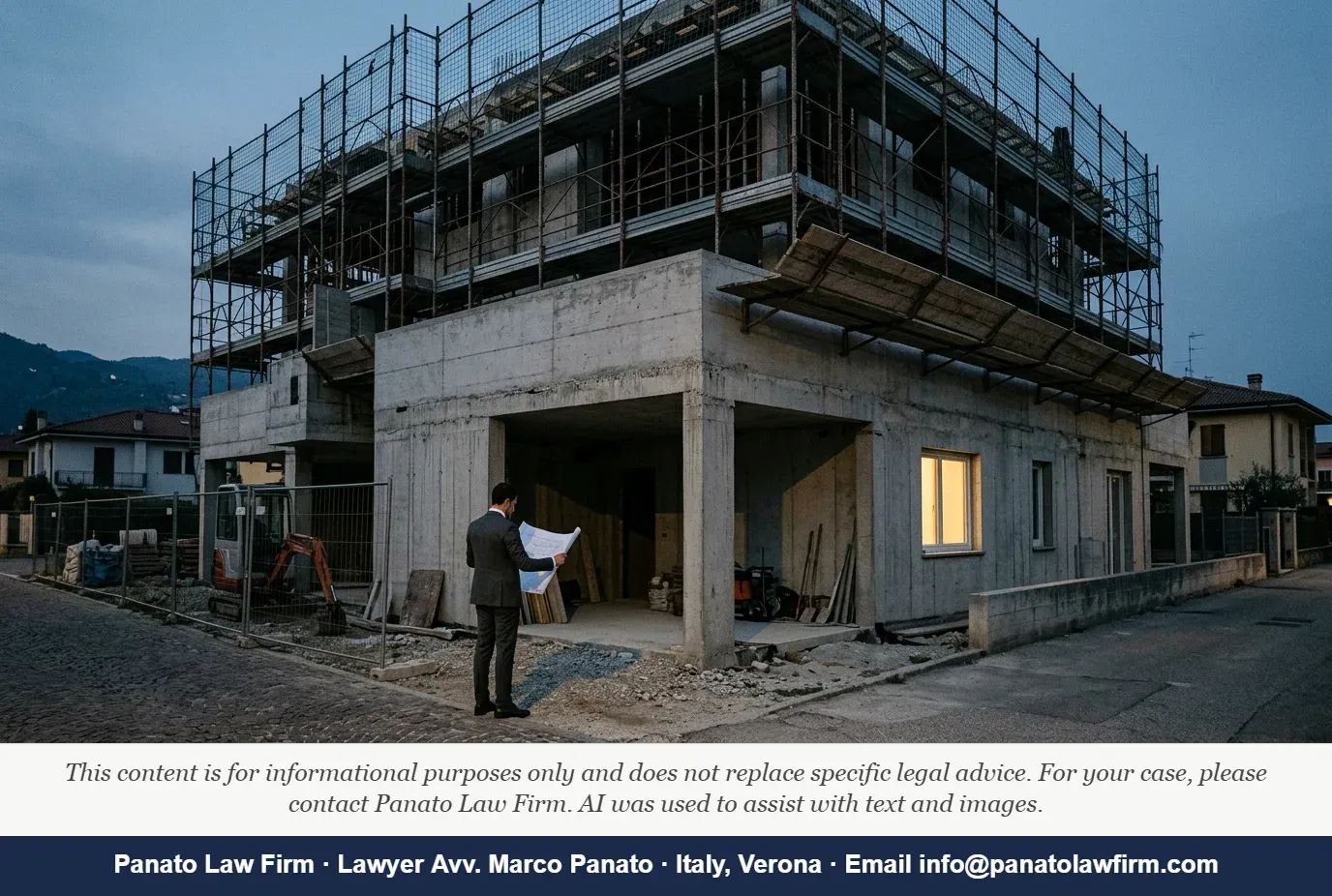
Image prompt: A partially completed modern apartment building on a hillside near Verona, scaffolding still in place against warm terracotta and pale limestone walls, late afternoon golden light casting long shadows across the construction site. In the foreground, an anonymous couple in professional attire review documents at a portable site table, their expressions attentive and cautious. The palette is warm amber and dusty grey, suggesting both promise and uncertainty, rendered in a realistic photographic style.
Image file: buying-off-plan-property-italy-developer-insolvency-protection-cover
HREFLANG BLOCK:
JSON-LD:
LANGUAGE QA: at the moment the preliminary sale contract is signed -> when the preliminary contract is signed · the contract is voidable at the buyer's election -> the buyer may rescind the contract · the guarantee falls away -> the guarantee lapses / expires · Italian case law has consistently held that a non-conforming fideiussione is as bad as no fideiussione at all -> Courts have consistently treated a non-conforming fideiussione as equivalent to none · commits a criminal offence under D.Lgs. 122/2005 -> is criminally liable under D.Lgs. 122/2005 · The guarantee is not optional, it is not a negotiating point -> The guarantee is not optional or a negotiating point · broadly, professional builders and real-estate development companies -> namely professional builders and property developers · a developer selling a property that already has its agibilità certificate by the time the compromesso is signed -> a developer selling a property for which an agibilità certificate has already been issued before the compromesso is signed
CHECK:
AUTHORITY 1: D.Lgs. 122/2005 — REFERENCES: yes / EXISTS? yes (normattiva.it) / CONTENT MATCHES? yes
AUTHORITY 2: D.Lgs. 14/2019 (CCII) — REFERENCES: yes / EXISTS? yes (normattiva.it) / CONTENT MATCHES? yes
AUTHORITY 3: Cass. civ., ord. 24 febbraio 2026, n. 6666 — REFERENCES: yes / EXISTS? UNVERIFIABLE (full text on italgiure not independently confirmed within this session; identified via brief and secondary commentary) / CONTENT MATCHES? partial — ruling reported consistent with brief's description; counsel should verify full text on italgiure.giustizia.it before relying on it in client advice
AUTHORITY 4: Art. 2775-bis codice civile — REFERENCES: yes / EXISTS? yes / CONTENT MATCHES? yes
OVERALL: AMBER — three authorities fully confirmed; the Cassazione order (the timeliness hook provided in the brief) is identified and described accurately per the brief but requires independent verification of the full judgment text on italgiure.giustizia.it before use in client-facing legal advice.
LOCAL NOTE:
1. Search intent targeted: informational with strong transactional lean — readers who have already identified an off-plan property in Italy and are assessing legal risk before committing money.
2. Local-market framing: contrasted the Italian statutory mandatory guarantee regime with the common-law escrow/trust model familiar to UK, Irish, US, Australian and Canadian buyers, explicitly noting that the fideiussione is not a negotiating point but a legal obligation backed by criminal sanctions — a distinction invisible to readers from common-law systems.
3. Italian terms retained untranslated: <i>fideiussione</i> (used in italic on first occurrence with explanation, then as recognised term throughout — readers searching "fideiussione Italy" use this word directly in English-language searches, so retaining it aids SEO without sacrificing clarity); <i>polizza decennale postuma</i> (explained in full on first use, too specific to have a standard English equivalent); <i>effetto prenotativo</i> (explained in context, no accepted English legal rendering).
Do you need legal assistance or a free estimate?
Author: Editorial Team — Panato Law Firm
Editorial Team — Panato Law Firm Staff