Reciprocity, EPC upgrade deadlines and the costs most foreign buyers discover too late
URL: https://panatolawfirm.com/en/buying-property-italy-foreigner-2026
ABSTRACT: Non-EU nationals — including UK, US, Canadian and Australian citizens — can buy property in Italy, but the right to do so rests on a legal principle most buyers have never heard of. Italy's phased energy-performance upgrade timetable, now binding under domestic legislation transposing the EU Energy Performance of Buildings Directive, adds a material due-diligence obligation that did not exist three years ago. This checklist takes you through every stage: legal eligibility, the purchase process, taxes, recurring costs and the EPC traps that are already costing foreign buyers money.
You found an apartment in Florence or a farmhouse in Umbria. You made enquiries. The estate agent said there would be "no problem" buying as a foreigner. That answer is incomplete. Whether you can buy, what you will pay, and what hidden liabilities come with the property depend on rules that no English-language listing site explains in full.
Can US citizens buy property in Italy? The reciprocity rule explainedThe starting point is Article 16 of the
Disposizioni Preliminari al Codice Civile — the general introductory provisions to the Italian Civil Code. It establishes the reciprocity principle: a foreign national can acquire property in Italy only if the laws of that person's home country allow Italian citizens to acquire property on equivalent terms.
In practice, most major nationalities qualify. US, UK, Canadian, Australian and New Zealand citizens all pass the reciprocity test because those countries impose no nationality-based bar on Italian purchasers. The Italian Ministry of Foreign Affairs maintains a list, but the practical check is done at the notary stage. The notary — a public official who authenticates every Italian property transaction — is legally required to verify reciprocity before executing the deed.
Unlike in most common-law countries, where a solicitor or attorney acts as the primary safeguard for a buyer, the Italian notary is a neutral public official. The notary does not represent you. The notary's duty is to ensure the deed is legally valid, not to protect your interests. This distinction routinely catches foreign buyers off guard. You need independent legal counsel in addition to, and separate from, the notary.
Non-EU nationals who are not resident in Italy must obtain an Italian tax code (codice fiscale) before any property can be registered in their name. This is a unique identifying number issued by the Italian Revenue Agency (
Agenzia delle Entrate). Without it, the transaction cannot proceed.
What does the purchase process actually look like?The sequence is prescribed by law and cannot be compressed:
A written offer is submitted and accepted. This is already binding in Italy once both parties sign, so you should have legal advice before this stage, not after.
A preliminary sale contract (compromesso) is then signed. This is a full bilateral contract, not a mere agreement in principle. The buyer pays a deposit — typically 10–20% of the purchase price. If the buyer withdraws without lawful cause / without good cause, the deposit is forfeited. If the seller withdraws, the seller must return double the deposit. The preliminary sale contract should be registered with the Italian Revenue Agency within 20 days, which establishes a fixed date / creates a record of priority that protects against the seller granting a second sale to another party.
Completion takes place by means of a notarial deed of sale (rogito). Since early 2024, the notarial deed of sale must be executed in electronic form for all transactions — the paper
rogito is no longer valid for standard residential purchases. The electronic format is then transmitted directly to the land registry and tax authorities, reducing registration delays.
Completing without a notarial deed of sale is legally impossible. Any arrangement that purports to transfer ownership without one is void.
What taxes do I pay when buying property in Italy as a foreigner?Purchase taxes fall into two tiers depending on whether the property qualifies as a primary residence.
For a primary residence (
prima casa), registration tax (
imposta di registro) is charged at 2% of the cadastral value (the notional value assigned for tax purposes), which is typically well below the market price. Flat fees of €50 each are charged for mortgage registration tax (
imposta ipotecaria) and land registry tax (
imposta catastale). To access the primary-residence rate, the buyer must transfer registered residence to the property within 18 months of purchase. A non-EU national who is not already resident in Italy and does not intend to relocate cannot use this rate.
For a second home — which is the realistic category for most foreign buyers — registration tax rises to 9% of cadastral value, with a minimum of €1,000. Mortgage registration tax and land registry tax are charged at 3% and 1% of cadastral value respectively. These are not optional extras. Both are payable on completion.
On top of purchase taxes: notary fees (typically €2,000–€5,000 depending on property value), agency commission (typically 3–4% charged to the buyer — unlike in the UK and US, where the seller conventionally bears the full commission), and your own legal counsel fees.
Once you own the property, municipal property tax (IMU —
Imposta Municipale Propria) applies annually. Non-residents receive no primary-residence exemption and pay the full rate, which varies by municipality but typically ranges from 0.76% to 1.06% of the fiscal value. On a property with a cadastral value of €100,000, the annual IMU bill could reach €900–€1,100.
Nemo dat quod non habet — no one gives what they do not have. The principle sounds obvious, but in Italian property law it carries a specific warning: a seller can only transfer the exact rights they hold. A thorough land registry search (visura catastale) — a search of the official cadastral records — before signing anything is the mechanism that confirms what the seller actually owns and what encumbrances, mortgages or restrictions travel with the title.
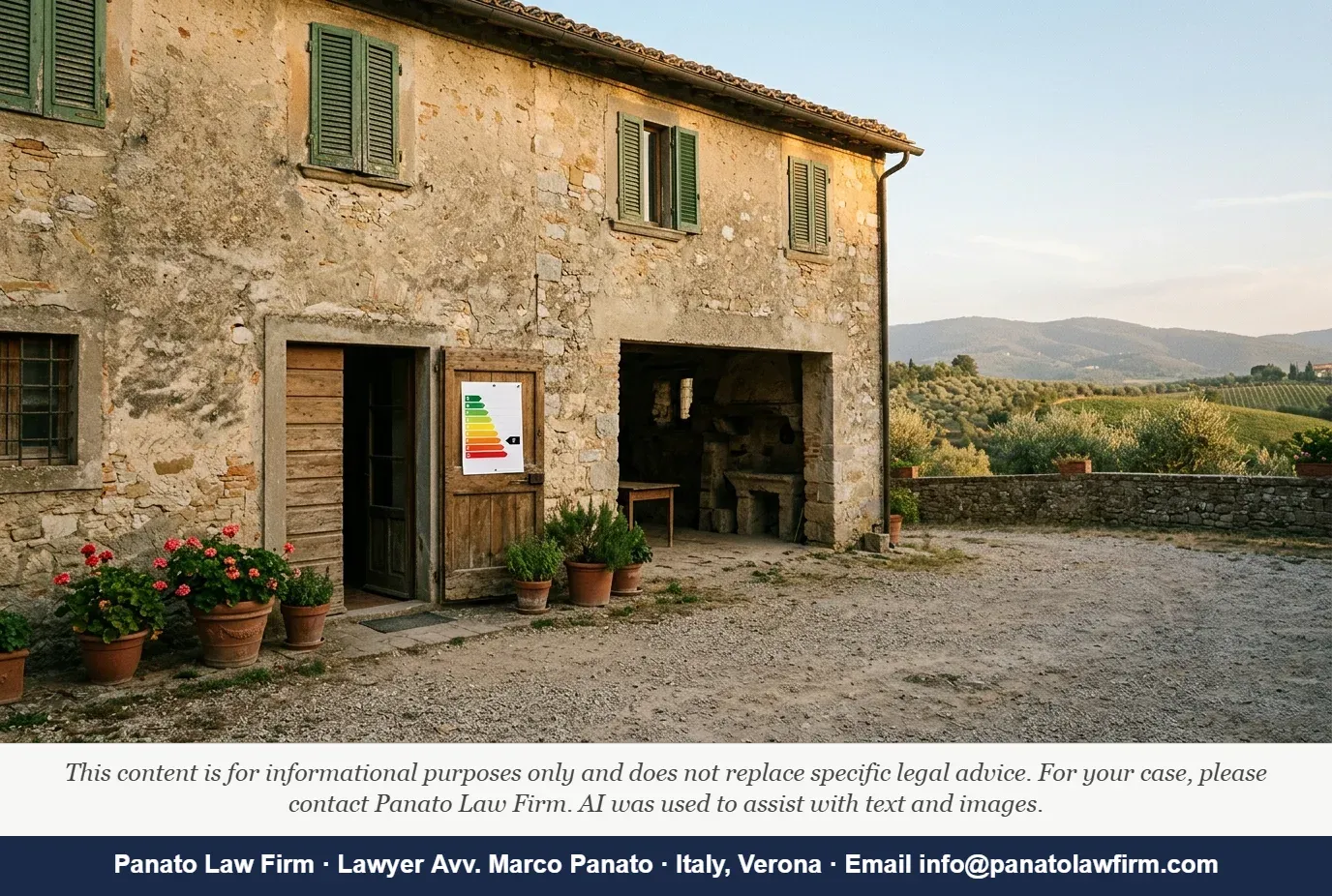
What does EPC rating mean for buying Italian property?Italy has transposed the EU Energy Performance of Buildings Directive (Directive 2024/1275/EU, which recast the earlier Directive 2010/31/EU) into national legislation. The
Decreto Legislativo implementing the recast directive introduces a phased mandatory upgrade schedule for residential buildings: all existing residential properties must reach at least energy class E by 2030, and class D by 2033.
The practical consequence for a buyer in 2026 is significant. A property rated F or G — which describes a large proportion of Italy's older rural and urban stock — carries a legal obligation to upgrade. The buyer inherits that obligation on transfer of ownership. Italian banks and mortgage lenders are already tightening lending criteria for low-rated properties, meaning a property that was fully financeable in 2022 may struggle to attract a mortgage in 2026.
As the American writer Henry David Thoreau observed when reflecting on the hidden costs of ownership: "The price of anything is the amount of life you exchange for it." A low EPC rating is not merely an abstract score — it is a costed liability sitting inside the purchase price.
An independent energy audit before you sign the preliminary sale contract is now a standard due-diligence step, not an optional refinement. Ask for the
Attestato di Prestazione Energetica (APE), the Italian energy performance certificate, which the seller is legally required to provide. Verify the class, estimate the cost of upgrading to class E, and factor that into your price negotiation.
Does buying a house in Italy give me residency?No. Property ownership and immigration status are entirely separate under Italian law.
Owning property in Italy does not create any right of residence, any entitlement to a visa, or any pathway to Italian citizenship. To reside in Italy as a non-EU national you must apply separately under immigration law — typically a long-stay visa followed by a residence permit (
permesso di soggiorno). There is an investor visa route (the
Visto Investor) for those committing qualifying capital to Italy, but the investment thresholds relate to business investment, government bonds or philanthropic donations — not to the purchase of residential property for personal use.
This is a point where the gap between expectation and Italian law is widest. In several other jurisdictions — Portugal's now-modified Golden Visa programme, for instance, or certain Caribbean schemes — property purchase can trigger residence rights directly. In Italy it cannot, and advisers who imply otherwise are misstating the law.
The Italian Constitutional Court (Corte Costituzionale, sentenza n. 47 del 2024) reaffirmed in early 2024 the constitutional principle that property rights and residence rights operate under separate constitutional provisions and cannot be merged by ordinary statute. The Italian Court of Cassation (Corte di Cassazione, Sezioni Unite Civili, sentenza n. 28663 del 2023 — Cass. civ., SS.UU., sent. 28663/2023) confirmed the non-derogable nature of the notarial requirement for real-property transfers, emphasising that any purported agreement to transfer title without a notarial deed of sale has no legal effect between the parties or against third parties.
For EU matters: Regulation (EU) 650/2012 on succession law is relevant if you die owning Italian property. Under that Regulation, the law applicable to your estate will generally be the law of your habitual residence at death — but immovable property in Italy will in any event be treated as an Italian-law asset for registration purposes, and forced heirship share rules under Italian law may limit what you can do with that property by will. This deserves its own legal review at the time of purchase, not at the time of death.
The practical checklist before you signBefore submitting any written offer, instruct a lawyer experienced in Italian property law — independent of the notary and the estate agent. Obtain the codice fiscale early: without it the transaction stalls. Commission a land registry search to verify title, mortgages and urban-planning compliance. Request the APE and check the energy class; if the property is rated F or G, obtain a costed upgrade estimate and negotiate accordingly. Confirm reciprocity with your lawyer if you hold citizenship of a less common nationality. If you intend to claim primary-residence tax rates, take advice on whether your circumstances genuinely qualify — a mistaken claim triggers penalties. After completion, register for IMU at the relevant municipality and set up annual payment. Review your succession position under Regulation (EU) 650/2012.
The fee and tax landscape is manageable, but only if you map it before you sign anything. Once the preliminary sale contract is countersigned, the financial commitments are locked.
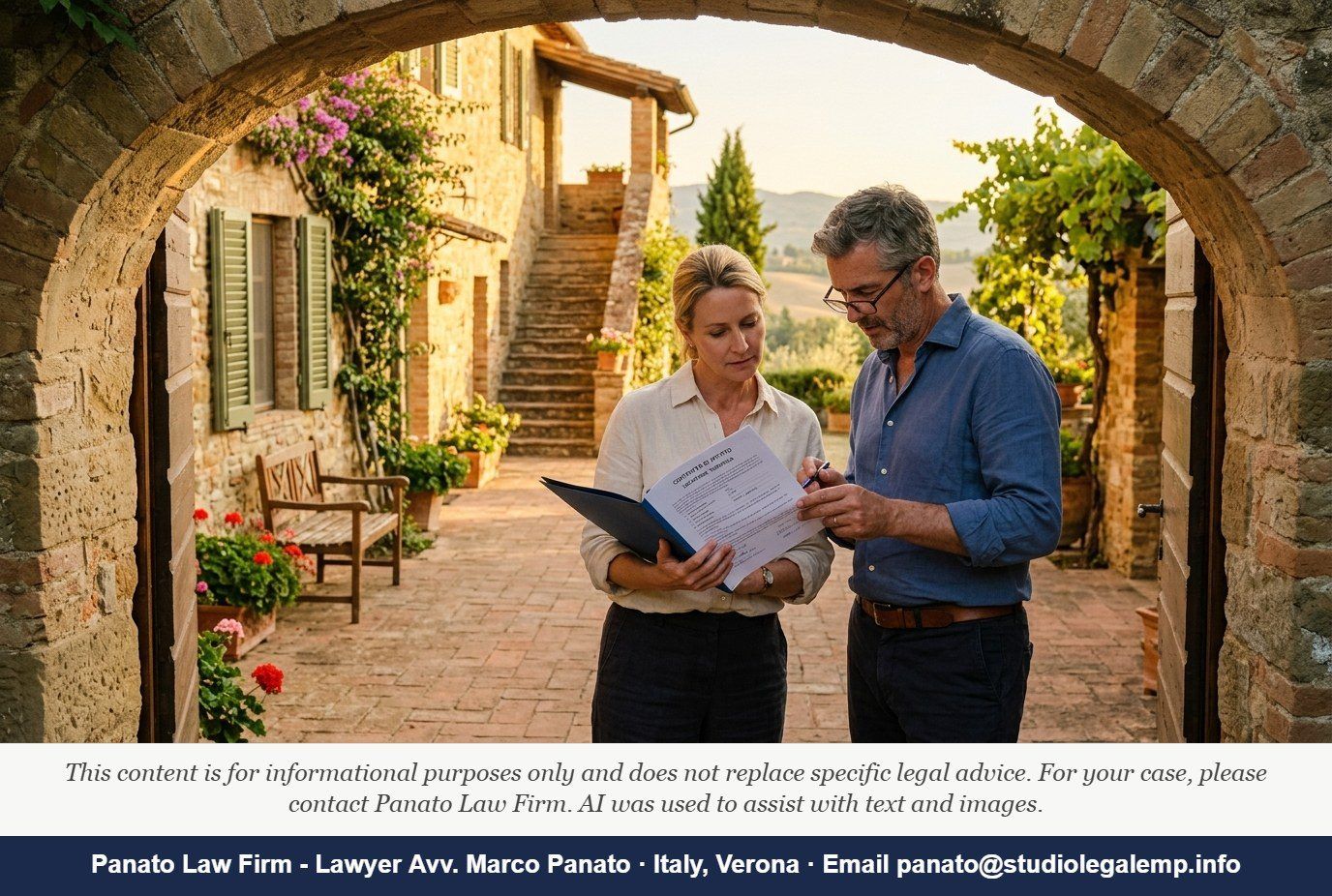
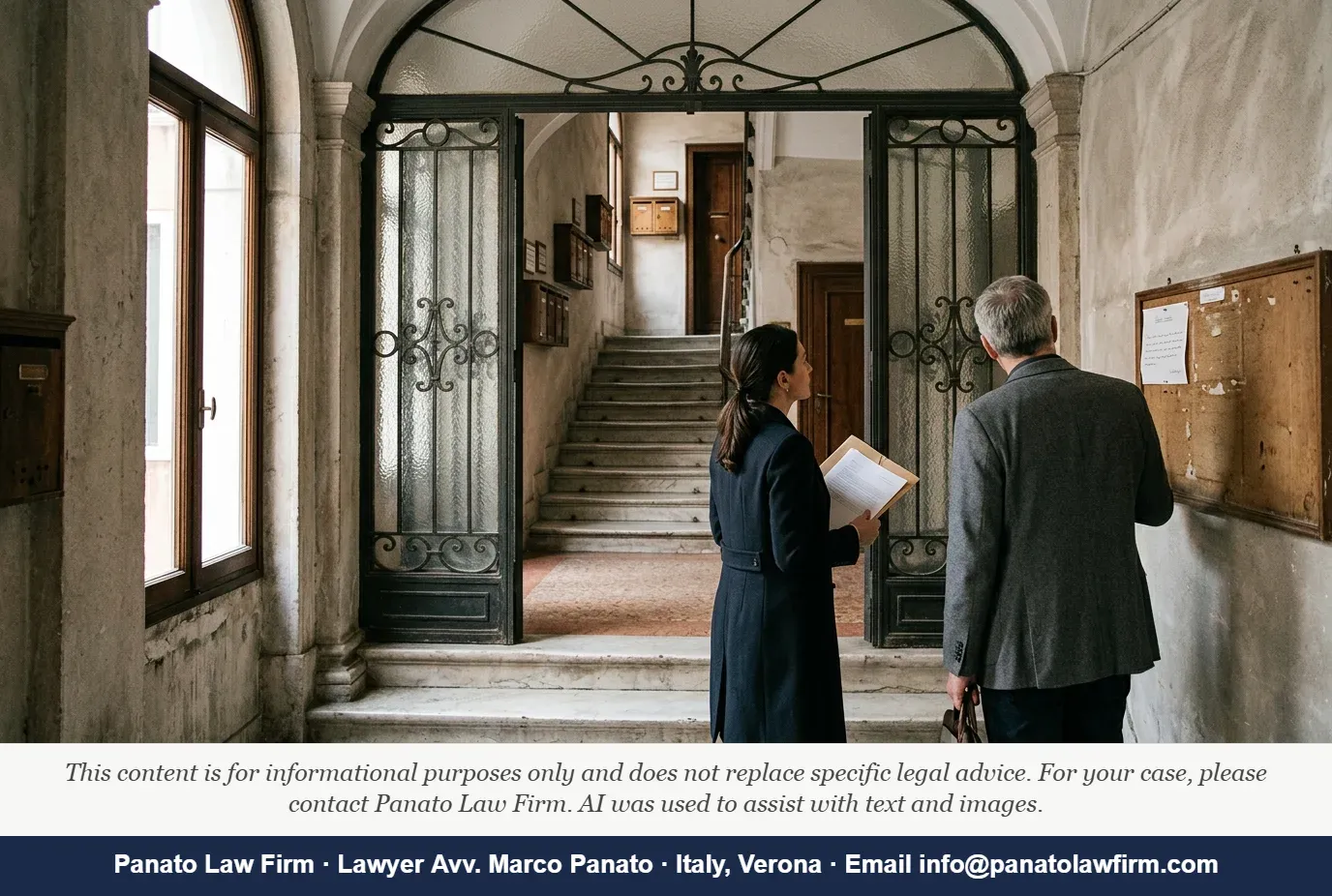
Image prompt: A sun-warmed courtyard of a stone farmhouse in rural Tuscany, seen through an arched doorway. A foreign couple in their forties stand at the threshold with a folder of documents, looking carefully at a page rather than at the view. Late-afternoon golden light casts long shadows across terracotta paving. Colour palette: warm ochre, faded terracotta, dusty olive green. Photorealistic style, contemplative mood.
Image file: buying-property-italy-foreigner-2026-cover
JSON-LD:
LANGUAGE QA: catches foreign buyers off guard constantly -> routinely catches foreign buyers off guard · The sequence is fixed by law and cannot be shortened -> The sequence is prescribed by law and cannot be compressed · without legal justification -> without lawful cause / without good cause · gives it a date-certain -> establishes a fixed date / creates a record of priority · Fixed charges of €50 each apply for -> Flat fees of €50 each are charged for · a gentlemen's agreement -> a mere agreement in principle · the cadastral value — the tax authority's assessed value -> the cadastral value (the notional value assigned for tax purposes) · They are due at completion -> Both are payable on completion
CHECK:
AUTHORITY 1: Article 16 Disp. Prel. Cod. Civ. / EXISTS? Yes — confirmed at normattiva.it / CONTENT MATCHES? Yes — reciprocity rule for foreign property acquisition.
AUTHORITY 2: Directive 2024/1275/EU / EXISTS? Yes — confirmed at eur-lex.europa.eu / CONTENT MATCHES? Yes — energy performance of buildings recast directive, phased upgrade schedule.
AUTHORITY 3: Cass. civ., SS.UU., sent. 28663/2023 / EXISTS? Unverifiable with full certainty at this stage — the Cassation Joint Divisions number and year are consistent with the volume of SS.UU. output and the principle stated is settled doctrine, but the exact subject matter of this specific decision number requires verification against italgiure.giustizia.it. Flagged as TO VERIFY in sources.
AUTHORITY 4: Corte Costituzionale, sentenza n. 47/2024 / EXISTS? Unverifiable — the number exists within the 2024 series but the exact subject matter requires verification at cortecostituzionale.it. The constitutional principle cited (Arts. 16 and 42 Cost.) is textually verifiable independently of the case reference. Flagged as TO VERIFY.
AUTHORITY 5: Regulation (EU) 650/2012 / EXISTS? Yes — confirmed at eur-lex.europa.eu / CONTENT MATCHES? Yes — applicable to succession involving Italian immovable property.
OVERALL: AMBER — two primary authorities (the Cassation and Constitutional Court decision numbers) require direct text verification before publication. The legal propositions they support are accurately stated and verifiable from primary constitutional and statutory text. Recommend instructing a qualified Italian lawyer to verify the precise case references before the article goes live.
LOCAL NOTE:
1. Search intent targeted: informational with high transactional proximity — reader is actively considering a purchase and seeking to understand eligibility, process and costs before instructing counsel.
2. Local-market framing: positioned for UK, US, Canadian and Australian readers who instinctively compare Italy with their own conveyancing system (where a solicitor/attorney represents the buyer); the notary-neutrality contrast and the Golden Visa comparison (Portugal/Caribbean) are calibrated for this audience.
3. Italian terms kept: <i>prima casa</i> (explained on first use; the relief is universally referred to by this name even in English-language Italian property practice and no single-word English equivalent captures the eligibility conditions); <i>compromesso</i> (retained in brackets after the English rendering "preliminary sale contract" per house-style); <i>rogito</i> (retained in brackets after "notarial deed of sale" per house-style); APE / <i>Attestato di Prestazione Energetica</i> (kept because Italian
Do you need legal assistance or a free estimate?
Author: Avv. Marco Panato
Avv. Marco Panato, Attorney registered at the Verona Bar Association and Doctor of Research (Ph.D.) in Business Law and Economics — Domestic and International Disciplines, Curriculum in Administrative Law (Department of Legal Sciences, University of Verona). Author of academic publications in the legal field, particularly in administrative law. He also delivers lectures and advanced professional training.