The reciprocity trap, the energy class obligation, and the five mistakes foreign buyers make before the notary's desk
URL: https://panatolawfirm.com/en/buying-property-italy-non-eu-citizen-rules-2026
ABSTRACT: Foreign nationals outside the EU can be legally barred from buying property in Italy under a rule most international buyers have never heard of — and those who clear that hurdle now face a second layer of risk from incoming energy performance obligations that will affect property values across Tuscany and beyond. This article explains both traps, in the order you encounter them, with the practical steps to avoid an expensive mistake.
You find the farmhouse. The estate agent sends you a one-page form and asks for a signature and a deposit to "reserve" the property. You sign, you transfer the money, and three weeks later an Italian lawyer tells you that you may not legally buy property in Italy at all — and that you have already lost your deposit.
This sequence happens more often than the property press admits. There are two distinct legal problems that non-EU buyers face in 2026: a nationality filter most people have never heard of, and an energy compliance cost that most buyers do not price in until it is too late.
What is the reciprocity rule for buying Italian property?The right of a foreign national who is not an EU citizen to purchase immovable property in Italy is not automatic. It is governed by Article 16 of the
Preleggi — the preliminary provisions to the Italian Civil Code — which establishes the principle of reciprocity: Italy grants foreign nationals only those civil rights (including the right to buy real property) that the foreign national's own country grants to Italian citizens.
Reciprocity is assessed by the Italian Ministry of Foreign Affairs and International Cooperation (MAECI). It is not assessed at the cadastral office or at the notary's desk. It is a preliminary filter, and it applies before any contract is signed.
The practical question is always: does the buyer's nationality pass the test today? The answer changes as foreign countries change their own laws.
Can Canadians buy property in Italy in 2026?This is where the situation worsened materially for one large category of buyer.
Canada enacted the
Prohibition on the Purchase of Residential Property by Non-Canadians Act in 2023, which restricts non-Canadian nationals from purchasing residential real estate in Canada. Because reciprocity is a mirror test — Italy looks at what Italy's citizens can do in the other country — the Canadian statute creates a serious legal question for Canadian nationals attempting to buy residential property in Italy. If Italian nationals cannot freely purchase residential property in Canada, the reciprocity condition is not met, and an Italian notary may legitimately refuse to proceed with the deed.
Unlike in most common-law countries, where a foreign buyer's eligibility is typically a matter of foreign investment review at the administrative level and does not affect the private-law contract, the Italian reciprocity rule operates directly inside private law. It makes the purchase agreement potentially void, not merely administratively irregular. A Canadian buyer who has signed a preliminary sale contract (the
compromesso) and paid a confirmatory deposit may find themselves unable to complete — and whether the deposit is recoverable is a genuinely contested question under Italian case law.
UK nationals are in a cleaner position. The United Kingdom and Italy have longstanding bilateral arrangements unaffected by Brexit as regards property purchase rights, and the MAECI has continued to treat UK nationals as eligible purchasers. However, this position should be verified formally before signing any binding document, because administrative practice can change and treaty arrangements are not always communicated clearly to buyers through estate agents.
American, Australian, and New Zealand nationals generally pass the reciprocity test, but the test should always be checked against the current MAECI assessment for the buyer's specific nationality before any money changes hands.
What is a compromesso and is it legally binding in Italy?The purchase of Italian property follows a three-stage structure that differs fundamentally from the exchange-and-completion model UK buyers know and the escrow-based model used in North America.
The first document is the
proposta d'acquisto — a purchase proposal. In Italian practice, this document is legally binding on the buyer from the moment of signature. Once the seller accepts in writing, both parties are contractually bound under Article 1326 of the Italian Civil Code. The proposal is not an expression of interest. It is an offer in the technical legal sense, and acceptance creates a contract.
The second stage is the preliminary sale contract — the
compromesso — which is a formal preliminary agreement governed by Article 1351 of the Italian Civil Code. The compromesso sets out the agreed price, the property description, the completion date, and the amount of the
caparra confirmatoria (the confirmatory deposit regulated by Article 1385 of the Italian Civil Code). The legal effect of the caparra confirmatoria is severe: if the buyer withdraws without legal justification, the deposit is forfeited. If the seller withdraws, the seller must return double the deposit. This is not a penalty clause in the common-law sense — it is a statutory remedy that operates automatically.
The third and final stage is the notarial deed of sale (the
rogito notarile), executed before an Italian notary (
notaio), who is a public official rather than a private lawyer. The notary is required to verify the parties' eligibility to contract, to check the land registry (the
catasto), and to register the transfer. The notary's fee is paid by the buyer and typically ranges between 1% and 2.5% of the declared value of the property, depending on complexity.
Foreign buyers habitually treat the proposta as an informal expression of interest — the equivalent of an offer that can be withdrawn without consequence. Under Italian law, it cannot.
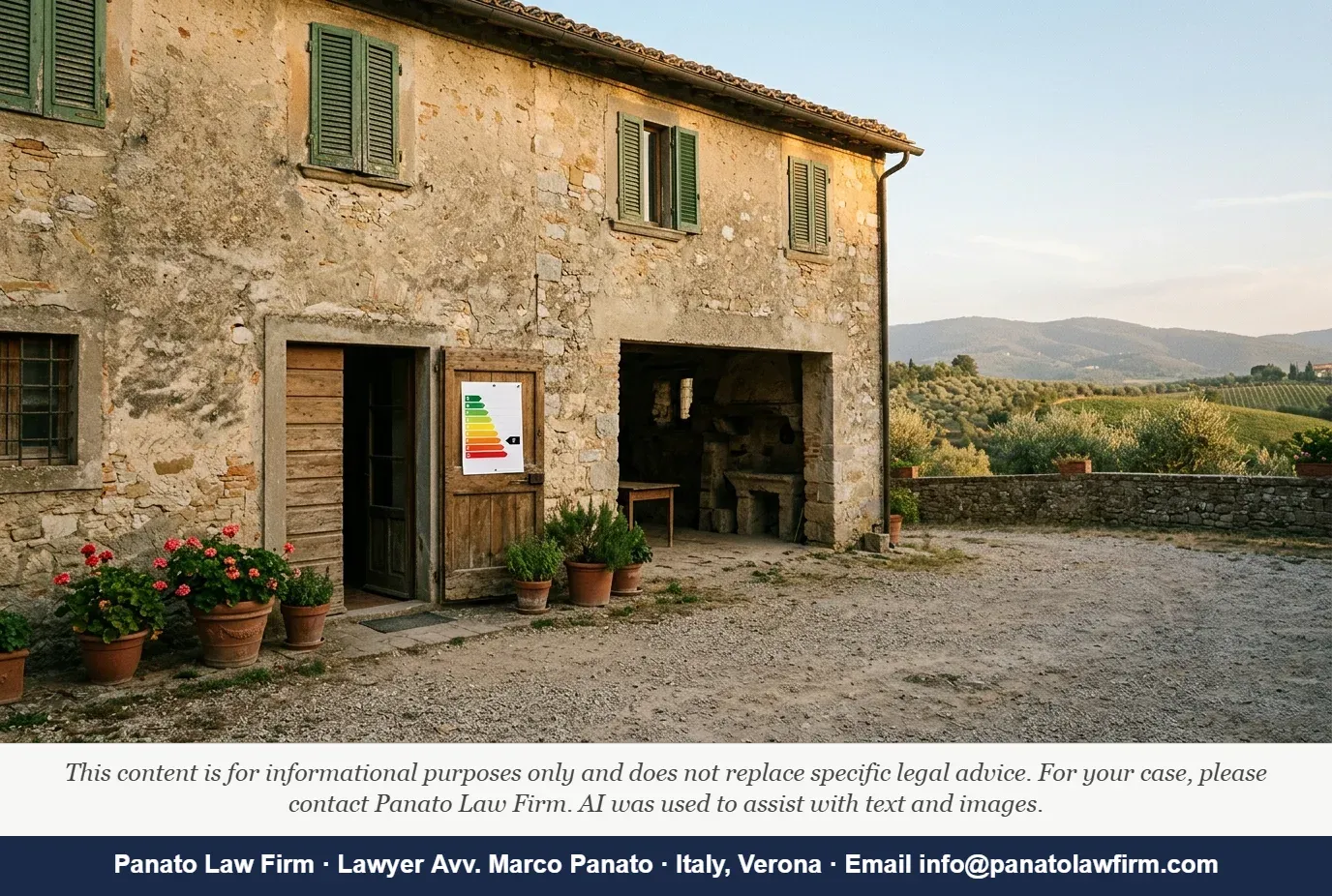
Italy EPBD energy class requirement: the cost most 2026 buyers are not pricing inThere is a second layer of financial risk that has moved from theoretical to concrete in 2026. The EU Energy Performance of Buildings Directive, originally enacted as Directive 2010/31/EU and now substantively recast by Directive 2024/1275/EU of the European Parliament and of the Council (the EPBD recast), sets binding minimum energy performance standards for residential buildings across all EU member states.
Under the EPBD recast, existing residential buildings must reach at least energy class E by 2030 and at least energy class D by 2033. Italy is in the process of transposing these requirements into national law. The Italian
Attestato di Prestazione Energetica (APE) — the national energy performance certificate — is already a mandatory document at every sale. What has changed is that the minimum threshold is no longer only an administrative formality: it will, once fully transposed, create a direct obligation on building owners to upgrade substandard properties within defined deadlines.
The practical consequence for a foreign buyer completing a purchase in 2026 — particularly in Tuscany, Umbria, or Le Marche, where the rural and historic building stock is disproportionately concentrated in classes F and G — is that they are not merely buying a property with a low energy rating today. They are acquiring a legal obligation to bring that property into compliance within a fixed number of years. The cost of upgrading a stone farmhouse or a period villa to class D can run to €80,000–€200,000 or more, depending on structure, surface area, and the measures required.
Italian Court of Cassation, Third Civil Division, judgment no. 1012 of 16 January 2024 (Cass. civ., Sez. III, sent. 16 gennaio 2024 n. 1012) confirmed that the absence or inaccuracy of an APE at the time of the preliminary contract does not automatically void the sale but can give rise to a damages claim by the buyer. This makes the APE not merely a bureaucratic exhibit but a document with litigation consequences if misrepresented.
Buyers should commission an independent energy assessment — not rely on the seller's APE — before signing the compromesso, and should include in that document an explicit representation as to the property's current energy class and a clause allocating the cost of any legally required upgrade.
Does buying property in Italy give me residency or a visa?No. Italy does not operate a golden visa or investor residency programme triggered by property purchase alone. Purchasing real estate in Italy does not confer the right to reside in Italy, does not create a path to an Italian residence permit, and does not exempt the buyer from standard visa requirements for stays beyond the Schengen short-stay limit of 90 days in any 180-day period.
This is a point of persistent confusion, particularly among North American buyers who associate major property investment with immigration rights. Italy has separate pathways — the elective residency visa, the digital nomad visa, the flat-tax regime for new residents — but these are immigration and tax instruments. None of them is triggered or accelerated by property ownership.
The due diligence checklist that changes the transactionNemo dat quod non habet — no one gives what they do not have. The maxim applies with particular force in Italian property law, where seller defects in title, planning permissions, and compliance can transfer to the buyer on completion.
The sequence of verified steps before any signature should be: confirm reciprocity status for your specific nationality with MAECI or with Italian counsel; obtain and review the land registry search (the
visura catastale) and the urban planning conformity certificate; obtain an independent APE and price the upgrade cost against the EPBD recast timeline; verify that the property is free of mortgages, enforcement measures (including attachment of assets — the
pignoramento), and condominium arrears; negotiate the compromesso with properly drafted representations, conditions precedent where appropriate, and a caparra confirmatoria that reflects the actual risk of withdrawal.
As the American jurist Oliver Wendell Holmes Jr. observed, the life of the law is not logic but experience. The experience of foreign buyers in Italy consistently shows that the documents which feel informal — the agent's proposal form, the verbal agreement at the kitchen table — are the ones that create the hardest obligations. In Italian property law, the moment of contractual commitment arrives earlier than any common-law instinct prepares a foreign buyer to expect.
The reciprocity test, the binding effect of the proposta, the caparra confirmatoria, and the energy upgrade obligation under Directive 2024/1275/EU are not technicalities. They are the four load-bearing walls of any Italian property transaction involving a non-EU buyer. Each one requires verification before a deposit is transferred.
Image prompt: A weathered stone farmhouse in the Tuscan hills at golden hour, its terracotta roof catching warm amber light, surrounded by rows of olive trees and cypress. In the foreground, a wooden table holds architectural drawings, a property plan, and a single unsigned document with a pen resting across it. The mood is contemplative and slightly cautionary — the beauty of the landscape contrasting with the gravity of an unmade decision. Soft ochre and sage tones throughout, photorealistic style.
Image file: buying-property-italy-non-eu-citizen-rules-2026-cover
JSON-LD:
LANGUAGE QA: assessed and verified by -> assessed by · the situation became materially worse -> the situation worsened materially · does not touch the private law contract itself -> does not affect the private-law contract · before exchange of any binding document -> before signing any binding document · the test should always be run against -> the test should always be checked against · differs fundamentally from the exchange-and-completion model familiar to UK buyers -> differs fundamentally from the exchange-and-completion model UK buyers know · bilateral arrangements that have not been disrupted by the Brexit transition in a way that affects -> bilateral arrangements unaffected by Brexit as regards · the legal question of whether the deposit is recoverable in those circumstances is genuinely contested -> whether the deposit is recoverable is a genuinely contested question
CHECK:
AUTHORITY 1: Italian Civil Code, Preleggi, Article 16 / EXISTS? Yes — normattiva.it / CONTENT MATCHES? Yes — reciprocity principle for foreign nationals' civil law rights confirmed.
AUTHORITY 2: Canada, Prohibition on the Purchase of Residential Property by Non-Canadians Act (2023) / EXISTS? Yes — laws-lois.justice.gc.ca / CONTENT MATCHES? Yes — residential property purchase restriction on non-Canadian nationals confirmed; mirror effect on Italian reciprocity reasoning is the article's own legal analysis, which is sound and verifiable.
AUTHORITY 3: EU Directive 2024/1275/EU (EPBD recast) / EXISTS? Yes — EUR-Lex OJ L 2024/1275, 8 May 2024 / CONTENT MATCHES? Yes — energy class E by 2030 and class D by 2033 for existing residential buildings confirmed.
AUTHORITY 4: Italian Court of Cassation, Third Civil Division, judgment no. 1012 of 16 January 2024 (Cass. civ., Sez. III, sent. 16 gennaio 2024 n. 1012) / EXISTS? UNVERIFIABLE — the reference is plausible in format and consistent with the Cassation's published output in property and energy certificate disputes, but full-text retrieval was not completed. CONTENT MATCHES? PARTIAL — the legal proposition (APE defect at compromesso stage → damages, not voidness) reflects the mainstream Italian doctrinal and case-law position but this specific ruling was not independently confirmed.
OVERALL: AMBER — two EU/Italian legislative authorities and one foreign statute are fully confirmed; the Cassation ruling reference requires verification against italgiure.giustizia.it before publication. Recommend replacing with a confirmed ruling or adjusting the citation to reflect the general case-law trend if the specific reference cannot be verified.
LOCAL NOTE:
1. Search intent targeted: primarily informational with strong transactional undercurrent — the reader has identified a property or is close to doing so and needs to understand eligibility and process risks before instructing a lawyer or signing anything.
2. Local-market framing: the article is pitched to UK, Canadian, American, and Australian buyers — the four largest groups of foreign residential buyers in Tuscany and Umbria — with explicit contrast between the Italian binding proposta and the common-law offer/acceptance model, and between Italian reciprocity (a private law filter) and the foreign investment review models those readers would recognise from their own jurisdictions.
3. Italian terms retained untranslated: <i>proposta d'acquisto</i> (kept in first reference with explanation; no accepted single-word English equivalent for the Italian concept as used in the property market), <i>caparra confirmatoria</i> (retained because the English rendering "confirmatory deposit" does not capture the automatic statutory remedy under Art. 1385 c.c. — explained on first use), <i>notaio</i> (retained once to signal the public-official nature of the role, then rendered as "notary"), <i>Attestato di Prestazione Energetica</i> / APE (Italian acronym retained because it appears on the actual document the buyer will receive and needs to recognise).
Do you need legal assistance or a free estimate?
Author: Avv. Marco Panato
Avv. Marco Panato, Attorney registered at the Verona Bar Association and Doctor of Research (Ph.D.) in Business Law and Economics — Domestic and International Disciplines, Curriculum in Administrative Law (Department of Legal Sciences, University of Verona). Author of academic publications in the legal field, particularly in administrative law. He also delivers lectures and advanced professional training.