The real tax arithmetic of corporate ownership in Italy — IMU at second-home rates, the rental income penalty and when share-transfer succession genuinely saves money
LANG: English (en) · AREA: Buying & Owning Property in Italy · TYPE: Legal update / what changed · MODEL: Sonnet 5 · SEO 68/100 · Flesch Reading Ease 37 · QA translated
ABSTRACT: An Italian <i>società a responsabilità limitata</i> (SRL) is widely marketed to foreign buyers as the smart way to hold Italian real estate — cleaner succession, capped liability, multi-investor flexibility. The pitch is compelling, but it glosses over three structural tax disadvantages that routinely surprise buyers after the deal closes. This article sets out the honest arithmetic: what the corporate route saves, what it costs, and when the numbers actually favour personal ownership.
You have found the property. A restructured farmhouse in Umbria, a lake-view apartment in the Veneto, a palazzo in Lecce with commercial development potential. Someone — a property finder, a promoter, perhaps a well-meaning friend — has told you to hold it through an Italian company. The structure, they say, protects you, simplifies inheritance for your children and gives you a clean vehicle for future acquisitions.
All of that is partially true. The difficulty is the word "partially."
The corporate route into Italian real estate is neither a tax shelter nor a trap by nature. It is a precision instrument. Used for the right asset class, the right hold period and the right family structure, it does what it promises. Used for a holiday home, a short-term rental flat or a single residential investment, it systematically underperforms personal ownership on every major tax metric. What changed in 2026 made that underperformance harder to ignore.
Should I buy Italian property through a company or in my own name?The first thing to understand is that Italian law places no nationality restriction on direct ownership of Italian real estate by foreign individuals, subject to a reciprocity requirement under applicable bilateral treaties (the Italian
Notariato, the national notarial authority, verifies this at the point of sale). A British, American, Australian or Irish citizen can buy in their own name without a local partner and without any corporate wrapper. One hundred per cent foreign ownership of an Italian SRL is equally permitted, and the reciprocity check applies to the ultimate controlling shareholder of the company just as it would to an individual buyer.
So the choice is genuinely open. What drives it is not law but economics — and the economics shifted in a specific way when the Ministry of Economy and Finance issued its Decree of 6 November 2025.
The IMU trap: what the 2026 reform actually means for corporate ownersIMU (imposta municipale propria) is Italy's annual municipal property tax, levied on the ownership of real estate. Under the Ministry of Economy and Finance Decree of 6 November 2025, the Ministry introduced a new system for setting municipal IMU rates, built around a standardised national rate table intended to simplify the system. Before 2026, over 250,000 different rate categories were in use across Italian municipalities. From 2026, these are replaced by a structured national rate table from which municipalities must choose.
For individual buyers who actually live in their Italian property as a primary residence, IMU does not apply: the
prima casa (main home) exemption removes the tax entirely for most residential categories. For everyone else — and this includes every corporate owner without exception — the property is treated as a second home.
For properties other than a main residence, the standard base IMU rate is 8.6 per thousand (‰). Municipalities can increase this up to an ordinary maximum of 10.6‰. In areas with a strong tourist economy, councils often choose the maximum rate to cover higher seasonal service costs.
The core problem for corporate owners is straightforward: an SRL cannot be a natural person and therefore can never satisfy the
prima casa conditions, which require the owner to be resident in the property as their habitual home. The company pays IMU at the second-home rate every year, no matter how the property is used. An individual buyer who moves their registered residence to the Italian property can claim the exemption. The company never can.
Unlike in most common-law countries — where a holding company owning residential real estate is taxed on income and gains but does not face a mandatory annual ownership charge linked to property value — Italian IMU is unavoidable at the entity level. There is no equivalent of the UK's standard non-resident landlord scheme that simply taxes what the company earns: Italy's IMU falls on the company simply by virtue of its ownership, every year, irrespective of income. For a residential investment property in a popular municipality with a €134,400 IMU tax base (not an unusual figure for a modest holiday home), that means an annual IMU bill approaching €1,400 at the maximum rate — before a single euro of income is earned.
What are the tax advantages of an Italian SRL for property purchase?There are genuine ones, and they matter in the right context.
Asset protection and limited liability. An SRL limits the exposure of the foreign shareholder to the value of their shareholding. Creditors of the company cannot ordinarily reach the shareholder's personal assets. For investors building a portfolio of rental units or combining property with a hospitality business, this separation is commercially valuable. It is not, however, a tax advantage.
Multi-investor structuring. The SRL is a natural vehicle for joint ventures. Two or more foreign co-investors who wish to hold Italian property together can do so via shares, avoiding the complications of co-ownership under Italian property law. Governance is governed by the company's constitutional documents rather than the default rules of the Italian Civil Code (
codice civile), which apply rigidly to direct co-ownership.
Capital expenditure deductibility. Income and capital gains earned by companies are subject to corporate income tax (IRES) at a flat rate of 24%. Expenses incurred in the production of taxable income are generally deductible, and rental income received by corporations is treated as business income and taxed at the IRES rate. This means renovation costs, management fees, financing costs and professional expenses are deductible against corporate rental income. An individual owner on the flat-rate
cedolare secca regime cannot deduct costs at all — the flat tax is the whole arrangement.
The comparison therefore depends on the margin. The standard
cedolare secca rate is 21% for most residential leases, with a reduced rate of 10% for certain regulated low-rent agreements. If a property generates high rental income relative to its expenses, the 21% flat rate is almost always cheaper than Italy's corporate tax system, which revolves around IRES at a flat 24% on net taxable profits and IRAP at a standard 3.9% regional rate. The combined IRES plus IRAP burden sits at 27.9% on the net figure — and IRAP is calculated on a slightly different, broader base than net profit. An individual paying 21% on gross income often pays less in absolute terms than a company paying 27.9% on its net, once accounting complexity and annual compliance costs are layered on top.
Does owning Italian property through a company save inheritance tax?This is where the corporate route has its clearest genuine merit — and where the picture became more nuanced in 2025.
Italian inheritance tax rates for direct-line heirs (children and spouses) are low by international standards: 4% on the value above a €1 million threshold per heir. However, the transfer of Italian real estate on death also triggers mortgage tax and cadastral tax (the latter at 1% of the cadastral value), and the new self-assessment regime introduced by Legislative Decree No. 123 of 1 August 2025, which significantly amended the Consolidated Act on Successions and Donations (Legislative Decree No. 346/1990) and entered into force on 1 January 2026, means heirs must now calculate and pay the tax themselves rather than waiting for the Italian Revenue Agency to issue a demand.
Here is where the SRL structure can genuinely help. Transferring shares in a company — whether by lifetime gift or on death — avoids the transfer of real estate itself and therefore sidesteps the mortgage and cadastral taxes that apply to direct property succession. Transfers of business assets, including companies, branches, shares and quotas, are exempt from inheritance tax, provided the beneficiary continues the business activity for at least five years. This exemption, available under the reformed succession rules, can be significant where the company genuinely operates as a business (a rental enterprise, an agriturismo, a hospitality venture).
The word "genuinely" is doing heavy work in that sentence. With Ruling No. 16/2026, the Italian Revenue Agency denied the inheritance tax exemption for the
mortis causa transfer of an Italian corporate shareholding. The ruling illustrates that the Revenue Agency scrutinises whether the company actually conducts a business or whether it is a passive property-holding shell dressed up to claim the exemption. A dormant SRL holding a single holiday villa and generating minimal or no commercial revenue is unlikely to qualify. The five-year business-continuity requirement must be met in substance.
Can a foreign company own residential property in Italy?A foreign company — a UK limited company, a Delaware LLC, an Irish private limited company — can in principle own Italian real estate directly, subject to the same reciprocity rules that apply to foreign individuals. In practice, the Italian notary at the point of sale (who completes the notarial deed of sale, or
rogito notarile) will check the nationality and status of the beneficial owner, not merely the registered seat of the company. A foreign entity owning Italian property will still owe Italian IMU and, if it generates income, will be liable for Italian income tax as a non-resident entity with Italian-source income.
The more common structure for foreign investors is to incorporate an Italian SRL specifically as the ownership vehicle. This gives a clean Italian legal person, with Italian tax registration (including an Italian VAT number,
partita IVA), subject to Italian accounting and filing rules. The annual compliance cost of maintaining an active Italian SRL — bookkeeping, a statutory auditor once turnover or asset thresholds are crossed, annual returns, IRES and IRAP advance payments — realistically ranges from €3,000 to €8,000 per year for a property-holding vehicle. That figure is invisible in the promotional materials and decisive in the arithmetic.
The decision framework: three questions before you structureThe Roman jurist's maxim applies well here:
in dubio pro reo has no place in tax planning, but the underlying principle — that clarity of intent must precede action — does. A more apt classical principle is
res ipsa loquitur: the facts speak for themselves, and the facts of your specific property determine the correct structure.
Pose three questions before you decide.
First: will you ever use the property personally as a primary residence? If yes, the SRL blocks your access to the
prima casa IMU exemption permanently. That is a recurring annual cost.
Second: what is the anticipated hold period, and what is the likely exit? An individual selling Italian property held for more than five years generally pays no capital gains tax on the appreciation. A corporate sale — at whatever point — generates IRES at 24% on the full gain, with no five-year exemption. For a long-term appreciation play, personal ownership is structurally more efficient at exit.
Third: is there a genuine business rationale for the company? The more the investment looks like a trading or hospitality business — multiple units, active management, professional letting — the more the corporate structure earns its keep in liability protection, accounting structure and, potentially, succession planning under the business-assets exemption.
As the economist John Kenneth Galbraith observed, "The modern conservative is engaged in one of man's oldest exercises in moral philosophy; that is, the search for a superior moral justification for selfishness." The tax promoters who sell the SRL route to every foreign buyer without distinction are engaged in a parallel exercise: the search for a structure that sounds sophisticated regardless of whether it fits. Rigour, not fashion, should drive the decision.
The Italian property market rewards patient, well-informed buyers. The corporate structure, used correctly, is one of the instruments available to them — not a universal default.
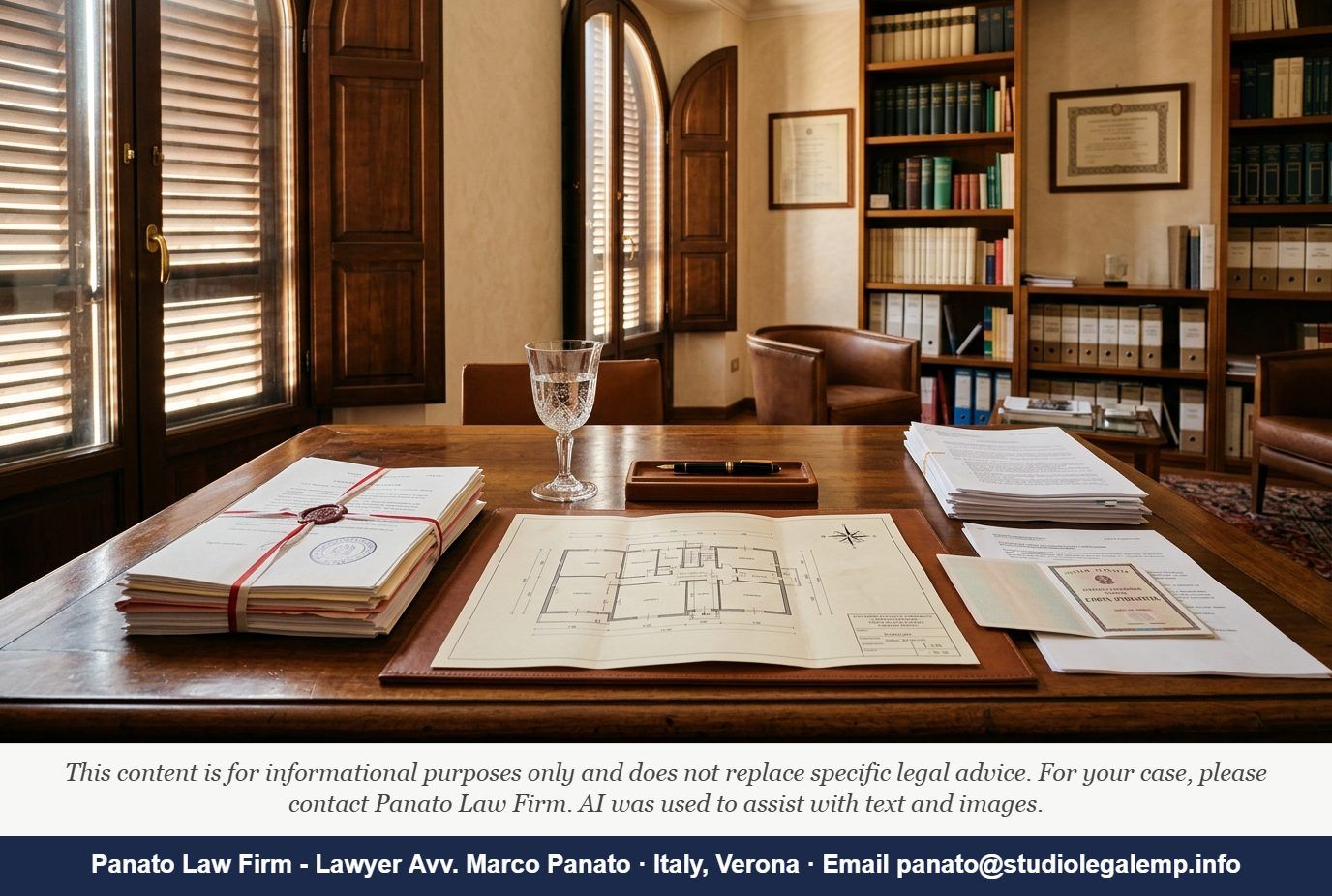
Image prompt: A clean-lined Italian commercial notary's office with warm afternoon light entering through tall wooden shutters. On a wide mahogany desk, a single architectural floor plan of an Italian property sits next to two stacks of documents: one labelled with a company seal, one with a personal identity card. A glass of mineral water and a fountain pen rest between them. The mood is deliberate and quietly high-stakes. Colour palette: warm amber, cream, deep walnut brown. Photorealistic style, no people, no text in the image.
Image file: buying-property-italy-through-company-foreign-investor-cover
HREFLANG BLOCK:
JSON-LD:
LANGUAGE QA: a new system was introduced for setting and managing municipal IMU rates -> the Ministry introduced a new system for setting municipal IMU rates · based on a structured national rate table prepared by the Ministry and designed to simplify the framework -> built around a standardised national rate table intended to simplify the system · The structural problem for corporate owners is this: -> The core problem for corporate owners is straightforward: · unconditionally, regardless of how the property is actually used -> no matter how the property is used · the UK's garden-variety non-resident landlord regime -> the UK's standard non-resident landlord scheme · Italy's IMU charges the company for existing as an owner -> Italy's IMU falls on the company simply by virtue of its ownership · subject to bilateral reciprocity -> subject to a reciprocity requirement under applicable bilateral treaties · a palazzo with commercial potential in Lecce -> a palazzo in Lecce with commercial development potential
CHECK:
AUTHORITY 1: Ministry of Economy and Finance Decree of 6 November 2025 (Decreto MEF 6 novembre 2025)
REFERENCES: Decreto Ministeriale, Ministero dell'Economia e delle Finanze, 6 November 2025 (cited as the source of the 2026 IMU rate reform)
EXISTS? Yes — confirmed by multiple independent Italian property tax sources (Idealista, IRECOM, Arletti & Partners) all citing this specific decree by date
CONTENT MATCHES what I wrote? Yes — standardised municipal rate categories, base 8.6‰, maximum 10.6‰, replacement of 250,000+ historic categories
AUTHORITY 2: Legislative Decree No. 123 of 1 August 2025 (Decreto Legislativo 1° agosto 2025, n. 123)
REFERENCES: D.Lgs. n. 123/2025, amending the Consolidated Act on Succession and Donation Tax (D.Lgs. n. 346/1990), effective 1 January 2026
EXISTS? Yes — confirmed by Arletti & Partners (primary source), corroborated by lawzana.com and theitalianlawyer.com
CONTENT MATCHES what I wrote? Yes — new consolidated act on indirect taxes including succession, entry into force 1 January
Do you need legal assistance or a free estimate?
Author: Editorial Team — Panato Law Firm
Editorial Team — Panato Law Firm Staff