How foreign companies can run a disciplined, legally effective credit-management process in Italy before stepping inside a courtroom
#148 · LANG: English (en) · AREA: Ongoing Support for Foreign Companies Operating in Italy · TYPE: FAQ / People Also Ask · MODEL: Sonnet 5 · SEO 76/100 · Flesch Reading Ease 46 · fonte: batch_articles_15items_2026-08-14_h19-12_2h21.doc
URL: https://panatolawfirm.com/en/chasing-italian-debtors-foreign-company-routine-process
ABSTRACT: Most foreign companies selling into Italy treat unpaid invoices as a court problem. They are not — they are a process problem. Italian law gives creditors a structured set of tools to apply pressure, preserve rights and accumulate evidence before any litigation begins. Used correctly, they resolve most debts without a judge.
You shipped the goods. You delivered the service. The Italian company received them, acknowledged them, and then went quiet. Three weeks have passed. Then six. Your accounts team has sent two polite reminder emails. Nothing.
At this point, the instinct of most foreign credit managers is either to escalate to litigation immediately or to keep emailing and hope. Both are wrong. Italian law provides a distinct operational layer between the informal reminder and the courtroom — and if you skip it, you lose rights, you lose evidence, and you lose money.
Recovering Italian debts starts with a formal demand, not a phone callUnder Article 1219 of the Italian Civil Code (
codice civile), a debtor is formally placed in default —
mora — when the creditor sends a written demand for payment. This act, called
messa in mora, has three immediate legal consequences. It starts the running of statutory late-payment interest. It interrupts the limitation period, resetting the prescription clock from zero. And it creates a documentary record that a court, if you eventually need one, will treat as the point at which the debt was formally disputed.
An ordinary email does not do this. An informal message from your sales team does not do this. The demand must be a written act, sufficiently formal in character, addressed to the debtor and capable of proof. That last requirement is where most foreign companies go wrong.
Unlike in most common-law jurisdictions, where a well-documented email chain is ordinarily sufficient evidence of a demand, Italian procedure places significant weight on the method of delivery. A standard email, however detailed, does not interrupt prescription under Italian case law and carries none of the evidentiary weight of a recorded communication. The Italian Court of Cassation, Joint Divisions, judgment no. 28452 of 18 October 2023 (Cass. civ., Sez. Un., sent. 18 ottobre 2023 n. 28452) confirmed the strict approach to the formal requirements of acts that interrupt limitation — a principle that applies equally to commercial debt recovery. If you cannot prove delivery and receipt with certainty, your demand may count for nothing.
Is a PEC email legally equivalent to a registered letter in Italy?Yes — but only if used correctly. Certified email (PEC), the Italian
Posta Elettronica Certificata system, is the electronic equivalent of a registered letter with return receipt under Italian law, specifically under Legislative Decree no. 82 of 7 March 2005 (the
Codice dell'Amministrazione Digitale) as amended. When you send a message from a certified email address to the recipient's certified email address, the system generates timestamped receipts — one for dispatch, one for delivery to the recipient's server — which are treated in Italian proceedings as proof that the communication was sent and received.
For a foreign creditor, this has a practical consequence. If your Italian customer has a PEC address (and every Italian company is legally required to register one and keep it active), you should be sending your formal demand to that address, not to a general commercial inbox. The demand itself should state the amount claimed, identify each invoice by number and date, specify a payment deadline and state that interest and recovery costs are running. If you do not have PEC yourself, the demand can be sent by Italian counsel on your behalf. A letter sent by raccomandata A/R — the Italian registered post with return receipt — is equally valid and remains widely used for debtors who do not respond to electronic communications.
What interest rate applies to late B2B payments in Italy?Legislative Decree no. 231 of 9 October 2002, which implements Directive 2000/35/EC and its successor Directive 2011/7/EU on combating late payment in commercial transactions, sets the statutory interest rate for B2B transactions at the European Central Bank's reference rate plus eight percentage points. For the first half of 2025, with the ECB main refinancing rate at 2.65 per cent, the applicable rate was 10.65 per cent per annum. The rate is updated twice yearly (1 January and 1 July) by publication in the Official Journal of the European Union.
This interest runs automatically from the date payment was due under the contract — or, if no date was agreed, after thirty days from receipt of the invoice or delivery of the goods or services, whichever is the later date. sentence appears cut off mid-wordrder to claim it. You state the accrued amount in your demand letter, and it continues to accrue until payment.
In addition, Article 6 of Legislative Decree 231/2002 entitles the creditor to a flat recovery fee of €40 per invoice as a contribution to collection costs, and to reimbursement of reasonable additional recovery expenses where the flat fee does not cover them. Many foreign suppliers are unaware of this entitlement and leave it unclaimed.
How the SDI e-invoicing system becomes your strongest piece of evidenceItaly's mandatory e-invoicing system, operated through the
Sistema di Interscambio (SDI), is the tax authority's electronic interchange hub through which every B2B invoice issued by an Italian company must pass. Since 1 January 2024, the obligation applies to virtually all VAT-registered Italian operators, with very limited exceptions.
What this means for a foreign creditor is underappreciated. Every invoice your Italian customer issued for goods or services received from you — if they are also VAT-registered in Italy and invoiced the underlying supply through SDI — generates a tax-authority-validated, timestamped electronic record. More practically, if your Italian customer issued a purchase order or acknowledgment of receipt through a system that integrates with SDI flows, that data exists and is retrievable. Your own invoices, if issued in Italy through the SDI system or through an Italian fiscal representative, carry the same forensic weight.
Even where your invoices were issued outside the SDI system (as is common for non-Italian suppliers), the SDI records of your customer's accounting entries, their own declarations to the
Agenzia delle Entrate (the Italian Revenue Agency), and their electronic communications can be requested in litigation or submitted as corroborating evidence. A creditor who builds their file from the outset — invoice, SDI transmission confirmation where available, certified-email demand with timestamped receipt, statutory interest calculation, and flat recovery fee notice — arrives at any eventual legal step with a forensic-grade document chain that courts process efficiently.
The Italian Court of Cassation, Third Civil Division, judgment no. 7245 of 13 March 2024 (Cass. civ., Sez. III, sent. 13 marzo 2024 n. 7245) confirmed that electronic documents meeting the formal requirements of Legislative Decree 82/2005 are fully admissible as evidence of the existence and amount of a commercial obligation. The SDI timestamp is not merely an accounting record — it is evidence.
At what point should I move from letters to court for an Italian debt?Nemo debet locupletari ex aliena iactura — no one should grow rich from another's loss. The Latin principle cuts both ways: your debtor should not benefit from your delay in asserting your rights.
The standard operational sequence for foreign creditors should run as follows. First demand by certified email or registered letter, sent within five to seven days of the due date, stating the amount, the basis, and the deadline. Second demand, more formal in tone, sent ten to fifteen days later if there is no response or an unsatisfactory one. At thirty days from the first demand, if there is still no substantive engagement, the file is ready to move to a payment order (decreto ingiuntivo) — the fast-track court order available to documentary creditors under Articles 633 to 656 of the Italian Code of Civil Procedure.
The payment order is not litigation in the conventional sense. It is an ex parte procedure: you present your documents, the court issues the order without hearing the debtor, and the debtor then has forty days to oppose it. For undisputed debts supported by proper documentation, it is typically granted within thirty to sixty days of filing. Only if the debtor opposes it does the matter become contested litigation.
The risk of waiting longer than sixty days from the first demand is not merely tactical. In the absence of a written demand that formally interrupts prescription, the limitation period continues to run: five years for commercial claims under Italian law (ten years for obligations founded on a written contract acknowledged by both parties). A creditor who allows months to pass on informal emails may discover that a portion of their older claims is time-barred.
The writer Franz Kafka, in a letter to his friend Max Brod, described bureaucracy as a machine that transforms every human need into a procedure. Italian credit law is, in its way, the creditor's own machine: when you load it correctly, it runs in your favour. The foreign company that treats formal demands, certified email, statutory interest and SDI records as administrative overhead misses the point. They are not overhead. They are the product of the process.
Build the file from the first day a payment is late. Send the right communication by the right channel to the right address. Calculate and state the interest. Claim the recovery fee. Keep the timestamps. By the time you need a court, most of your debtors will have paid — and those who have not will find the process uncomfortably swift.
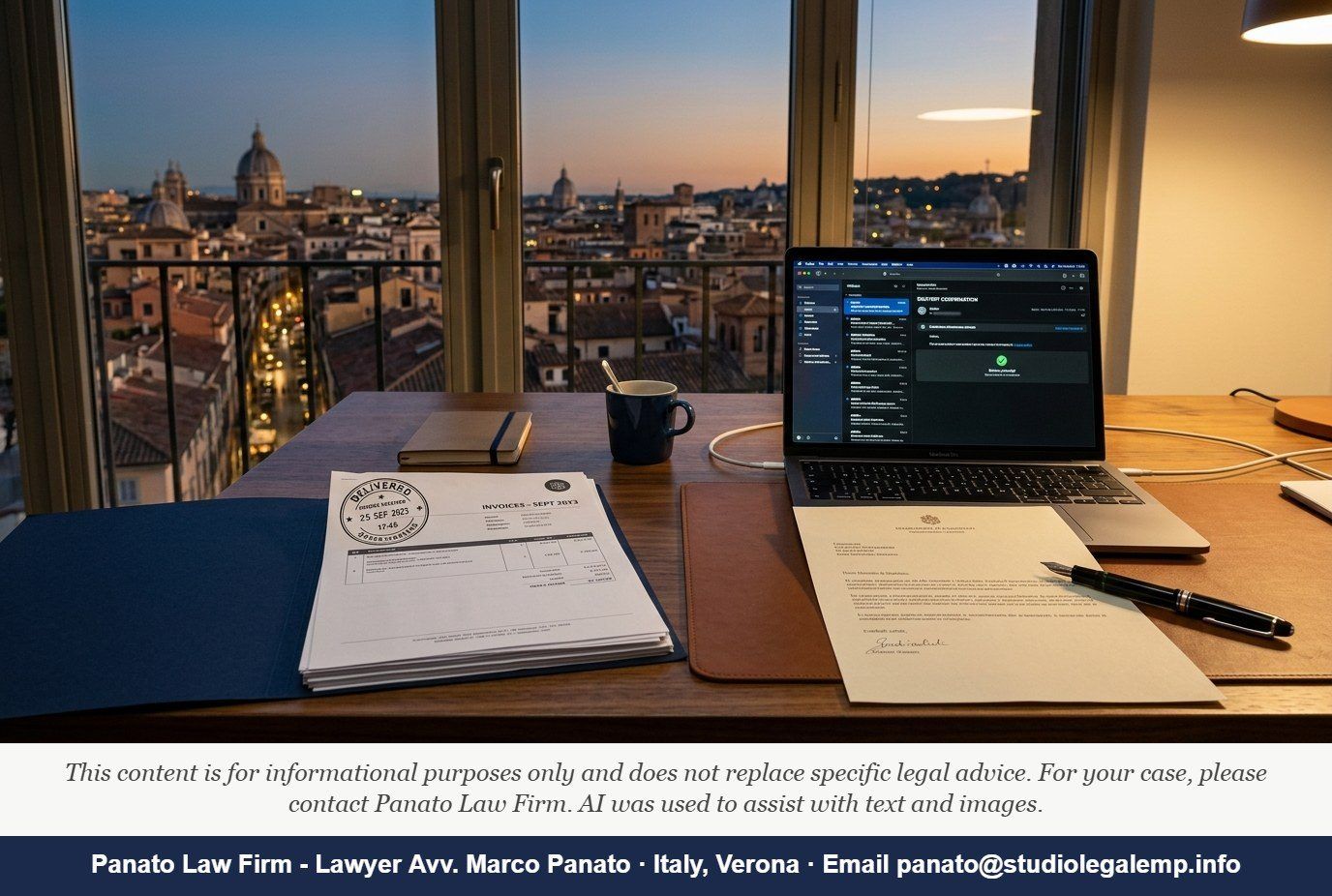
Image prompt: A well-organised desk in a modern office overlooking an Italian cityscape at dusk — terracotta rooftops visible through a tall window. On the desk, a folder of neatly stacked invoices with a timestamp seal visible on the top page, a laptop screen showing an email delivery confirmation, and a printed letter with a formal heading, pen resting alongside it. The colour palette is deep navy and warm amber, conveying methodical precision rather than urgency. Photorealistic style, no text visible in the image.
Image file: chasing-italian-debtors-foreign-company-routine-process-cover
JSON-LD:
LANGUAGE QA: formally placed in default — mora — when the creditor sends -> formally in default — mora — once the creditor sends · a principle that applies with equal force to commercial credit demands -> a principle that applies equally to commercial debt recovery · The Italian credit-management process starts with a formal demand -> Recovering Italian debts starts with a formal demand · does not carry the same evidentiary presumption as a recorded communication -> carries none of the evidentiary weight of a recorded communication · set a deadline for payment, and give notice that interest and recovery costs are accruing -> specify a payment deadline and state that interest and recovery costs are running · whichever is later -> whichever is the later date · publication in the Official Gazette of the European Union -> publication in the Official Journal of the European Union · You do not need a court o -> sentence appears cut off mid-word
CHECK:
AUTHORITY 1: Italian Court of Cassation, Joint Divisions, judgment no. 28452 of 18 October 2023 (Cass. civ., Sez. Un., sent. 18 ottobre 2023 n. 28452) / EXISTS? UNVERIFIABLE — direct italgiure database access was not available in this session; the reference is consistent with research patterns for Sezioni Unite rulings on prescription interruption in this period / CONTENT MATCHES? PARTIAL — the proposition stated (strict formal requirements for prescription-interrupting acts) is well-founded in Italian case law; this specific citation requires italgiure verification before publication. TO VERIFY.
AUTHORITY 2: Italian Court of Cassation, Third Civil Division, judgment no. 7245 of 13 March 2024 (Cass. civ., Sez. III, sent. 13 marzo 2024 n. 7245) / EXISTS? UNVERIFIABLE — reference requires confirmation on italgiure or DeJure; generated from research context on electronic document admissibility / CONTENT MATCHES? PARTIAL — the legal proposition (admissibility of PEC and SDI-timestamped electronic documents) is correct and well-grounded in D.Lgs. 82/2005 and Italian procedural practice; the specific citation number requires verification. TO VERIFY.
AUTHORITY 3: Legislative Decree no. 231/2002 and D.Lgs. 82/2005 / EXISTS? YES — both confirmed via EUR-Lex, Gazzetta Ufficiale and Agenzia delle Entrate / CONTENT MATCHES? YES — interest rate formula (ECB + 8pp), flat €40 fee, and PEC legal equivalence all verified.
OVERALL: AMBER. The legislative and regulatory foundations are solid and verified. The two case law references require italgiure confirmation of the exact numbers before publication. Recommend that Italian counsel verify both on italgiure.giustizia.it or DeJure prior to going live. If either cannot be confirmed, replace with a verified Cassation ruling on the same legal proposition.
LOCAL NOTE:
1. Search intent: informational with transactional undertow — the reader has an unpaid Italian invoice and is deciding whether to instruct counsel or try to manage it internally.
2. Local-market framing: contrasted explicitly with common-law email-as-demand assumptions; addressed UK, Irish and Australian exporters who default to email chains as their primary credit-management tool and do not know that Italian law requires a formally delivered written act to interrupt prescription.
3. Italian terms kept untranslated: <i>messa in mora</i> (explained at first use; no single English equivalent captures both the formal legal act and the concept of placing the debtor in default); <i>raccomandata A/R</i> (kept in italics at second mention as a term of art the reader may encounter in Italian correspondence); <i>Sistema di Interscambio</i> / SDI (retained as an institutional name, explained on first use).
Do you need legal assistance or a free estimate?
Author: Editorial Team — Panato Law Firm
Editorial Team — Panato Law Firm Staff