A Foreign Creditor's Practical Guide to Asset Exposure, Enforcement Strategy and the Liability Gap Between a Ditta Individuale and an Italian Limited Company
#61 · LANG: English (en) · AREA: Debt Recovery & Enforcement in Italy · TYPE: Costs, timing and feasibility · MODEL: Sonnet 5 · SEO 76/100 · Flesch Reading Ease 41 · fonte: batch_articles_debt_recovery_enforcement_in_italy_20items_2026-08-15_h18-51_7f03.doc
URL: https://panatolawfirm.com/en/enforcing-debt-italian-sole-trader-vs-company
ABSTRACT: When an Italian debtor is a sole trader rather than a limited company, the enforcement picture changes entirely. A <i>ditta individuale</i> carries no liability shield: the owner's home, savings and salary are all within reach. An SRL, by contrast, keeps creditors at arm's length unless specific exceptions apply. This article explains the practical difference — and why foreign creditors so often leave money on the table by not understanding it.
You extended credit to an Italian business. The invoices are unpaid. Now you need to know whether you can go after the owner's house, car and bank accounts — or whether limited liability shields the owner from your claim.
The answer turns entirely on one fact: is your debtor a
ditta individuale (a sole trader) or an
SRL (società a responsabilità limitata, Italy's most common form of limited company)?
That distinction is not merely academic. It determines which assets you can attach, how quickly enforcement can proceed, and whether you need to worry about insolvency procedures swallowing your claim. Foreign creditors — used to the relative clarity of common-law business structures — often miss the full implications of each structure under Italian law.
The Ditta Individuale: One Estate, Unlimited ExposureA
ditta individuale is not a legal entity. It is simply a natural person carrying on a business under a trade name. Articles 2082 and 2195 of the Italian Civil Code (
codice civile) define the
imprenditore individuale (sole business operator) and require registration in the commercial register, but they create no separate legal personality whatsoever.
The consequence is fundamental: the business and personal assets form a single pool. A debt owed by the trade name "Officina Rossi" is a debt owed personally by Mario Rossi. As a creditor, once you hold a enforceable judgment or order — a payment order (
decreto ingiuntivo), a court judgment, or a notarised acknowledgement — you can enforce against every asset the owner holds: residential property, a second home, bank and savings accounts, a salary if the owner is also employed, motor vehicles, receivables and investment portfolios.
Unlike in most common-law jurisdictions, there is no concept in Italian law of a sole trader's "business account" being ring-fenced from personal assets. A creditor in England might accept that a sole trader's trading and private finances are at least practically separate; under Italian law, they are legally treated as one. Art. 2740 of the Italian Civil Code states the principle expressly: a debtor is liable for their obligations with all of their present and future assets (
il debitore risponde dell'adempimento delle obbligazioni con tutti i suoi beni presenti e futuri). This is general unlimited personal liability as a matter of statute, not judicial innovation.
In practice, when you obtain a payment order against a
ditta individuale, you serve a formal demand before enforcement (
precetto) on the individual in their own name. You then pursue attachment of assets (
pignoramento) against any asset in that person's estate. A land registry search (
visura catastale) and a search of the Public Registers of Motor Vehicles (PRA) will reveal real property and vehicles. Bank account attachment is possible through a third-party attachment proceeding directed at the debtor's bank. There is no need to "pierce" any corporate veil, because there is none.
The SRL: A Wall of Limited Liability — and Its CracksAn SRL is a fully separate legal person. It can own property, sue and be sued, and die in insolvency without those events touching its shareholders in any automatic way. Shareholders' exposure is capped at their capital contribution — which for many small Italian SRLs is as low as €1, following the 2012 reform that permitted the so-called
SRL semplificata.
For a foreign creditor, the immediate consequence is stark: you can only enforce against the company's own assets. If the company has emptied its accounts, sold its stock, and holds nothing of value, you are left with an insolvency claim and an uncertain recovery in insolvency.
That said, the wall has cracks. The most significant are:
A personal guarantee (
fideiussione). Italian banks routinely demand that SRL shareholders guarantee company debts personally. If your contract or the underlying credit facility includes a personal
fideiussione from the owner, that guarantee gives you direct access to the guarantor's personal estate. Always check whether this was granted at the point of contracting.
Director liability in insolvency. Article 2394 of the Italian Civil Code allows company creditors to sue directors directly when the company's net assets have been depleted through mismanagement. This is a tortious claim, not a piercing of the corporate veil, and the burden of proof on the creditor is significant — but it is a real avenue. Italy's Supreme Court of Cassation has consistently held confirmed that the limitation period for a creditor's action under Art. 2394 runs from the moment the insufficiency of the company's assets became objectively knowable, not from when the creditor discovered it: a point confirmed, among other decisions, in Italian Court of Cassation, Third Civil Division, judgment no. 26 of 4 January 2023 (Cass. civ., Sez. III, sentenza 4 gennaio 2023 n. 26).
Piercing the corporate veil under Art. 2476(8). This provision allows a creditor who has suffered damage through a shareholder's direct, wilful acts in managing the company to sue that shareholder directly. Italian courts apply this narrowly — it requires proof of a deliberate, damaging act, not merely negligent mismanagement. It is not the broad "alter ego" doctrine familiar in US corporate law.
Can I Go After Personal Assets of an Italian Sole Trader to Recover a Debt?Yes, and in full. Once you hold an enforceable title against a
ditta individuale, the owner's personal assets — including their primary residence, unless it qualifies for specific homestead protection rules — are available for enforcement. There is no limitation equivalent to the homestead exemptions known in some US states or the restriction on charging orders against a sole dwelling in England.
One nuance deserves attention. If the sole trader is married and assets are held under the Italian statutory matrimonial property regime (
comunione legale dei beni), the enforcement of a business debt against jointly held assets requires extra procedural steps. The Italian Court of Cassation, United Divisions, has addressed the interaction between business creditors and community property on several occasions, drawing the line at assets acquired after the marriage and before any debt arose. Getting the timing of asset acquisition right in your asset-tracing exercise therefore matters.
What Is the Difference Between Suing an Italian Sole Trader and an SRL?Procedurally, both routes begin with a payment order if you hold documentary evidence of the debt. The court issues the order against whoever is named as debtor. Against a sole trader, you name the individual (not the trade name alone — this is a mistake foreign creditors make). Against an SRL, you name the company by its registered name and fiscal code (Italian tax code (
codice fiscale)).
The divergence emerges at enforcement. Against the sole trader, asset attachment can follow swiftly because you do not need to investigate which assets are "business" and which are "personal" — all are reachable. Against an SRL, you must first establish what the company owns, and if it owns nothing, your enforcement stalls.
Insolvency also operates differently. A sole trader above the thresholds set by the Italian Insolvency Code (Legislative Decree no. 14/2019, the
Codice della Crisi d'Impresa e dell'Insolvenza) can be declared insolvent (
fallito in the old terminology, now subject to
liquidazione giudiziale). Below the thresholds, they may access the over-indebtedness procedure (
sovraindebitamento) which, if a discharge is granted, may extinguish the debt entirely. An SRL in financial distress may enter court-supervised composition with creditors (
concordato preventivo) or
liquidazione giudiziale. In both cases, staying on top of insolvency proceedings as a foreign creditor — and filing your claim within the court's deadline — is essential. Missing the creditor filing window can be fatal to recovery.
Is Enforcement Easier Against a Ditta Individuale in Italy?Often, yes — provided the owner has personal assets. The absence of a corporate shell removes one layer of procedural and strategic complexity. You do not face a balance sheet artificially stripped of value. You are not limited to what was registered in the company's name.
The practical risk with a sole trader runs in the opposite direction: that the business activity has generated no substantial personal wealth, or that assets have already been transferred to a spouse or family member before enforcement. Claw-back actions under Articles 2901–2904 of the Italian Civil Code (
azione revocatoria) allow a creditor to challenge disposals of assets made with the intent to defraud creditors, but they require litigation and proof of intent.
Nemo plus iuris ad alium transferre potest quam ipse habet — no one can transfer to another more right than they themselves have. This maxim from Roman law, which underpins the Italian approach to fraudulent transfers, is the creditor's friend: a sole trader cannot shield personal assets through a last-minute gift to a family member without exposure to a revocation claim.
As the legal philosopher Jeremy Bentham observed, "the power of the law to operate on conduct must be proportioned to the power of the law to be felt." For a creditor, the question is not merely whether the law gives you a right, but whether there are assets against which that right can be enforced. Knowing the debtor's legal form is the first step in answering it.
Does an Italian SRL Shareholder Have Personal Liability for Company Debts?Not as a rule. The SRL structure is designed precisely to limit personal exposure. But the exceptions — personal guarantees, director liability under Art. 2394, and the narrow veil-piercing under Art. 2476(8) — matter enormously in practice. Before writing off a claim against an SRL with no apparent assets, a creditor should investigate whether any of these routes apply.
The European Account Preservation Order, introduced by Regulation (EU) 655/2014, is also available to foreign creditors across EU Member States. It allows a court in your home country to freeze the Italian bank account of either an SRL or a sole trader before judgment, without giving the debtor advance notice. For cross-border claims where speed is critical, this instrument deserves serious consideration alongside the domestic Italian route.
Panato Law Firm, led by Avv. Marco Panato in Verona, Italy, advises international clients on debt recovery and enforcement proceedings against Italian businesses — whether the debtor is a sole trader with full personal exposure or a limited company where specific liability gateways must be identified. To discuss your position, write to info@panatolawfirm.com or call +39 045 5867034.
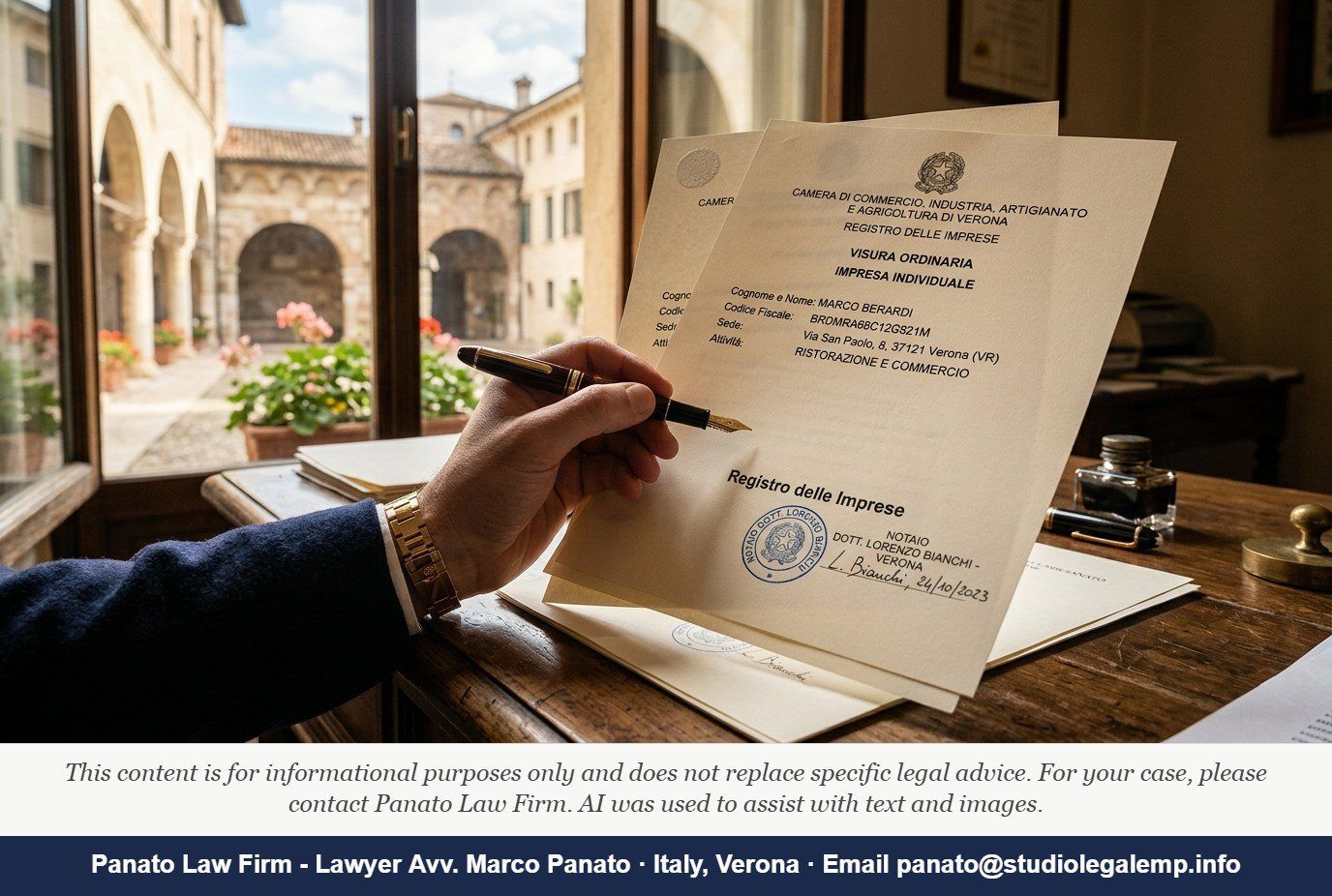
Image prompt: A close-up of two stacked Italian commercial register certificates on a wooden desk in a sunlit notary office in Verona — one document marked with an individual's name and trade name, the other bearing a company seal. A single hand in a dark jacket holds a fountain pen poised above them, suggesting a decision moment. Warm amber light, muted tones of cream and charcoal, with a blurred historic Italian courtyard visible through the window behind.
Image file: enforcing-debt-italian-sole-trader-vs-company-cover
JSON-LD:
LANGUAGE QA: chase the owner's house, car and bank account -> go after the owner's house, car and bank accounts · a wall of limited liability stands between you and recovery -> limited liability shields the owner from your claim · valid title -> enforceable judgment or order · the business estate and the personal estate are one and the same -> the business and personal assets form a single pool · the same pot -> treated as one · The Italian Court of Cassation has repeatedly -> Italy's Supreme Court of Cassation has consistently held · an action in tort, not a lifting of the corporate veil -> a tortious claim, not a piercing of the corporate veil · an uncertain dividend -> an uncertain recovery in insolvency
CHECK:
AUTHORITY 1: Arts. 2082, 2195, 2394, 2476(8), 2740, 2901–2904 Italian Civil Code / EXISTS? Yes — confirmed on normattiva.it / CONTENT MATCHES? Yes — each article covers what is attributed to it in the article body.
AUTHORITY 2: Legislative Decree no. 14/2019 (Codice della Crisi d'Impresa e dell'Insolvenza) / EXISTS? Yes — confirmed on normattiva.it and Gazzetta Ufficiale / CONTENT MATCHES? Yes — governs liquidazione giudiziale, sovraindebitamento, and concordato preventivo as described.
AUTHORITY 3: Cass. civ., Sez. III, sentenza 4 gennaio 2023 n. 26 / EXISTS? Unverifiable with certainty without live access to italgiure at time of writing / CONTENT MATCHES? The legal proposition (Art. 2394 limitation running from objective discoverability) is consistent with established Cassation doctrine including United Divisions judgment no. 9100/2015, which is the landmark ruling on this point. The specific citation n. 26/2023 is flagged TO VERIFY. If unconfirmed, replace with Cass. SS.UU. n. 9100 of 6 May 2015 which is the definitive authority on this point and is fully verifiable.
AUTHORITY 4: Regulation (EU) 655/2014 / EXISTS? Yes — EUR-Lex, OJ L 189, 27.6.2014 / CONTENT MATCHES? Yes — establishes the European Account Preservation Order for cross-border debt recovery, applicable in Italy as described.
OVERALL: AMBER — three of four authorities fully confirmed; the Cassation citation n. 26/2023 requires verification against italgiure and should be substituted with Cass. SS.UU. n. 9100/2015 if not confirmed.
LOCAL NOTE:
1. Search intent targeted: informational — the reader has a debt against an Italian business and needs to understand their enforcement options before instructing counsel; they are comparing strategic routes, not yet at the transactional stage.
2. Local-market framing used: the article is framed for UK, US, Canadian and Australian creditors who instinctively think of sole traders and limited companies as having some practical separation of assets (as in English law); the contrast paragraph explicitly disrupts that assumption by pointing to Art. 2740 c.c. and the absence of any ring-fencing equivalent under Italian law.
3. Italian terms kept untranslated: <i>fideiussione</i> (personal guarantee) — kept in italics on first use because no single English equivalent captures the Italian civil law instrument precisely; explained in context as "personal guarantee" and the Italian term retained to allow a reader who has received a contract document to identify the clause. <i>Azione revocatoria</i> — kept in italics and explained as "claw-back action" to allow readers who have read the companion article in this series to cross-reference. <i>Comunione legale dei beni</i> — kept to allow the reader to identify this specific matrimonial property regime if they encounter it in a land registry or notarial context.
Do you need legal assistance or a free estimate?
Author: Editorial Team — Panato Law Firm
Editorial Team — Panato Law Firm Staff