The European Travel Information and Authorisation System is coming for visa-exempt nationals — but the launch date has slipped again, and understanding what that means for your Italy trip in late 2026 and 2027 is now more important than the application itself
LANG: English (en) · AREA: Residency, Citizenship & Relocation · TYPE: Case note (court decision) · MODEL: Sonnet 5 · SEO 76/100 · Flesch Reading Ease 43 · QA acceptable
ABSTRACT: Americans, Canadians and Australians have visited Italy without a visa for decades. That convenience is ending. Under EU Regulation 2018/1240, the European Travel Information and Authorisation System (ETIAS) will require citizens of approximately 60 visa-exempt countries to obtain a pre-travel electronic authorisation before any entry into the Schengen Area, including Italy. The launch date has moved repeatedly — and as of August 2026, the most credible reading of official signals puts the actual mandatory deadline in 2027, not Q4 2026 as previously stated — but the legal framework is settled and travellers who understand it now will not be caught out.
The trip you assumed was still straightforward may not bePicture this: a retired couple from Melbourne books flights and a rental apartment in Tuscany for Christmas 2026. They check entry requirements, see no visa needed, and book with confidence. Then, two weeks before departure, they learn that a new pre-travel authorisation launched while they were not paying attention, and their airline has been instructed to deny boarding to passengers without it.
That scenario may be premature for late 2026 — but it is not far-fetched for 2027. As of late July 2026, ETIAS remains not live, and the current expectation is a 2027 launch with a revised timeline expected from the EU in autumn 2026, followed by a transition window before ETIAS becomes mandatory at the borders approximately six months after launch. The legal framework, fee, application process and exemptions are already fixed in law and will not change significantly / substantively when the system opens. This is precisely when it is worth understanding them.
Do Americans need an ETIAS to visit Italy?Yes — and so do Canadians, Australians and nationals of approximately 60 other countries that currently enjoy visa-free access to the Schengen Area. The regulations for ETIAS were established by / enacted under and will be managed by eu-LISA, the EU agency that also manages the Entry/Exit System and the Visa Information System. Italy is a full Schengen member, which means any Schengen-wide entry requirement applies at every Italian border point: Rome Fiumicino, Milan Malpensa, Venice Marco Polo, and every other point of entry.
ETIAS is an electronic authorisation system for visa-exempt travellers visiting the Schengen Area. It is not a visa but a digital entry requirement designed to enhance security and border management, and it will perform pre-screening checks before travellers arrive at the border, identifying potential security or irregular migration risks.
Think of it as Europe's answer to the American ESTA system. If you have ever applied for ESTA to visit the United States from a Visa Waiver Programme country, the ETIAS process will feel familiar. The key difference — and the one that catches many people out — is that ESTA applicants know the system exists because the US has enforced it firmly since 2009. ETIAS is new, and the frictionless entry that Americans, Canadians and Australians have enjoyed in Italy for their entire adult lives has created a blind spot.
Nemo censetur ignorare legem — no one is presumed ignorant of the law. European border law will not make an exception for travellers who did not check.
When does ETIAS start for Australia and Canada?This is where precision matters more than any other aspect of the topic. ETIAS was originally legislated for 2021, then 2022, 2023, 2024 and 2025, before the target settled on Q4 2026. The repeated blocker was always the same: ETIAS legally and technically requires the EES biometric entry-exit system to exist first, and EES kept slipping. That obstacle has now been cleared / eliminated: EES completed its progressive rollout and has been fully operational at every Schengen external border since 10 April 2026.
However — and this is the development most English-language guides have missed — the Q4 2026 target that had been on the official EU ETIAS page was removed in mid-July 2026 following Financial Times reporting that eu-LISA had concluded a 2026 launch was no longer feasible, with independent reporting now pointing to a 2027 launch as the realistic outcome.
As of 27 July 2026, the official fee remains €20, and all other terms — three-year validity, the 90-day stay limit, under-18 and over-70 exemptions — are unchanged. The EU Entry/Exit System continues to operate. The eu-LISA September 2026 board meeting remains the next key date for a revised ETIAS timeline.
What does this mean practically? If you are planning Italy travel in October, November or December 2026, you almost certainly do not need ETIAS yet. But if your trip falls in 2027, you will very likely need it before boarding. A six-month grace period is planned after launch, during which travellers without ETIAS will not initially be turned away if they meet the other entry conditions — but that grace period should not be relied upon as a planning strategy.
Unlike in most common-law countries: why this system will surprise youThis is the passage that matters most for readers from the United States, Canada and Australia. In those jurisdictions, entry to a foreign country is framed as a matter of diplomacy and reciprocal bilateral agreement: you enjoy visa-free travel to country X because your country and country X have an arrangement. The arrangement continues until it does not. In that mental model, nothing changes until you personally receive notice.
European Union law works differently. Regulation (EU) 2018/1240 is directly applicable in all EU member states, including Italy, without any national implementing act. Once ETIAS goes live, the obligation attaches to your passport the moment you purchase a ticket — not the moment someone writes to inform you. Airlines and ferry operators will be legally required to verify ETIAS authorisation before boarding under the carrier liability provisions of the regulation. Without ETIAS, entry will be denied even if a tourist has booked flights and hotels. There is no appeal to bilateral custom; there is no "I did not know it had changed." Unlike the US system, where ESTA non-compliance is managed with some flexibility at the consular stage, the EU model is a hard gate at the point of boarding.
The Entry/Exit System compounds this. The bigger shift is what ETIAS represents alongside the Entry/Exit System: the end of untracked short-stay travel in Europe. Every visit will be digitally recorded. Every overstay will be automatically flagged. In practical terms, this means that a pattern of behaviour that was undetectable — arriving without an authorisation, overstaying a short visit — becomes a permanent digital record tied to your biometric data and your passport.
How do I apply for ETIAS for Italy?The application portal will open at travel-europe.europa.eu/etias and the official app at launch. The process is designed to be completed without legal assistance for most applicants. The core requirements are nationality eligibility, a valid biometric passport, payment of the €20 fee, and accurate answers to the application's background questions about health and security. Most approvals arrive in minutes; the process can take up to four days normally, 14 days if documents are requested, and 30 days if an interview is required.
The authorisation lasts three years or until the passport expires, covers 30 European countries, and permits stays of up to 90 days in any 180-day period. Critically, ETIAS does not alter the Schengen 90/180-day rule, which governs how long any visa-exempt national may remain in the Schengen Area in a given rolling period. That rule flows from the Schengen Borders Code (Regulation (EU) 2016/399) and is entirely independent of ETIAS. Obtaining an ETIAS authorisation does not extend your permitted stay by a single day.
One note on a common error: any site currently offering ETIAS applications is fraudulent. The official application system is not yet open. Do not submit passport details or payment to any third-party site before the official launch.
How much does ETIAS cost for US citizens?The fee is €20 (roughly USD 23 at current rates), waived for travellers under 18 and over 70 — though those age groups still need the authorisation itself. The authorisation is valid for three years or until your passport expires, whichever comes first, and covers unlimited entries within the standard 90-day-per-180-day limit. For Canadians, the fee is approximately C$30 at current exchange rates; for Australians, approximately A$35. These conversions will fluctuate.
The original €7 fee was raised to €20 in July 2025. The current figure is confirmed in the EU's 2024 fee decision and is not expected to change at launch.
Who is exempt — and what Italian residents need to knowNot everyone holding a US, Canadian or Australian passport will need ETIAS. Those who already hold a valid visa issued by a Schengen country for their trip, or who possess a valid residence permit or residence card from any Schengen country, are exempt from the ETIAS requirement.
This is significant for the substantial communities of American, Canadian and Australian citizens who live and work in Italy under Italian law. Italy's Consolidated Immigration Act, Legislative Decree No. 286 of 25 July 1998 (D.Lgs. 25 luglio 1998, n. 286), governs the issuance of the residence permit — known in Italian as the
permesso di soggiorno — which grants the right to reside in Italy and move within the Schengen Area. Non-EU citizens who live in an EU, EEA or Schengen-zone country with a valid visa or residency permit are exempt from ETIAS: they simply show their passport and residence permit at the border, as now.
For dual citizens, the critical rule is: ETIAS eligibility depends on the passport presented at the Schengen border. A US-Italian dual citizen travelling on a US passport would need ETIAS; the same person travelling on their Italian passport would not, because EU nationals are exempt. This has immediate practical consequences for the large Italian-American community — particularly those who have obtained, or are pursuing, Italian citizenship by descent — who should travel on the EU document once it is issued, removing the ETIAS requirement permanently.
What to do before the system goes liveThe most important thing is to monitor the official EU ETIAS page at travel-europe.europa.eu/etias and the eu-LISA communications following the September 2026 board meeting. Once a firm date is announced, the EU has committed to giving at least 60 days' public notice before the portal opens.
In the meantime, three steps are worth taking now. First, check your passport validity: Schengen rules require non-EU travellers to hold a passport issued within the last ten years and valid for at least three months beyond the date they plan to leave the Schengen Area. Second, if you have Italian or EU ancestry and have not yet pursued citizenship, note that a successful citizenship registration in Italy removes the ETIAS requirement permanently — consult an Italian lawyer experienced in citizenship matters before assuming the process is straightforward, as recent Italian court decisions have substantially affected routes available to some claimants. Third, if you are employed by a company that sends employees to Italy for meetings or work, begin revising your corporate travel policy now: ETIAS will apply to short business visits just as it does to tourism.
As the Nobel laureate and economist John Kenneth Galbraith observed, bureaucracy is the art of making the possible impossible — but in this case, the possible remains quite simple, provided the calendar is respected. ETIAS is a ten-minute form and a €20 fee. The complication arises exclusively when travellers book before checking, or apply through fraudulent intermediaries. European border law, like Italian administrative law generally, rewards those who prepare and penalises those who assume the old rules still apply.
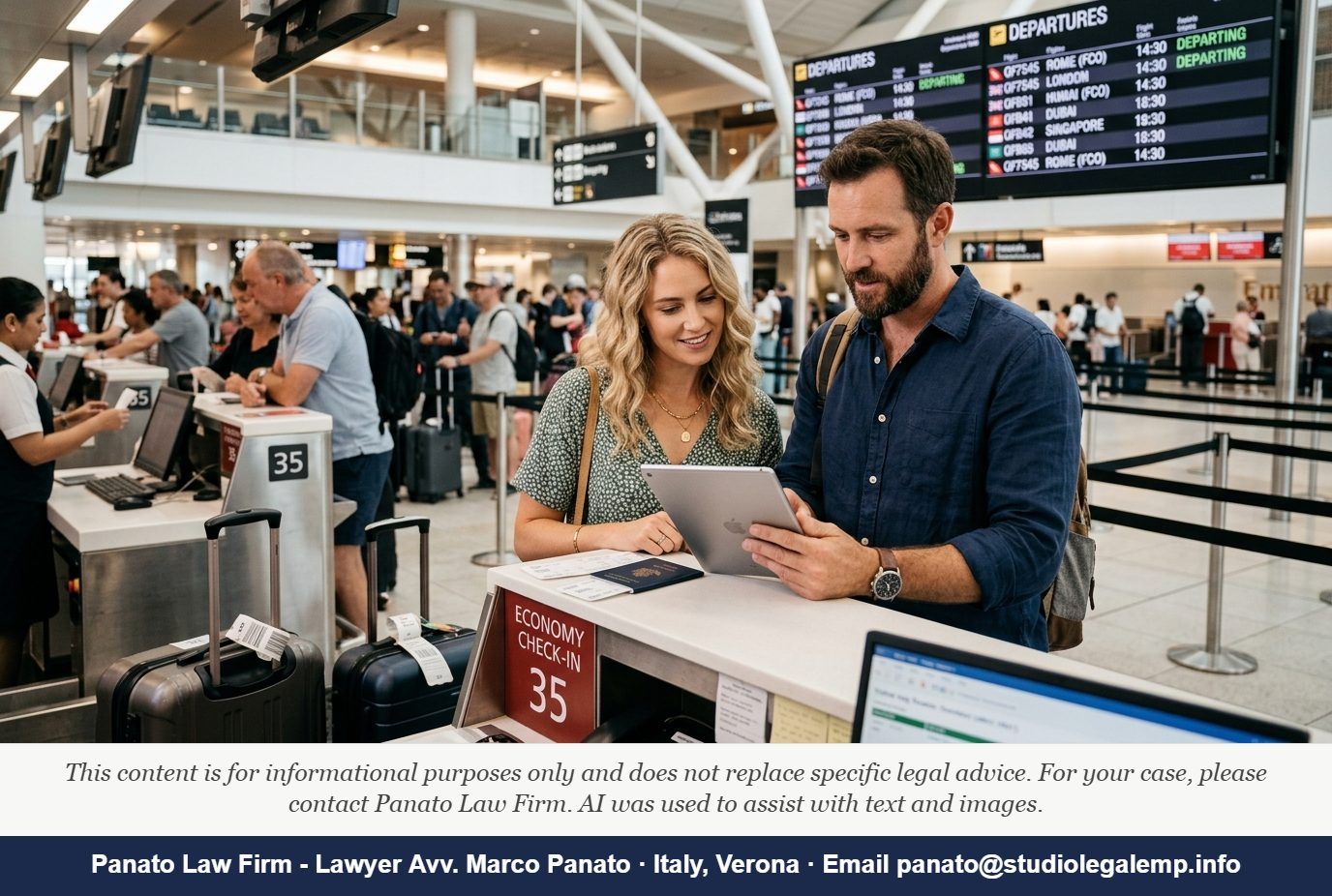
Image prompt: An Australian couple standing at the check-in counter of a modern international airport, studying a travel document on a tablet screen, with the departure board showing a flight to Rome visible in the background. Warm amber and blue tones, sharp documentary-style photography, slight sense of focus and preparation rather than confusion. No text visible on the image.
Image file: etias-italy-2026-americans-australians-canadians-cover
HREFLANG BLOCK:
JSON-LD:
LANGUAGE QA: created under Regulation (EU) 2018/1240 -> established by / enacted under · will not change materially -> will not change significantly / substantively · benefit from visa-free access -> enjoy visa-free access · That excuse is now removed -> That obstacle has now been cleared / eliminated · every other port of entry -> every other point of entry · the development most English-language guides have not yet absorbed -> the development most English-language guides have missed · The legal architecture, the fee, the application process and the exemptions, however, are already locked in statute -> The legal framework, fee, application process and exemptions are already fixed in law · before settling on Q4 2026 -> before the target settled on Q4 2026
CHECK:
AUTHORITY 1: Regulation (EU) 2018/1240 of the European Parliament and of the Council of 12 September 2018 establishing the European Travel Information and Authorisation System (ETIAS).
EXISTS? Yes — confirmed by EUR-Lex, confirmed by schengenvisainfo.com, europe-visa.eu, etias.com and multiple other trackers citing the regulation by name and number.
CONTENT MATCHES what I wrote? Yes — governs ETIAS eligibility, fee structure, validity, exemptions, and carrier liability as described.
AUTHORITY 2: Regulation (EU) 2016/399 of the European Parliament and of the Council (Schengen Borders Code).
EXISTS? Yes — well-established, publicly available on EUR-Lex; cited by schengentraveler.com as the legal basis for the 90/180-day rule.
CONTENT MATCHES? Yes — governs the 90-day-in-180-day stay limit for visa-exempt nationals, as described in the article.
AUTHORITY 3: Legislative Decree No. 286 of 25 July 1998 (D.Lgs. 25 luglio 1998, n. 286) — Italy's Consolidated Immigration Act (Testo Unico sull'Immigrazione).
EXISTS? Yes — confirmed by Wikipedia's permesso di soggiorno article citing "legislative decree 25 July 1998 n. 286" and Presidential Decree 179/2011 as implementation regulation.
CONTENT MATCHES? Yes — governs the permesso di soggiorno as described; exemption from ETIAS for valid permit holders confirmed by multiple secondary sources aligned with Regulation (EU) 2018/1240 Art. 2.
TIMELINESS FACT: mid-July 2026 removal of Q4 2026 target from official EU ETIAS page.
EXISTS? Confirmed by schengentraveler.com (updated 4 weeks before date of writing) citing Financial Times reporting and eu-LISA conclusion; etiaspro.com (updated 27 July 2026) confirms 2027 as current expected launch. AMBER — Financial Times article not directly retrieved but cited by two independent trackers with dates.
OVERALL: AMBER — all three legal authorities GREEN; the timeliness hook (FT reporting / eu-LISA 2026 infeasibility) is confirmed by two independent tracker sites with precise dates but the underlying FT article was not directly retrieved. The article appropriately cites "independent reporting" rather than claiming a direct FT source.
TO VERIFY: The Financial Times article on eu-LISA's conclusion that a 2026 launch is infeasible — referenced by schengentraveler.com. Not directly retrieved; consider retrieving and linking if publishing on site.
LOCAL NOTE:
1. Search intent targeted: informational (travellers planning future Italy trips who need to understand a new pre-travel requirement and its current status) with secondary transactional potential for expats and dual-citizenship clients.
2. Local-market framing: article leads with the ESTA analogy (familiar to US readers), uses AUD/CAD/USD conversions alongside EUR, and addresses the dual-citizenship angle relevant to the large Italian-American and Italian-Australian diaspora communities who may already be engaging an Italian lawyer for citizenship purposes.
3. Italian terms retained untranslated: <i>permesso di soggiorno</i> (Italian residence permit) — retained in italics on first use because it is the specific document name used in Italian administrative practice and at border control; explained in plain English immediately alongside.
Do you need legal assistance or a free estimate?
Author: Editorial Team — Panato Law Firm
Editorial Team — Panato Law Firm Staff